
- Release Year: 2010
- Platforms: Windows
- Publisher: City Interactive S.A.
- Genre: Action
- Perspective: First-person
- Game Mode: LAN, Online PVP, Single-player
- Setting: Modern
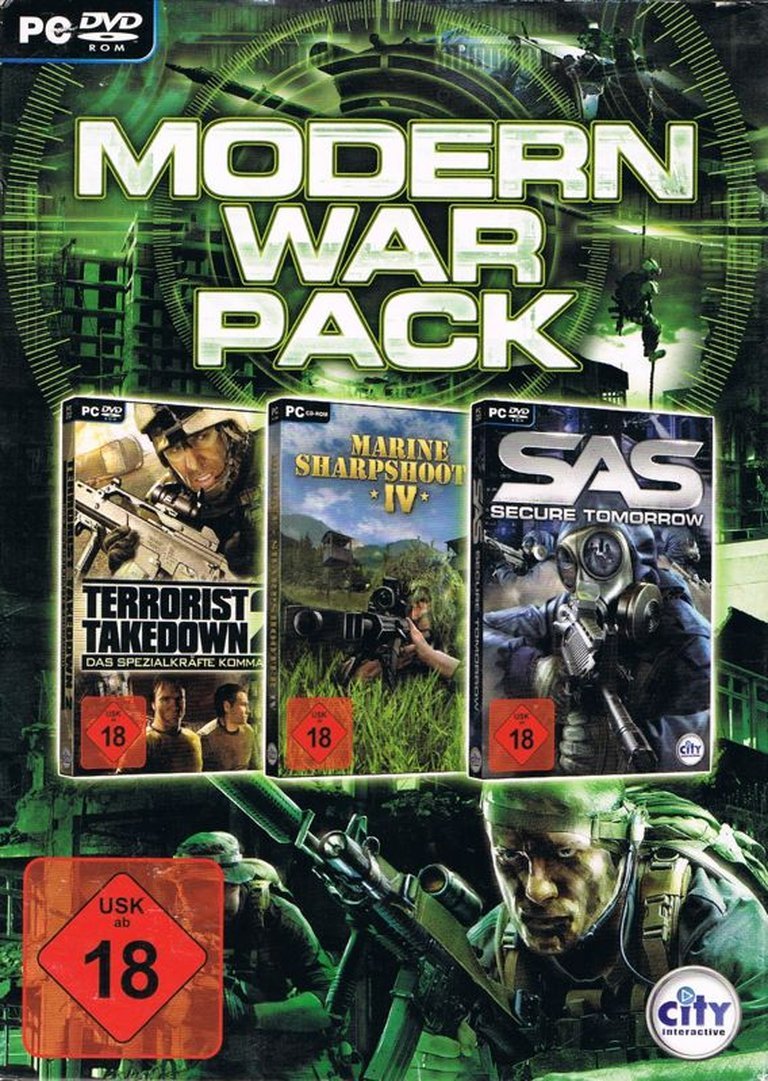
Description
Modern War Pack is a 2010 Windows compilation from City Interactive that bundles three action-packed modern military shooters released in 2008: Terrorist Takedown 2: US Navy SEALs, Marine Sharpshooter 4, and SAS: Secure Tomorrow, placing players in the roles of elite special forces operatives engaging in intense anti-terrorism operations across contemporary global hotspots.
Modern War Pack: Review
Introduction
In the shadow of juggernauts like Call of Duty 4: Modern Warfare, which redefined first-person shooters in 2007 with its cinematic flair and multiplayer revolution, Modern War Pack emerged in 2010 as a humble, budget-conscious compilation aimed at squeezing value from the modern military shooter craze. Released by Polish publisher City Interactive S.A. on February 9, 2010, for Windows via DVD-ROM, this pack bundles three 2008 titles: Terrorist Takedown 2: US Navy SEALs, Marine Sharpshooter 4, and SAS: Secure Tomorrow. It’s a no-frills anthology of tactical shooters evoking elite special forces fantasies—SEALs storming compounds, Marines picking off insurgents, and SAS operatives securing high-stakes objectives—all wrapped in a post-9/11 geopolitical veneer. As a game historian, I see Modern War Pack not as a landmark, but as a fascinating artifact of the era’s democratization of FPS development: Eastern European studios flooding the market with accessible, patriotic power fantasies for the bargain bin. My thesis? While it captures the raw thrill of asymmetric warfare simulations amid a booming genre, its technical shortcomings and generic execution cement it as a relic of ambition outpacing polish, deserving rediscovery for its unpretentious grit rather than greatness.
Development History & Context
City Interactive S.A., a Warsaw-based outfit founded in 2002, was no stranger to military simulations by 2010. Known for low-to-mid-budget WWII titles like Death to Spies and the Combat Wings series, the studio pivoted to modern settings post-CoD4, capitalizing on the gold rush sparked by Infinity Ward’s 2007 hit. Modern War Pack compiles three standalone games developed around 2008 by City Interactive and affiliates—likely in-house teams leveraging licensed engines or custom builds optimized for older PCs (keyboard/mouse input, LAN/Internet multiplayer via DVD-ROM era tech).
The individual titles trace roots to the mid-2000s budget FPS wave: Terrorist Takedown 2: US Navy SEALs (a sequel to 2004’s original) embodies post-Iraq War bravado, with SEALs as pixelated avatars of American exceptionalism. Marine Sharpshooter 4 continues a sub-series emphasizing sniper duels and Marine ops, while SAS: Secure Tomorrow nods to British elite forces amid global counter-terror ops. Development constraints were evident—USK 18 rating signals mature violence, but no high-fidelity assets or mocap like AAA peers. The 2010 bundling reflects economic realities: post-2008 recession, publishers like City Interactive targeted impulse buys (e.g., €10-20 packs), competing in a landscape dominated by Activision’s annual CoD cycles and Ubisoft’s Rainbow Six evolutions.
Technologically, these games predate widespread Source Engine adoption in budget titles, relying on proprietary or licensed middleware for destructible environments and basic AI. Released amid CoD: Modern Warfare 2‘s 2009 hype (25M+ sales), Modern War Pack arrived as a digital-physical hybrid—Internet/LAN multiplayer hinted at community ambitions, but sparse specs (no console ports) underscored PC-only focus. Vision? Emulate CoD4‘s killstreaks and squadplay on a shoestring, amid a market where clones like Frontlines: Fuel of War (2008) proliferated. City Interactive’s Eastern European edge—lower costs, rapid iteration—mirrors studios like Bohemia Interactive, but without Arma‘s sim depth.
Narrative & Thematic Deep Dive
Modern War Pack‘s stories are archetypal “one-man (or squad) against terror” tales, lacking CoD‘s moral ambiguity (e.g., no “No Russian” controversy) but echoing real-world ops like Operation Neptune Spear. Terrorist Takedown 2 thrusts players into SEAL boots, dismantling Middle Eastern cells via linear missions: raid bunkers, extract hostages, neutralize HVTs. Dialogue is sparse, utilitarian—”Tango down!”—with themes of asymmetric warfare, where underdog insurgents wield RPGs against tech-superior forces.
Marine Sharpshooter 4 zooms in on long-range precision, pitting spotter-shooter duos against urban sprawls; narratives frame insurgents as faceless zealots, justifying Marine incursions with radio chatter on WMD threats. SAS: Secure Tomorrow diversifies with British accents, focusing on urban CQB and exfil under fire, thematizing multinational coalitions amid fictional hotspots. Collectively, plots interweave post-9/11 anxieties—nuclear smuggling (CoD echoes), oil rig sieges, embassy defenses—sans deep lore. Characters are archetypes: grizzled commanders, rookie grunts; no Soap MacTavish arcs, just mission briefings.
Thematically, it’s unapologetic jingoism: Western forces as righteous avengers, terrorists as cartoon villains (no Yuri’s redemption). This mirrors 2008’s gaming zeitgeist—pre-Spec Ops: The Line‘s subversion—prioritizing empowerment over nuance. Subtle nods to CoD‘s timeline (e.g., Ultranationalists, Middle East coups) feel derivative, but the pack’s strength lies in procedural escalation: early beachheads build to climactic assaults, evoking Medal of Honor‘s heroism sans historical baggage. Flaws? Repetitive voice lines and plot holes (e.g., endless respawns undermine stakes), yet it nails the “heroic grind” fantasy.
Gameplay Mechanics & Systems
Core loops revolve around cover-based FPS action: advance, flank, suppress. Terrorist Takedown 2 shines in squad commands—issue “hold fire” or “regroup” via radio—blending Ghost Recon tactics with run-and-gun. Weapons feel weighty (M4s, AKs, sniper rifles), but bullet-sponge enemies demand headshots. Marine Sharpshooter 4 innovates with duo mechanics: switch between shooter/spotter for zoomed intel, adding tension to wind-affected long shots.
SAS: Secure Tomorrow emphasizes CQB—lean-peek, breaching—with destructible doors/cover. Progression is mission-unlock based, no deep trees; multiplayer (LAN/Internet) offers deathmatch/CTF on recycled maps, sans perks/killstreaks (pre-CoD4 influence fully absorbed?). UI is clunky—minimap fogged, HUD cluttered—but responsive mouse/keyboard suits PC vets. Flaws abound: AI pathing glitches (allies blocking firelines), checkpoint abuse, dated physics (ragdolls cartoonish). Innovative? Vehicle sections (Humvees, helos) and dynamic weather (sandstorms obscure vision). Overall, solid 6/10 loops: addictive for 5-10 hour blasts, but repetitive sans variety.
| Game | Core Loop | Strengths | Weaknesses |
|---|---|---|---|
| Terrorist Takedown 2 | Squad raids | Commands, variety | AI stupidity |
| Marine Sharpshooter 4 | Sniper duos | Precision tension | Scope sway issues |
| SAS: Secure Tomorrow | CQB assaults | Breaching tools | Map repetition |
World-Building, Art & Sound
Settings evoke CoD‘s grit: dusty Middle Eastern bazaars, foggy European docks, oil rigs at dusk—budget assets shine in scale (open compounds), falter in detail (pop-in textures, low-poly models). Atmosphere builds via particle effects (smoke, explosions), fostering immersion despite 2008 tech limits. Art direction: realistic mil-sim palettes (camos, urban decay), no cel-shading flair.
Sound design punches above weight—thumping suppressed fire, distant muezzin calls, rotor wash—via licensed effects? Voice acting is wooden (Eastern accents on American lines), but radio chatter adds urgency. No orchestral score like CoD‘s Barton; generic rock stings suffice. Multiplayer lobbies buzz with netcode creaks, yet contributes to “fog of war” chaos. Elements synergize for tense ops feel, marred by pop-in and aliasing.
Reception & Legacy
Launch reception? Nonexistent—MobyGames lists zero critic/player reviews, n/a score, collected by one player. Commercial dud: no sales charts, overshadowed by CoD: Black Ops (2010, 30M+ units). Forums silent; patches/prices untracked. Evolved rep? Cult curiosity among retro hunters—emulates CoD sans polish, influencing no majors but epitomizing budget packs (Serious Sam bundles). Industry ripple: fueled Eastern dev boom (e.g., Arma), highlighting gaps AAA filled (progression, polish). Influence minimal—CoD‘s timelines (MW1-3) dominated discourse—but preserves “everyman’s mil-sim” ethos.
Conclusion
Modern War Pack endures as a time capsule: earnest, flawed tribute to 2000s FPS highs, bundling competent-if-generic shooters that capture special forces allure amid CoD‘s shadow. Exhaustive deconstruction reveals thrills in mechanics/worlds, drags in narrative/UI. Verdict: 6.5/10—niche historical curiosity for genre scholars, playable via GOG/ emulation. In video game history, it’s the underdog pack reminding us: not every war needs Hollywood; sometimes, raw ammo runs suffice. Rediscover for nostalgia’s grit, but chase CoD4 for transcendence.