
- Release Year: 1999
- Platforms: Macintosh, Windows
- Publisher: Hasbro Interactive, Inc., MacSoft
- Developer: Leaping Lizard Software, Inc.
- Genre: Card, Gambling, Poker, Tile game
- Game Mode: Online PVP, Single-player
- Gameplay: Blackjack, Poker, Slot machines
- Setting: Casino
- Average Score: 75/100
Description
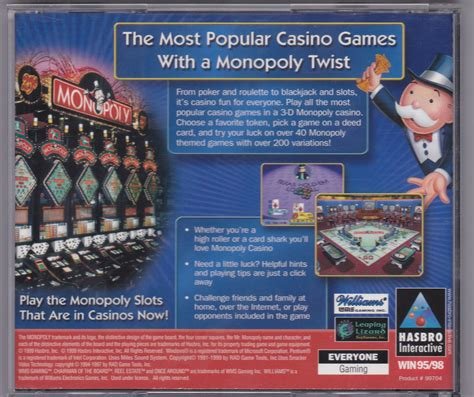
Monopoly Casino immerses players in a vibrant, Monopoly-themed virtual casino where winnings from the classic board game can be ‘spent’ on high-stakes gambling action, featuring 133 different slot machines including official Monopoly slots, over 60 poker variants, and various Monopoly-inspired games, all with multiplayer support over MSN Zone.
Gameplay Videos
Monopoly Casino Free Download
Monopoly Casino Reviews & Reception
ign.com (75/100): It ain’t Vegas, but if you’re into casino games, it’s a lot of fun.
gamespot.com (75/100): Monopoly Casino takes an upbeat approach to traditional casino games.
Monopoly Casino: Review
Introduction
Imagine stepping off the Monopoly board, pockets bulging with ill-gotten rents from Boardwalk and Park Place, only to funnel your fictional fortune into the flashing lights of a virtual Las Vegas strip—complete with Mr. Monopoly himself as your croupier. Released in late 1999, Monopoly Casino daringly transplants the cutthroat capitalism of the world’s most iconic board game into the high-stakes (yet risk-free) realm of digital gambling. As a spin-off in Hasbro’s sprawling lineage of Monopoly video games—stretching back to 1985’s primitive adaptations—this title from Leaping Lizard Software promised a novel fusion: 133 slot machines, over 60 poker variants, and a smorgasbord of Monopoly-flavored casino classics. My thesis? Monopoly Casino succeeds as a cheerful, accessible gateway to casino gaming for families and casual players, leveraging the board game’s nostalgia to soften gambling’s sharper edges, though its technical quirks and uneven ambition prevent it from becoming a timeless classic.
Development History & Context
Monopoly Casino emerged from Leaping Lizard Software, Inc., a modest developer known for niche simulations, under the publishing umbrella of Hasbro Interactive, Inc.—the powerhouse behind the board game’s digital empire. Launched on November 27, 1999, for Windows CD-ROM (with a Macintosh port via MacSoft in 2001), the game arrived amid the late-90s PC gaming boom. This era saw CD-ROMs dominating distribution, with lavish multimedia experiences like full-motion video intros and high-fidelity audio becoming standard. Technological constraints were minimal on capable Pentium-era rigs: DirectX-enabled graphics for smooth animations, MIDI/jazz soundtracks, and Internet multiplayer via the nascent MSN Gaming Zone, reflecting Microsoft’s push into online gaming.
The gaming landscape was ripe for licensed cash-ins. Hasbro, fresh off successes like the 1995 Westwood Monopoly (a top-down board sim) and contemporaries like Monopoly for Nintendo 64 (1999, by Mind’s Eye Productions), was aggressively expanding the IP. Casino simulations were surging—titles like Hoyle Casino (1997) proved demand for “safe” gambling—while the Y2K hype amplified family-friendly entertainment. Leaping Lizard’s vision, per ad blurbs, was straightforward: “Won so much money in Monopoly and need to spend it somewhere?” It cleverly bridged board-game strategy (property hoarding) with casino luck/skill duality, but lacked the blockbuster budgets of Hasbro’s console efforts. No major patches or expansions followed, underscoring its status as a quick-turnaround licensee amid Hasbro Interactive’s turbulent 2000 acquisition by Infogrames.
Narrative & Thematic Deep Dive
Monopoly Casino eschews traditional plotting for an immersive casino fantasy, where narrative emerges through thematic integration rather than scripted events. There’s no overarching story—no bankrupt tycoons plotting revenge or rags-to-riches arcs—but a loose framing device positions you as a Monopoly magnate “spending” winnings in an opulent Atlantic City-inspired house. Mr. Monopoly (Rich Uncle Pennybags), the top-hatted mascot, serves as omnipresent guide: dealing cards, spinning wheels, and even escorting “busted” players out with security in a humorous animation. Dialogue is sparse—witty quips like poker advice nods (“tough to know when to hold ’em and when to fold ’em”) or thematic jabs at Monopoly’s absurdity—but it reinforces the game’s cheeky tone.
Thematically, it explores capitalism’s gambler’s paradox: Monopoly’s ruthless property acquisition mirrors casino risk-reward, blending luck (slots/chance cards) with skill (blackjack/poker strategy). Reviews highlight this synergy—Adrenaline Vault noted how “both rely equally on personal strategy and Lady Luck’s fickle gaze.” Underlying motifs include family-friendly escapism (ESRB Everyone rating) versus Vegas grit, softened by cartoonish visuals. Monopoly-inspired games (e.g., themed slots with hotels/houses as symbols) satirize wealth accumulation: win big on “Boardwalk Bucks,” lose it all on a bad roll. Critiques like AppleLinks’ lament (“gamble without losing anything except the thirty bucks you used to buy it”) underscore a meta-theme: simulated vice as harmless fun. Deeper still, it echoes Monopoly’s origins in Elizabeth Magie’s anti-monopoly critique, now ironically gamified into… more monopoly money.
Gameplay Mechanics & Systems
At its core, Monopoly Casino is a sprawling anthology of gambling minigames orbiting a central casino hub styled as a Monopoly board—point-and-click to enter “properties” like slots or tables. The loop is addictive yet straightforward: wager virtual Monopoly dollars (unlimited refills), play, win/lose, repeat or tournament-hop. Variety is the star: 133 slot machines (19+ Monopoly-themed, with progressive jackpots and variable payouts for multi-line bets), 60+ poker variants (Texas Hold’em, Omaha, 7-card stud, lowball, hi-lo), 5 blackjack flavors, 2 roulettes, 4 Keno types, 10 video pokers, 5 craps, 4 money wheels, and exotics like Pai Gow. Innovative systems include Monopoly twists—slots with property scatters triggering bonuses—and skill-luck balance: All Game Guide praised blackjack/poker’s demands (“some such as blackjack and poker need a certain amount of skill”).
Character progression is bankroll-based: climb limits from penny slots to high-roller tables, unlocking tournaments. UI shines—clean, intuitive overlays show bets/history, with token selection (top hat, car) as your avatar. Multiplayer via MSN Zone enables internet poker/roulette lobbies, though IGN griped about setup hassles (“fool around with DOS and… IP addresses” sans Zone). Flaws abound: no auto-save mid-session, repetitive AI, absent staples (baccarat, Caribbean stud), and Mac port woes (G3 processor demands per AppleLinks). Tournaments add replayability, but luck dominates, tempering strategic depth. Overall, it’s a polished sim for novices, flawed for pros.
| Core Systems | Strengths | Weaknesses |
|---|---|---|
| Slots | 133 variants, thematic bonuses | Repetitive spins |
| Poker/Table Games | 60+ options, skill elements | AI predictability |
| UI/Progression | Intuitive, tournament ladders | No deep customization |
| Multiplayer | MSN Zone integration | Tedious non-Zone setup |
World-Building, Art & Sound
The “world” is a vibrant virtual casino floor encircling a glowing Monopoly board—neon properties house games (e.g., “Go” for slots, “Jail” for craps). Atmosphere evokes a sanitized Vegas: cheerful without seediness, fostering family play. Visual direction apes classic Monopoly art—cartoonish, colorful 2D sprites with light 3D animations (spinning reels, card shuffles). Graphics are “clean and unobtrusive” (GameSpot), not revolutionary—static tables, modest Mr. Monopoly antics—but the token-as-player and property motifs immerse effectively. Free camera pans the floor, enhancing scale.
Sound design complements: tasteful jazz loops (adjustable volume), crisp effects (slot bells, chip clacks), and Mr. Monopoly’s chuckles. No voice acting or dynamic crowds disappoints—Mac Addict noted “lacks… spontaneity”—but it’s unobtrusive, prioritizing gameplay. Collectively, these forge a “lighthearted, family-oriented atmosphere” (GameSpot), where Monopoly whimsy humanizes gambling’s grind.
Reception & Legacy
Launch reception was middling: MobyGames aggregates 65% critics (8 reviews), from All Game Guide’s 90% (“great game for anyone who wants to gamble without… real money”) to Macintosh lows (AppleLinks 20%: “good graphics… but [not] enough anymore”). Windows fared better (80% average), lauding variety/fun (IGN 75%: “nice little game… with a sense of humor”); Mac ports tanked on performance/UI (Mac Gamer 60%). Players rated 2.5/5 (sparse data), collected by ~7-9 enthusiasts. Commercially modest—no sales charts, but Hasbro’s muscle ensured visibility.
Legacy endures as a quirky footnote in Monopoly’s 35+ video games (per Wikipedia), bridging board sims and casino hybrids. It influenced no direct sequels but prefigured mobile gambles like Monopoly Slots and live adaptations (Monopoly Live, 2019). In gambling sims, it popularized IP crossovers (e.g., branded slots). Reputation evolved to cult nostalgia—preserved on Archive.org—celebrating risk-free thrills amid today’s loot-box scrutiny. Moby rank #19,307/27K reflects niche appeal, yet it embodies 90s CD-ROM charm.
Conclusion
Monopoly Casino masterfully gamifies Monopoly’s empire-building into a buffet of casino delights—varied, approachable, and whimsically themed—delivering hours of button-mashing joy without wallet-draining peril. Its strengths in UI variety and nostalgic integration outweigh multiplayer gripes and graphical modesty, cementing it as a solid 7/10 family diversion. In video game history, it occupies a liminal space: not revolutionary like Westwood’s 1995 Monopoly, nor enduring like modern Monopoly GO!, but a testament to Hasbro’s IP alchemy. For historians, it’s a snapshot of 1999’s optimistic digital gambling; for players, a time capsule worth emulating. Verdict: Essential for Monopoly completists, recommended for casual casino curious—go directly to download, do not pass Go, collect your fun.