
- Release Year: 2018
- Platforms: PlayStation 4, Windows, Xbox One
- Publisher: Capcom Co., Ltd.
- Developer: Capcom Co., Ltd.
- Genre: Role-playing
- Perspective: Behind view
- Game Mode: Online Co-op, Single-player
- Gameplay: Action RPG, Open World, Sandbox
- Setting: Fantasy
- Average Score: 89/100
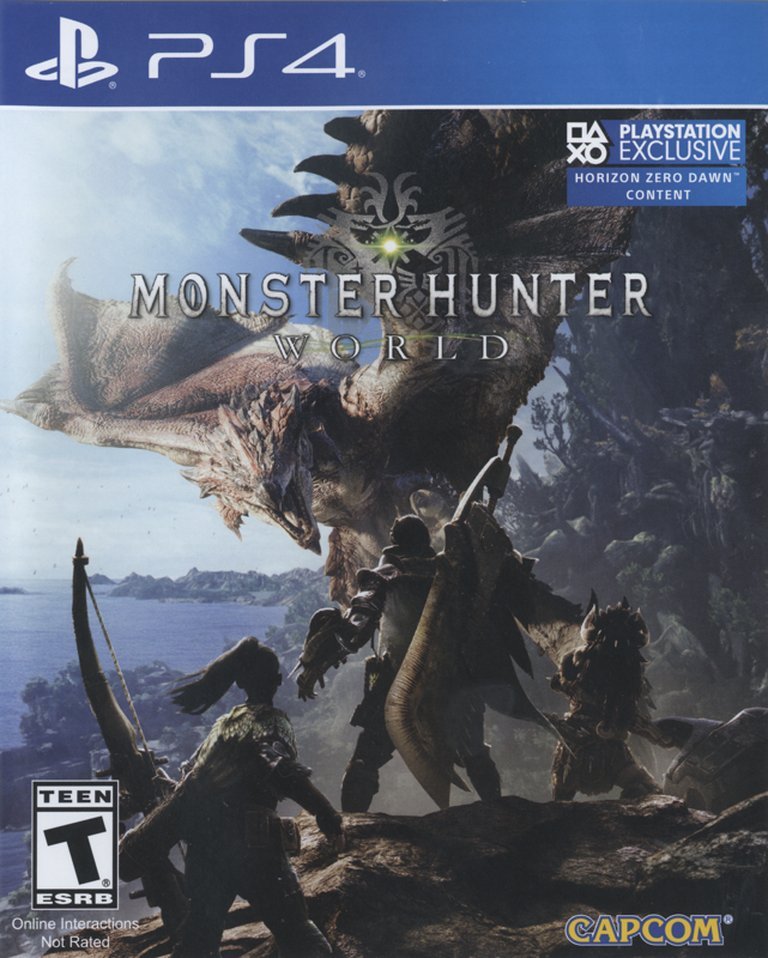
Description
Monster Hunter: World is an action RPG set in a expansive fantasy ecosystem where players become hunters tasked with tracking, hunting, and capturing colossal monsters in a seamless open world, utilizing real-time combat and sandbox-style exploration.
Gameplay Videos
Where to Buy Monster Hunter: World
PC
Monster Hunter: World Free Download
Monster Hunter: World Mods
Monster Hunter: World Guides & Walkthroughs
Monster Hunter: World Reviews & Reception
metacritic.com (90/100): Monster Hunter finally arrives on the new generation consoles. Its soul is intact: it is always divided in two main sectors, the preparation and the hunt, and it’s fun as ever.
ign.com : Bold and newly beautiful, this RPG demands to be played on its own terms.
opencritic.com (95/100): Bold and newly beautiful, Monster Hunter: World demands to be played on its own terms and rewards you with an amazing RPG.
Monster Hunter: World: The Global Hunt That Redefined an Era
Introduction: The Beast That Conquered the World
For over a decade, the Monster Hunter series existed as a beloved, enigmatic cult phenomenon—a franchise of immense depth and punishing elegance that thrived primarily on Nintendo’s handhelds. It was a series revered by its dedicated community but often impenetrable to the outside world, its complex systems and archaic presentation creating a formidable barrier to entry. Then, in 2018, Capcom unleashed Monster Hunter: World, a game that did not merely enter the global stage but obliterated the boundaries that had long confined it. This was not a simple iteration; it was a deliberate, monumental recalibration. By harnessing the power of modern hardware to realize a seamless, living ecosystem and meticulously streamlining a labyrinthine formula without sacrificing its soul, Capcom achieved the seemingly impossible. They made the esoteric universal. Monster Hunter: World stands as one of the most significant and successful gambits in modern game development—a flawless fusion of preservation and revolution that not only became Capcom’s best-selling title but also fundamentally altered the landscape for action RPGs and live-service design. This review will argue that World is not just the pinnacle of its series but a landmark title of the eighth console generation, whose legacy is defined by its audacious accessibility, breathtaking world design, and an unwavering commitment to a core gameplay loop of profound satisfaction.
Development History & Context: From Handheld Niche to Global Phenomenon
The genesis of Monster Hunter: World lies in a profound moment of introspection at Capcom. Following the success of Monster Hunter 4 and Generations, the core Osaka-based development team, led by Director Yuya Tokuda and Producer Ryozo Tsujimoto, faced a pivotal question: where could the series go next? The answer was dictated by hardware. For years, the series had been synonymous with the Nintendo DS and 3DS, platforms that necessitated zoned maps (separate areas connected by loading screens) due to memory limitations. With the PlayStation 4 and Xbox One offering unprecedented power, the team saw an opportunity to realize a vision long-held but technically impossible: a truly contiguous, open world where hunters and monsters could roam without interruption.
This technical leap was inseparable from a commercial ambition. As documented in post-release analyses, the Monster Hunter brand had historically seen a drastic sales disparity between Japan (where it reliably moved 3-4 million units) and the West, where its complexity and platform exclusivity to portables limited its reach. Capcom’s international divisions had long advocated for a “global” title. The gamble was risky—alienating the core Japanese audience was a genuine fear. However, Sony’s explicit promise to support a simultaneous worldwide release and leverage the title to boost PS4 sales provided the necessary security. This corporate backing allowed for a larger budget, which Tokuda described as necessary to “go up against Hollywood movies,” though it also required stringent cost management across Capcom.
The development mantra was clear: preserve the core, revolutionize the presentation. This meant the fundamental loop—hunt, carve, craft, hunt stronger monsters—remained sacrosanct. However, every systemic element surrounding it was scrutinized. The team prototyped for 18 months with a 50-70 person squad, creating an early build that famously lacked combat entirely to test environmental traversal and the fledgling “Scoutfly” tracking system. This phase revealed the cascading consequences of a seamless world. The classic “Monster Hunter Flex”—the locked animation where a hunter stood still to drink a potion—was a death sentence in an open zone where a monster could attack from any angle. It was scrapped, allowing movement while consuming items. The open map also demanded faster, more agile player movement and correspondingly smarter, more aggressive monster AI to maintain tension.
The decision to drop a numerical title (Monster Hunter 5) was equally strategic. The team feared a “5” would signal to newcomers that they were too late to the party. “World” became a multifaceted subtitle: it referenced the open maps, the living ecosystems, the simultaneous global launch, and the worldwide server infrastructure. The game was built on a modified MT Framework engine, targeting a stable 30fps across base PS4 and Xbox One hardware, with enhancements for the mid-cycle PS4 Pro and Xbox One X. The PC port, delayed to August 2018, was a source of particular pride for Capcom, developed internally to ensure proper optimization and a bespoke matchmaking system (replacing console-native services), though it would later face criticism for a lack of mod support at launch.
Narrative & Thematic Deep Dive: Science, Survival, and the Elder Crossing
While previous Monster Hunter plots were often sparse, contextual backdrops for the hunts, World commits to a fully realized, voice-acted narrative that bookends the gameplay. The story is driven by the “Elder Crossing”—a decadal phenomenon where colossal Elder Dragons migrate to the “New World,” an uncharted continent. The player is a Hunter of the Fifth Fleet, joining the Research Commission under the command of the Admiral and the wise, provisional Commander. Their initial mission is to investigate the gargantuan, volcanic Zorah Magdaros, which is mysteriously veering off its expected path.
The narrative unfolds through “Assignments,” story quests accompanied by cutscenes. It’s a tale of ecological science gone awry. The Commission learns Zorah Magdaros is dying and its bio-energy release in the underground Everstream would cataclysmically alter the New World. The hunter’s intervention drives it into the ocean, creating a new ecosystem. However, the predator Nergigante, an Elder Dragon that feeds on its kin, was protecting Zorah as a meal. Nergigante’s subsequent rampage disrupts the ecological balance, driving other Elder Dragons from their home in the Elder’s Recess. The climax reveals the true catalyst: Xeno’jiiva, an infant, parasitic Elder Dragon incubating in the Recess, siphoning the bio-energy of deceased elders and mentally calling them to the New World. The hunter’s final battle is one of planetary preservation.
Thematically, the narrative moves beyond simple monster-slaying. It explores ecological interconnectedness—the environments feel alive because they are alive, with monsters hunting, eating, and fighting for territory, directly impacting quests. The Commission’s role as scientists and observers is foregrounded; research is a core gameplay mechanic. The story also touches on humanity’s relationship with nature—the hunters are not conquerors but necessary regulators in a delicate system. Characters like the enthusiastic Handler (who becomes a fully realized partner) and the philosophically burdened Admiral provide emotional anchors. The dialogue, while sometimes clunky, is consistently voiced, a first for the series, investing the player in the Commission’s scientific expedition rather than a faceless grunt’s quest for bigger swords. It’s a surprisingly robust sci-fi eco-thriller that gives context and weight to every hunt.
Gameplay Mechanics & Systems: The Refined, Rippling Loop
At its heart, World is an obsessive, meticulous engine of progression. The “carve and craft” loop is unchanged in principle: hunt a Rathalos, carve its parts, forge the Rathalos armor set and fire sword, hunt a more dangerous monster. But every system feeding into this loop has been optimized and interconnected.
-
Combat & Mobility: All 14 weapon classes received subtle but transformative tweaks to enable a faster, more fluid pace. The removal of the “flex” for item use is the most impactful quality-of-life change in series history. Stamina management remains crucial but is more forgiving in recovery. New tools like the Slinger (a grappling hook/projectile launcher) and Mantles (temporary buffs like the Ghillie Mantle for stealth or the Temporal Mantle for auto-dodging) add strategic layers. The environment is now a weapon: shoot boulders, trigger landslides, or lure monsters into other predators’ territories. These changes make combat feel less like a stat-check and more like a dynamic puzzle box where the hunter must use all tools at their disposal.
-
The Seamless World & Scoutflies: The elimination of zone loading screens is the single greatest technical and design achievement. The five main locales (Ancient Forest, Wildspire Waste, Coral Highlands, Rotten Vale, Elder’s Recess) are vast, vertical, and pervasively alive. This necessitated the Scoutfly system. Instead of following a fixed map route, players collect monster tracks, which level up Scoutfly tracking for that species, eventually auto-leading them to the target. This innovatively merges exploration with research, making tracking an active, rewarding gameplay loop rather than a menu chore. Expeditions allow free-roam without quest penalties, encouraging ecological observation.
-
Quest Structure & Multiplayer: The binary of “Solo” vs. “Multiplayer” quests is dead. Every quest can be attempted alone or with a SOS Flare summoning up to three allies. The new structure is elegant:
- Assignments: Story quests, non-repeatable.
- Optional Quests: Repeatable, often given by NPCs.
- Investigations: The stroke of genius. Generated from collected tracks, these have random goals (hunt/capture, time limits, faint limits) and offer bonus rewards. They create infinite, tailored hunts and are the primary endgame loop.
- Event Quests: Time-limited (later all made permanent), often featuring unique conditions (mini/tiny monsters) or crossovers (Final Fantasy Behemoth, Witcher 3 Leshen), injecting novelty.
Multiplayer lobbies hold 16 players, with smooth SOS join-in. Critically, cross-region play (same console family) is supported, a landmark for the series. However, the lack of cross-play and the initial stipulation that high-rank story quests were solo-only (a significant misstep later patched) were notable flaws.
-
Progression: Tempered Monsters & Augments: The endgame revolves around Tempered Monsters— metallic-hued, hyper-aggressive variants introduced via Title Updates. Hunting them yields “Spirit Gems” used to Augment weapons (adding elemental damage, affinity, or special effects) and armor (extra slots, resistances). This system provided a deep, repeatable grind with tangible power progression beyond simple rank-ups. The Kulve Taroth siege quest, a 4-player race to break the gold dragon’s horns for randomized golden weapons, was a spectacular, emergent multiplayer highlight.
-
Quality of Life (QoL): The game painstakingly erodes series-era friction. The crafting list is clear and functional. The canteen and item box are accessible from any camp. Armor skills are streamlined from the obscure, point-based system of old to a simple additive total. The Hunter’s Notes provide immediate, in-game monster weakness data. These are not “dumbing down” but clarity improvements, respecting the player’s time without removing depth.
World-Building, Art & Sound: An Ecosystem, Not a Battlefield
The thematic core of World is that the environment is not a backdrop but a character. The Ancient Forest isn’t just a level; it’s a multi-layered canopy ecosystem where the herbivorous Apceros graze under the watchful eye of the apex predator Rathalos. The Coral Highlands’ unique verticality and luminous flora create a breathtaking, alien zone that feels genuinely explorable. The Rotten Vale, a toxic underground basin filled with decaying Elder Dragon remains, is a masterpiece of oppressive, atmospheric design. The seamless transitions between these zones—climbing a vine wall from a forest floor into the canopy, diving into a pool that leads to an underwater cave—create a profound sense of scale and discovery.
Monster design is where the series’ artistry shines, elevated by new hardware. Nergigante, the flagship, is a biomechanical horror of constantly growing spikes, its animation a terrifying testament to the new detail possible. New monsters like the ghostly Ancient Leshen or the explosive Pukei-Pukei are instant classics. Even returning favorites like the fire-and-ice Teostra and Lunastra feel newly dangerous in their intricate, sprawling arenas. The art direction masterfully blends fantastical biology with a grounded, almost documentary realism. There are no floating platforms; cliffs have feasible handholds, trees have bark textures, and monsters interact with the terrain—sliding down slopes, burrowing, or nesting.
The sound design is equally crucial. The roar of a Diablos charging from behind a dune, the chitter of a horde of Jagras, the ambient drip of water in the Rotten Vale—all are meticulously placed for directional awareness and immersion. The soundtrack, composed by Akihiko Narita and others, dynamically swells during combat but often recedes into ambient, tribal percussion that emphasizes the natural soundscape. The decision to use a single, cohesive main theme (“Realm of the Elder Dragons”) that subtly weaves into area music creates a unifying, epic motif for the global expedition.
Reception & Legacy: The Breakout That Changed Everything
Monster Hunter: World’s reception was a resounding, unprecedented triumph.
-
Critical Acclaim: It achieved universal acclaim (90/100 on Metacritic for PS4/XB1, 88 for PC). Critics universally praised the successful balancing act of accessibility and depth. IGN’s 9.5/10 hailed it as “the most audacious” entry, while Game Informer (9.5/10) and USgamer (100%) celebrated the removal of “fat” from the formula. Common praises: the living ecosystems, the seamless world, the intuitive Scoutflies, and the meaningful QoL changes. Criticisms were minor and consistent: the camera can still be tricky in claustrophobic spaces, some found the story forgettable, and the PC port’s initial lack of mods and stuttering were noted (though later patched). Famitsu’s near-perfect 39/40 signaled major approval from its home market.
-
Commercial Tsunami: The sales figures are stratospheric and have continued to climb. It sold 5 million copies in its first 3 days, shattering series records. By April 2018, it had passed 8 million, making it Capcom’s best-selling game ever and driving the company to its most profitable fiscal year. The August 2018 PC launch saw 240,000 concurrent players on Steam, the highest for any 2018 launch and a Japanese-published title at the time. Crucially, for the first time, overseas shipments surpassed Japanese shipments (71% outside Japan). As of January 2024, over 23 million copies have been sold/ shipped, a number that continues to be buoyed by events like the “Return to World” campaign ahead of Monster Hunter Wilds.
-
Industry Influence & Legacy:
- Globalized a Japanese Icon: World proved that a deeply Japanese, mechanically complex franchise could achieve mainstream global success. It directly paved the way for the worldwide simultaneous release of its successor, Monster Hunter Rise.
- Live-Service Blueprint: The Title Update system—free, major content drops (new monsters, quests, systems)—coupled with cosmetic-only microtransactions and no pay-to-win, became a model for “games as a service” done right. It fostered a healthy, engaged community for years.
- Reinforced the “Seamless World” Paradigm: Its success validated the open-zone design in action RPGs. Iceborne expanded on this with the clutch claw and sledging mechanics. Environmental interaction as a core combat tenet has been influential.
- Community & Accessibility: The in-game information systems, while imperfect, drastically lowered the initial barrier. Fan initiatives like “Adopt-A-Hunter” flourished, a testament to the game’s design encouraging mentorship. It demonstrated that depth and accessibility are not mutually exclusive.
- Cross-Promotion Powerhouse: The high-profile collaborations (Final Fantasy XIV, The Witcher 3, Assassin’s Creed) were not just Easter eggs but full-featured, story-integrated quests with unique rewards, showcasing a new standard for publisher crossovers.
Conclusion: The Apex Predator of Action RPGs
Monster Hunter: World is a watershed moment. It is the rare game that successfully performs open-heart surgery on a beloved franchise without causing it to flatline. By leveraging technological power to create a breathtaking, seamless world and applying a surgeon’s precision to streamline decades of accumulated friction, Capcom delivered an experience that feels bothmagnificently modern and reverently traditional. The thrill of the hunt—the stomach-dropping roar of a new monster, the tense dance of dodging and striking, the clatter of carves, the satisfaction of a newly forged weapon—has never been more potent or more widely shared.
Its legacy is twofold. First, as the undisputed, record-shattering apex of the Monster Hunter series, it set a new benchmark for world design, player agency, and post-launch support that Rise and the upcoming Wilds must engage with. Second, and more broadly, it stands as a masterclass in how to evolve a niche formula for a global audience. It did not compromise its challenging combat or intricate crafting; it simply made the path to those joys clearer, more intuitive, and infinitely more awe-inspiring. For newcomers, it is the perfect entry point. For veterans, it was a long-awaited homecoming on a grander scale. In the annals of game design, Monster Hunter: World will be remembered not just as a phenomenal game, but as the moment the hunt truly went global, forever changing what an action RPG could be. It is, quite simply, a classic.