
- Release Year: 2002
- Platforms: Windows
- Publisher: Phenomedia AG, Ravensburger Interactive Media GmbH
- Genre: Compilation
- Game Mode: Single-player
- Gameplay: Shooting
- Average Score: 60/100
Description
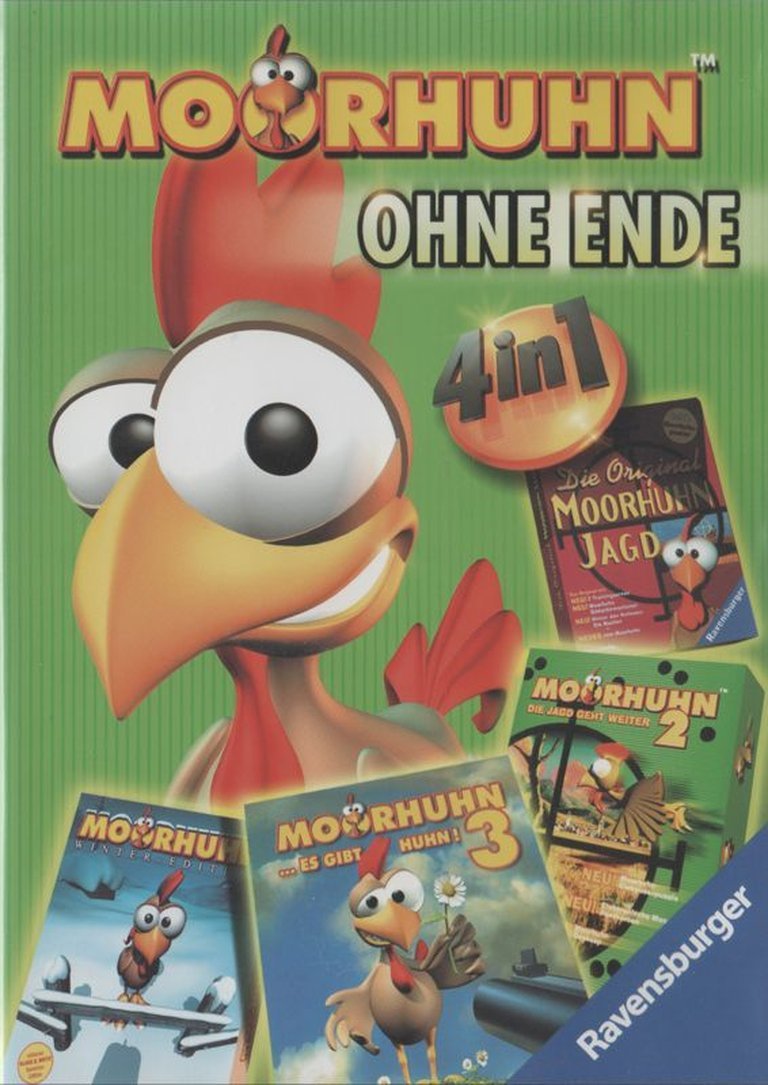
Moorhuhn ohne Ende is a 2002 Windows compilation pack featuring four entries from the popular Moorhuhn (Crazy Chicken) shooter series: the original Die Original Moorhuhnjagd, Moorhuhn 2, Moorhuhn 3 (Chicken Chase), and the seasonal Moorhuhn: Winter-Edition, where players use a mouse to aim and shoot at flocks of cartoon chickens flying across scenic outdoor backdrops within time limits to achieve high scores.
Moorhuhn ohne Ende Reviews & Reception
retro-replay.com : deceptively simple yet addictive shooter mechanics.
Moorhuhn ohne Ende: Review
Introduction
Imagine a world where a simple browser game crashes corporate servers, inspires dictionary entries, and balloons a modest advergame into a billion-euro empire—only to implode in scandal. This is the chaotic legacy of Moorhuhn ohne Ende, a 2002 Windows compilation that bundles four cornerstone titles from Germany’s most improbable gaming phenomenon: Die Original Moorhuhnjagd (aka Crazy Chicken: The Original), Moorhuhn 2, Moorhuhn 3 (internationalized as Moorhen 3 …Chicken Chase), and Moorhuhn: Winter-Edition. Born from a 1999 promotional stunt for Johnnie Walker whisky, the Moorhuhn (Crazy Chicken) series exploded via illicit downloads, captivating German-speaking Europe with its addictive point-and-click shooting gallery antics. As a historian of casual gaming’s golden age, I argue that Moorhuhn ohne Ende is not just a value-packed retrospective but a time capsule of early-2000s viral culture, encapsulating the franchise’s raw charm, mechanical evolution, and cultural zenith before corporate hubris derailed it.
Development History & Context
Developed amid the dot-com bubble’s froth, Moorhuhn ohne Ende emerged from Bochum-based Phenomedia AG (formerly Art Department advertising agency) and Dutch studio Witan Studios, with key creative input from Ingo Mesche, the brainchild behind the titular swamp chickens (Moorhühner, literally “moor hens”). Conceived in 1998 as KippenSchieten (Chicken Shoot), the prototype debuted at the Bizarre ’98 demoparty before morphing into a Johnnie Walker promo: promoters in hunter garb lugged laptops to bars, letting patrons blast cartoon fowl in 90-second bursts. Never meant for wide release, pirated copies spread like wildfire online—its 2MB footprint perfect for email chains—prompting Art Department to officially host downloads by 1999.
Phenomedia, acquiring the IP, went public in late 1999, skyrocketing to a €1 billion valuation on Moorhuhn‘s hype. The compilation arrived in 2002 via Phenomedia AG and Ravensburger Interactive Media GmbH, on CD-ROM for Windows PCs supporting mouse input and DirectX 3.1. Technological constraints were minimal—2D sprites, parallax scrolling, and basic particle effects ran on era hardware like Pentium IIs—mirroring the casual boom alongside titles like Bejeweled or The Sims. The gaming landscape? PC dominance in Europe, pre-mobile explosion, with shareware portals (e.g., early MobyGames) fueling virality. Yet scandal loomed: by 2002, executives Markus Scheer and Björn Denhard faced probes for balance-sheet fraud, confessing and earning prison terms in 2009. Assets transferred to Phenomedia publishing GmbH, but ohne Ende (Endless) ironically marked the frenzy’s peak, compiling hits amid this turbulence.
Narrative & Thematic Deep Dive
Moorhuhn ohne Ende eschews deep plots for whimsical vignettes, yet its thematic tapestry weaves addiction, mischief, and anthropomorphic rebellion. No overarching story binds the quartet, but each offers feather-light lore framing the hunter-vs.-chicken arms race. Die Original Moorhuhnjagd sets the moorland stage: you, the nameless sportsman, pursue evasive Moorhühner in Scottish-inspired bogs, their panicked flaps implying a society under siege. Subtext? Non-lethal K.O.s (chickens tumble cartoonishly, one high-score graphic shows injury, not death), nodding to animal welfare backlash from groups like Deutscher Tierschutzbund.
Moorhuhn 2 expands to a village outskirts, introducing puzzles hinting at chicken cunning—shoot a frog (Moorfrosch) in sequence to unlock secrets like a Snake mini-game, portraying fowl as puzzle-masters. Moorhuhn 3 shifts to beaches, adding Lesshuhn (dim-witted “less-chickens,” a pun on extinction via stupidity) and rival hunters, thematizing competition and hierarchy. Winter-Edition, a reskinned Moorhuhn 2 add-on, festooned with Haribo ads, evokes holiday havoc amid snow, chickens in scarves defying seasonal peril.
Characters shine through expressive sprites: Moorhuhn variants display intelligence (tool use, costumes), while sidekicks like tutorial mole Hank (debuting in Winter) or frog pests add personality. Dialogue? Absent save internal score taunts, but themes probe virality’s double-edge—workplace “threat” (estimated €135M annual German productivity loss)—and advergame ethics. Johnnie Walker branding scrubbed post-promo, yet the hunt satirizes excess, chickens as resilient everymen. In aggregate, it’s thematic poultry noir: endless pursuit in absurd simplicity.
Gameplay Mechanics & Systems
At its core, Moorhuhn ohne Ende refines the shooting gallery loop: 90 seconds, infinite ammo, mouse-aimed shots at flying Moorhühner (distant ones worth more). UI is spartan—score/clock overlay, high-score tables—prioritizing flow. Progression? High-score chasing via replays, with MobyGames leaderboards fostering competition (though this compilation lacks online).
Die Original is purest: static screen, basic birds, power-ups (time-freeze eggs). Moorhuhn 2 innovates with interactive puzzles—shoot objects in order (e.g., frog chains for multipliers, Snake Easter egg)—elevating scores stratospherically, flaws notwithstanding (trial-error discovery). Moorhuhn 3 amps chaos: rival AI steals points, penalizing Lesshuhn, Tetris-esque Moortris secret, beach hazards. Winter-Edition tweaks puzzles for snow (avalanche balls), maintaining familiarity.
Innovations shine: risk-reward (misfires deduct time), bonus rounds post-high-score. Flaws? Repetition across titles, no save-states, dated controls (mouse-only, no keyboard). Yet compulsion endures—anti-frustration via checkpoints in secrets, Duck Hunt-inspired timing. As compilation, seamless launcher switches games, optimizing for modern Windows. Exhaustive depth lies in mastery: 3/5 MobyGames average belies replayability.
World-Building, Art & Sound
Settings evoke pastoral idylls turned battlegrounds, building immersive moors-to-beaches via 2D parallax. Original’s misty Scottish bogs feel alive with wind-swept grass; 2‘s village adds windmills, buses for dynamism. 3‘s sunny strands bustle with crabs, balloons; Winter’s frosted hamlet twinkles with flakes, enhancing coziness. Atmosphere? Chaotic whimsy—feathers explode, confetti bursts on combos—fostering addictive “one more go.”
Art direction: Cartoon sprites burst personality—chickens’ bulging eyes convey panic, redesigned in later franchise entries (post-X, but roots here). Low-res charm ages gracefully, particle effects (smoke, fireworks) pop. Sound design amplifies: Twangy shotgun blasts, clucks/squawks crescendo in frenzy, upbeat folk chiptunes (Nils Fritze’s precursors) loop hypnotically. Winter adds tinkly bells, Haribo jingles. Collectively, elements forge escapist bliss—simple worlds pulsing with emergent life.
Reception & Legacy
Launched commercially on CD-ROM (USK 6+), Moorhuhn ohne Ende rode the franchise wave: originals sold 300K+ copies despite rampant piracy (180K/hour downloads crashed IXPs). MobyGames logs 3/5 from two player ratings, zero reviews—indicative of casual obscurity outside Germany. Broader Moorhuhn mania spawned merch, comics, TV shorts (26 episodes, chickens clucking voicelessly), Wigald Boning single, even Duden dictionary entry. Platinum/Gold VUD awards for sales; championships (German, Swiss) built community.
Reputation evolved: Early hype (“Germany’s top game,” outpacing Pokémon among kids) soured post-Phenomedia scandal (insolvency 2002, execs jailed). Yet legacy endures—15M+ paid sales, 80M demos by 2013; spin-offs (karts, adventures, VR) to 2025’s Kart 4. Influence? Pioneered viral advergames, browser casuals (Duck Hunt homage), workplace debates. Clones (Chicken Shoot) proliferated; it prefigured mobile free-to-play. As compilation, it preserves the “boom,” influencing endless shooters.
Conclusion
Moorhuhn ohne Ende distills the franchise’s essence: addictive simplicity masking puzzle depth, cultural wildfire tamed into treasure. From ad stunt to empire’s echo, its four games chronicle evolution—from raw hunt to winter whimsy—flaws (repetition, scandals) paling against charm. Definitive verdict: Essential historical artifact (8/10), a must-play for casual gaming scholars, evoking nostalgia’s purest cluck. In video game history, it claims a feathered footnote as virality’s first feathered flock.