
- Release Year: 1995
- Platforms: Windows
- Publisher: Moraffware
- Developer: Moraffware
- Genre: Strategy, Tactics
- Perspective: Top-down
- Game Mode: Single-player
- Gameplay: Board game
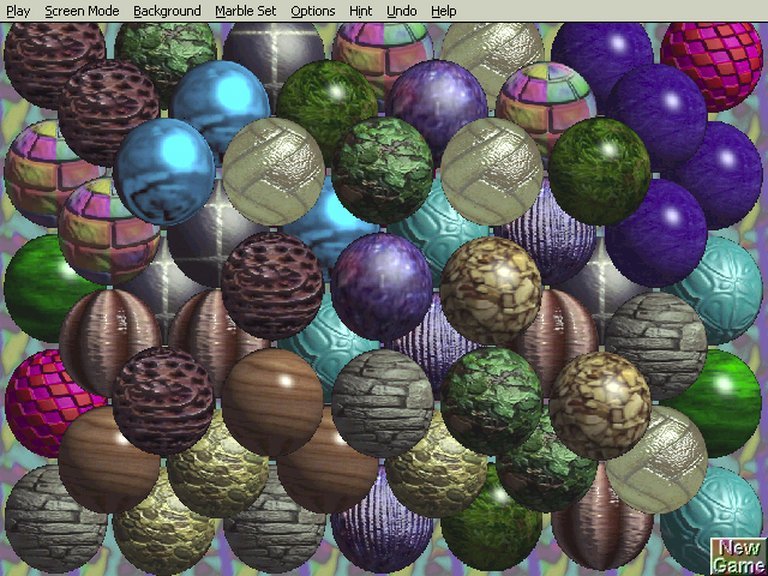
Description
Moraff’s Spherejongg is a shareware Mahjongg game released in 1995 for Windows, featuring spherical ’tiles’ or balls that aim to reduce eyestrain and simplify gameplay. The game offers mouse-controlled mechanics, customizable difficulty settings, multiple layouts, and hint/undo functions, with an extended edition providing enhanced graphics and guaranteed solvable puzzles. It supports both windowed and full-screen play, tracks high scores and statistics, and includes sound effects for an immersive experience.
Gameplay Videos
Moraff’s Spherejongg Free Download
Moraff’s Spherejongg Reviews & Reception
myabandonware.com : I used to play this all the time as a kid with my grandma. She passed recently and I’ve sat here crying for a few minutes, because I was finally able to find it for her.
Moraff’s Spherejongg: A Revolutionary Twist on Mahjongg
Introduction
In the mid-1990s, the puzzle genre was dominated by traditional tile-matching games, but Moraff’s Spherejongg dared to redefine the formula. Released in 1995 by Moraffware, this Windows-based Mahjongg variant replaced flat tiles with spherical, marble-like pieces, promising reduced eyestrain and a fresh visual experience. While it lacked the narrative depth of contemporary RPGs or the adrenaline of action games, Spherejongg carved its niche as a relaxing yet mentally stimulating puzzle game, beloved by casual players and nostalgia seekers alike.
This review explores the game’s development, mechanics, and enduring legacy, arguing that Spherejongg was more than just a gimmick—it was a thoughtful evolution of a classic genre.
Development History & Context
The Rise of Moraffware
Moraffware, founded by Steve Moraff, was a prolific developer of shareware games in the 1980s and 1990s. Known for titles like Moraff’s Revenge (1988) and Moraff’s Morejongg (1992), the studio specialized in accessible, mouse-driven puzzle games that thrived in the shareware market. Spherejongg emerged as part of a broader trend in the mid-’90s: experimenting with 3D aesthetics in traditionally 2D genres.
Technological Constraints & Innovations
- Windows 3.x Era: Running on early Windows systems, Spherejongg leveraged 16-bit graphics and mouse-driven controls, a stark contrast to DOS-based competitors.
- 3D Spherical Tiles: The game’s defining feature—ray-traced marble-like spheres—was a technical feat for its time, offering 16 million colors (in later versions) and reducing visual fatigue.
- Shareware Model: The base version was free, with a registered “Extended Edition” unlocking additional layouts, voices, and guaranteed solvable puzzles.
The Gaming Landscape of 1995
While Spherejongg lacked the mainstream appeal of Doom II or Civilization II, it thrived in the casual gaming space, competing with titles like Microsoft’s Entertainment Pack and Shanxi (another Mahjongg variant). Its accessibility and low system requirements made it a staple on family PCs.
Narrative & Thematic Deep Dive
A Game Without a Story
Unlike narrative-driven puzzles (e.g., The 7th Guest), Spherejongg was pure gameplay, eschewing plot for meditative tile-matching. However, its thematic elements were subtle yet effective:
– Eyestrain Reduction: The spherical tiles were marketed as easier on the eyes, a nod to the era’s growing awareness of digital fatigue.
– Nostalgia & Comfort: User testimonials (e.g., MyAbandonware comments) reveal Spherejongg as a bonding tool—players recall sharing it with grandparents or parents, evoking warmth and nostalgia.
The Sound of Silence (and Marbles)
- Minimalist Audio: The game featured sound effects (e.g., marble clicks, a chorus of “Sorry!” when no moves remained) but no music in early versions.
- Later Enhancements: Version 4.0 introduced MIDI music support, allowing players to import their own tracks—a rare feature for puzzle games of the era.
Gameplay Mechanics & Systems
Core Loop: Matching Marbles
The rules mirrored traditional Mahjongg solitaire:
1. Objective: Clear all spheres by matching identical pairs.
2. Constraints: Only exposed spheres (no overlapping neighbors) could be selected.
3. Difficulty Modes:
– Easy: Standard rules.
– Medium: Spheres must have an empty space above or below.
– Expert: Spheres must have an empty space to the left or right.
– “Always Possible”: Guaranteed solvable layouts (registered version only).
UI & Quality-of-Life Features
- Hint System: Highlighted available matches.
- Undo Function: A rarity in early puzzle games.
- Statistics Tracking: High scores and completion times.
- Customization: Players could adjust tile sets, backgrounds, and layouts.
Flaws & Frustrations
- Ambiguous Selection: Some spheres were hard to distinguish due to 3D shading.
- Limited Shareware Content: The free version lacked voices and advanced layouts, incentivizing registration.
World-Building, Art & Sound
Visual Design: A Marble Wonderland
- 3D Rendering: The spheres’ glossy, ray-traced appearance stood out in 1995.
- Backgrounds: Later versions included photographic backdrops, adding depth.
- Color Psychology: The vibrant marbles reduced monotony compared to traditional tiles.
Sound Design: Functional but Forgettable
- Effects: Satisfying clicks and chimes reinforced matches.
- Voices: The registered version’s “Sorry!” chorus became a quirky trademark.
Reception & Legacy
Critical & Commercial Reception
- No Formal Reviews: Spherejongg lacked mainstream coverage but thrived in shareware circles.
- User Testimonials: Modern players (e.g., MyAbandonware users) praise its nostalgic value and accessibility.
Influence on Later Games
- Moraffware’s Legacy: The studio’s later titles (Moraff’s Tinyjongg, Moraff’s Escapade) refined the formula.
- 3D Puzzle Trends: Spherejongg foreshadowed 3D tile-matching games like Zuma and Bejeweled 3.
Conclusion: A Small but Shining Gem
Moraff’s Spherejongg was never a blockbuster, but it perfected its niche. By blending innovative 3D design with classic Mahjongg mechanics, it offered a relaxing yet engaging experience that resonated with casual players. Today, it stands as a time capsule of 1990s shareware culture—a game that, for many, was more than just a puzzle; it was a shared memory.
Final Verdict: 7.5/10
- Pros: Unique visuals, accessible gameplay, nostalgic charm.
- Cons: Limited depth, ambiguous tile selection, dated audio.
- Legacy: A cult classic that deserves recognition in puzzle game history.
For those who played it with family, Spherejongg isn’t just a game—it’s a piece of digital heritage. And in an era of hyper-realistic graphics, its simple, colorful marbles remain a testament to the power of clever design.