
- Release Year: 2005
- Platforms: Windows
- Publisher: rondomedia Marketing & Vertriebs GmbH
- Developer: phenomedia publishing gmbh
- Genre: Action
- Perspective: Side view
- Game Mode: Single-player
- Gameplay: Arcade, Platforming
- Setting: Africa
Description
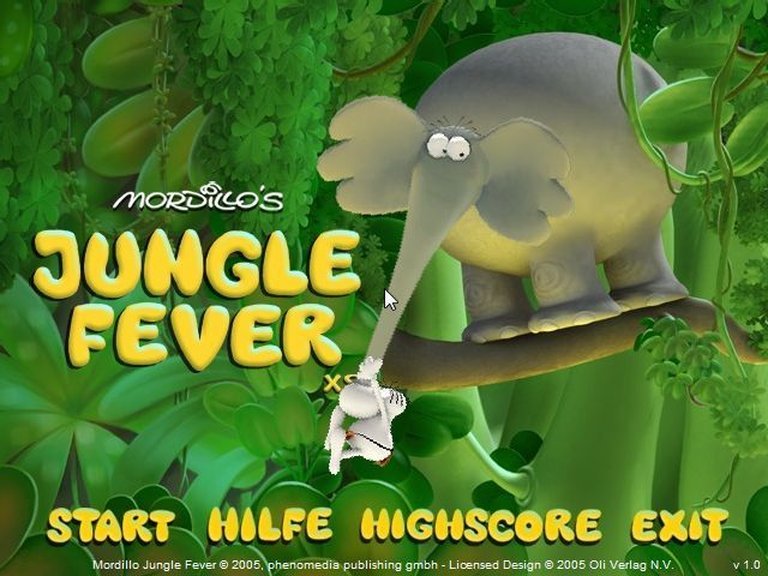
Mordillo’s Jungle Fever is an arcade action game based on the cartoon characters of Guillermo Mordillo. Players control a Tarzan-like hero as he swings from liana to liana through the African jungle, avoiding cute but dangerous animals such as monkeys, giraffes, and a crocodile, across 30 levels to rescue his lover and return to their tree house.
Mordillo’s Jungle Fever: A Critical Autopsy of a Forgotten Cartoon Adaptation
Introduction: Swing and a Miss
On April 1, 2005—a date that ironically foretold its reception—Mordillo’s Jungle Fever swung silently into the crowded PC Windows market, a commercial title that vanished almost as quickly as it appeared. Based on the whimsical, internationally beloved cartoons of Argentine-French artist Guillermo Mordillo, the game promised to transplant his signature style of voluptuous figures, playful humor, and lush, organic environments into an interactive experience. What it delivered, however, was a starkly minimalist arcade action game that would garner a devastating 28% average critic score and languish in the deepest trenches of gaming obscurity. This review posits that Mordillo’s Jungle Fever is not merely a bad game, but a profound case study in squandered potential—a technical and artistic collaboration that failed to grasp the essence of its source material, opting for rote, disposable design over the creative spirit that defined Mordillo’s work. Its legacy is that of a cautionary tale about the perils of treating vibrant intellectual property as mere window dressing for a mechanically barren and creatively bankrupt core.
Development History & Context: The Budget Bundle Blueprint
The Studio and the License:
Developed by phenomedia publishing gmbh, a German studio with a portfolio largely composed of budget casual and compilation titles (notably the Moorhuhn/”Moorhen” series), Jungle Fever was not conceived as a flagship project. It was a licensed product, leveraging the established but niche European popularity of Guillermo Mordillo’s cartoons. The publisher, rondomedia Marketing & Vertriebs GmbH, specialized in distributing such value-oriented software, often bundling titles like this in multi-game packs such as Moorhuhn präsentiert 10 Fun Games (2003). This context is crucial: Jungle Fever was born not from a creative vision to innovate, but from a business imperative to fill a compilation disc with inoffensive, low-cost content targeting a casual, often older or family-oriented audience in the German-speaking markets (Austria, Germany, Switzerland).
Technological Constraints & Era:
Released in 2005, the game existed in a peculiar interim period for PC casual gaming. The dominance of simplistic, browser-based or CD-ROM “clicker” games was being challenged by the rise of downloadable casual portals (Big Fish Games, PopCap). Yet, the Moorhuhn model—cheap physical discs with dozens of simple games—still had retail traction. Technologically, Jungle Fever represents the nadir of this model: a 2D side-scroller with minimal animation, basic collision detection, and no save functionality, all running on what was even then antiquated technology. The choice of a single-button control scheme (spacebar or mouse click) was less a design philosophy and more a necessity to ensure absolute accessibility for the presumed “computer analphabet” demographic PC Action derisively noted.
The Gaming Landscape:
The mid-2000s saw the platformer genre in a state of flux. While console players enjoyed the artistic mastery of Rayman 3 or the 3D ambitions of Super Mario Sunshine, the PC casual space was flooded with derivative, shallow fare. Jungle Fever arrived in the shadow of classic arcade swing mechanics from Jungle Hunt (1982) and the barrel-hopping chaos of Donkey Kong, but without the tight design or escalating challenge of those pioneers. It was a game visually styled for a family audience but mechanically designed for the shortest possible attention span, a contradiction that insured its rapid dismissal by anyone seeking substantive gameplay.
Narrative & Thematic Deep Dive: The Ghost of Mordillo
Plot and Characters: An Exercise in Narrative Minimalism
The narrative is brutally simple, presented in a single paragraph on the back of the box and a brief description in-game: the player controls a “typically Mordillo comic figure in a Tarzan outfit”—a man with an exaggerated, rounded physique, large nose, and modest loincloth—who must swing through a jungle to rescue his “Jane,” a voluptuous woman with the signature Mordillo hairstyle, waiting in the “green depths.” After 30 levels, they reunite and retire to a “tree house.” There is no dialogue, no character motivation beyond rescue, and no world-building. The story is a skeletal archetype, a narrative justification devoid of drama, humor, or personality. It reduces Mordillo’s richly populated, humorous world to a single, silent protagonist-antagonist relationship.
Thematic Analysis: Missed Opportunities
Guillermo Mordillo’s cartoons are celebrated for their gentle, absurdist humor, their celebration of curvaceous, joyful life, and their organic, teeming ecosystems where animals and humans interact in playful, often surreal ways. Jungle Fever captures the aesthetic of this world—the rounded shapes, the vibrant green palette, the “cute-looking” animals—but entirely misses its thematic soul.
* The Jungle as Character vs. Obstacle Course: In Mordillo’s art, the jungle is a living, breathing, humorous entity. In the game, it is a sterile, repetitive backdrop—a series of identical vertical shafts with liana (vines) and platform nodes. The “inhabitants” (monkeys, giraffes, a crocodile) are not comedic foils; they are punitive, unavoidable obstacles to be actively avoided. This inverts Mordillo’s spirit. Where his cartoons find joy in the chaotic interplay of creatures, the game instills fear and frustration.
* Absence of Humor: The game’s tone is one of tense, silent concentration. There is no whimsy, no visual gags, no playful interaction. The hero’s grin is a static sprite; the enemies’ behaviors are functional patterns (monkeys fling coconuts, giraffes block, crocodile lunges from water). The profound lightness of Mordillo is replaced by the anxiety of perfect timing.
* The “Rescue” Decontextualized: Jane is not a character but a icon—the final goal. Her presence provides no narrative weight, emotional stake, or humorous potential. The reunion is a brief, static animation, not a payoff. This strips the entire premise of its romantic (in the broad, cartoon sense) and comedic potential, leaving a hollow mechanical exercise.
In essence, the game is a thematic flatline. It applies the skin of Mordillo’s universe while ignoring the heartbeat of his artistic philosophy.
Gameplay Mechanics & Systems: The Descent into Repetition
Core Loop & Vine-Swinging Mechanic:
The entire gameplay revolves around a single, binary input: press the spacebar/mouse button to release from a swinging liana and propel your character forward to the next vine or platform. The mechanic is deceptively simple in explanation but requires precise timing, angle judgment, and momentum control. Early levels teach the basic pendulum release. Later levels introduce gap widths, moving platforms, and environmental hazards (water with the crocodile, ground-based obstacles).
Progression & Structure:
* 30 Fixed Levels: The game is a linear ascent. No branching paths, no secret areas.
* No Character Progression: There are no power-ups, no upgrades, no new abilities. The hero’s capabilities are identical on Level 1 and Level 30. The only “progression” is the player’s own skill.
* No Save System: As noted by PC Games, the complete lack of a save or password system is a cardinal sin. Players must restart from the beginning after failing, a legacy design choice that feels particularly punitive in a 30-level gauntlet of increasing precision.
* Instant Death & Punishment: Contact with any enemy (monkey coconut, giraffe, crocodile) or falling into a pit results in immediate death and a level restart. There are no hit points, no invulnerability frames.
Innovation vs. Flaws:
* The “Innovation”: The core swinging sensation, while simple, provides a satisfying “aha” moment when a difficult gap is cleared through perfect timing. The momentum-based physics are consistent and understandable.
* The Overwhelming Flaws:
1. Monotony: The visual and mechanical repetition is catastrophic. Screenshots from one mid-level are virtually indistinguishable from another. The same few enemy types reappear with only minor positional shifts. GameStar’s comparison to RTL’s Dschungelcamp (a notoriously trashy German reality TV show) is brutal but apt: it highlights the game’s perceived lack of excitement and artificial, repetitive struggle.
2. Lack of Depth: There are no alternate routes, no risk/reward choices, no emergent gameplay. The “solution” to every level is one predetermined timing sequence. Mastery isrote memorization, not adaptive problem-solving.
3. Unforgiving Precision: The hitboxes are unforgiving. Late releases are not “near misses”; they are fatal falls. This breeds frustration rather than the “just one more try” compulsion of a well-designed platformer.
4. Zero Redundancy/Recovery: Once a swing is initiated, the player is on a fixed path. There is no way to abort or adjust mid-swing, making mis-timed inputs feel exceptionally cheap.
5. UI & Feedback: The UI is nonexistent beyond a basic score/level counter. There is minimal feedback on successful dodges, no audio/visual cues for enemy wind-ups (relying on predictable patterns), leading to deaths that feel blind and unfair.
The gameplay is a pure, unadulterated execution of a single mechanic, stretched thin across 30 levels without the structural support of variety, narrative context, or meaningful progression. It is the definition of a “one-trick pony” where the trick, while competent, is not compelling enough to sustain alone.
World-Building, Art & Sound: A Gilded Cage
Visual Direction & Animation:
This is the game’s sole, undeniable strength, and the primary reason it garners any attention at all. phenomedia successfully translated Mordillo’s cartoon aesthetic—the soft, rounded forms, the exaggerated proportions, the warm, earthy color palette—into competent 2D sprites. The hero’s loincloth and hair flap with simple animation; the animals have distinct, “cute” designs that align with Mordillo’s originals. The jungle backgrounds, while repetitive, use a pleasing variety of greens and browns with occasional butterflies or leaves to suggest life. The animation is smooth and functional, meeting the basic expectations of a 2005 casual title. It looks exactly like a cheap, licensed cartoon game should look: inoffensive, colorful, and clearly derived from a recognizable style.
Sound Design & Music:
Conversely, the audio is not just forgettable, but actively detrimental. The soundtrack consists of a handful of short, looping, royalty-free-style tropical-styled MIDI tracks that are both cheesy and grating after a few minutes. Sound effects are sparse and generic: a boing for jumps, a splash for water, a basic crunch for death. There is no thematic cohesion, no attempt to use music or sound to enhance the jungle atmosphere or Mordillo’s playful tone. The audio landscape is as empty and repetitive as the level design, contributing to the overall feeling of cheapness and fatigue.
Synthesis: Aesthetic Without Atmosphere
The visuals and audio exist in a state of complete dissonance from the gameplay. While the art suggests a lighthearted, humorous world, the gameplay forces the player into a tense, repetitive, frustrating grind. The lush visuals become a cruel joke—a beautiful cage for a monotonous activity. The world feels dead because the gameplay mechanics do not allow for interaction, observation, or joy within it. You are not exploring Mordillo’s jungle; you are enduring a series of identical vine-switching puzzles against its static backdrop. The art is a magnificent, wasted facade.
Reception & Legacy: The Sound of Silence
Critical Reception:
The German-language press, which formed the core audience for this regional release, eviscerated the game. The Metacritic-equivalent aggregate score of 28% is damning:
* PC Action (14%): “So simple everything is, so quickly does it become boring. Swinging from lianes was more exciting 23 years ago in Jungle Hunt.”
* GameStar (5%): “Tarzan would have every reason to howl at this game… Even RTL’s Dschungelcamp [a notoriously lowbrow reality show] was more exciting.”
* PC Games (44%): The most forgiving, noting its “cute comic graphics” and simple controls but concluding it was “much too short” and offered “no storage function.”
* PlnéHry.cz (50%): Arguing it could be finished in “a few minutes” and that players wouldn’t “feel like returning to Mordillo.”
The consensus was unanimous: profoundly shallow, mechanically obsolete, and a waste of a beloved license.
Commercial & Cultural Legacy:
Commercially, it was a non-entity. Its inclusion in the Moorhuhn präsentiert 10 Fun Games bundle (noted as 2003, though Jungle Fever released in 2005—suggesting compilation date discrepancies) is its primary claim to existence, likely sold as a discount bin item or a bundled extra. It has no cult following, no speedrunning community, and no Influence on subsequent game design. No developer has cited it as an inspiration. It represents a dead-end branch on the platformer evolutionary tree: a simplification that stripped away all complexity, challenge, and charm, leaving only a hollow shell.
Its Place in History:
Mordillo’s Jungle Fever is historically significant only as a prime example of mid-2000s casual game development at its most uninspired. It demonstrates the cynical end of licensed adaptations where the IP is a mere marketing coat of paint on a pre-fab, low-effort gameplay skeleton. It is a ghost in the machine of video game history—a title that exists in databases (MobyGames, MyAbandonware, Retro Replay) but not in memory or discourse. Its legacy is a reminder that beautiful art cannot compensate for barren mechanics, and that a license, however cherished, is meaningless without a game that understands and respects its spirit.
Conclusion: A Fading Footnote
Mordillo’s Jungle Fever is a galling paradox: a game that looks like it should be charming, yet is fundamentally joyless. It takes the vibrant, humorous, life-affirming world of Guillermo Mordillo and transmutes it into a silent, repetitive, punishing obstacle course. The single-button vine-swinging mechanic, while conceptually sound, is utterly devoid of the variation, systemic interplay, or escalating creativity needed to sustain interest across 30 identical-feeling levels. The lack of a save function in 2005 was an archaic, player-hostile choice.
Visually, it is a competent translation of its source material, but this only deepens the tragedy. One can see the ghost of a good game—a Rayman or Donkey Kong Country with Mordillo’s sensibilities—haunting these sprites. That ghost is exorcised by the barren design, the repetitive enemy placements, the failure to leverage the jungle as a playground rather than a prison.
This review’s thesis stands confirmed: Mordillo’s Jungle Fever is not just a bad game, but a symbol of creative bankruptcy. It is a game made to fill a space on a compilation disc, to satisfy a contractual obligation for a “Mordillo game,” with no higher ambition than technical completion. Its 28% aggregate score is not an injustice; it is a mercy. It spared the game from the greater ignominy of being remembered for anything other than its spectacular failure to capture the whimsy it so literally depicted. It swings from the vine of its concept directly into the abyss of obscurity, where it rightfully remains—a brief, painful fever dream in the history of platformers, and a permanent stain on the legacy of a great cartoonist.