
- Release Year: 1996
- Platforms: Macintosh, Windows
- Publisher: LucasArts Entertainment Company LLC
- Developer: LucasArts Entertainment Company LLC
- Genre: Action, Educational
- Perspective: 1st-person
- Game Mode: Single-player
- Gameplay: Puzzle elements
- Setting: Ecology, Nature
- Average Score: 85/100
Description
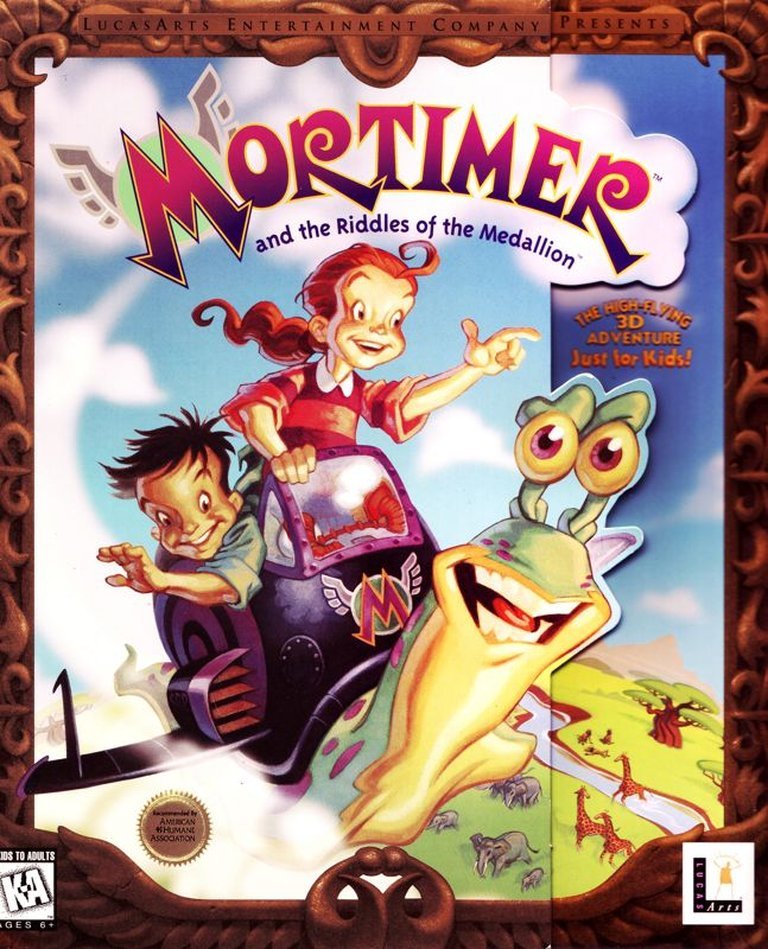
Mortimer and the Riddles of the Medallion is an action/puzzle game developed by LucasArts, primarily aimed at children. Players take on the role of either Sid or Sally, riding a giant snail named Mortimer to stop the villainous Lodius, who has stolen a magical medallion and turned all the animals into statues. The game features five action-packed levels where players must revive the animals and solve riddles to progress, blending adventure with educational elements focused on ecology and nature.
Gameplay Videos
Mortimer and the Riddles of the Medallion Free Download
Mortimer and the Riddles of the Medallion Reviews & Reception
gamesreviews2010.com : A charming and challenging children’s puzzle video game that follows the adventures of Mortimer, an oversized, anthropomorphic snail with a knack for solving mysteries.
mobygames.com (77/100): A critical and commercial success upon its release, and it remains a beloved classic among puzzle game enthusiasts today.
myabandonware.com (94/100): I was a tester at LucasArts working on Mortimer way back in ’96. Other testers stressing out new Star Wars and Indiana Jones games made fun of us in the Mortimer group, but I enjoyed playing a clever, silly, bright and cheerful game for a few months instead of the often dark and violent ones we usually tried to break.
Mortimer and the Riddles of the Medallion: A Whimsical Journey Through LucasArts’ Forgotten Gem
Introduction: A Snail’s Tale of Adventure and Education
In the mid-1990s, LucasArts—renowned for its groundbreaking adventures like Monkey Island and Day of the Tentacle—ventured into uncharted territory with Mortimer and the Riddles of the Medallion, a children’s game that blended action, puzzles, and environmental education. Released in 1996 for Windows and Macintosh, Mortimer stands as a curious footnote in the studio’s legacy: a game that dared to be both educational and entertaining, a rare balance in an era dominated by either dry edutainment or pure action. This review explores why Mortimer remains a cult favorite, dissecting its design, narrative, and the unique charm that has kept it alive in the memories of those who played it.
Development History & Context: LucasArts’ Foray into Kids’ Gaming
The Studio’s Shift in Focus
By 1996, LucasArts was at the height of its creative powers, but the company was also exploring new demographics. Mortimer was part of a broader initiative to create games for younger audiences, a departure from its usual fare of dark humor and complex narratives. The game was unveiled at the 1995 Electronic Entertainment Expo (E3) as a “kiddie title” that defied the era’s skepticism toward educational games. A Computer Games Strategy Plus reviewer famously noted, “It’s very hard to sneer at the pure and lustrous quality of this kiddie title,” a testament to its polished execution.
Technological Foundations
Mortimer utilized the Star Wars: Rebel Assault engine, a 3D rail-shooter framework that powered LucasArts’ earlier cinematic games. While the engine was already showing its age by 1996, the team repurposed it to create a vibrant, first-person adventure where players rode a giant snail through diverse ecosystems. The game’s technical constraints—such as the reliance on pre-rendered backgrounds and limited interactivity—were cleverly masked by its whimsical art style and engaging gameplay loops.
The Creative Team
The project was helmed by Steve Purcell, a LucasArts veteran known for his work on Sam & Max Hit the Road, and Casey Donahue Ackley, who contributed to the game’s script and media acquisition. The voice cast included industry stalwarts like Maurice LaMarche (Lodius, the villain) and Kevin Meaney (Mortimer), lending the game a professional sheen rare in children’s titles of the era. Notably, George Lucas himself was involved in the project, underscoring its importance to the studio’s expansion into family-friendly content.
Narrative & Thematic Deep Dive: A Battle of Wits and Ecology
Plot Overview
Mortimer follows the adventures of Sid or Sally (the player’s chosen protagonist), who team up with Mortimer, a giant, talking snail, to thwart the nefarious Lodius. Lodius, a former student of the eccentric Professor Laslow, has stolen the Medallion of Animalium, a magical artifact that can turn living creatures into stone. Using the medallion’s power, Lodius has petrified the world’s animals and shattered the artifact into seven pieces. The player’s quest is to revive the animals, solve riddles posed by anthropomorphic “Gates,” and reassemble the medallion to defeat Lodius.
Themes: Environmentalism and the Power of Knowledge
At its core, Mortimer is an ecological fable. Each of the game’s four levels—Savannah, Taiga (Forest), Arctic, and Desert—introduces players to real-world animals and their habitats. The game subtly teaches biology and conservation through its gameplay:
– Animal Revival Mechanics: Players must “unpetrify” animals by clicking on their stone statues, which triggers brief educational snippets about each species.
– Riddle-Based Progression: The Gates, towering sentinels made of local materials (stone, wood, ice), pose riddles whose answers are the names of revived animals. This reinforces learning through interaction.
– Lodius as a Cautionary Figure: The villain’s descent into madness—symbolized by his grotesque, bat-like appearance—serves as a metaphor for humanity’s destructive relationship with nature.
Character Analysis
- Mortimer: The game’s breakout star, Mortimer is a lovable, wisecracking snail whose shell doubles as a vehicle (transforming into an aircraft or submarine as needed). His vulnerability to salt (a running gag) and his deadpan humor make him one of LucasArts’ most underrated characters.
- Lodius: A tragic figure, Lodius is a former protégé of Laslow who succumbed to the medallion’s corrupting influence. His design—part-gargoyle, part-mad scientist—echoes classic Disney villains, and his voice work by Maurice LaMarche (known for Animaniacs and Brainiac in Superman: The Animated Series) gives him a delightfully hammy presence.
- The Animals: Each of the 28 animals players encounter has a distinct personality, from the pompous lion to the hyperactive roadrunner. Their dialogue is packed with puns and whimsy, making the educational content palatable.
Gameplay Mechanics & Systems: A Hybrid of Action and Puzzle-Solving
Core Gameplay Loop
Mortimer is a first-person rail shooter/puzzle hybrid with a structure that alternates between:
1. Action Segments: Players navigate Mortimer through 3D environments, reviving animals and fending off Lodius’ minions (e.g., Salt-Shaker Hornets, Beastie Bags) by clicking on them to fire mucus projectiles.
2. Puzzle Segments: At the end of each level, players must solve a riddle posed by a Gate. The answer is always the name of an animal revived in that level, requiring players to recall information from their interactions.
Combat and Progression
- Combat: The game’s combat is simplistic by design, catering to younger players. Enemies are defeated by rapid cursor clicks, with no complex aiming or strategy required. The challenge ramps up in Lodius’ fortress, where players must navigate mazes without Mortimer’s protection.
- Difficulty Settings: Mortimer offers three difficulty levels, adjusting the complexity of riddles and the aggression of enemies. The hardest setting introduces more obscure animal facts, making it engaging for older players.
- Non-Linearity: While the game is largely linear, players can revisit areas to interact with animals they missed, encouraging exploration.
UI and Accessibility
The game’s UI is a masterclass in child-friendly design:
– Mortimer’s Cockpit: The HUD displays icons of revived animals, serving as both a progress tracker and a visual aid for riddle-solving.
– Voice-Acted Hints: Animals and Gates provide auditory clues, making the game accessible to younger players who might struggle with reading.
– Save System: The game allows saving after each level, a considerate feature for its target audience.
Flaws and Frustrations
- Rail-Shooter Limitations: The Rebel Assault engine’s rigidity occasionally leads to frustrating navigation, particularly in tight spaces where collision detection feels imprecise.
- Repetitive Combat: The lack of variety in enemy encounters can make action segments feel tedious, especially for older players.
- Language Barrier: The game’s initial English-only release was a significant hurdle for non-native speakers, as the riddles relied heavily on wordplay and specific terminology.
World-Building, Art & Sound: A Feast for the Senses
Visual Design: A Cartoonish Wonderland
Mortimer’s art style is a vibrant blend of Saturday morning cartoon aesthetics and LucasArts’ signature humor. The game’s environments are richly detailed, with each ecosystem boasting distinct color palettes:
– Savannah: Golden grasses and towering baobab trees.
– Taiga: Dense forests with autumnal hues.
– Arctic: Icy caverns and aurora-lit skies.
– Desert: Rolling dunes and ancient ruins.
The character designs are equally memorable:
– Mortimer’s Shell: A marvel of imagination, equipped with a cockpit, weapons, and even a periscope for underwater exploration.
– The Gates: Colossal, singing faces embedded in their environments, each with a unique vocal performance (e.g., the Arctic Gate’s deep, echoing baritone).
Sound and Music: A Mini Musical
The game’s audio design is a standout feature:
– Voice Acting: The cast delivers performances that are both exaggerated and heartfelt, with Kevin Meaney’s Mortimer stealing the show with his deadpan delivery.
– Musical Numbers: The Gates and the Medallion itself sing riddles and songs, turning the game into a mini-musical. The final credits feature a full-fledged animal choir, a delightful capstone to the adventure.
– Ambient Sounds: Each environment is filled with appropriate wildlife noises, enhancing immersion.
Reception & Legacy: A Cult Classic’s Journey
Critical Reception
Mortimer received moderately positive reviews, with critics praising its charm and educational value but noting its simplicity. Key takeaways from contemporary reviews:
– Fun Online (83%): “The funniest 3D action game we know… but the English version is a hurdle for German kids.”
– Gamezilla (80%): “A uniquely designed educational game… but the sudden difficulty spike in the castle level is jarring.”
– PC Player (80%): “Witty dialogues and cartoon-like animations… technically excellent by LucasArts’ standards.”
– CNET (Unscored): “The flights through tight passages can frustrate younger players.”
The game’s MobyGames score of 7.1 reflects its niche appeal—beloved by those who played it but overshadowed by LucasArts’ more famous titles.
Commercial Performance and Awards
While not a blockbuster, Mortimer was nominated for an Emmy, a rare honor for a children’s game. Its commercial performance was modest, but it found a dedicated audience among parents and educators seeking engaging, non-violent entertainment.
Legacy and Influence
- Educational Gaming: Mortimer was ahead of its time in blending education with genuine fun, paving the way for later titles like Zoombinis and Putt-Putt.
- LucasArts’ Shift: The game marked one of LucasArts’ few successful forays into children’s gaming, though the studio would later abandon the genre to focus on licensed properties.
- Cult Following: Decades later, Mortimer retains a nostalgic fanbase, with players like Leah (from MyAbandonware) recalling it as “a cool part of my childhood” and testers like Scruffy remembering it as a “clever, silly, bright, and cheerful” respite from darker games.
Conclusion: A Snail’s Pace to Greatness
Mortimer and the Riddles of the Medallion is a flawed but endearing masterpiece—a game that dared to be both educational and entertaining in an era when those goals were often mutually exclusive. Its strengths lie in its charming narrative, vibrant world-building, and innovative blend of action and puzzle-solving, all wrapped in LucasArts’ signature humor. While its technical limitations and repetitive combat hold it back from true greatness, its heart and creativity ensure its place in gaming history.
Final Verdict: 8/10 – A Timeless Adventure for the Young and Young-at-Heart
For those who played it as children, Mortimer is a nostalgic treasure. For modern audiences, it’s a fascinating artifact of a time when games could be whimsical, educational, and fun without compromise. If you can look past its dated mechanics, you’ll find a game that still sparkles with the magic of discovery—much like the medallion itself.
Where to Play Today:
– Abandonware Sites: MyAbandonware offers downloads for both Windows and Mac versions.
– Emulation: Works on modern systems via DOSBox or compatibility modes.
– Preservation Efforts: Fan projects occasionally resurface, aiming to remaster or adapt the game for new generations.
In the end, Mortimer is more than just a children’s game—it’s a testament to the power of creativity in gaming, and a reminder that sometimes, the most unforgettable adventures come from the unlikeliest of heroes… even if that hero is a giant, salt-averse snail.