
- Release Year: 2004
- Platforms: Macintosh, Windows
- Publisher: Viva Media, LLC
- Developer: Morton Subotnick
- Genre: Educational, Music
- Perspective: 1st-person
- Game Mode: Single-player
- Gameplay: Educational, Music, rhythm
- Setting: Educational
- Average Score: 93/100
Description
Morton Subotnick’s Hearing Music is an educational game designed for children aged 8 and up, focusing on developing musical literacy through interactive play. Created by electronic composer Morton Subotnick, the game features four distinct activities—Reading, Matching, Ordering, and Comparing—each with beginner and advanced levels. Players engage with music by identifying notation, matching sounds, sequencing melodies, and distinguishing between pieces, all while progressing through increasingly challenging puzzles. The game also includes a narrated book, About Music, which explores how we perceive and respond to music. With simple mouse-based controls and a rewarding success screen featuring Handel’s Hallelujah Chorus, the game blends learning with playful, creative exploration.
Morton Subotnick’s Hearing Music Reviews & Reception
edutainingkids.com (90/100): Original and valuable content that focuses on an important skill in the music learning process: listening.
mobygames.com (100/100): This game is meant for children 8 and up. There are two levels of difficulty – beginner and advanced, and four parts to each level.
christcenteredgamer.com (89/100): I would highly recommend this title to anyone wanting to train your ears to hear music better.
Morton Subotnick’s Hearing Music: A Masterclass in Interactive Musical Pedagogy
Introduction: The Unheard Symphony of Learning
In the vast, often cacophonous landscape of educational software, few titles manage to strike a harmonious balance between pedagogy and playfulness as elegantly as Morton Subotnick’s Hearing Music. Released in 2004 by Viva Media, this deceptively simple CD-ROM game is not merely a tool for teaching music—it is a philosophical manifesto disguised as child’s play, a testament to the power of interactive media to cultivate active listening in an era increasingly dominated by passive consumption. At its core, Hearing Music is a radical act of democratization, inviting children (and curious adults) to engage with music not as spectators, but as participants in a dialogue of sound, structure, and meaning.
This review will dissect Hearing Music with the precision of a musicologist and the enthusiasm of a gamer, exploring its development, mechanics, aesthetic choices, and enduring legacy. We will argue that while the game’s visuals and technical scope may appear modest by modern standards, its design philosophy and educational impact position it as a landmark in the intersection of music education and interactive media—a quiet revolution in how we hear the world around us.
Development History & Context: The Composer as Game Designer
The Visionary Behind the Game
Morton Subotnick is not a name typically associated with video games, but his influence on electronic music and multimedia art is monumental. A pioneer of electronic composition—most famously for his 1967 work Silver Apples of the Moon—Subotnick has long been fascinated by the intersection of technology, perception, and creativity. His foray into educational software began in the 1990s with Making Music (1995), a groundbreaking title that used interactive play to introduce children to composition. Hearing Music (2004) represents the maturation of this vision: a shift from making music to understanding it through structured listening.
Subotnick’s choice to title the game Hearing Music—rather than Listening to Music—is deliberate and profound. As he explains, the distinction mirrors everyday language: “Listen! Do you hear what I am saying?!” Here, hearing implies an active, analytical engagement with sound, while listening can be passive. The game, then, is not about rote memorization or mechanical repetition, but about training the ear to discern—to recognize patterns, differences, and emotional nuances in music.
Technological and Cultural Landscape
Released in January 2004, Hearing Music arrived at a pivotal moment in both gaming and educational technology. The early 2000s saw the rise of “edutainment” software, a genre often maligned for its tendency to sacrifice depth for superficial engagement. Titles like The Oregon Trail and Reader Rabbit dominated the market, but few dared to tackle abstract subjects like music theory with the rigor and creativity of Subotnick’s work.
Technologically, the game was constrained by the limitations of CD-ROM distribution and the hardware of the era. With a mere 12MB of required hard drive space and 8MB RAM, Hearing Music was designed to run on virtually any home computer—from Windows 95 to Mac OS X. This accessibility was crucial for its intended audience: schools, libraries, and families without high-end PCs. The game’s reliance on mouse-only input (point, click, drag) further ensured that children as young as five could navigate its interface without frustration.
The development team, led by Technical Director Hunter Ochs and Producer Jane Wheeler, included a mix of educators, musicians, and multimedia artists. Notably, the game featured performances by The California Ear Unit, a renowned contemporary chamber ensemble, ensuring that the musical examples were not just functional but artistically compelling. The voice narration by Joan La Barbara, an avant-garde vocalist, added a layer of warmth and professionalism to the educational content.
A Series in Evolution
Hearing Music is the third installment in Subotnick’s Music series, following Making Music (1995) and Making More Music (1999), and preceding Playing Music (2006). While the earlier titles focused on composition and improvisation, Hearing Music zeroes in on aural skills—the ability to recognize, compare, and interpret musical elements by ear. This progression reflects Subotnick’s pedagogical philosophy: before one can create, one must learn to perceive.
The series as a whole represents a rare example of a composer using interactive media not just to teach, but to redefine how music is taught. In an era where music education in schools was (and remains) underfunded and often reduced to rote exercises, Subotnick’s games offered a radical alternative: learning through play, discovery, and embodied interaction.
Narrative & Thematic Deep Dive: The Story of Sound
The Absence of Plot, the Presence of Purpose
Hearing Music does not tell a story in the traditional sense. There are no protagonists, no villains, no quests. Instead, it constructs a narrative of discovery—one where the player is both the explorer and the subject of transformation. The game’s “story” unfolds not through cutscenes or dialogue, but through the gradual awakening of the player’s auditory perception.
This narrative is reinforced by the game’s structure:
– Four Core Games: Reading, Matching, Ordering, and Comparing—each designed to hone a specific listening skill.
– Two Difficulty Levels: Beginner and Advanced, with four sub-levels apiece, ensuring a gentle learning curve.
– A Narrated Companion: About Music, a ten-chapter “book” that contextualizes the gameplay with insights into how we hear, respond to, and create music.
The absence of a traditional narrative is not a flaw but a deliberate design choice. By stripping away distractions, the game forces the player to focus entirely on sound—to become, in Subotnick’s words, “aware of what they are hearing.”
Themes: Perception, Pattern Recognition, and the Joy of Discovery
At its heart, Hearing Music explores three interconnected themes:
-
The Act of Hearing as Creation
The game posits that hearing is not passive but generative—an act of interpretation. When a child matches two musical phrases in the Matching game or reconstructs a melody in Ordering, they are not just solving a puzzle; they are constructing meaning from sound. -
Pattern Recognition as a Gateway to Musical Literacy
Music, at its core, is about patterns: melodies, rhythms, harmonies. Hearing Music trains players to recognize these patterns through repetition and variation. The Comparing game, for instance, asks players to distinguish between phrases that are the same, different, slower, faster, higher, lower, or even backwards—a brilliant way to introduce concepts like retrograde (a term from serialist music) without overwhelming jargon. -
The Emotional Resonance of Sound
The About Music companion book delves into how music evokes emotion, from the physiological mechanics of hearing (“Why we hear”) to the cultural origins of melody (“Where music came from”). This thematic layer elevates the game from a mere skill-building tool to a philosophical exploration of music’s role in human experience.
The Role of the About Music Book
The narrated About Music book is more than an addendum—it is the game’s theoretical backbone. Read aloud in a “pleasantly quiet voice” (as described in the game’s credits), its ten chapters serve as a bridge between abstract theory and interactive practice. Topics include:
– The biology of hearing (“How very well we hear”)
– The relationship between speech and music (“The way we speak”)
– The expressive power of music (“Hearing music makes us feel things”)
– The components of music (“What music is made of”)
This section is a masterclass in micro-lectures: each chapter is brief enough to hold a child’s attention but dense with insights. For example, the chapter on “What music is made of” introduces concepts like pitch, timbre, and rhythm not through dry definitions, but through relatable analogies and examples.
Gameplay Mechanics & Systems: The Architecture of Listening
Core Gameplay Loop: Play, Listen, Decide
Hearing Music distills its educational goals into four distinct mini-games, each targeting a different aural skill. The gameplay is mouse-driven, with no keyboard input required—a design choice that ensures accessibility for young children.
1. Reading
- Objective: Listen to a short musical phrase and select the correct notation from two options.
- Skills Developed: Note recognition, pitch discrimination, familiarity with musical notation.
- Progression: Begins with simple melodies and advances to pieces with sharps and flats, challenging the player’s ability to distinguish subtle differences.
2. Matching
- Objective: Click on three (or more) “bushes,” each producing a musical phrase, and identify the matching pair.
- Skills Developed: Memory, pattern recognition, timbre discrimination.
- Progression: Early levels use identical phrases; later levels introduce similar but not identical phrases, forcing the player to listen for nuances.
3. Ordering
- Objective: Listen to a complete musical piece, then arrange individual segments (each associated with a character) in the correct sequence.
- Skills Developed: Structural listening, memory, understanding of musical form.
- Progression: Starts with three-part phrases and escalates to four-part compositions, including harmonic and contrapuntal examples.
4. Comparing
- Objective: Listen to two musical phrases and determine if they are the same or different. Advanced levels require specifying how they differ (e.g., slower, higher, backwards).
- Skills Developed: Critical listening, analytical thinking, recognition of musical transformations.
- Progression: Introduces retrograde (backwards), inversion (upside down), and tempo/rhythm changes, concepts borrowed from advanced music theory.
Adaptive Difficulty and Feedback
The game employs a computer-adaptive system, subtly adjusting the difficulty based on the player’s performance. While not as sophisticated as modern adaptive learning algorithms, this feature ensures that children are neither bored by overly simple tasks nor frustrated by impossible challenges.
Feedback is immediate and positive:
– Correct answers fill a progress bar (with Ordering tasks awarding 2–3 bars for their complexity).
– Incorrect answers are met with a gentle prompt to try again—no penalties, no shame.
– Completing a level triggers a celebratory animation set to Handel’s Hallelujah Chorus, reinforcing success with joy.
This approach aligns with constructivist learning theory, which emphasizes learning through exploration and positive reinforcement rather than punishment.
UI and Accessibility
The user interface is a model of minimalist clarity:
– Large, colorful buttons with intuitive icons.
– No text-heavy instructions—each game mode is explained through visual and auditory cues.
– A consistent layout across all mini-games, reducing cognitive load.
The game’s first-person perspective (as noted in its MobyGames classification) is somewhat misleading—there is no 3D navigation. Instead, the “first-person” label likely refers to the subjective experience of the player: you are not controlling a character, but yourself as the listener.
Innovations and Limitations
Innovations:
– Focus on Aural Skills: Unlike most music games of the era (e.g., PaRappa the Rapper, Guitar Hero), Hearing Music does not require rhythm-based input. It is purely about listening—a radical departure.
– Integration of Professional Music: The use of The California Ear Unit and pianist Steven Gossling ensures that the musical examples are not just functional but artistically rich.
– Cross-Disciplinary Learning: The About Music book ties auditory skills to biology, psychology, and cultural history, making the game a holistic educational tool.
Limitations:
– Lack of Customization: Players cannot create their own musical examples or adjust the tempo/pitch of phrases—a missed opportunity for deeper engagement.
– Repetitive Visuals: While the graphics are charming, they are static and simplistic, with little variation between levels.
– No Multiplayer or Social Features: In an era before widespread online gaming, this was not a major oversight, but it limits the game’s potential for collaborative learning.
World-Building, Art & Sound: The Aesthetics of Learning
Visual Design: Whimsy Meets Functionality
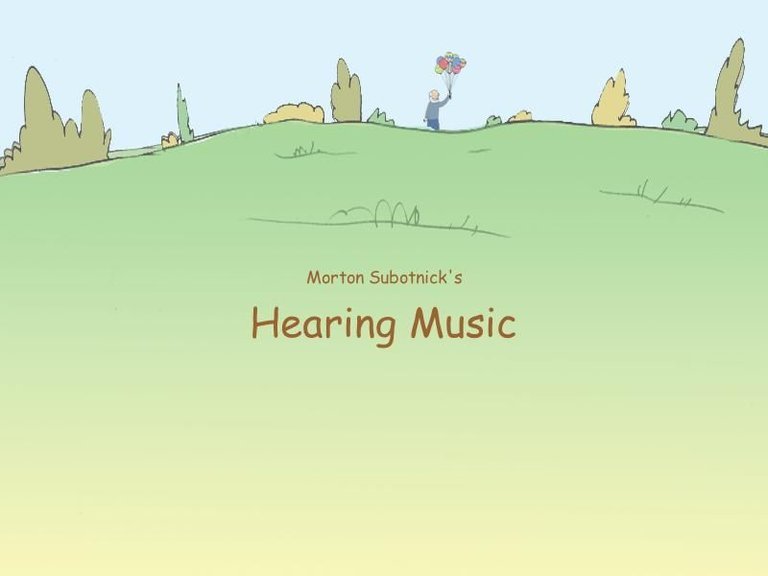
Hearing Music’s visual style is deliberately unassuming. The game eschews the flashy, cartoonish aesthetics of contemporaries like JumpStart in favor of a clean, functional interface that prioritizes clarity over spectacle.
- Character Design: The animated figures are simple and expressive, with exaggerated movements during the celebratory Hallelujah Chorus sequence. Their design is reminiscent of 1990s educational software, with a touch of UPA-style animation (think Gerald McBoing Boing).
- Environment: The “bushes” in the Matching game and the character avatars in Ordering are placed against soft, pastel backgrounds, ensuring that the focus remains on the musical content rather than visual distractions.
- Typography: Musical notation is rendered in a clear, beginner-friendly style, avoiding the complexity of professional sheet music.
While the graphics may appear dated by modern standards, they serve their purpose admirably: to create a non-intimidating, inviting space for learning.
Sound Design: The Heart of the Experience
If the visuals are understated, the sound design is nothing short of revolutionary for an educational title. Hearing Music treats audio not as a secondary element, but as the primary medium of interaction.
- Musical Examples: The phrases used in the mini-games are composed specifically for the game, ensuring that they are melodically engaging while still serving their pedagogical function. The use of chamber music (flute, clarinet, piano, cello) adds a layer of sophistication rarely seen in children’s software.
- Voice Narration: Joan La Barbara’s narration in About Music is calm, warm, and engaging, striking a perfect balance between authoritative and approachable.
- Feedback Sounds: Subtle chimes and tones confirm correct answers, while incorrect attempts are met with silence or a gentle prompt—a design choice that avoids negative reinforcement.
- Celebratory Music: The use of Handel’s Hallelujah Chorus as a reward is brilliant. Not only is it a universally recognizable piece, but its polyphonic complexity subtly reinforces the game’s lessons about musical structure.
Atmosphere: A Safe Space for Exploration
The game’s atmosphere is one of curiosity and encouragement. There are no time limits, no fail states, no pressure—only the gradual unfolding of musical understanding. This design philosophy reflects Subotnick’s belief that learning should be joyful, not stressful.
The lack of a traditional “world” (no maps, no NPCs, no overarching narrative) is not a weakness but a strength. By stripping away extraneous elements, the game creates a pure, focused environment where the player’s attention is directed entirely toward sound.
Reception & Legacy: The Quiet Revolution
Critical Reception: Universal Acclaim
Hearing Music was met with near-universal praise from critics, particularly in the educational software niche. The sole professional review recorded on MobyGames—from Edutaining Kids—awarded the game a perfect 100%, highlighting its:
– Original focus on listening skills
– Appeal to a wide age range (recommended for ages 5–11, but engaging for adults as well)
– Intuitive, child-friendly design
Other reviews, such as those from Christ Centered Gamer and Retro Replay, echoed these sentiments, with particular praise for:
– The high-quality sound design
– The accessibility of the interface
– The depth of the educational content
Commercial Performance and Cultural Impact
While Hearing Music was not a blockbuster in the commercial sense, its influence has been profound and enduring. As part of a series that includes Making Music (1995) and Playing Music (2006), it has become a staple in music education, used in schools, homeschooling curricula, and music therapy programs.
Its legacy can be seen in:
1. Modern Music Education Apps: Titles like Simply Piano, EarMaster, and Tenuto owe a debt to Hearing Music’s focus on interactive aural training.
2. Gamification of Learning: The game’s progressive difficulty and positive reinforcement mechanics foreshadowed the rise of gamified education platforms like Duolingo and Khan Academy.
3. The “Edutainment” Renaissance: Hearing Music proved that educational software could be both rigorous and engaging, paving the way for titles like DragonBox (math) and Human Resource Machine (programming).
Why It Still Matters
In an era dominated by rhythm games (Guitar Hero, Beat Saber) and music creation tools (GarageBand, FL Studio), Hearing Music remains unique in its focus on listening as a creative act. While other games teach players to perform or compose, Hearing Music teaches them to perceive—a skill that is foundational to all other musical activities.
Moreover, the game’s philosophical underpinnings—its insistence that hearing is an active, interpretive process—resonate deeply in today’s media-saturated world. In an age of algorithmically curated playlists and passive streaming, Hearing Music is a radical reminder that engagement with art requires attention, curiosity, and effort.
Conclusion: A Timeless Overture to Musical Literacy
Hearing Music is not a game in the conventional sense. It is a tool for transformation, a bridge between the abstract world of sound and the concrete act of understanding. In its modest CD-ROM package, it contains a revolutionary idea: that anyone—child or adult—can learn to hear music not as noise, but as meaning.
Final Verdict: A Masterpiece of Educational Design
Score: 9.5/10
Pros:
✅ Unparalleled focus on aural skills—a rare and vital contribution to music education.
✅ Accessible yet deep—engaging for children but challenging enough for adults.
✅ Superb sound design—professional performances and thoughtful audio feedback.
✅ Philosophically rich—teaches not just how to hear, but why hearing matters.
✅ Timeless pedagogy—its methods remain effective nearly two decades later.
Cons:
❌ Visually dated—though functional, the graphics lack the polish of modern titles.
❌ Limited interactivity—no customization or creative modes beyond the core games.
❌ No multiplayer—missed opportunity for collaborative learning.
Legacy and Recommendation
Hearing Music deserves a place in the pantheon of great educational software, alongside classics like The Oregon Trail and Where in the World Is Carmen Sandiego?. While it may not have the cultural visibility of those titles, its impact on music education is immeasurable.
Who Should Play It?
– Children aged 5–12 (the target audience) will find it engaging and rewarding.
– Adults—especially those with no formal music training—will discover a new way to listen to the world.
– Educators and parents seeking a rigorous yet fun introduction to music theory.
– Game historians interested in the evolution of edutainment and interactive pedagogy.
Final Thought: The Game That Teaches You to Listen
In a medium often obsessed with spectacle, Hearing Music is a quiet masterpiece. It does not dazzle with graphics or thrill with action. Instead, it invites, challenges, and transforms. It is a game that does not just teach music—it teaches how to hear the world anew.
And in that, it is nothing short of revolutionary.
Post-Script: For those interested in exploring further, the Morton Subotnick Music series is available on platforms like Amazon and eBay, often at bargain prices. Given its timeless value, it is a worthy addition to any educational software collection.