
- Release Year: 2007
- Platforms: PlayStation 2, Windows
- Publisher: Game Factory Interactive Ltd., Nobilis France, Nobilis Group, Russobit-M, Valcon Games LLC
- Developer: Fresh3D S.A.R.L.
- Genre: Sports
- Perspective: 3rd-person
- Game Mode: Single-player
- Gameplay: Exploration, Time-based challenges, Tricks
- Setting: Grand Canyon, Hawaii, Rocky Mountains, The Alps
- Average Score: 26/100
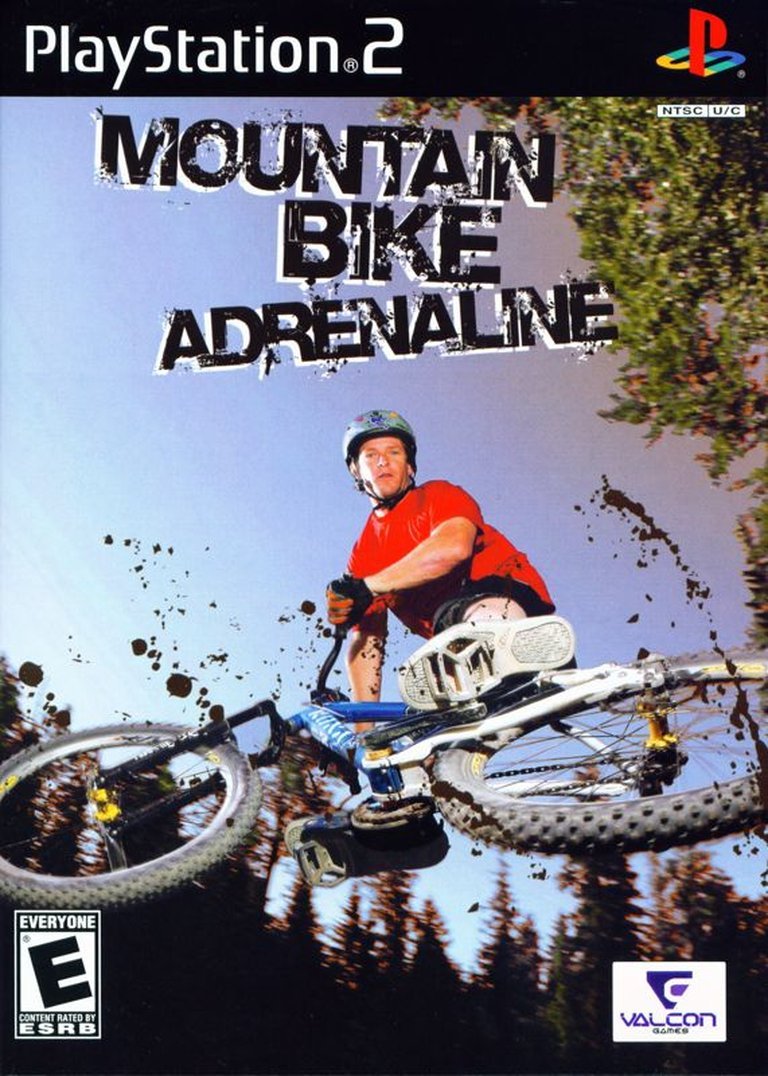
Description
Mountain Bike Adrenaline is a sports game that lets players experience the thrill of mountain biking across four stunning locations: the Rocky Mountains, the Alps, Hawaii, and the Grand Canyon. With four distinct game modes—Stopwatch, Challenge, Arcade, and Freedom—players can race against the clock, complete tasks, perform tricks, or freely explore the terrain. The game features six customizable riders, real-life mountain bikes, and a unique concentration gauge that slows down gameplay for executing complex stunts. Whether competing in timed races or pulling off daring tricks, players can immerse themselves in the adrenaline-pumping world of extreme biking.
Gameplay Videos
Mountain Bike Adrenaline Free Download
PlayStation 2
Mountain Bike Adrenaline Cracks & Fixes
Mountain Bike Adrenaline Reviews & Reception
mobygames.com (26/100): Average score: 26% (based on 7 ratings)
ign.com : Mountain Bike Adrenaline falls squarely into the “crap” category, but even as I bumbled through the game’s clunky, unintuitive menus and regularly found my xtreeeem mountain biker getting high-centered on various little rocks or riding straight up tree trunks, I couldn’t help but feel like the game could have been rather neat.
Mountain Bike Adrenaline Cheats & Codes
PlayStation 2
Pause the game and input the specific combination of buttons.
| Code | Effect |
|---|---|
| L1, L1, R1, R1 | Unlock All Bikes |
| Up, Down, Left, Right | Unlock All Levels |
| Circle, Square, Triangle | Activate Turbo Boost |
| R1, L1, R1, L1 | Unlock Freestyle Mode |
| L2, R2, L2, R2 | Enable Infinite Stamina |
| Up, Up, Down, Down | Unlock All Tricks |
| L1 + R1 + L2 + R2 | Unlock all bikes |
| L1 + R1 + Up | Unlock expert mode |
| R2 + L2 + Down | Unlock all characters |
| L1, L1, R1, R1 | XJD Racer |
| L2, R2, L2, R2 | Mountain Beast |
| L1, R1, L2, R2 | Speed Demon |
| R1, R1, L2, L2 | Trickster |
| L1, L2, R1, R2 | Ultimate Rider |
| R2, R2, L1, L1 | Turbo Boost |
| L1, R2, L1, R2 | Nitro Boost |
| L2, R1, L2, R1 | Super Speed |
| L1, L1, R1, L1 | Hidden Valley |
| R2, L2, R2, L2 | Mountain Summit |
| L1, R1, L2, R1 | Urban Jungle |
Mountain Bike Adrenaline: A Flawed but Fascinating Relic of Budget Gaming
Introduction
Mountain Bike Adrenaline (2007) is a game that exists in the shadowy liminal space between ambition and execution, a title that dared to dream big but was ultimately hamstrung by the harsh realities of budget development. Released for the PlayStation 2 and later ported to Windows, this mountain biking simulator was developed by Fresh3D and published by Nobilis Group, with Valcon Games handling North American distribution. At first glance, it promised an exhilarating freeride experience across some of the world’s most breathtaking landscapes, from the Rocky Mountains to the Grand Canyon. Yet, beneath its ambitious premise lay a game plagued by technical limitations, questionable design choices, and a development cycle that was, by all accounts, a race against time and resources.
This review seeks to unpack Mountain Bike Adrenaline not just as a game, but as a case study in the challenges of budget game development in the mid-2000s. It is a title that, despite its critical drubbing, offers a fascinating glimpse into the compromises and creative solutions that define the lower echelons of the gaming industry. Through an exhaustive analysis of its development history, gameplay mechanics, artistic choices, and legacy, we will explore how Mountain Bike Adrenaline became both a cautionary tale and a curious footnote in the history of sports games.
Development History & Context
The Studio and the Vision
Fresh3D, the studio behind Mountain Bike Adrenaline, was a small French developer with a modest portfolio. Prior to this title, they had released Wild Water Adrenaline, a white-water rafting game that enjoyed limited local success. The studio’s contract with Nobilis Group stipulated the creation of four action sports titles under the Salomon branding, a partnership that lent the game a veneer of authenticity but also raised expectations. Mountain biking, being a far more popular and competitive sport than rafting, placed Mountain Bike Adrenaline under considerable pressure to deliver.
The vision for Mountain Bike Adrenaline was clear: to create a freeride experience that emphasized exploration and realism over the linear, arcade-style racing of competitors like Downhill Domination (2003). Franck Sauer, the game’s creative and technical art director, has spoken at length about the team’s desire to capture the “freedom of free riding,” a philosophy that influenced everything from level design to physics simulation. This ambition, however, clashed with the game’s meager budget of approximately €250,000—a fraction of the €2 million average for PS2 titles at the time.
Technological Constraints and Creative Solutions
The PS2, by 2007, was nearing the end of its lifecycle, and its hardware limitations were well-documented. Fresh3D’s decision to use the open-source ODE (Open Dynamics Engine) physics engine, rather than the industry-standard Havok, was a cost-saving measure that would later haunt the game. While ODE was capable, it was also buggy and unoptimized for the PS2’s architecture. The team, led by Yann Robert (CEO and director of development), spent considerable effort tweaking ODE to run efficiently, but the engine’s inherent flaws—such as sticky collisions and unpredictable object interactions—remained.
The game’s terrain system was another area of innovation and compromise. Fresh3D employed dynamic tessellation and vector displacement mapping to create detailed, deformable landscapes—a technique that was ahead of its time but taxed the PS2’s capabilities. The result was a game that frequently suffered from geometry pop-in, resolution drops, and framerate chugging, particularly when the camera struggled to keep up with the action.
The Gaming Landscape of 2007
By the time Mountain Bike Adrenaline launched in May 2007 (Europe) and October 2007 (North America), the gaming world was in the midst of a generational shift. The PlayStation 3 and Xbox 360 were already on the market, and the PS2, while still dominant in terms of installed base, was increasingly seen as a platform for budget titles and niche experiences. Sports games, meanwhile, were dominated by annualized franchises like FIFA, Madden, and Tony Hawk’s Pro Skater, leaving little room for experimental or mid-tier entries.
In this context, Mountain Bike Adrenaline was an anomaly—a licensed sports game that eschewed the polished, arcade-style gameplay of its peers in favor of a more simulationist approach. Its closest competitor, Downhill Domination, had been released four years earlier and was remembered for its fast-paced, trick-heavy gameplay. Mountain Bike Adrenaline, by contrast, aimed for a slower, more methodical experience, one that emphasized realism over spectacle. This choice, while admirable in theory, alienated players accustomed to the high-octane thrills of other extreme sports games.
Narrative & Thematic Deep Dive
The Absence of Narrative
Mountain Bike Adrenaline is, at its core, a game without a story. There are no characters to speak of, no overarching plot, and no dialogue beyond the occasional grunts and exclamations of the riders. The six selectable competitors—three men and three women—are little more than avatars, distinguished only by their models and the bikes they ride. This lack of narrative is not necessarily a flaw; many sports games thrive without storytelling. However, in a game that positions itself as a “freeride experience,” the absence of any contextual framing or personality feels like a missed opportunity.
The game’s thematic focus is squarely on the thrill of mountain biking itself, with an emphasis on the sport’s technical and physical demands. The “concentration gauge,” a mechanic that allows players to slow down time to execute complex tricks, is the closest thing to a narrative device, serving as a metaphor for the mental focus required in real-world biking. Yet, even this mechanic feels underutilized, as the gauge depletes too quickly to be of much practical use.
The Illusion of Freedom
The game’s four modes—Stopwatch, Challenge, Arcade, and Freedom—attempt to cater to different playstyles, but each is undermined by the game’s technical limitations. The “Freedom” mode, unlockable only after completing a certain number of challenges, promises an open-ended exploration experience. In practice, however, the mode is hamstrung by invisible walls, repetitive landscapes, and the same physics issues that plague the rest of the game.
Thematically, Mountain Bike Adrenaline is a game about constraint masquerading as freedom. The developers’ desire to create a realistic, physics-driven experience clashes with the PS2’s hardware limitations, resulting in a game that feels simultaneously ambitious and stifled. The landscapes, while visually impressive in screenshots, are marred by pop-in, low-resolution textures, and a lack of environmental interaction. The rider animations, though technically advanced for their use of real-time inverse kinematics, come across as stiff and unnatural.
Gameplay Mechanics & Systems
Core Gameplay Loop
At its heart, Mountain Bike Adrenaline is a game about navigating downhill courses while performing tricks and avoiding obstacles. The core gameplay loop involves accelerating down a slope, jumping over gaps, and executing stunts to earn points or complete challenges. The game offers four distinct modes:
- Stopwatch: A time-trial mode where players must complete a course within a set time limit.
- Challenge: A task-based mode where players must perform specific actions, such as wheelies or jumps, to progress.
- Arcade: A trick-focused mode where players earn points by performing stunts within a time limit.
- Freedom: An exploration mode that allows players to ride without constraints, though it is locked behind progression in the other modes.
On paper, this structure is sound, offering variety and replayability. In practice, however, the gameplay is undermined by a litany of technical and design issues.
Physics and Control
The physics system is the most contentious aspect of Mountain Bike Adrenaline. The game’s use of the ODE engine results in a bike that feels simultaneously too heavy and too light, with collisions that are either overly sticky or unpredictably bouncy. Trees, in particular, are notorious for trapping the player’s bike, a flaw that became a meme among reviewers. The bike’s handling is further complicated by an automatic gear-shifting system that often shifts too aggressively, causing the rider to lose momentum or stall entirely.
The controls themselves are serviceable but unremarkable. The left analog stick steers the bike, while the face buttons handle acceleration, jumping, and tricks. The “concentration mode,” activated by holding the Circle button, slows down time to allow for precise trick execution. However, the mode’s short duration and the game’s lack of a robust trick system make it feel gimmicky rather than essential.
Progression and Unlockables
Progression in Mountain Bike Adrenaline is tied to completing challenges and earning medals in the various modes. Successful completion unlocks new bikes, riders, and eventually the Freedom mode. The unlock system is straightforward but lacks depth; there is little incentive to replay levels beyond achieving a high score or completing all challenges.
The game’s six riders and assortment of licensed bikes (from brands like Cannondale, Kona, and Specialized) are the primary unlockables. However, the differences between riders and bikes are minimal, with most variations being cosmetic. This lack of meaningful progression further contributes to the game’s repetitive feel.
User Interface and Presentation
The UI in Mountain Bike Adrenaline is functional but uninspired. Menus are cluttered and unintuitive, with some options buried beneath layers of submenus. The HUD during gameplay is minimal, displaying only the essential information (speed, stamina, concentration gauge), but it lacks the polish of contemporary sports games.
One of the most glaring issues is the game’s lack of mipmapping, a technique used to reduce texture aliasing at a distance. The absence of mipmapping results in textures that appear pixelated and blurry, a problem exacerbated by the game’s frequent resolution drops. The interlaced rendering mode, a common technique on the PS2 to improve performance, causes noticeable flickering, further detracting from the visual experience.
World-Building, Art & Sound
Setting and Atmosphere
Mountain Bike Adrenaline features four distinct locations: the Rocky Mountains, the Alps, Hawaii, and the Grand Canyon. Each environment is designed to evoke the unique challenges and beauty of its real-world counterpart. The Rocky Mountains, for example, are characterized by steep, rocky descents, while Hawaii offers lush, tropical trails.
The game’s environments are its strongest visual asset. Franck Sauer’s background in photography and texture capture is evident in the detailed ground textures, which were created using a custom remote-controlled camera system attached to a blimp. The landscapes, while technically impressive, are marred by the PS2’s limitations. Geometry pop-in is rampant, and the draw distance is disappointingly short, causing terrain and objects to appear abruptly as the player approaches.
The atmosphere of Mountain Bike Adrenaline is one of isolation and solitude. There are no spectators, no competitors, and no ambient wildlife—just the rider and the trail. This minimalist approach could have been effective in creating a meditative, immersive experience. Instead, the lack of environmental detail and the game’s technical issues make the world feel empty and lifeless.
Visual Direction
The visual direction of Mountain Bike Adrenaline is a study in contrasts. On one hand, the game’s environments are ambitious, with dynamic tessellation and displacement mapping creating detailed, uneven terrain. On the other hand, the character models are rudimentary, with blocky, low-polygon limbs that recall early PS1-era graphics. The bikes, while accurately modeled, lack the polish and detail of their real-world counterparts.
The game’s color palette is muted, with an emphasis on earthy browns, greens, and grays. This choice reflects the natural settings but also contributes to the game’s drab, unexciting visual identity. The lack of vibrant colors or striking visual effects further underscores the game’s budget constraints.
Sound Design
The sound design in Mountain Bike Adrenaline is, like much of the game, a mixed bag. The bike sounds—gear shifts, brake squeals, and tire skids—are serviceable, though they lack the depth and realism of modern sports games. The ambient sounds, such as wind and distant wildlife, are sparse and often drowned out by the game’s repetitive soundtrack.
The music, composed of a handful of generic rock and hip-hop tracks, is one of the game’s weakest elements. The tracks are poorly mixed, with some featuring repetitive, grating lyrics (e.g., a hip-hop track that endlessly repeats “yeah, yeah” and “make some noise”). The soundtrack’s lack of variety and poor production values make it a frequent target of criticism.
Reception & Legacy
Critical Reception
Mountain Bike Adrenaline was met with near-universal disdain from critics. The game holds a Metacritic score of 30/100 (based on one review) and a MobyGames aggregate score of 26%. Reviewers lambasted the game’s broken physics, ugly graphics, and frustrating gameplay.
- IGN (3/10): Sam Bishop’s review highlighted the game’s potential but ultimately dismissed it as “crap,” citing its clunky controls, poor collision detection, and technical issues. He noted that while the game had moments of fun, they were overshadowed by its myriad flaws.
- GameStar (Germany, 38%): The German outlet criticized the game’s unrealistic physics and frustrating level design, calling it a “frustration guarantee.”
- Jeuxvideo.com (10%): The French review was particularly scathing, describing the game as a “simulator that gives you access to the wonderful world inside a 3D model” and dismissing it as “exotic but quickly tiring.”
Player reception was similarly negative, with an average score of 2.6/5 on MobyGames. Many players echoed the critics’ complaints, citing the game’s technical issues and lack of polish.
Commercial Performance and Legal Issues
Despite its poor reception, Mountain Bike Adrenaline sold respectably, with estimated global sales of around 450,000 units. The game’s budget pricing (often retailing for under $20) likely contributed to its commercial success, as it appealed to casual players and bargain hunters.
However, the game’s financial success was overshadowed by legal disputes between Fresh3D and Nobilis Group. The developers alleged that Nobilis withheld royalties, particularly from North American sales handled by Valcon Games. Fresh3D pursued legal action, but Nobilis’s subsequent bankruptcy left the developers with little recourse. This dispute underscores the precarious nature of budget game development, where even commercial success can fail to translate into financial stability for the developers.
Legacy and Influence
Mountain Bike Adrenaline is not remembered as a landmark title in the sports genre. Its legacy, if any, is as a cautionary tale about the pitfalls of budget development and the importance of playtesting and polish. The game’s ambitious physics and terrain systems were ahead of their time but were ultimately undermined by the PS2’s limitations and the team’s lack of resources.
In the years since its release, Mountain Bike Adrenaline has become a cult curiosity, occasionally resurfacing in discussions about “so bad it’s good” games or as a case study in failed ambition. It serves as a reminder that even the most well-intentioned projects can falter without adequate funding, time, and support.
Conclusion
Mountain Bike Adrenaline is a game of contradictions—a title that dared to innovate but was ultimately undone by its own limitations. It is a fascinating artifact of the mid-2000s gaming landscape, a time when the PS2 was both a dominant platform and a graveyard for underfunded, overambitious projects. The game’s development history, marked by creative solutions and financial constraints, offers a rare glimpse into the challenges faced by small studios in an industry increasingly dominated by blockbuster titles.
As a gameplay experience, Mountain Bike Adrenaline is deeply flawed. Its physics are broken, its controls are clunky, and its presentation is marred by technical issues. Yet, beneath these flaws lies a game that, in moments, captures the thrill of mountain biking—the rush of speeding down a steep slope, the satisfaction of landing a tricky jump, the quiet beauty of a well-designed trail. These moments are fleeting, buried beneath layers of frustration, but they hint at what the game could have been with more time, money, and polish.
In the grand tapestry of video game history, Mountain Bike Adrenaline is a footnote—a minor entry in the sports genre that failed to leave a lasting impact. Yet, it is also a testament to the resilience and creativity of small development teams, a reminder that even the most flawed games can offer valuable lessons. For historians and enthusiasts, it stands as a case study in the compromises of budget gaming, a game that, despite its many failings, remains a curious and compelling relic of its era.
Final Verdict: 4/10 – A Flawed Experiment
Mountain Bike Adrenaline is not a good game by any conventional metric, but it is an interesting one. Its ambition is admirable, its execution is flawed, and its legacy is one of missed potential. For those curious about the challenges of budget game development or the quirks of late-era PS2 titles, it is worth a look—if only to marvel at how a game with so much promise could go so wrong.