
- Release Year: 2015
- Platforms: Windows
- Publisher: Anuman Interactive SA
- Genre: Compilation
- Game Mode: Single-player
- Setting: Brutal sports, Future sports
Description
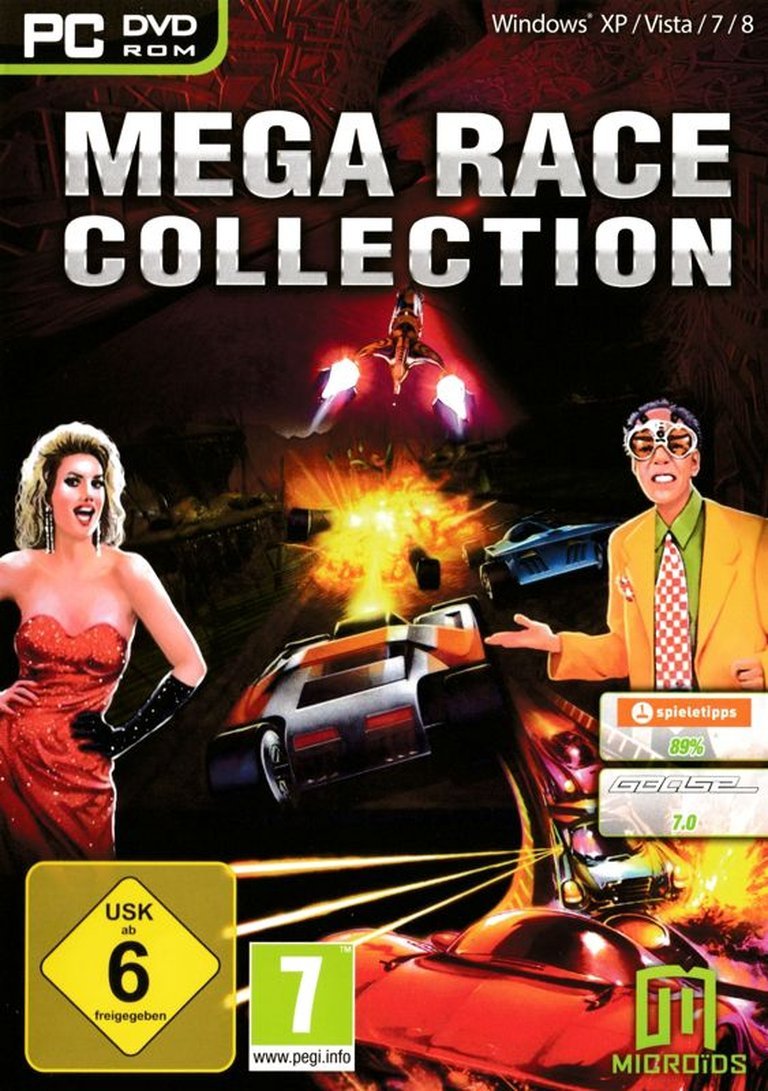
MR Mega Race Trilogy is a compilation of three classic vehicular combat games set in a dystopian future where players compete as contestants in the high-stakes ‘MegaRace’ television show. Hosted by the eccentric Lance Boyle, players engage in deadly races against speed gangs, utilizing strategic driving and vehicle-mounted weapons to survive the brutal competition across multiple tracks and worlds.
MR Mega Race Trilogy: Review
Introduction
Step into the dystopian, neon-drenched future of the 25th century, where reality television has evolved into a lethal spectacle. MR Mega Race Trilogy, a 2015 compilation by Anuman Interactive SA, bundles the entire MegaRace saga—spanning 1994, 1996, and 2001—into a single Windows package. This collection isn’t merely a nostalgic trip; it’s a time capsule of 1990s experimental game design, where Full-Motion Video (FMV) and rail-shooter mechanics collided with a satirical vision of a media-saturated society. Developed by Cryo Interactive for the original entries and later studios for the third installment, the trilogy revolves around the gloriously unhinged game show host Lance Boyle, whose smarmy charm and fourth-wall-breaking antics elevate the series beyond its technical limitations. This review argues that while the MegaRace trilogy suffers from repetitive gameplay and dated presentation, its audacious fusion of cyberpunk aesthetics, vehicular combat, and campy FMV storytelling cements it as a cult classic—flawed but unforgettable, embodying the wild ambition of an era when games dared to be as bizarre as their VHS-era inspirations.
Development History & Context
The genesis of MegaRace lies in the fertile ground of early 1990s French developer Cryo Interactive, fresh off successes like Dune. Director Rémi Herbulot and designer Florian Desforges envisioned a vehicular combat game that married arcade thrills with the then-novel allure of FMV, aiming to push the boundaries of MS-DOS, Sega CD, and 3DO hardware. Published by The Software Toolworks in 1993, the first game leveraged pre-rendered 3D graphics and over 20 minutes of live-action footage featuring actor Christian Erickson as the iconic Lance Boyle. Technologically, it was constrained by the era’s limited storage and processing power, forcing the rail-shooter design—players could only steer left/right or accelerate within narrow parameters while FMV backgrounds dictated the track’s path. This wasn’t laziness but a pragmatic choice: syncing real-time 3D with FMV was nearly impossible, so Cryo opted for a “guided experience” that prioritized cinematic spectacle over player freedom.
The sequel, MegaRace 2 (1996), retained the pre-rendered approach but upgraded to polygonal car models, refining gameplay with a garage system for repairs and upgrades. By MegaRace 3 (2001), Cryo had departed, and the series shifted to full real-time 3D, discarding FMV for free-roaming tracks and sci-fi flying vehicles—a genre pivot reflecting the industry’s shift from FMV fad to polygonal dominance. The 2015 compilation, released by Anuman Interactive (owners of the Cryo brand), was a preservation effort, bundling Windows versions with DOSBox compatibility for modern systems. It arrived during a wave of classic re-releases (e.g., on GOG.com), signaling a renewed appreciation for 1990s experimentalism. Contextually, MegaRace emerged alongside FMV-driven titles like Night Trap and The 7th Guest, capitalizing on CD-ROM’s promise of “interactive movies.” Yet, while peers relied on B-movie tropes, MegaRace carved its niche by embedding FMV into gameplay itself—a hybrid that felt both ahead of its time and tethered to its limitations.
Narrative & Thematic Deep Dive
At its core, the MegaRace trilogy presents a dystopian satire of reality TV, where the line between entertainment and violence is deliberately blurred. The narrative is deceptively simple: players are contestants on MegaRace, a broadcast on the fictional VWBT (Virtual World Broadcast Television) channel, tasked with annihilating speed gangs in live-or-die virtual races. Yet its true star is Lance Boyle, portrayed with flamboyant relish by Christian Erickson. Boyle is a master of absurdist monologues, delivering acidic one-liners, veiled threats, and non-sequiturs (“A fully-qualified, dolphin dentist!”) while breaking the fourth wall to mock the player’s failures. In MegaRace, he’s a smarmy game show host; by MegaRace 3, he devolves into a hostile caricature, barking “Have a nice death, baby!”—a trajectory that mirrors the trilogy’s descent from campy satire to nihilistic farce.
Thematic layers abound. The crapsack future—industrial ghettos, orbital junkyards, and shark-filled tubes—echoes cyberpunk staples like Blade Runner and The Running Man, but with a twist: violence is sanitized as “virtual,” with Lance insisting, “He only got splattered virtually.” Yet the game hints at darker consequences, questioning if prolonged exposure risks frying one’s neurons. The emphasis on symbols on the racetrack—temporary power-ups or debuffs—serves as a metaphor for media manipulation: sponsors (e.g., “Bigger, Plastic Crocodiles”) embed their influence into the very fabric of the “game.” Despite its simplicity, the narrative thrives on Boyle’s charisma, turning repetitive races into darkly comedic skits. As TV Tropes notes, Lance’s dialogue lampshades the absurdity, with long lists of “mad scientist projects” or accidental misnaming of his assistant (“Charlene… or somebody surprisingly similar”). By the trilogy’s end, the narrative’s evolution—from FMV spectacle to real-time chaos—mirrors gaming’s own journey, leaving players to ponder: in a world where violence is entertainment, who’s really the contestant?
Gameplay Mechanics & Systems
The MegaRace trilogy’s gameplay is a study in contrasts: innovative in concept but repetitive in execution. All entries are vehicular combat games, but their core loops diverge sharply. The original MegaRace is a rail shooter, eschewing traditional controls for a constrained “side-to-side and accelerate” system dictated by pre-rendered FMV tracks. Players must eliminate speed gangs via missiles, ramming them into walls, or triggering explosions by passing them—all within three laps. Symbols scattered on the track add chaos: some grant missile refills or shields, while others disable weapons or warp the screen. This creates tense risk-reward calculus, but the design’s rigidity shows its age; with no turning or braking, races feel like interactive cutscenes. The sequel, MegaRace 2, retains this structure but introduces a garage system between races, allowing players to repair and upgrade cars—a welcome touch of progression. It also polygonal models for vehicles, offering smoother visuals but the same on-rails frustration.
MegaRace 3 radically shifts to real-time 3D, replacing wheeled vehicles with flying cars and free-roaming tracks. This genre shift alleviates the rail-shooter’s monotony but introduces new flaws: sluggish controls and a lack of polish. Across all games, objectives are clear—annihilate all enemies—but escalation is monotonous; each race adds more gang members without introducing meaningful mechanics. Innovative elements exist: the “Skyholder” bonus track in the first game (a gravity-defying arena with enemies racing toward you) or the “Last-Chance Speedway” (The Can) as a penalty for failure. Yet these are exceptions; most gameplay boils down to memorizing symbol patterns and enemy routes. Technical issues persist, like a game-breaking bug in MegaRace where disabled weapons carry over to the next race if not fixed by symbols. Controller support (gamepad) in the 2015 compilation aids accessibility, but the core loop remains a product of its era—more a tech demo than a satisfying experience. As White Wolf Inphobia noted in 1995, it’s “original… but becomes repetitive. Now if the enemy could shoot back!”
World-Building, Art & Sound
The MegaRace trilogy’s world-building is a cyberpunk fever dream, realized through varied, imaginative environments that transcend the gameplay’s limitations. Tracks span five distinct “worlds”: from the industrial decay of “Wasteland” and “Terminal City” to the aquatic wonders of “Maeva” (complete with shark tunnels) and the surreal “Skyholder,” a bonus track defying gravity in an alien sky. These settings aren’t just backdrops; they’re characters, each with unique hazards and aesthetics. For instance, “The Orbital Junkyard” races through an asteroid field, while “Belly of the Beast” unfolds inside a “Fractalian Whale.” The art direction leans into high-concept futurism—gleaming, dystopian metropolises contrasted with derelict graveyards—all rendered in pre-rendered 3D for the first two entries. This technique, cutting-edge in 1993, now feels dated but retains a kitschy charm, especially in FMV sequences where Lance Boyle’s live-action performance clashes with pixelated explosions.
Sound design complements the visuals, with Stéphane Picq’s chiptune techno soundtrack in MegaRace evoking the era’s synthwave urgency. Sound effects—missile launches, screeching tires—are functional yet unremarkable, elevated by Erickson’s vocal performance. His delivery is the trilogy’s auditory centerpiece: a mix of smarmy bravado and sudden menace, turning expository dialogue into comedic gold. In MegaRace 2 and MR3, the soundtrack shifts to orchestral/electronic hybrids, reflecting the move to real-time 3D but losing the first game’s gritty edge. The 2015 compilation preserves these elements faithfully, though upscaled visuals can’t hide the FMV’s graininess. Ultimately, the world-building’s strength lies in its ambition: it’s a universe where “Magical Maeva” is a theme-park version of Atlantis, and “Particle Accelerator” doubles as a racetrack. As TV Tropes quips, it’s “The Theme Park Version” of the future—exhilarating, illogical, and undeniably memorable.
Reception & Legacy
Upon release, MegaRace defied easy categorization. Critics lauded its technical audacity; Next Generation awarded the 3DO version 4/5 stars, hailing it as a potential competitor to racing giants like Daytona USA. GamePro acknowledged “difficult controls” but praised the “fun gameplay and impressive graphics.” Commercially, it thrived, selling 330,000 units by September 1995 and later being marketed as having “Over 1.5 Million Sold!” by publisher Mindscape. Ports to Sega CD and 3DO expanded its reach, though reviews noted hardware-specific quirks—Sega CD’s flickering ghosts, for instance, became a notorious talking point. Yet the trilogy’s reputation cooled over time. MegaRace 2 and MR3 received scant attention, with the latter’s subtitle “Nanotech Disaster” deemed irrelevant to its content. By the 2000s, the games were relics of FMV’s heyday, overshadowed by polygonal racers like Gran Turismo.
The 2015 compilation, however, sparked renewed interest. Anuman Interactive’s release preserved the originals with DOSBox, positioning them as historical artifacts. While modern reviews are scarce, GOG.com and Steam listings highlight a niche but dedicated fanbase, drawn to Lance Boyle’s cult following and the trilogy’s place in gaming’s experimental phase. Its legacy is dual-edged: technically, it pioneered FMV integration in vehicular combat, influencing titles like RoadBlasters and Spy Hunter. Culturally, it birthed Lance Boyle as an icon—his return in a 2014 mobile/reboot teaser (announced by ZOOM Platform) underscores his enduring appeal. Yet the trilogy also serves as a cautionary tale; its repetitive gameplay and dated mechanics underscore the limitations of pre-rendered tech. As White Wolf Inphobia presciently noted, it offered “initial enjoyment” but couldn’t sustain it. Today, MR Mega Race Trilogy is less a playable masterpiece and more a museum piece—vital for understanding the 1990s’ wild, unpolished creativity.
Conclusion
MR Mega Race Trilogy is a testament to gaming’s capacity for weirdness. Compiling three distinct entries across eight years, it’s a fractured artifact: a 1993 FMV pioneer, a 1996 refinement, and a 2001 genre reinvention. Its strengths are undeniable—Lance Boyle’s larger-than-life presence, a cyberpunk world bursting with imagination, and a willingness to marry spectacle with satire. Yet its weaknesses are equally pronounced: rail-shooter monotony, technical glitches, and an evolution that feels more reactive than revolutionary. The 2015 compilation, faithful though it may be, can’t erase the gameplay’s datedness; today’s players may find the pre-rendered tracks and on-rails constraints more frustrating than thrilling. Yet dismissing the trilogy ignores its historical significance. It’s a snapshot of an era when games weren’t afraid to be ambitious, messy, and unapologetically camp. In the end, MR Mega Race Trilogy earns its place not as a timeless classic, but as a flawed, fascinating relic—a reminder that sometimes the most enduring legacies come from the most audacious failures. As Lance Boyle might say: “You’re with MegaRace Trilogy. It’s like gaming history, only a lot more brutal!” For historians and connoisseurs of digital antiquity, that’s more than enough. Verdict: A must-experience cult oddity, but strictly for the nostalgically adventurous.