
- Release Year: 1996
- Platforms: Macintosh, Windows
- Publisher: Viacom New Media
- Developer: Viacom New Media
- Genre: Simulation
- Perspective: 3rd-person
- Game Mode: Hotseat, Single-player
- Gameplay: Board game, trivia
- Setting: Game show
Description
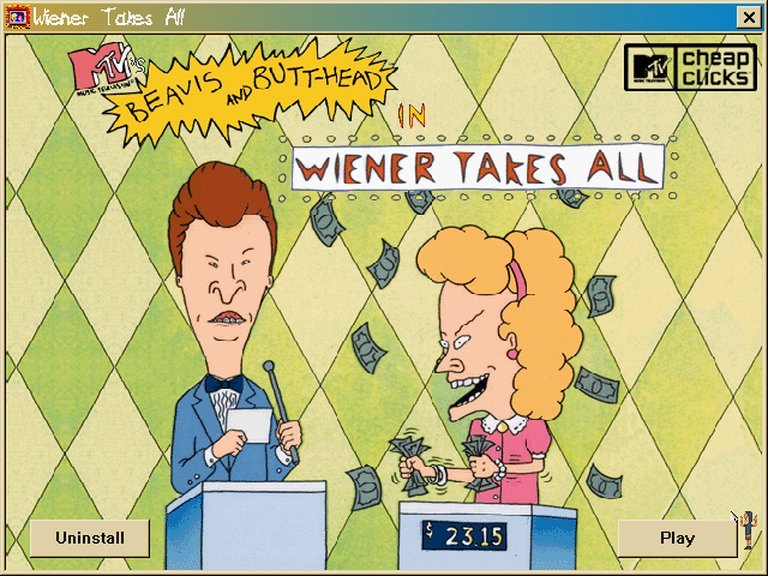
Based on the MTV animated series, ‘MTV’s Beavis and Butt-Head: Wiener Takes All’ is a party trivia simulation where the iconic duo host a quiz show from their familiar couch. Players compete by buzzing in first to answer multiple-choice questions about the show, with correct responses adding virtual dollars and incorrect ones deducting them, aiming to achieve the highest score by the end.
MTV’s Beavis and Butt-Head: Wiener Takes All: A Cynical Artifact of the Mid-90s License Boom
Introduction: Huh-huh-huh. Another Beavis Game.
In the crowded, cacophonous mid-1990s video game market, few licenses were as perfectly—and problematically—suited to the medium of interactive entertainment as MTV’s Beavis and Butt-Head. The show’s core ethos was passive, nihilistic critique; its protagonists were two teenage couch potatoes whose entire worldview was shaped by mocking music videos and each other. Translating that into a game required a fundamental act of violence against the source material, forcing the inert duo into an active role. MTV’s Beavis and Butt-Head: Wiener Takes All, released in 1996 as part of Viacom New Media’s “Cheap Clicks” budget line, represents the nadir of this contradiction. It is not a game about doing Beavis and Butt-Head things; it is a game hosted by them, a thin, cynical veneer of their personas grafted onto a standard trivia game format. My thesis is this: Wiener Takes All is a historically significant failure. It is a stark case study in the era’s cynical, low-effort licensed game production, a product that misunderstands its source material’s appeal yet inadvertently captures the hollow, repetitive nature of its heroes’ existence. It is, in essence, the video game equivalent of watching Beavis and Butt-Head watch TV—an experience that is precisely what the game purports to be.
Development History & Context: The “Cheap Clicks” Assembly Line
Studio & Vision: The game was developed by Viacom New Media, the internal video game division of the media conglomerate that owned MTV. By 1996, Viacom was aggressively monetizing the Beavis and Butt-Head franchise across multiple platforms. The “Cheap Clicks” label, under which Wiener Takes All was marketed (alongside titles like Screen Wreckers and Little Thingies), signified a low-budget, quick-turnaround strategy aimed at the franchise’s young fanbase. The vision, per the credits, was likely less about creative expression and more about efficient asset reuse and minimal development cycles. Lead Designer and Producer John Podlasek, along with Executive Producer David Marsh, helmed a team that also worked on other Beavis projects and licensed titles like Are You Afraid of the Dark?, indicating a template-based approach.
Technological Constraints & Landscape: The game was built for Windows 95 and Macintosh, requiring a Pentium-class PC or PowerPC Mac, 8MB of RAM, and a 2X CD-ROM drive—contemporary but modest specs. This constrained the visual fidelity and audio complexity. The era was the golden age of the CD-ROM “edutainment” and “multimedia experience,” where full-motion video and voice clips were selling points. Wiener Takes All leverages this by incorporating digitized voice clips of Mike Judge’s characters (credited as stars on IMDb), but the underlying gameplay is a rudimentary 2D trivia interface. It landed in a crowded market for party/trivia games, most notably competing with the critically adored and far more innovative You Don’t Know Jack series. The critical consensus would show just how poorly it compared.
Franchise Context: This was not Viacom’s first Beavis game. 1994-1995 saw console action games for Genesis, SNES, and Game Gear. Virtual Stupidity (1995), a point-and-click adventure, was the critical high-water mark for the franchise in games, praised for its writing and sense of humor. Wiener Takes All, therefore, represents a retreat from that attempt at a “real” game into a cheap, easily producible format—a clear step down in ambition.
Narrative & Thematic Deep Dive: The Humiliation of Participation
A “narrative” analysis of a trivia game is a unique challenge, as there is no traditional plot. The narrative is the framing device and the thematic content of the questions themselves.
The Framing Device: The Couch. The entire “story” is that Beavis and Butt-Head are hosting a fictional game show. The player(s) are contestants. This is established in the MobyGames description: “Both characters are on their usual couch in front of the tv where questions will be shown.” The genius of the show—its satire of television’s mind-numbing influence—is inverted here. Instead of watching TV, you are participating in a TV show hosted by the ultimate TV-watchers. The thematic irony is thick: to engage with Beavis and Butt-Head, you must subject yourself to a structured, quiz-based activity, the very antithesis of their laissez-faire attitude. The game’s title, a pun on “winner takes all,” replaces “