
- Release Year: 1985
- Platforms: FM-7, Hitachi S1, PC-88, PC-98, Sharp X1, Windows
- Publisher: Xtalsoft Co., Ltd.
- Developer: Xtalsoft Co., Ltd.
- Genre: Role-playing, RPG
- Perspective: 1st-person
- Game Mode: Single-player
- Gameplay: Party-based, Top-down exploration, Turn-based combat
- Setting: Fantasy
- Average Score: 84/100
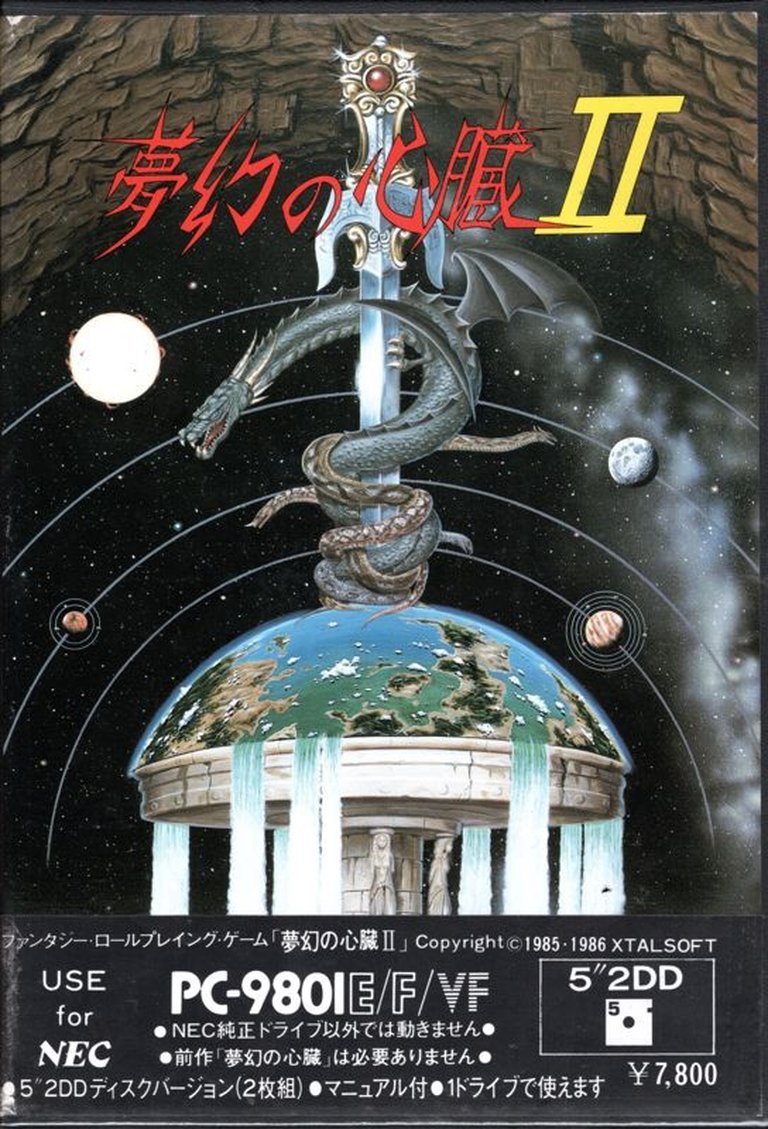
Description
Mugen no Shinzō II is a fantasy role-playing game where the protagonist, after retrieving the Heart of Phantasm in the first game, is transported to the realm of Elderein, now under the rule of the evil Prince of Darkness. The hero must defeat this tyrant and find a way home, exploring a top-down overworld with visible enemies, recruiting allies, and engaging in turn-based, first-person battles reminiscent of early Ultima games.
Where to Buy Mugen no Shinzō II
PC
Mugen no Shinzō II Reviews & Reception
mobygames.com (84/100): A role-playing game very similar visually and gameplay-wise to early Ultima games.
Mugen no Shinzō II: A Forgotten Gem of Early Japanese RPGs
Introduction
In the annals of video game history, certain titles emerge as pivotal yet overlooked milestones, shaping genres in ways that only become apparent decades later. Mugen no Shinzō II (1985) is one such game—a sequel that refined the foundations of Japanese role-playing games (JRPGs) while drawing inspiration from Western classics like Ultima. Developed by Xtalsoft for the PC-88 and later ported to multiple platforms, this title stands as a testament to the creativity and technical ingenuity of early Japanese game developers. Though overshadowed by later giants like Dragon Quest and Final Fantasy, Mugen no Shinzō II introduced mechanics and design philosophies that would influence the evolution of RPGs for years to come.
This review aims to dissect Mugen no Shinzō II in exhaustive detail, exploring its development history, narrative depth, gameplay innovations, and lasting legacy. By examining its strengths and shortcomings, we can better understand its place in the pantheon of classic RPGs and why it deserves recognition as a pioneering work.
Development History & Context
The Studio and Creators’ Vision
Xtalsoft, the developer behind Mugen no Shinzō II, was a relatively small but ambitious studio in the mid-1980s Japanese gaming scene. The company had already made a name for itself with the original Mugen no Shinzō (1984), a game that blended fantasy storytelling with rudimentary RPG mechanics. The sequel, Mugen no Shinzō II, was conceived as an evolution of its predecessor, aiming to address the first game’s limitations while expanding its scope.
The creators’ vision was clear: to craft a more immersive and strategic RPG experience. Inspired by the Ultima series, particularly its top-down exploration and first-person combat, Xtalsoft sought to adapt these elements into a distinctly Japanese framework. The result was a game that felt familiar to fans of Western RPGs but introduced innovations that would later become staples of JRPGs.
Technological Constraints of the Era
The PC-88, the game’s original platform, was a powerful machine for its time but still faced significant hardware limitations. With a resolution of 640×200 pixels and a color palette restricted to 8 colors, developers had to be creative in their use of visuals. Mugen no Shinzō II overcame these constraints by prioritizing clarity and functionality in its design. The overworld, for instance, was rendered in a top-down perspective that maximized screen real estate, while enemy encounters were depicted with large, detailed portraits to enhance immersion.
The game’s turn-based combat system was another response to technological limitations. Real-time combat would have been too demanding for the hardware, so the developers opted for a strategic, menu-driven approach that allowed for deeper tactical play without overburdening the system.
The Gaming Landscape of 1985
The mid-1980s were a formative period for RPGs, with both Western and Japanese developers experimenting with the genre’s possibilities. In Japan, Dragon Quest (1986) was on the horizon, poised to revolutionize the industry, but Mugen no Shinzō II arrived just before this seismic shift. It existed in a transitional space, bridging the gap between early, text-heavy RPGs and the more polished, narrative-driven experiences that would follow.
Western RPGs like Ultima III: Exodus (1983) and Wizardry (1981) had already established many of the genre’s conventions, but Japanese developers were beginning to put their own spin on these ideas. Mugen no Shinzō II was part of this wave, offering a hybrid experience that blended Western mechanics with Japanese storytelling sensibilities.
Narrative & Thematic Deep Dive
Plot Overview
Mugen no Shinzō II continues the story of its predecessor, following a protagonist who, after retrieving the Heart of Phantasm, is teleported not to his home but to another fantasy realm, Elderein. This land is under the oppressive rule of the Prince of Darkness, and the hero must rally allies, confront this tyrannical force, and find a way to escape.
The narrative is straightforward by modern standards but was ambitious for its time. It introduced the concept of a protagonist stranded in a foreign world, a theme that would later be explored in games like Secret of Mana and Chrono Trigger. The story’s focus on liberation and escape also resonated with players, offering a clear goal that drove the gameplay forward.
Characters and Dialogue
While Mugen no Shinzō II lacks the deep character development of later RPGs, it introduced the idea of a party system, allowing the protagonist to recruit allies who could join him in battle. This was a significant step forward from the first game, where the hero fought alone. The allies, though not deeply fleshed out, added a layer of strategy to combat and exploration, as players had to consider their strengths and weaknesses.
Dialogue in the game is minimal but functional, serving to advance the plot and provide context for the player’s actions. The writing is concise, reflecting the technical limitations of the era, but it effectively conveys the game’s themes of struggle and perseverance.
Themes and Symbolism
At its core, Mugen no Shinzō II is a story about overcoming adversity. The protagonist’s journey through Elderein is a metaphor for the human experience of facing and conquering challenges. The Prince of Darkness represents the oppressive forces that seek to control and dominate, while the hero’s quest for freedom mirrors the universal desire for autonomy and self-determination.
The game also explores themes of isolation and camaraderie. The protagonist begins his journey alone but gradually builds a party of allies, emphasizing the importance of cooperation and friendship in the face of overwhelming odds. This theme would become a cornerstone of JRPGs, where the bonds between characters often drive the narrative forward.
Gameplay Mechanics & Systems
Core Gameplay Loops
Mugen no Shinzō II is structured around a classic RPG loop: explore the overworld, enter towns to gather information and supplies, and engage in combat to progress the story. The game’s overworld is expansive, with towns and dungeons scattered across the landscape. Players must navigate this world carefully, as enemies roam freely, and battles can occur at any time.
The elimination of random encounters was a significant innovation. Instead of being ambushed by invisible foes, players could see enemies on the overworld map and choose whether to engage or avoid them. This added a layer of strategy to exploration, as players could plan their routes to minimize unnecessary battles or seek out stronger enemies for greater rewards.
Combat and Character Progression
Combat in Mugen no Shinzō II is turn-based and viewed from a first-person perspective, with large enemy portraits filling the screen. This design choice was both a technical necessity and a stylistic flourish, as it allowed the developers to create detailed and intimidating enemy visuals despite the hardware’s limitations.
The turn-based mechanics are simple but effective. Players select actions for each party member, such as attacking, using items, or casting spells, and then watch as the battle unfolds. The system lacks the depth of later RPGs, but it is functional and engaging, offering a satisfying challenge without overwhelming the player.
Character progression is handled through a traditional leveling system. As characters gain experience points from battles, they level up, increasing their stats and unlocking new abilities. This system is straightforward but provides a sense of growth and accomplishment as the player’s party becomes more powerful.
UI and Innovations
The game’s user interface is sparse but intuitive, reflecting the design philosophies of the era. Menus are text-based, with players navigating through options using the keyboard. While this may seem archaic by modern standards, it was a practical solution given the hardware constraints.
One of the game’s most notable innovations was its approach to enemy encounters. By making enemies visible on the overworld, Mugen no Shinzō II introduced a level of player agency that was rare in RPGs of the time. This mechanic would later be adopted by games like The Legend of Zelda and Secret of Mana, where enemy visibility became a standard feature.
World-Building, Art & Sound
Setting and Atmosphere
Elderein, the game’s primary setting, is a richly detailed fantasy realm filled with diverse landscapes, from lush forests to desolate wastelands. The world is presented in a top-down perspective, with towns and dungeons rendered in a way that emphasizes exploration and discovery. The game’s atmosphere is one of mystery and danger, as players never know what challenges await them around the next corner.
The art style is simple but effective, with environments and characters designed to be easily distinguishable. The use of large enemy portraits in combat adds a sense of scale and intensity, making battles feel more immersive despite the hardware’s limitations.
Visual Direction
Given the technical constraints of the PC-88, Mugen no Shinzō II’s visuals are a triumph of creativity over limitation. The overworld is rendered in a way that maximizes screen space, allowing players to see more of the environment at once. Towns and dungeons are designed with a focus on functionality, ensuring that players can navigate them without confusion.
The enemy portraits are particularly noteworthy. Despite the limited color palette, the developers managed to create detailed and expressive images that conveyed the menace of the game’s foes. This attention to detail helped to elevate the combat experience, making each encounter feel unique and memorable.
Sound Design
The game’s sound design is minimal but effective. The PC-88’s audio capabilities were limited, but Mugen no Shinzō II makes use of simple melodies and sound effects to enhance the atmosphere. The combat music, for instance, is a repetitive but driving tune that adds tension to battles, while the overworld theme is a more relaxed melody that encourages exploration.
While the sound design may not be as sophisticated as later RPGs, it serves its purpose well, providing auditory feedback that complements the visual experience.
Reception & Legacy
Critical and Commercial Reception
Mugen no Shinzō II was released to a modest reception in 1985. While it was not a commercial blockbuster, it garnered a small but dedicated following among RPG enthusiasts. Critics praised its innovative mechanics, particularly the visible enemy encounters and party system, but noted that it lacked the polish and depth of later titles.
The game’s legacy has grown over time, as modern players and historians have come to appreciate its contributions to the RPG genre. Its influence can be seen in later games that adopted its mechanics, such as The Legend of Zelda and Secret of Mana, which also featured visible enemies and a focus on exploration.
Influence on Subsequent Games
Mugen no Shinzō II’s most significant contribution to the RPG genre was its approach to enemy encounters. By making enemies visible on the overworld, the game introduced a level of player agency that would become a standard feature in later RPGs. This mechanic allowed players to strategize their approach to combat, choosing whether to engage or avoid enemies based on their current strength and resources.
The game’s party system also had a lasting impact. While later RPGs would expand on this concept with more complex character interactions and development, Mugen no Shinzō II laid the groundwork for the idea of a protagonist who could recruit allies to aid in their quest.
Conclusion
Mugen no Shinzō II is a game that deserves to be remembered as a pioneering work in the RPG genre. While it may not have achieved the commercial success or critical acclaim of later titles, its innovations in gameplay mechanics and world design have had a lasting impact on the industry. By introducing visible enemy encounters and a party system, the game helped to shape the future of RPGs, influencing titles that would go on to define the genre.
For modern players, Mugen no Shinzō II offers a fascinating glimpse into the early days of RPG development. Its simplicity and creativity are a testament to the ingenuity of its developers, who worked within the constraints of their hardware to create a game that was both engaging and innovative. While it may not be as polished or complex as later RPGs, it remains a vital piece of video game history, worthy of recognition and appreciation.
Final Verdict: Mugen no Shinzō II is a forgotten gem that laid the groundwork for many of the mechanics and design philosophies that would come to define the RPG genre. While it may not be as well-known as later classics, its contributions to the evolution of RPGs make it a title that deserves to be celebrated. For fans of retro gaming and RPG history, it is a must-play experience.