
- Release Year: 2024
- Platforms: Windows
- Publisher: Meridian4, Inc.
- Developer: HitherYon Games
- Genre: Adventure
- Perspective: Diagonal-down
- Gameplay: Graphic adventure, Puzzle elements
- Setting: Detective, Mystery
- Average Score: 70/100
Description
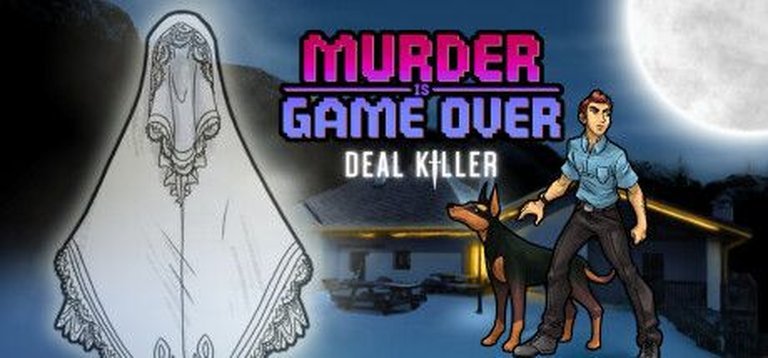
Murder Is Game Over: Deal Killer is a standalone investigative adventure game in the Murder Is Game Over series, where players join Detective Guy and his partner Cleo as they probe a murder at a haunted mountain chalet in the Italian Alps. Following death threats against CEO Billy Kramer, the duo must explore the isolated scene, collect clues, interrogate eight suspects, and unravel a narrative-driven mystery with simplified puzzle elements in roughly four hours of gameplay.
Gameplay Videos
Where to Buy Murder Is Game Over: Deal Killer
Murder Is Game Over: Deal Killer Reviews & Reception
metacritic.com (60/100): for only $5, you get a fun little mystery game filled with good moments and solid characters.
oneupnerd.com (80/100): Competitively priced, with an average duration and a simplified deductive process, Murder Is Game Over: Deal Killer is a great title to relax for a few hours.
keengamer.com : It’s a fun couple hours spent with interesting characters and entertaining mysteries.
Murder Is Game Over: Deal Killer: Review
Introduction: The Cozy Corner of the Detective Genre
In an era where blockbuster narrative adventures often wield the investigative complexity of a Phoenix Wright or the phenomenological depth of an Her Story, the indie scene continues to cultivate a quieter, more intimate space for murder mysteries. It is within this niche that HitherYon Games’ Murder Is Game Over: Deal Killer arrives—not with a seismic tremor, but with a deliberate, pixelated footprint. Released in February 2024 as the third entry in a modest but persistent series, this game represents a fascinating case study in constrained development, serialized storytelling, and the enduring appeal of the “closed circle” mystery. At its core, Deal Killer is a testament to the idea that a compelling whodunit need not be labyrinthine; it can instead be a concise, character-driven experience that prioritizes vibe and cohesion over bewildering complexity. My thesis is this: Murder Is Game Over: Deal Killer is a successful, if unassuming, iteration of the cozy detective game. It leverages the nostalgic aesthetics of RPG Maker, a charming canine sidekick, and a tightly focused plot to deliver a satisfying—if brief—mystery that understands its limitations and, for the most part, plays well within them.
Development History & Context: A Solo Dev’s Alpine Retreat
Murder Is Game Over: Deal Killer emerges from a distinctly DIY context. The game was developed by HitherYon Games, identified across multiple sources as a solo developer operation. This immediately frames the project within the long and venerable tradition of the auteur indie developer, a tradition deeply intertwined with the accessibility of tools like RPG Maker. The game’s explicit listing as using the “RPG Maker” engine on MobyGames and its promotional materials is not merely a technical footnote; it is a central part of its identity and a key to understanding its design constraints and aesthetic choices.
The technological landscape for this 2024 release is one where RPG Maker MV (RMMV), the engine referenced in forum discussions, is a mature, widely-understood tool. Its strengths—rapid prototyping, 2D sprite-based graphics, and a point-and-click interface—are fully embraced here. The “diagonal-down” perspective and “2D scrolling” visual style, as catalogued on MobyGames, are not ambitious departures but rather the expected output of the engine, executed with a competency that suggests the developer has mastered its quirks. The choice of RPG Maker necessarily dictates a certain visual language: tile-based environments, expressive but limited character sprite animations, and UI elements rooted in the engine’s default systems. Deal Killer does not attempt to subvert these; it works within them to create a cohesive 16-bit-inspired aesthetic.
The gaming landscape at the time of release is crowded with detective games, from the AAA legal dramas of Ace Attorney to the gritty investigations of The Case of the Golden Idol. For a $4.99 title, Deal Killer cannot compete on scope or mechanical depth. Instead, its context is the thriving market for “cozy games” and short-form narrative experiences, often sold on platforms like Steam and itch.io where a compelling premise and a fair price can outweigh a lack of production scale. The developer’s vision, as gleaned from the official descriptions, is clear: to create a series of standalone-but-connected murder mysteries starring a detective duo, with a focus on “well-realized” characters and settings. The Italian Alps chalet is not just a setting; it’s a practical choice for a single-location mystery that an indie dev can build and populate without overwhelming scope. The game’s journey from a beta release on itch.io (October 2023) to a full launch across PC stores (February 2024) and later to consoles via publisher Ratalaika Games (September 2024) indicates a careful, step-by-step approach to distribution typical of small-scale operations.
Narrative & Thematic Deep Dive: Greed, Ghosts, and Canine Companions
The plot of Deal Killer is a classic “closed circle” mystery executed with efficient precision. The victim is Billy Kramer, CEO of the fictional video game publisher “Hacking Game”—a name dripping with industry satire. He is summoned to a remote, blizzard-stranded chalet in the Italian Alps for a celebratory party over a major corporate deal, only to be murdered shortly after Detective Guy and his partner, the astute Cleo, arrive. The suspects are his inner circle: eight individuals, each with a motive rooted in the toxic corporate culture Kramer embodied.
The narrative’s strength lies not in a convoluted web of red herrings but in the economy of its clues and the specificity of its character writing. The suspects are archetypes given just enough texture to feel engaging: the sycophantic subordinate, the disgruntled creative, the ambitious heir, the paranoid security chief. Reviews consistently note the cast as “intriguing” and “colorful,” with OneUpNerd highlighting how the writing made them feel “much more involved” than the previous entry. The dialogue serves double duty: advancing the plot while simultaneously painting each character as a plausible culprit. The “back-stabbing” nature of the victim’s circle aligns perfectly with the fictional publisher’s implied exploitative practices, creating a cohesive thematic throughline about the human cost of corporate greed in the games industry.
Intertwined with this grounded corporate drama is a layer of local folklore—the legend of a “ghostly harbinger of death.” This is not merely set dressing; the supernatural element actively参与到 the investigation, sending the player on a specific “side-quest” that resolves into a clever, pragmatic explanation. It’s a thematic echo of the dual nature of the detective work: the rational (corporate motives) and the superstitious (the haunting legend), both of which must be interrogated. The resolution provides a satisfying synthesis, rewarding attentive players who connect the folklore’s details to the physical clues.
The protagonist duo is central to the game’s identity. Detective Guy is notably a muted, almost player-avatar figure. Critically, he is described as “the least interesting character,” overshadowed by the more dynamic suspects and his partner. This is a bold, perhaps risky, choice. The true narrative focal point becomes Cleo, the “clue-sniffing dog.” Mechanically and thematically, Cleo is the star. She is the active searcher, the one who uncovers the physical evidence that drives the inquiry. This inverts the classic detective dynamic and leans into the game’s lighthearted, almost cartoonish tone—a commentary on the series’ title itself, Murder Is Game Over, suggesting a playful, meta attitude towards violence. The narrative’s continuity with previous games is a bonus for series veterans but is presented in a way that ensures Deal Killer functions perfectly as a standalone experience, as confirmed by multiple reviewers who entered the series here.
Gameplay Mechanics & Systems: Simplicity as a Feature, Not a Bug
Gameplay in Deal Killer is deliberately minimalist, structured around a two-part loop: Detective Guy’s interrogations and Cleo’s clue-sniffing searches. The interface is classic point-and-click: players navigate the chalet’s rooms via a 2D scrolling map, interact with hotspots, and select dialogue options. The core deductive process, as summarized by KeenGamer, is “simplistic” and provides “little challenge,” a sentiment echoed by Defunct Games’ remark that the case is one “Sherlock Holmes or Benoit Blanc would be able to solve in the first few minutes.”
This simplicity is the game’s most defining and divisive mechanical trait. The investigation lacks the layered puzzle-solving of traditional adventure games or the intricate testimony mechanics of Ace Attorney. Instead, the challenge is one of attention and synthesis. The player’s primary tool is a notepad (literal or mental) to track alibis, motives, and physical evidence. The game does not withhold information; it presents it clearly, expecting the player to assemble the pieces. The final “summation” scene, where all suspects are gathered, is not a test of logic so much as a confirmation of observation—you are essentially clicking through a list of established facts to identify the killer.
The one notable innovation is the “disguise mechanic,” mentioned in all official descriptions. This is a simple but effective tool: donning a specific costume allows Guy to overhear a private conversation or trigger a unique reaction from a suspect, providing a critical piece of information otherwise inaccessible. It’s a low-complexity, high-yield moment that breaks the monotony of static interrogations and adds a touch of playful agency.
The gameplay’s length (consistently reported as 2-4 hours) is intrinsically linked to its mechanical simplicity. A longer game with this shallow a deduction loop would become repetitive. As OneUpNerd astutely notes, the brevity is a double-edged sword: it feels short, but it allows for “full focus and involvement in the plot” without fatigue. The gameplay systems, therefore, are perfectly calibrated for the intended experience—a single-sitting, contemplative mystery. They do not aspire to be an “immersive sim” or a “walking simulator” in the complex sense, despite some user tags on Steam suggesting such; they are a guided narrative tour with light interaction. The inclusion of a secondary objective—searching for hidden food bags for Cleo to earn achievements—serves as a gentle nudge toward environmental exploration and adds a layer of completionist fun without disrupting the main mystery’s pacing.
World-Building, Art & Sound: Alpine Atmosphere in 16-Bit
The world of Deal Killer is its most consistently praised aspect. The setting—a “haunted mountain chalet in the Italian Alps” during a “horrendous blizzard”—is a masterclass in atmospheric shorthand. The “snowed-in” premise immediately establishes isolation, a classic mystery trope that justifies the confined suspect list and raises the stakes. The pixel art, built in RPG Maker, achieves a “really pretty good” standard as per KeenGamer. The environments are “detailed” and “clear,” with no confusion over object identity or character sprites. The chalet interiors, from the opulent main hall to the dusty attic, are rendered with a cozy, lived-in feel that contrasts with the chilling exterior.
The “visual direction” leans into a stylized, slightly exaggerated 16-bit aesthetic. Character portraits during dialogue are clear and expressive, conveying personality through limited frames. The choice of a “diagonal-down” perspective for exploration is functional, offering a clear view of rooms while maintaining that classic isometric RPG feel. The art successfully distinguishes the eight suspects, each with a unique sprite and color palette, which is crucial for player recall during the deduction phase. Where the art stumbles, as noted by one review, is in conveying vast vistas—the “beautiful mountain view” mentioned in dialogue may not match the scale seen in-game, a common limitation of tight, tile-based engines.
Sound design is competent and serves its purpose without great distinction. The music provides a “sense of urgency and mystery,” with tracks that likely loop without becoming intrusive. Sound effects for footsteps, clue discoveries, and environmental ambiance (howling wind, creaking floors) effectively build the isolated, spooky mood. The most significant audio choice highlighted is a specific “sound effect [that] is very important to the plot,” suggesting a clever aural clue integrated into the mystery’s resolution. While it may not have a “soundtrack you’ll be going back to,” the audio design is a successful, unobtrusive foundation for the narrative tension. Together, the art and sound create a world that feels small, manageable, and perfectly suited to the game’s pacing—a “spooky resort hotel” that is more character than mere location.
Reception & Legacy: A Niche but Positive Cult Following
Upon its February 2024 release, Deal Killer entered a quiet market space with little mainstream fanfare but garnered a dedicated, positive response from its target audience. Its “Metascore” on Metacritic is listed as “tbd” pending more critic reviews, with only one formal critic review (60/100 from KeenGamer) cited at the time of writing. User reception, however, is strikingly uniform: on Steam, all 15 user reviews are “Positive,” and on PlayStation, it holds a 4.63-star average from 16 ratings. This dichotomy suggests the game finds its core audience—players seeking a specific, short-form detective experience—who are largely delighted by what it offers.
Criticisms cluster around two main points: length and challenge. KeenGamer and Defunct Games both note the 2-4 hour runtime and the “too easy” mystery, directly comparing it unfavorably to giants like Ace Attorney or Danganronpa. The detective protagonist’s lack of depth is also cited as a weakness. However, these critiques are almost always tempered by recognition of the price point ($4.99) and the game’s focused aspirations. OneUpNerd’s 80/100 verdict perfectly encapsulates this: “Competitively priced, with an average duration and a simplified deductive process… a great title to relax for a few hours.” The Pillow Fort review calls it “a great way to spend 2 hours,” emphasizing consistent storytelling and “spooky vibes.”
The game’s legacy is still being written, but its position within the “Murder Is Game Over” series is secure. It is the third chapter, demonstrating HitherYon Games’ commitment to a serialized format. Its release on multiple platforms (PC via Meridian4, consoles via Ratalaika) indicates a successful publishing strategy for an indie title. More broadly, it contributes to a growing subgenre of “light detective games” built on accessible engines—titles that prioritize cozy aesthetics and narratives over mechanical depth. It stands as a successful example of how to use RPG Maker for more than traditional JRPGs, applying its toolkit to the adventure/detective genre with competent, engaging results. It likely won’t shift industry paradigms, but it solidifies a niche for well-crafted, bite-sized mysteries and proves that a solo dev can produce a polished,marketable product with a clear vision.
Conclusion: A Pleasant, If Ephemeral, Stop in the Alps
Murder Is Game Over: Deal Killer is not the game for players seeking a brain-melting deduction challenge or an epic narrative saga. It is, instead, a precisely engineered piece of comfort food for fans of detective fiction. Its greatest success is in its focused execution: a single, contained location; a tight, motive-driven suspect list; a gameplay loop that never overcomplicates its central premise; and a charming, dog-assisted twist on the classic detective duo. The pixel art creates a welcoming, nostalgic world, and the story, while straightforward, is peppered with enjoyable character moments and a clever integration of its supernatural red herring.
Its flaws are the natural corollaries of its design goals. The mystery’s simplicity will leave hardened genre veterans underwhelmed. Detective Guy’s blank-slate persona is a missed opportunity for deeper characterization. Its brief length, while perfectly suited to its mechanics, inevitably feels like a appetizer rather than a main course.
However, to judge it by the standards of a Danganronpa is to miss the point. At $4.99, for a 2-3 hour experience with a satisfying conclusion, consistent tone, and genuine charm, Deal Killer delivers remarkable value. It is a game that knows exactly what it is and who it is for. For players who want to curl up with a cozy, pixelated whodunit that moves at a pleasant clip and features a heroic dog, the journey to this haunted Alpine chalet is well worth the trip. It may not be “game over” for the murder, but for this small, earnest series, it is another solid, enjoyable chapter in the books.
Final Verdict: 78/100 – A Short, Sweet, and Satisfying Detective Snack.