
- Release Year: 2013
- Platforms: Windows
- Publisher: Ludosity AB
- Developer: Ludosity AB, Remar Games
- Genre: Action
- Perspective: Side view
- Game Mode: Single-player
- Gameplay: Platform, Shooter
- Setting: Futuristic, Sci-fi
- Average Score: 83/100
Description
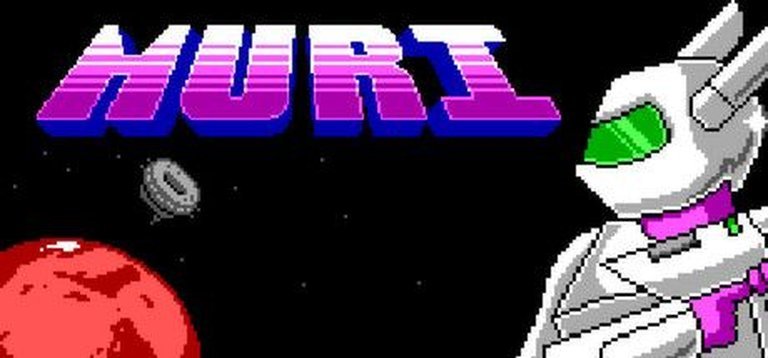
MURI is a retro-inspired action-platformer that pays homage to late ’80s and early ’90s DOS games. Players take on the role of Adwoa, a woman in a robot suit, as she embarks on a quest to uncover the fate of humanity after the disappearance of Mars. The game features four episodes with five levels each, offering a mix of platforming and shooting gameplay across a sci-fi setting. With multiple difficulty settings, classic choppy or smooth screen movement options, and a variety of weapons, MURI blends nostalgic aesthetics with modern accessibility, though it lacks a save feature.
Where to Buy MURI
MURI Guides & Walkthroughs
MURI Reviews & Reception
metacritic.com (72/100): brilliant homage of the oldschool EGA shareware platformers
mobygames.com (79/100): MURI is a game inspired by late ’80s and early ’90s DOS platformers.
steambase.io (90/100): MURI has earned a Player Score of 90 / 100.
store.steampowered.com (93/100): Very Positive (93% of 308 user reviews for this game are positive).
MURI Cheats & Codes
PC
Enter one of the following codes during game play to activate the corresponding cheat function. A message will appear in the space that normally displays ‘PRESS F1 FOR HELP’ to confirm correct code entry.
| Code | Effect |
|---|---|
| rgfill | +20 to ammo for all weapons |
| rgwish | Level skip |
| rgcell | Remaining cells set to four |
| rgcats | Remaining lives set to seven |
| rgiosa | Toggle invincibility |
| rgmoon | Toggle moon jump; hold to rise when falling |
| rgduck | Add ‘duck’ item to each level; when collected it sits on Adwoa’s head |
| rgtilt | Cycle through graphic tile sets |
| rgnull | End game |
| rgxces | Unknown |
MURI: A Love Letter to DOS Platformers and a Bold Experiment in Retro Revival
Introduction
In an era where high-definition graphics, open-world sprawl, and cinematic storytelling dominate the gaming landscape, MURI (2013) emerges as a defiant anomaly—a meticulously crafted homage to the late ’80s and early ’90s DOS platformers. Developed by Daniel Remar of Remar Games and published by Ludosity, MURI is not merely a retro-inspired game but a simulation of the era, complete with 16-color EGA graphics, PC Speaker sound, and the choppy, blocky scrolling of classic titles like Commander Keen, Duke Nukem, and Bio Menace. Yet, beneath its nostalgic veneer lies a game that is both a celebration of the past and a subversive commentary on the themes of technological hubris, human extinction, and the ethical dilemmas of scientific progress.
This review will dissect MURI in its entirety, exploring its development context, narrative depth, gameplay mechanics, aesthetic choices, and legacy. We will argue that MURI is not just a “retro game” but a meta-retro experience—one that challenges modern players to engage with the limitations and design philosophies of an earlier era while delivering a story that is surprisingly ambitious for its genre.
Development History & Context
The Creators and Their Vision
MURI was the brainchild of Daniel Remar, a Swedish indie developer with a deep affinity for retro gaming. Remar’s portfolio includes cult classics like Iji (2008), Hero Core (2010), and Hyper Princess Pitch (2012), all of which share a common thread: a reverence for the design sensibilities of the 16-bit and DOS eras. For MURI, Remar sought to create a game that didn’t just look like a DOS platformer but felt like one—warts and all.
The game was developed in just seven months, from May to December 2013, a remarkably short production cycle that speaks to Remar’s efficiency and clarity of vision. Ludosity, known for Ittle Dew (2013), served as the publisher, providing the necessary support to bring MURI to Steam.
Technological Constraints and Design Choices
MURI is a deliberate exercise in self-imposed limitations. The game’s technical specifications are a love letter to the hardware of the early ’90s:
- Graphics: 320×200 resolution with a 16-color EGA palette, complete with dithering and the characteristic “blocky” aesthetic of the era.
- Sound: PC Speaker audio, meaning no MIDI soundtracks or complex sound effects—just the bleeps and bloops of an internal computer speaker.
- Frame Rate: A default of 16 FPS, with an optional “smooth” mode at 32 FPS for modern players. This choppy animation was a hallmark of early DOS games, where hardware limitations forced developers to prioritize gameplay over fluidity.
- Scrolling: The screen moves in discrete blocks rather than smoothly, mimicking the technical constraints of games like Duke Nukem (1991).
These choices were not made out of laziness or lack of resources but as a philosophical statement. Remar wanted players to experience the feel of playing a game on a 486 DX2 in 1992—complete with the jank, the quirks, and the occasional frustration.
The Gaming Landscape in 2013
2013 was a pivotal year for indie games. Titles like Gone Home, The Stanley Parable, and Papers, Please were redefining what indie games could achieve in storytelling and player agency. Meanwhile, the retro revival was in full swing, with games like Shovel Knight (2014) and Cave Story (2004) proving that pixel art and chiptune music could still captivate modern audiences.
MURI entered this landscape as an outlier. While other retro-inspired games sought to modernize classic mechanics (e.g., Shovel Knight’s tight controls and fluid animation), MURI embraced the imperfections of the past. It was a game that dared to ask: What if we didn’t just borrow the aesthetics of retro games but also their flaws?
Narrative & Thematic Deep Dive
Plot Summary
MURI’s story is a sci-fi tragedy that unfolds across four episodes, each consisting of five levels. The narrative is delivered through text-heavy cutscenes, a staple of DOS-era games that relied on exposition over cinematic storytelling.
The premise is as follows:
– Humanity has colonized Mars, and a research station orbiting the planet is conducting controversial experiments on life and death.
– The scientists develop the MURI suit, a powered exoskeleton of “cataclysmic power.”
– Kojo, the son of the lead scientists, is equipped with the suit. Fearing its potential as a weapon, Earth and Mars prepare for war.
– Before the conflict can escalate, Mars vanishes without a trace, leaving Earth in chaos.
– Adwoa, one of the MURI suit’s creators (and Kojo’s mother), dons the suit to uncover the truth behind Mars’ disappearance and the fate of humanity.
The story takes a dark turn as Adwoa discovers that Kojo, in an attempt to “rebuild” Mars, absorbed the entire planet into the MURI suit, becoming a comatose vessel for the ghosts of all Martian life. The final act sees Adwoa and her husband, Kwaku, attempting to fuse with Earth’s core to create a new world—a bittersweet ending that leaves the fate of humanity ambiguous.
Themes and Symbolism
MURI’s narrative is deceptively complex for a game of its scope. Several key themes emerge:
-
Technological Hubris and Unintended Consequences
- The MURI suit is a Frankensteinian creation—a tool meant to transcend human limitations that instead becomes a catalyst for destruction.
- Kojo’s attempt to “rebuild” Mars mirrors the Icarus myth: his ambition leads to catastrophe, and his good intentions result in the erasure of an entire planet.
-
The Ethics of Scientific Progress
- The game questions whether some knowledge should remain untouched. The MURI project is framed as a Pandora’s Box—once opened, its consequences cannot be undone.
- Adwoa’s journey is one of redemption and culpability. She is both a victim of circumstance and an architect of the disaster, making her a villain protagonist in the TV Tropes sense.
-
Family and Sacrifice
- The relationship between Adwoa, Kwaku, and Kojo is central to the story. The game explores parental guilt, as Adwoa must confront the consequences of her actions on her son.
- The bittersweet ending, where Adwoa and Kwaku merge with Earth’s core, suggests a cyclical view of existence—destruction as a precursor to rebirth.
-
Existential Dread and Cosmic Horror
- The disappearance of Mars is never fully explained, leaving players with a sense of cosmic unease.
- The final boss—a sentient Earth’s core—embodies Gaia’s vengeance, resisting Adwoa’s attempt to reshape the planet.
Character Analysis
- Adwoa: The protagonist is a flawed scientist whose actions drive the plot. She is neither a traditional hero nor a villain but a complex figure whose motivations shift from curiosity to desperation.
- Kojo: A tragic figure whose idealism leads to catastrophe. His fate—trapped in a suit with the ghosts of Mars—is a haunting metaphor for the burden of creation.
- Esi (Adwoa’s Daughter): A poignant subplot involves Adwoa facing her daughter in combat. The game allows players to sheathe their weapons, but Esi dies regardless—a shaggy dog story that underscores the futility of Adwoa’s quest.
Dialogue and Writing Style
The game’s dialogue is minimalist but effective, relying on exposition-heavy text screens reminiscent of Commander Keen or Jill of the Jungle. While the writing lacks the wit of Duke Nukem, it compensates with atmospheric gravitas, particularly in the later episodes.
One standout feature is the Bilingual Bonus: “MURI” means “impossible” in Japanese, a nod to the game’s final difficulty level and its themes of insurmountable challenges.
Gameplay Mechanics & Systems
Core Gameplay Loop
MURI is a side-scrolling platformer-shooter with Metroidvania-lite elements. The gameplay revolves around:
- Exploration: Levels are non-linear, with hidden paths, destructible walls, and optional areas.
- Combat: A mix of run-and-gun action and tactical weapon management.
- Progression: Players unlock new weapons and abilities, though the game lacks a traditional save system.
Movement and Controls
- Jumping: Adwoa’s jump is floaty and inertia-less, akin to Turrican or Metroid. Holding the jump button allows for precise vertical movement, a design choice that rewards patience over twitch reflexes.
- Shooting: Players can fire left or right, duck, and shoot downward. The lack of diagonal aiming is a deliberate throwback to early platformers.
- Collision: Touching enemies deals mutual damage—a mechanic that encourages Goomba Stomps and careful positioning.
Weapon System
MURI’s weapon system is one of its most innovative (and divisive) features:
- Default Weapon: An infinite-ammo pea shooter (a staple of the genre).
- Special Weapons: Five additional weapons, each with limited ammo (20 rounds per pickup):
- Rapid Fire: Faster version of the default weapon.
- Mk. 5: A spread shot (five bullets in a fan pattern).
- Laser: High-damage, bouncing projectiles.
- Mega Shot: A homing missile.
- Chaos Shot: The Infinity +1 Sword—a massive, screen-clearing blast.
The Controversial Design Choice:
– The game automatically equips the strongest weapon in your inventory, preventing manual selection.
– This forces players to use their best weapons rather than hoarding them—a subversion of the “Too Awesome to Use” trope.
Pros and Cons of the System:
– Pros:
– Encourages aggressive playstyle.
– Prevents weapon hoarding, a common pitfall in Metroidvanias.
– Cons:
– Limits tactical flexibility. Players cannot switch to a spread shot for crowd control or a laser for tight corridors.
– Frustrating in boss fights, where specific weapons may be more effective.
Difficulty and Progression
MURI offers four difficulty settings:
– Easy: More ammo, health pickups, and easier bosses.
– Normal: Balanced experience.
– Hard: No health pickups, tougher bosses.
– MURI (Impossible): No health pickups, no 1UPs, and brutal boss fights.
Scoring and Replayability:
– The game tracks score, completion percentage, and time bonuses, encouraging speedrunning and 100% completion.
– Cells (hidden collectibles) unlock high-tier weapons before boss fights, adding a risk-reward element to exploration.
Level Design
The levels are labyrinthine but fair, with:
– False walls and destructible barriers hiding secrets.
– Backtracking required to access new areas after acquiring keys or destroying obstacles.
– Verticality: Players frequently ascend and descend, using elevator rods and explosive chain reactions to progress.
Boss Fights:
– Each episode culminates in a boss battle, ranging from giant robots to organic horrors.
– The final boss—Earth’s core—is a symbolic confrontation, representing nature’s resistance to human meddling.
UI and HUD
The HUD is a minimalist masterpiece, with:
– Energy (HP): Displayed as a green bar (max 8).
– Ammo Count: Shows remaining rounds for special weapons.
– Score and Timer: Classic DOS-era touches.
The Absence of a Save System:
– MURI does not allow saving, a deliberate choice to mimic the arcade-like difficulty of DOS games.
– Losing all lives kicks players back to the title screen, a punishing but authentic design decision.
World-Building, Art & Sound
Visual Design: A Celebration of EGA
MURI’s art direction is a faithful recreation of 16-color EGA graphics, with:
– Dithering: Used sparingly to create shading effects.
– Bold, Stark Colors: The limited palette forces creative use of contrast.
– Pixel Art: Sprites are detailed and expressive, with Adwoa’s animations conveying weight and purpose.
The Frame and HUD:
– The game is encased in a wide border, mimicking the aspect ratio of old CRT monitors.
– The HUD is chunky and functional, with large, readable numbers—a necessity given the low resolution.
Sound Design: The Symphony of PC Speaker
The audio in MURI is a triumph of limitation:
– No In-Game Music: Only the title screen and end credits feature a melody, a nod to early DOS games that lacked soundtracks.
– PC Speaker Sound Effects: Every gunshot, jump, and enemy death is rendered in monophonic beeps, creating a hauntingly nostalgic soundscape.
– Ambient Noise: The silence between sound effects is deafening, amplifying the game’s isolated, desolate atmosphere.
Atmosphere and Immersion
MURI’s world is bleak and oppressive, with:
– Abandoned Research Stations: Filled with broken machinery and eerie lighting.
– Robot Graveyards: The remnants of the war between Earth and Mars.
– Organic Horrors: The final episode introduces biological abominations, signaling the game’s shift from sci-fi to cosmic horror.
The lack of music enhances the sense of loneliness, making Adwoa’s journey feel isolated and desperate.
Reception & Legacy
Critical Reception
MURI was warmly received by critics, with an average score of 79% (MobyGames) and Very Positive user reviews on Steam (93% positive from 308 reviews).
Praise:
– Retro Spirit Games (85%): “The best DOS tribute game I have ever seen.”
– GAMERamble (80%): “A homage to classic DOS platformers that still manages to deliver an entertaining experience.”
– GameGrin (80%): “A trip down memory lane that lives on long after you solve the Martian mystery.”
Criticism:
– GameCloud (70%): “Lack of a save system can be annoying to modern players.”
– TitaniumDragon (Metacritic User Review): “It succeeds in replicating the feel of a terrible old game run on DOS. This is not a good thing.”
Commercial Performance
MURI was a niche success, appealing primarily to:
– Retro enthusiasts who grew up with DOS games.
– Indie fans looking for short, challenging experiences.
– Speedrunners drawn to its scoring system and 100% completion challenges.
The game’s $9.99 price point and frequent Steam sales made it accessible, though its hardcore difficulty limited its mainstream appeal.
Influence and Legacy
MURI’s legacy lies in its uncompromising retro design:
– It proved that modern audiences could appreciate the limitations of old hardware when used intentionally.
– It inspired other retro revival games to embrace authenticity over modernization (e.g., Dusk, Amid Evil).
– It challenged the notion that retro games must be “updated” to be enjoyable.
However, its lack of a save system and punishing difficulty remain polarizing, ensuring that MURI remains a cult classic rather than a mainstream hit.
Conclusion: A Flawed Masterpiece
MURI is a paradox—a game that is both brilliantly designed and deliberately flawed. It is a love letter to an era that many modern gamers never experienced, yet it demands to be played on its own terms.
Strengths:
– Authentic retro aesthetic that goes beyond mere pixel art.
– Deep, thematic narrative that explores hubris, sacrifice, and cosmic horror.
– Tight, challenging gameplay that rewards exploration and mastery.
– Innovative weapon system that subverts player expectations.
Weaknesses:
– No save system, a design choice that will frustrate modern players.
– Limited weapon selection can feel restrictive in certain situations.
– Short length (2-3 hours) may leave some wanting more.
Final Verdict:
MURI is not for everyone. It is a game that celebrates its limitations rather than apologizing for them. For those who grew up with DOS platformers, it is a nostalgic triumph. For newer players, it is a challenging but rewarding glimpse into gaming’s past.
Score: 8.5/10 – A bold, uncompromising retro experience that stands as both a tribute and a testament to the enduring appeal of classic gameplay.
Where It Stands in Gaming History:
MURI is a footnote in the grand narrative of video games, but it is a vital one. It proves that retro games can be more than just aesthetic pastiches—they can be philosophical statements about the medium itself. In an industry obsessed with bigger, better, and more realistic, MURI dares to ask: What if we went smaller? What if we embraced the past, flaws and all?
For that alone, it deserves to be remembered.