
- Release Year: 2022
- Platforms: Windows
- Publisher: Valkeala Software
- Developer: NTStudios, Valkeala Software
- Genre: Action
- Perspective: Behind view
- Game Mode: Single-player
- Gameplay: Platform
- Setting: Fantasy
Description
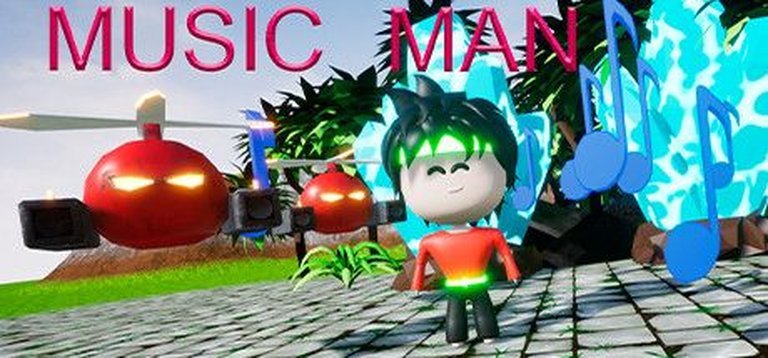
Music Man is a fantasy-themed action platformer set across two large open worlds. Players take on the role of a young hero whose mission is to collect all the blue music notes hidden throughout each level. The game features flying enemies that fire missiles, various collectibles like coins and hearts, and interactive elements such as breakable boxes and barrels. Once all notes are collected, the player can use a piano to open a portal and complete the level. Coins are used to unlock jumping and moving platforms, adding a puzzle element to the navigation.
Gameplay Videos
Where to Buy Music Man
PC
Guides & Walkthroughs
Reviews & Reception
store.steampowered.com : Collect all music notes in 2 different big worlds to finish maps. Beware dangerous enemies and use platforms to move forward.
steamcommunity.com : I’d pay 60.
Music Man: Review
Introduction
In the vast and often cacophonous symphony of the indie game scene, a lone, earnest note occasionally rings out, striving for a melody amidst the noise. Music Man, a 2022 release for Windows by Valkeala Software and NTStudios, is one such note. Priced at a mere $0.49 on Steam and boasting a “Positive” user review rating, this title presents itself as a simple, budget-friendly collectathon platformer. Yet, to dismiss it as just another asset-flip in a crowded marketplace would be to ignore the fascinating, albeit unintended, narrative it embodies. This is not a review of a masterpiece, but rather an archaeological dig into a curious artifact—a game whose existence, its near-total critical silence, and its thematic dissonance with a far more famous namesake create a compelling case study in modern indie development. Our thesis: Music Man is a profoundly flawed, technically rudimentary game, but its very obscurity and the stark contrast between its humble reality and the cultural weight of its title make it an unintentionally poignant commentary on the challenges of creating art in the digital age.
Development History & Context
Music Man emerged not from the hallowed halls of a major studio, but from the collaborative effort of Valkeala Software and NTStudios, with developer Tero Lunkka at the helm. Released on June 16, 2022, it entered a gaming landscape dominated by live-service behemoths and meticulously crafted narrative adventures. This was the era of Elden Ring and Horizon Forbidden West, where production values soared to astronomical heights. Music Man exists in stark opposition to this reality.
The technological constraints here are not those of vintage hardware but of scope and budget. Built with the Unreal Engine—a tool capable of photorealistic grandeur—the game’s visuals are instead reminiscent of early 2000s platformers, utilizing generic asset store models and simple textures. The developers’ vision, as gleaned from the Steam description, was straightforward: create a 3D world where a player collects music notes, avoids enemies, and unlocks platforms. There is no mention of a deeper artistic ambition; it is a game built around a core, simple gameplay loop.
This stands in brutal contrast to the other “Music Man” that dominates search engine algorithms and cultural awareness: the iconic con man Professor Harold Hill from Meredith Willson’s legendary 1957 musical, The Music Man. That work, a Tony Award-winning masterpiece about the power of music (and deception) to transform a community, represents a peak of American theatrical artistry. The 2022 video game Music Man shares a name but possesses none of its thematic richness, narrative complexity, or cultural impact. This shared title is a cruel accident of branding, casting the game’s modest aspirations into a shadow it could never escape. It was released into a void, with no critic reviews on Metacritic and only a handful of user reviews on Steam, a ghost in the machine of the gaming industry.
Narrative & Thematic Deep Dive
If one expects a narrative worthy of the name “Music Man,” they will find only a haunting emptiness. The game’s “STORY,” as presented in its official description, is a masterclass in functional, non-literary prose: “Player are young man whose mission is collect all blue music notes at different levels.” There is no named protagonist, no motivation beyond the act of collection, no conflict beyond the environmental hazards, and no resolution beyond the opening of a portal.
The characters are non-existent. The “young man” is a silent, anonymous avatar. The “flying enemy with missiles” is a mechanical obstacle, devoid of lore or purpose. The dialogue is absent; the world does not speak to the player. The underlying themes are those of the most basic video game logic: the intrinsic reward of completionism. Collect the notes because they are there. Unlock the platform because it is locked.
This stands in jaw-dropping contrast to the narrative depth of the musical The Music Man, a story rich with themes of community, redemption, belief versus reality, and the transformative power of art—even fraudulent art. Harold Hill’s lie gives a stagnant town a purpose and a rhythm. The game Music Man offers no such lie or truth; it simply is. It is a purely mechanistic experience, a skeleton without the flesh of story. This void becomes its most defining characteristic—a theme of absence itself.
Gameplay Mechanics & Systems
The core gameplay loop of Music Man is brutally simple and endlessly repetitive. The player must explore two large, open-world levels to find and collect all the blue music notes scattered throughout the environment. Once all are collected, the player can interact with a piano to open a portal and complete the level.
Movement and Interaction: Control is direct and utilitarian, likely mapped to standard WASD and spacebar for jumping. The perspective is behind the player character, offering a functional third-person view of the simplistic environments.
Combat and Hazards: There is no traditional combat. The primary antagonist is a “flying enemy with missiles” that the player must simply avoid. This adds a layer of passive threat but no active engagement.
Progression and Economy: A secondary collectible, coins, serves as a currency to unlock “different jumping and moving platforms,” gating progression. Hearts can be collected to increase health. The game also features “Power collectables,” though their function is ambiguously described. Treasure chests require keys, and barrels and boxes must be hit to reveal their contents (coins or notes). This creates a basic economy of exploration: find keys to open chests to get coins to unlock platforms to find more notes.
UI and Systems: The user interface is undoubtedly minimal, likely featuring only essential elements like note count, coin count, and health. The most “innovative” system is its strict punishment for failure: “If you die or quit game you need start from starting point again.” This roguelite-esque permadeath mechanic feels disproportionately harsh for a game otherwise presenting itself as a casual collectathon, highlighting a significant flaw in its design philosophy. There is no character progression, no skill tree, no evolution of mechanics—just repetition until completion.
The gameplay is the definition of functional but uninspired. It is a checklist given interactive form, lacking the polish, fluidity, or inventive spark that defines the best platformers.
World-Building, Art & Sound
The world of Music Man is a generic fantasy landscape built from commonplace Unreal Engine assets. The two “big open worlds” are likely sparse environments with basic terrain, simple structures, and floating platforms—a digital playground devoid of life, history, or character.
Visual Direction: The art style is plain 3D, aiming for clarity over aesthetic distinction. There are no bold artistic choices, no unique visual identity. It is a place that exists only to be traversed, not to be remembered. The setting is “Fantasy” only in the broadest, most nondescript sense of the word.
Atmosphere: The atmosphere is null. There is no mood established through lighting, environmental storytelling, or sound. The world feels like a testing ground, a blank canvas that was never painted upon.
Sound Design: This is the game’s greatest ironic failure. For a title named Music Man, the audio experience is reportedly forgettable. User reviews on its sequel’s community page mention that “the music quickly drowns out the background so please just listen to the music till your ears are ok with it then mute the game.” This suggests a repetitive, potentially grating soundtrack that actively detracts from the experience. There is no dialogue, and sound effects are undoubtedly standard and unremarkable. In a cruel twist of fate, the game that bears the name of a celebrated musical offers nothing of musical merit. It does not use sound to build its world; it uses sound to fill a silence, and does so poorly.
Reception & Legacy
The reception of Music Man can be summarized in one word: silence.
Critical Reception: At the time of this writing, there are zero professional critic reviews for the game on aggregates like Metacritic or MobyGames. It was not deemed worthy of coverage by any major—or even minor—gaming publication. It slipped into the market unnoticed by the critical establishment.
Commercial Reception: On Steam, it holds a “Positive” rating based on all of 10 user reviews. It is the definition of a niche product, finding a minuscule audience willing to look past its glaring flaws, perhaps due to its incredibly low price point. Its commercial impact is effectively zero.
Legacy and Influence: Music Man has no discernible influence on the industry. It did not pioneer new mechanics, inspire a genre, or even become a so-bad-it’s-good cult classic. Its legacy is its obscurity. It serves as a stark example of the sheer volume of content on digital storefronts—games that are made and released but never truly seen. Its only cultural connection is through its name, a name that forever ties it to a work of art so superior that the comparison becomes a historical footnote of cruel irony. The game’s legacy is to be a answer to a trivia question: “What is the name of that obscure game that has nothing to do with the musical?”
Conclusion
Music Man is not a good game. It is a technically basic, artistically barren, and mechanically repetitive collectathon that fails to leverage its own title’s concept in any meaningful way. Its sound is lacking, its story is nonexistent, and its challenge is rooted in frustration rather than engagement.
Yet, its place in video game history, while minor, is secure as a perfect artifact of a specific reality of the modern gaming ecosystem. It represents the thousands of ultra-low-budget indie titles that launch into the void, competing for oxygen in an overcrowded room. Its existence is a testament to the accessibility of game development tools, while its obscurity is a testament to the difficulty of creating something that truly resonates.
The final verdict is paradoxical. As a piece of interactive entertainment, Music Man is not worth your time. But as a case study—a symbol of the dissonance between ambition and execution, and a poignant reminder of the long shadow cast by iconic art—it is unexpectedly fascinating. It is the video game equivalent of a lonely, off-key note played in an empty room, a world away from the triumphant blast of seventy-six trombones. It is, ultimately, a story of silence.