
- Release Year: 2000
- Platforms: Windows
- Publisher: MVP Software
- Developer: Two Lights Entertainment
- Genre: Card, Patience, Puzzle, Solitaire, Tile game
- Perspective: Top-down
- Game Mode: Single-player
- Gameplay: Cards, Tiles
Description
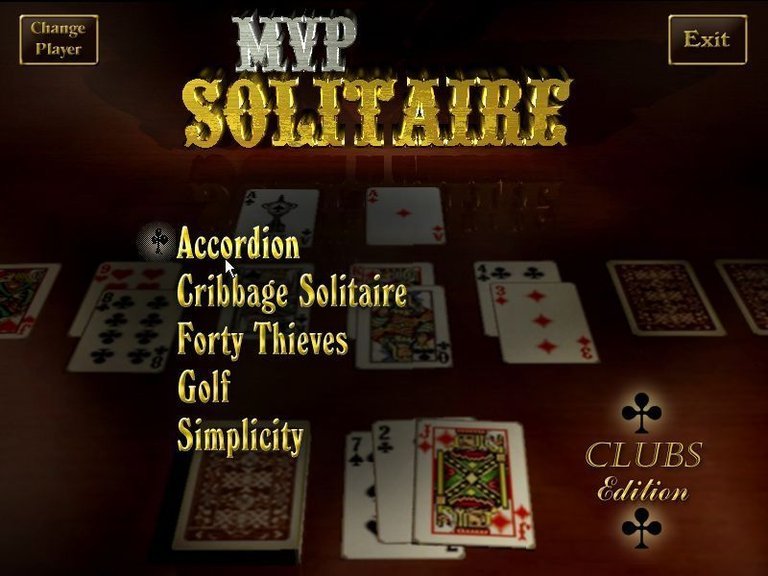
MVP Solitaire: Clubs Edition is a freeware try-before-you-buy version of MVP Solitaire: Deluxe Edition, released in 2000 for Windows. This simplified edition features two card decks and five solitaire variants—Accordion, Cribbage Solitaire, Forty Thieves, Golf, and Simplicity—with a top-down, fixed perspective and point-and-select interface designed to introduce players to the full game experience.
MVP Solitaire: Clubs Edition: Review
Introduction
In the vast landscape of digital solitaire games, MVP Solitaire: Clubs Edition stands as a modest yet intriguing entry, released in 2000 by MVP Software and developed by Two Lights Entertainment. At first glance, it might seem like just another casual card game, but a deeper dive reveals a product that, while limited in scope, offers a glimpse into the early days of digital card gaming. This review will explore the game’s development history, its gameplay mechanics, and its place within the broader context of solitaire gaming. By the end, we’ll determine whether MVP Solitaire: Clubs Edition is a forgotten gem or a footnote in gaming history.
Development History & Context
The Studio and Its Vision
MVP Solitaire: Clubs Edition was developed by Two Lights Entertainment, a studio known for creating a variety of card and board games. The game was published by MVP Software, a company with a portfolio that included other card-based titles like MVP Bridge and MVP Backgammon. The development team consisted of nine individuals, including programmers, producers, artists, and sound designers. Notably, the game was part of a larger strategy by MVP Software to offer a “try-before-you-buy” model, with the Clubs Edition serving as a stripped-down version of the more comprehensive MVP Solitaire: Deluxe Edition.
Technological Constraints and Gaming Landscape
Released in 2000, MVP Solitaire: Clubs Edition arrived during a transitional period in gaming. The late 1990s and early 2000s saw the rise of personal computers as a primary gaming platform, with Windows becoming the dominant operating system. This era also marked the beginning of the digital solitaire craze, largely fueled by Microsoft’s inclusion of Solitaire in Windows 3.0. The gaming landscape was characterized by a mix of casual and hardcore gaming experiences, with solitaire games serving as a popular pastime for office workers and casual gamers alike.
The technological constraints of the time meant that games had to be lightweight and easy to run on a wide range of hardware. MVP Solitaire: Clubs Edition reflects this era with its simple graphics and straightforward gameplay mechanics. The game’s fixed/flip-screen visual style and point-and-select interface were typical of the time, designed to be accessible to a broad audience.
Narrative & Thematic Deep Dive
Plot and Characters
Unlike many modern games, MVP Solitaire: Clubs Edition does not feature a narrative or characters. It is purely a collection of solitaire games, each with its own set of rules and objectives. The absence of a narrative is not a detriment, as solitaire games have traditionally been about the gameplay experience rather than storytelling. The game’s simplicity allows players to focus solely on the mechanics and strategy of each solitaire variant.
Themes and Dialogue
The game’s themes revolve around relaxation and mental engagement. Solitaire has long been associated with leisure and stress relief, and MVP Solitaire: Clubs Edition continues this tradition. The game’s interface is clean and uncluttered, with a focus on the cards themselves. The absence of dialogue or complex themes allows players to immerse themselves in the game without distractions.
Gameplay Mechanics & Systems
Core Gameplay Loops
MVP Solitaire: Clubs Edition includes five different solitaire games: Accordion, Cribbage Solitaire, Forty Thieves, Golf, and Simplicity. Each game offers a unique set of rules and challenges, providing variety for players. The core gameplay loop involves arranging cards according to specific rules to achieve a winning condition. The game’s interface is intuitive, with a point-and-select system that allows players to drag and drop cards with ease.
Combat and Character Progression
As a solitaire game, MVP Solitaire: Clubs Edition does not feature combat or character progression. Instead, the challenge lies in mastering the rules of each solitaire variant and achieving the best possible outcomes. The game’s difficulty varies depending on the variant, with some games being more straightforward and others requiring more strategic thinking.
User Interface
The user interface is simple and functional. The game features a top-down perspective with a fixed/flip-screen visual style. The cards are clearly displayed, and the interface allows for easy navigation between different games. The point-and-select interface is intuitive, making it accessible to both casual and experienced players.
Innovative or Flawed Systems
One of the game’s strengths is its variety. By including five different solitaire games, it offers a range of experiences that can appeal to different players. However, the game’s limited scope is also its weakness. With only two decks of cards and five games, it lacks the depth and variety of more comprehensive solitaire collections. Additionally, the game’s graphics and sound design are basic, reflecting the technological limitations of the time.
World-Building, Art & Sound
Setting and Atmosphere
MVP Solitaire: Clubs Edition does not feature a complex setting or atmosphere. The game’s focus is purely on the solitaire experience, with a clean and uncluttered interface. The absence of a narrative or characters means that the setting is minimalistic, allowing players to focus on the gameplay.
Visual Direction
The game’s visual style is simple and functional. The cards are clearly displayed, and the interface is designed to be intuitive. The fixed/flip-screen visual style is typical of early digital solitaire games, and while it may not be visually stunning by modern standards, it is effective for the game’s purposes.
Sound Design
The sound design is minimal, with simple sound effects for card movements and actions. The music, if any, is likely to be subtle and unobtrusive, designed to enhance the game’s relaxing atmosphere without distracting from the gameplay. The sound design is functional but not particularly memorable.
Reception & Legacy
Critical and Commercial Reception
MVP Solitaire: Clubs Edition does not appear to have received significant critical or commercial attention. The game’s status as a “try-before-you-buy” release suggests that it was intended more as a promotional tool for the Deluxe Edition rather than a standalone product. As a result, it may have flown under the radar for many gamers and critics alike.
Influence on Subsequent Games and the Industry
While MVP Solitaire: Clubs Edition may not have had a significant impact on the industry, it is part of a broader trend of digital solitaire games that emerged in the late 1990s and early 2000s. The game’s inclusion of multiple solitaire variants reflects the growing popularity of these games as casual entertainment. Its legacy lies in its contribution to the digital solitaire genre, which continues to be a popular pastime for many players.
Conclusion
MVP Solitaire: Clubs Edition is a modest but noteworthy entry in the digital solitaire genre. While it lacks the depth and variety of more comprehensive solitaire collections, it offers a range of solitaire games that can provide hours of entertainment. Its simple interface and straightforward gameplay make it accessible to a wide audience, and its historical context as a “try-before-you-buy” release provides insight into the marketing strategies of the time.
In the grand scheme of video game history, MVP Solitaire: Clubs Edition may not be a groundbreaking title, but it holds a place as a representative of the early digital solitaire craze. Its legacy lies in its contribution to the genre and its role in introducing players to the world of digital card games. For those interested in the history of solitaire gaming, MVP Solitaire: Clubs Edition is a worthwhile, if minor, footnote.