
- Release Year: 2006
- Platforms: Windows
- Publisher: rondomedia Marketing & Vertriebs GmbH
- Developer: Fancy Bytes
- Genre: Educational, Simulation
- Perspective: Fixed / flip-screen
- Game Mode: Single-player
- Gameplay: Mini-games
Description
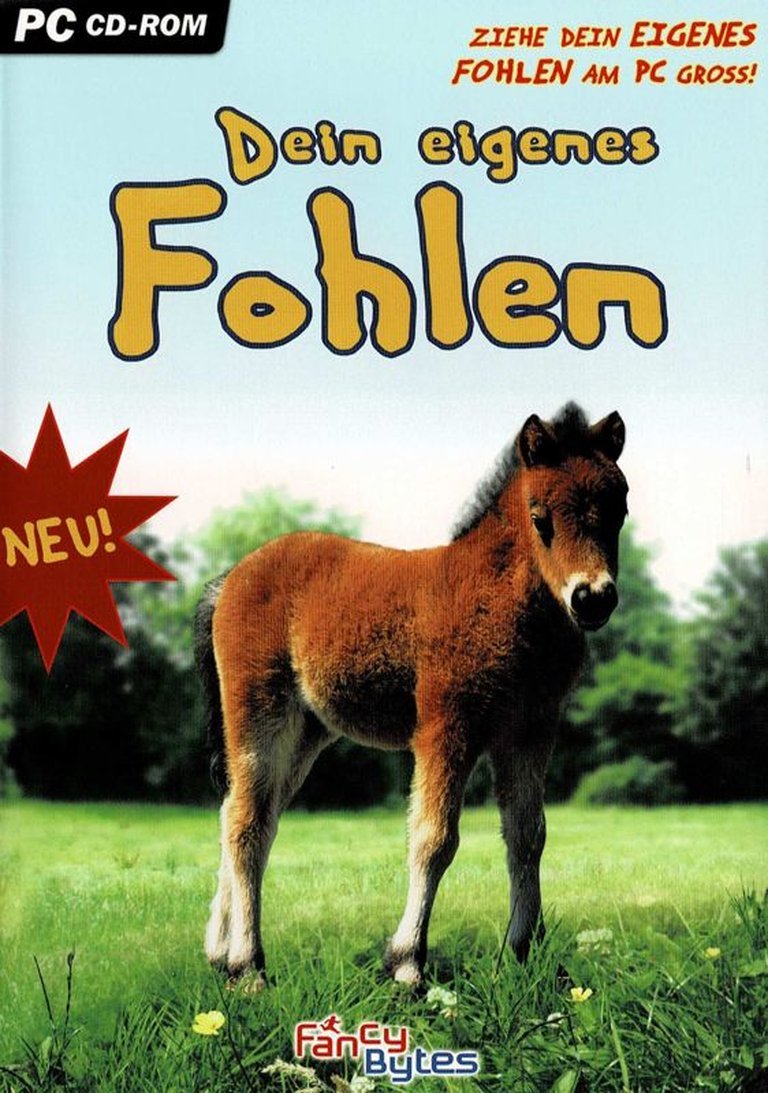
My Own Foal is an educational simulation game where you raise a virtual foal, playing with it daily to ensure its happiness. The game features five mini-games, a customizable home environment, and year-round events with different activities for each season. Colorful cartoon graphics bring your equine companion to life as you manage its care and growth through various seasonal tasks.
My own Foal: Review
Introduction
In the vast landscape of interactive entertainment, few titles manage to distill the essence of nurturing and ecological awareness into such a focused, accessible experience as My own Foal. Released in 2006 by Fancy Bytes and published by rondomedia, this Windows-exclusive educational simulation stands as a quiet but significant artifact of the casual gaming boom. At its core, the game tasks players with the profound responsibility of raising a virtual foal from infancy to maturity, blending simple mechanics with subtle lessons about nature and care. While it may lack the narrative complexity of AAA epics or the mechanical depth of hardcore simulations, its deliberate design and earnest purpose illuminate a niche corner of gaming history—a testament to how software can foster empathy and environmental consciousness in young audiences. This review argues that My own Foal, despite its simplicity, represents a pioneering fusion of pet-care simulation and ecological education, whose legacy lies in its understated influence on subsequent casual and educational games.
Development History & Context
My own Foal emerged from Fancy Bytes, a developer specializing in accessible family-oriented software, with publishing handled by rondomedia—a German company known for distributing niche and educational titles. Released on March 15, 2006, the game arrived during a pivotal moment in gaming history. The mid-2000s saw the explosive growth of casual gaming, driven by platforms like PopCap Games (e.g., Bejeweled) and Nintendo’s DS, which popularized touch-based interactions (Nintendogs launched in 2005). Technologically, the game was constrained by its Windows-only CD-ROM format, reflecting an era before digital storefronts like Steam dominated distribution. Its fixed/flip-screen interface and point-and-click mechanics were deliberate choices to ensure accessibility for young players and older hardware.
The game’s development context is shaped by two intersecting trends: the rising demand for educational software and the success of virtual pet simulations. Fancy Bytes capitalized on this by simplifying pet care into digestible mini-games and daily routines, while rondomedia leveraged its expertise in European educational markets. Notably, the title’s German-language release (Dein eigenes Fohlen) underscores its targeted audience: families seeking child-friendly content with subtle learning objectives. In a gaming landscape increasingly dominated by violent or competitive titles, My own Foal positioned itself as a counterpoint—a gentle, purpose-driven experience prioritizing responsibility over conflict.
Narrative & Thematic Deep Dive
The narrative of My own Foal is intentionally minimalist, serving as a framework for player-driven interaction rather than a traditional plot. The player is entrusted with a newborn foal, setting the stage for a journey defined by growth, care, and seasonal change. Overseeing this “big pet” from infancy to adulthood becomes the central narrative arc, with the foal’s happiness and health as the primary metrics of success. While lacking explicit dialogue or complex characters, the game’s narrative unfolds through player actions: feeding, grooming, and playing with the foal build a silent bond, transforming the virtual animal into a character defined by its needs and responses.
Thematically, the game explores responsibility and ecological stewardship. The “Ecology / nature” educational designation highlights its focus on interconnectedness—players must adapt their care routines to seasonal changes (e.g., adjusting for winter’s harshness or summer’s abundance), subtly reinforcing environmental awareness. The cycle of life is emphasized through the foal’s visible aging and the recurring events tied to the calendar, turning daily routines into rituals of nurturing. The absence of conflict or antagonists underscores a pacifistic worldview, where growth is achieved through patience and consistency rather than overcoming challenges. This approach aligns with the source material on game lore, which emphasizes “interconnected webs” and “personal tales” to build emotional investment, even in abstract forms. The result is a parable of care, where the player’s dedication to the foal becomes a metaphor for stewardship of the natural world.
Gameplay Mechanics & Systems
My own Foal’s gameplay revolves around a cyclical daily routine, executed through a point-and-click interface. Each session begins with assessing the foal’s needs, which fluctuate based on in-game time and seasonal events. Core mechanics include:
– Care Management: Feeding, brushing, and providing equipment (e.g., blankets, toys) to maintain the foal’s happiness and health. This resource loop echoes principles from game design literature, where “meaningful choices” (e.g., prioritizing food over play) drive engagement.
– Mini-Games: Five varied activities—likely including simple challenges like obstacle courses or fetch—reward players with coins to purchase upgrades. These serve as both gameplay diversions and teaching tools, reinforcing motor skills and decision-making.
– Seasonal Progression: The game tracks four distinct seasons, each altering the foal’s environment and available activities. Spring might introduce new growth, while winter demands extra care, adding dynamism to the routine.
– Resource Economy: Coins earned from mini-games fund equipment and supplies, teaching basic financial planning. The progression system is tied to the foal’s growth, with visual milestones (e.g., size changes, new abilities) providing tangible rewards.
The interface prioritizes simplicity, with clear icons for actions and a flip-screen layout to avoid overwhelming young players. While not innovative, these systems align with best practices for educational design, as outlined in sources like How to Develop A Game Plot, which stress “player-driven” mechanics that “amplify” emotional investment. The lack of failure states (the USK “0” rating confirms no punitive elements) ensures a frustration-free experience, though this simplicity may limit long-term replayability for older audiences.
World-Building, Art & Sound
The game’s world is a pastoral idyll, rendered in a bright, cartoon aesthetic that evokes children’s book illustrations. The fixed screens focus on the foal’s immediate environment—a cozy stable with outdoor pastures—where seasonal changes alter the background (e.g., blooming flowers in spring, snow-covered fields in winter). This visual consistency, while modest, creates a cohesive micro-universe that feels alive and responsive. The “cartoon animated foal” is the centerpiece, designed with expressive movements (e.g., nuzzling, trotting) to convey emotions, fostering player attachment through visual storytelling.
Sound design, though not extensively detailed, likely complements the pastoral setting with gentle ambient sounds (birdsong, wind) and cheerful audio cues for interactions. The absence of voice-acting emphasizes the universal, wordless bond between player and foal, aligning with the game’s educational ethos. As sources on world-building stress, such environmental details—like “lore embedded in item descriptions” or “symbolism”—transform a simple setting into a “living universe.” Here, the seasons and foal’s growth serve as environmental storytelling, subtly teaching ecological cycles without explicit exposition.
Reception & Legacy
Upon release, My own Foal garnered limited mainstream coverage, a common fate for niche educational titles. No critical reviews survive in the provided archives, suggesting it resonated primarily with its target demographic: parents seeking edutainment for children. Its commercial performance remains undocumented, but its longevity is evidenced by a 2012 iOS port (My Foal), indicating sustained interest in the concept.
Legacy-wise, the game occupies a footnote in the history of pet simulations. While it predates titles like Stardew Valley’s animal husbandry or Animal Crossing’s nurturing elements, its influence is more thematic than mechanical. It exemplifies the “virtual life” genre’s potential for education, predating the widespread adoption of “eco-conscious” gameplay in titles like Spiritfarer. Its emphasis on daily routines and seasonal changes also foreshadows modern “cozy games” like Cozy Grove, which similarly prioritize calm, repetitive care. However, its technical limitations (Windows-only, CD-ROM) and genre obscurity have limited its historical visibility, relegating it to a curiosity in educational gaming’s evolution.
Conclusion
My own Foal is a humble yet compelling artifact of gaming’s capacity for gentle, purposeful design. By distilling pet care into a series of nurturing mini-games and seasonal routines, Fancy Bytes crafted an experience that transcends its simplicity. Its strengths lie in its unwavering focus on responsibility and ecological awareness, using gameplay as a conduit for empathy rather than spectacle. While its dated presentation and limited scope may alienate modern audiences, its legacy endures in its thematic blueprint—a reminder that games can teach without lecturing. In the pantheon of educational software, My own Foal stands as a quiet milestone, proving that the most profound experiences often emerge not from spectacle, but from the quiet act of caring for another. For historians and educators alike, it serves as a vital, if overlooked, chapter in the story of games as tools for growth and understanding.