
- Release Year: 2022
- Platforms: Nintendo Switch, PlayStation 5, Windows, Xbox One, Xbox Series
- Publisher: DMM Games LLC, Focus Home Interactive SAS, Pathea LLC, PM Studios, Inc.
- Developer: Pathea LLC, PM Studios, Inc.
- Genre: Simulation
- Perspective: 3rd-person (Other)
- Game Mode: Online Co-op, Single-player
- Gameplay: Animals, Base building, Blacksmithing, Botany, Business simulation, Character progression, Crafting, Dating simulation, Day, Decoration, Equipment quick slots, Farm, Fishing, Garden, Having children, Horse riding, Jetpack, Managerial, Mini-games, Mining, night cycle, Photography, Romance, RPG elements, Seasonal change, Skill Tree, Survival cooking
- Setting: Post-apocalyptic, Western
- Average Score: 85/100
Description
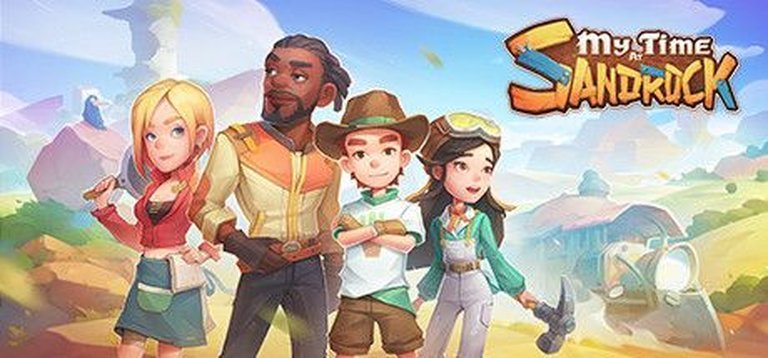
My Time at Sandrock is a simulation RPG set in a post-apocalyptic desert town. As a new builder, players must gather resources, craft machinery, and rebuild the community’s workshop to restore Sandrock to its former glory. The game features a rich narrative, relationship-building with townsfolk, farming, mining, and various activities within a dynamic day/night cycle and seasonal changes.
Gameplay Videos
Where to Buy My Time at Sandrock
My Time at Sandrock Free Download
Crack, Patches & Mods
Guides & Walkthroughs
Reviews & Reception
opencritic.com (75/100): Whether collecting resources, building items, or passing the day away playing minigames with townies, My Time at Sandrock is a joy.
ign.com (80/100): My Time at Sandrock is an excellent entry in an ever-growing list of cozy games, consistently fun while managing to stand apart from the crowd thanks to its theme of optimism grown out of hard times.
imdb.com (100/100): What a beautiful game~ Gameplay is great, can’t wait for more voice lines to be released and implemented! The characters are all so unique and enjoyable.
My Time at Sandrock: A Desert Oasis of Crafting, Community, and Conspiracy
As a sequel to the beloved My Time at Portia, My Time at Sandrock had enormous shoes to fill. Developed by Pathea Games and published by PM Studios and Focus Entertainment, this life-sim RPG not only meets but often exceeds the lofty expectations set by its predecessor. Set in a post-apocalyptic desert town struggling for survival, the game masterfully blends intricate crafting systems, deep social mechanics, and a surprisingly compelling narrative into a cohesive and addictive experience. This review will delve into every facet of Sandrock, from its development history to its lasting legacy, providing a comprehensive analysis of its place in the pantheon of cozy life-simulation games.
Introduction: The Builder’s Call to the Desert
In the vast, sun-scorched expanse of the Eufaula Desert, the town of Sandrock stands as a testament to both human resilience and folly. Once a prosperous boomtown fueled by the discovery of Old World relics, it has since dwindled into a struggling community on the brink of collapse. As a new Builder arriving from the prosperous city of Highwind, you are tasked with not just constructing machines and fulfilling commissions, but with revitalizing the very soul of this parched land. My Time at Sandrock is a game about hope, community, and the tangible impact of one’s labor. It takes the foundational mechanics of Portia and refines them, while transplanting the experience into a wholly new and challenging environment that demands innovation and perseverance. This review will argue that Sandrock is not merely a successful sequel, but a landmark title in the life-sim genre, one that expertly balances cozy comfort with gripping, high-stakes drama.
Development History & Context: Building on a Solid Foundation
Pathea Games, a Chinese independent studio, first found significant success with My Time at Portia in 2018. The game was praised for its charming world and engaging crafting loop, though it was also criticized for technical issues and a certain lack of polish. For their sequel, Pathea aimed to iterate and improve upon every aspect of the original.
The development of My Time at Sandrock was a community-driven endeavor from the start. In October 2020, the studio launched a Kickstarter campaign to fund the project. It was a resounding success, attracting nearly 10,000 backers from over 160 countries and raising $524,770—far exceeding its initial goals. This demonstrated the significant appetite for a follow-up and allowed the developers to dream bigger. The game was initially slated for an Early Access release in March 2021, but this was delayed due to the necessary process of obtaining a local rating certification in China. It eventually launched into Early Access on Steam on May 26, 2022, where it remained for over a year, allowing the team to incorporate extensive player feedback.
This period of Early Access was crucial. Pathea used it to refine systems, squash bugs, and expand the game’s content significantly, with major updates like the “Knives Out” update in April 2023 adding minigames, narrative content, and wedding mechanics. The full 1.0 release followed on November 2, 2023, for Windows, PlayStation 5, Xbox Series X/S, Xbox One, and Nintendo Switch, with a PlayStation 4 version arriving later in September 2024.
Built on the Unity engine with Wwise handling sound, the game represents a technical step up from Portia. The team, led by Director Xu Zhi and Executive Producer Li An, aimed to create a more visually diverse and mechanically complex world. The shift from Portia’s lush, green environment to a harsh desert required a complete rethinking of resource economies—water, not wood, became the lifeblood of both the town and the player’s workshop. This constraint was a deliberate creative decision to differentiate the sequel and provide a new set of challenges for veterans of the series.
Narrative & Thematic Deep Dive: Uncovering Sandrock’s Secrets
The narrative of My Time at Sandrock is its most significant improvement over its predecessor. What begins as a simple story of a builder helping a dying town slowly unfurls into a complex tale of conspiracy, betrayal, and redemption.
The Plot: From Dust to Drama
The game is set approximately 330 years after the “Day of Calamity,” an apocalyptic event that destroyed modern civilization. The player arrives in Sandrock, a town in the Alliance of Free Cities, which is locked in a cold war with the expansionist Duvos Empire. The initial hours are spent on typical life-sim fare: introductions, simple commissions, and learning the town’s rhythms. The central looming threat is Logan, a former local hero turned outlaw who allegedly destroyed the town’s water tower.
However, the story takes a sharp turn in the “Wham Episode” mission, “The Goat.” It is revealed that Logan is actually Good All Along, framed by a conspiracy within the town itself. His actions were a desperate attempt to expose a plot to hoard Sandrock’s water and weaken it for an impending invasion by Duvos. The conspirators—Yan (the lazy Guild leader), Miguel (the devout church official), Pen (the boastful superhero), and Matilda (the kindly mayor)—are revealed to be Duvos agents. This Halfway Plot Switch transforms the game from a cozy town simulator into a thrilling narrative about resisting occupation and uncovering the truth.
Themes of environmental conservation (Green Aesop), the dangers of unchecked technology (Lost Technology), and the importance of community are woven throughout. The narrative doesn’t shy away from dark moments, including the death of Logan’s father, Howlett, from a disease deliberately inflicted by Pen, and the subsequent Hostage Situation involving Haru and Andy. Yet, it consistently returns to its core theme: a belief in Sandrock and its people. The town’s motto, “Conserve Water,” evolves from a practical necessity into a symbolic rallying cry for resilience.
Characters: The Heart of the Desert
The characters are the soul of Sandrock. Unlike the sometimes-homogeneous cast of Portia, the residents here are remarkably well-developed with distinct personalities, backstories, and narrative arcs.
- The Builder (Player Character): While a silent protagonist, your actions define the town’s recovery. The story makes you the central hero without feeling unearned.
- Logan: The charismatic outlaw with a heart of gold, whose redemption arc is a driving force of the narrative.
- Grace: The Blue Moon Saloon’s cook who is secretly an agent for the Alliance’s intelligence service, providing crucial intel.
- Unsuur: A member of the Civil Corps whose deadpan humor and bizarre obsession with rocks (Shout-Out to Cast Away‘s Wilson) make him an instant fan favorite.
- Fang: The mysterious doctor who speaks rarely but carries a tragic past involving Broken Heart Syndrome (Takotsubo cardiomyopathy), which is explored in depth through his questline.
- Yan: A superb Hate Sink whose laziness and greed mask his deeper treachery.
The game avoids one-note characters. Even the villains, particularly Miguel, are given moments of Jerkass Has a Point and nuanced motivations, believing their harsh actions are for the greater good. The Continuity Nods to My Time at Portia, through characters like Higgins, Gust, and Albert, satisfyingly flesh out the shared world without relying on them.
Gameplay Mechanics & Systems: The Loop of Labor and Love
My Time at Sandrock features one of the most satisfying and complex gameplay loops in the genre, built on three pillars: crafting, socializing, and exploring.
The Core Crafting Loop
The Item Crafting system is the game’s backbone. As a builder, you accept commissions from the Commerce Guild to construct items for the town and its residents. This involves a multi-step process: gathering raw materials (scrap, wood, ore), refining them into usable parts (bars, plates, screws) using machines (furnaces, grinders, processors), and assembling the final product on an Assembly Station.
The desert setting introduces crucial twists. Thirsty Desert mechanics mean water is a vital resource for cooling your machines, adding a constant layer of management. Cutting down trees is heavily restricted, forcing players to rely more on recycling scrap metal—a brilliant Gameplay and Story Integration that reinforces the setting’s scarcity. The Equipment Upgrade path is clear and rewarding, with new tiers of tools and machines unlocked by spending Data Discs at the Research Center.
Combat and Exploration
Combat is a simple Hack and Slash system with four melee weapon types (sword/shield, daggers, spears, two-handers) and ranged options like the Awesome, but Impractical Vintage Assault Rifle. It’s serviceable, if not the game’s strongest suit, with critics like IGN noting dungeon design can be “a little too basic.” However, it provides a necessary break from crafting and is integrated well into story dungeons and boss fights against enemies like the Lizard Folk Geeglers.
Exploration is rewarded with rare materials, relics for the museum, and lore through Apocalyptic Logs scattered in ruins. The world is a Wide-Open Sandbox gradually unlocked as you repair Broken Bridges and complete major story projects like the tunnel to Portia.
Social Systems and Progression
The social system is deep and rewarding. Building relationships through gifts, conversations, and completing quests unlocks perks, discounts, and even assistance with your workshop. The Romance system allows you to date, marry, and have children with 21 characters, regardless of gender (Everyone Is Bi). The Relationship Values system is generous, with story events often granting points with the entire town, making it easy to become friends with everyone.
Anti-Frustration Features are plentiful and thoughtful. Chests are linked, so resources anywhere on your property can be used for crafting. The game speed is adjustable. Critical story missions often grant infinite stamina and pause the clock to prevent Unwinnable states. These smart designs smooth out the potential rough edges of a very complex game.
World-Building, Art & Sound: A Painfully Beautiful Wasteland
The art direction of Sandrock represents a significant evolution from Portia. While retaining the Super-Deformed character style, the models show more variety in body types and detail, averting the “noodle people” look of the first game. This Art Evolution makes the cast more distinct and expressive.
The world itself is a character. The desert is not a barren wasteland but a painted landscape of ochre mesas, rusted ruins, and a surprisingly vibrant oasis. The Deadly Dust Storm events are visually impressive, reducing visibility and bringing out dangerous monsters. The change of seasons affects the color palette dramatically, with winter bringing a Surprisingly Realistic Outcome light frost to the desert.
The sound design is equally superb. The soundtrack shifts seamlessly from upbeat, folksy tunes in town to tense, adventurous themes in the ruins. The voice acting, while not fully comprehensive, is used for key story moments and adds immense personality to the characters. The ambient sounds of whistling wind, chirping crickets, and humming machinery sell the atmosphere completely.
The World-Building is exquisite. Lore is found everywhere, from the Church of the Light—a religion formed after people emerged from centuries underground—to the corporate-cult Geeglers, who worship a tattered Geegle Company Handbook as a holy text. The setting feels lived-in and believable, a testament to the developers’ dedication to their creation.
Reception & Legacy: From Critical Acclaim to Cozy Staple
Upon its full release, My Time at Sandrock was met with widespread critical acclaim. On MetaCritic, it holds strong scores of 80/100 for both PC and PS5 versions, while the Switch version suffered with a 64/100 due to significant technical issues at launch. The aggregate MobyScore sits at a respectable 7.5.
Critics universally praised the game’s improvements over Portia. TechRaptor (90%) called it “a compelling and lusciously detailed life simulator,” while GLHF on Sports Illustrated (90%) hailed it as “easily the best life-sim of 2023” and compared its addictive quality to Stardew Valley. The depth of characters, the engaging story, and the refined crafting loop were consistently highlighted as major strengths.
The primary criticism, especially for the Nintendo Switch version, involved performance problems. Reviews from Nintendo Life (50%) and Digitally Downloaded (40%) described the port as a “crusty, stuttering mess” with long load times. However, post-launch patches have alleviated many of these issues, and the PC version was always considered the definitive way to play.
Commercially, the game has been a success, solidifying the My Time series as a major player in the life-sim genre. Its legacy is already evident. It demonstrated that a sequel could successfully change its setting and tone while deepening its mechanics. It also proved the viability of a more narrative-driven approach to the farming-sim format. The announcement of a sequel, My Time at Evershine, just a year after Sandrock’s release, is a testament to its impact and the confidence Pathea has in the franchise.
Conclusion: A Modern Classic Forged in the Desert Sun
My Time at Sandrock is a triumph. It is a game that understands the core appeal of its genre—the satisfying progression of building a life and a community from nothing—while having the confidence to tell a story with genuine stakes and dramatic weight. It avoids the Sequel Escalation trap of simply being “more,” instead opting to be “better”—more polished, more nuanced, and more compelling.
The game is not without its flaws. The combat can feel simplistic, the early game can be grueling (Early Game Hell), and the technical performance on consoles (especially at launch) was a legitimate blemish. Yet, these are minor quibbles in the face of its overwhelming achievements. The rich narrative, the deeply rewarding crafting systems, the unforgettable cast of characters, and the beautifully realized world all combine to create an experience that is both incredibly cozy and unexpectedly thrilling.
It earns its Happy Ending through player effort, making the sight of a revitalized Sandrock, green and prosperous, feel like a genuine accomplishment. My Time at Sandrock doesn’t just pass the torch from Portia; it raises that torch high, illuminating a path forward for life-simulation games. It is an essential play for any fan of the genre and secures its place as a modern classic.