
- Release Year: 2004
- Platforms: Macintosh, Windows
- Publisher: Cyan Worlds, Inc., Ubisoft Entertainment SA
- Developer: Cyan Worlds
- Genre: Compilation
- Perspective: First-person
- Game Mode: Single-player
- Gameplay: Adventure, Exploration, Puzzle
- Setting: Fantasy, Myst
Description
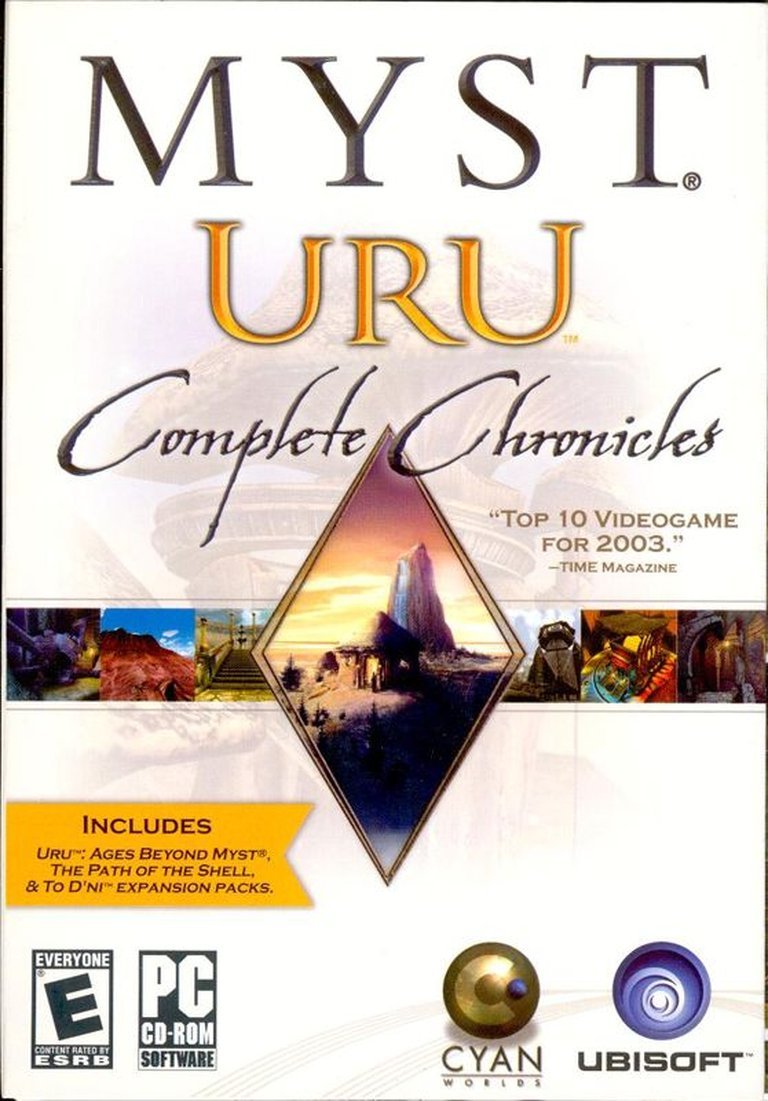
Myst Uru: Complete Chronicles is a compilation that bundles the adventure game Uru: Ages Beyond Myst with its two expansions, The Path of the Shell and the free To D’ni add‑on. Set in the ancient subterranean civilization of D’ni, players explore richly detailed ages, solve intricate puzzles, and uncover the mystery of the lost city while navigating a seamless blend of exploration and storytelling. The collection offers updated graphics, atmospheric soundscapes, and a complete narrative experience for both newcomers and longtime fans.
Where to Buy Myst Uru: Complete Chronicles
PC
Myst Uru: Complete Chronicles Free Download
Myst Uru: Complete Chronicles Patches & Updates
Myst Uru: Complete Chronicles Mods
Myst Uru: Complete Chronicles Guides & Walkthroughs
Myst Uru: Complete Chronicles Cheats & Codes
PC
| Code | Effect |
|---|---|
| Green, Orange, Orange, Green, Green and Orange | opens the Bevin Egg Room |
Myst Uru: Complete Chronicles: Review
Introduction
From the moment the first Myst box opened in 1993, a new paradigm of puzzle‑driven, atmospheric adventure was born. Eight years later, Cyan Worlds attempted to evolve that legacy into a living, breathing world with Uru: Ages Beyond Myst, and the 2004 compilation Uru: Complete Chronicles finally gathered the whole saga into a single package. This review argues that, despite the shattered ambitions of its online component, the Complete Chronicles stands as a masterclass in environmental storytelling, intricate puzzle design, and immersive sound‑scapes—yet it remains a niche experience that rewards patience more than reflexes.
Development History & Context
The Studio & Vision
- Cyan Worlds, Inc. – the original creators of the Myst series – spearheaded the project. Their ambition was to transform the static, pre‑rendered worlds of the early games into a networked, explorable 3D environment that could be experienced both offline and online.
- Ubisoft Entertainment SA acted as the publisher, providing the financial muscle needed for a multi‑platform release and the ambitious online infrastructure.
Technological Constraints
- The early‑2000s marked a transitional period for PC graphics: DirectX 8/9 was emerging, but many gamers still ran on modest hardware. Uru therefore adopted a moderately detailed polygonal engine that balanced visual fidelity with performance on a wide range of Windows PCs.
- The online component—intended as a persistent multiplayer “Uru Live” hub—relied on early broadband services that were unevenly adopted across the West. The failure of the service before many could log in, as noted by Game Chronicles, underscored the risk of tying a core narrative experience to an unproven network layer.
Market Landscape (2004)
- By 2004, the adventure genre had been eclipsed by action‑oriented titles, yet there remained a devoted core audience craving cerebral experiences. The release of Uru: Complete Chronicles (June 4, 2004) positioned itself as a collector’s edition aimed at both longtime fans and newcomers seeking a complete, offline experience.
- The compilation later appeared in the Myst: 25th Anniversary Collection (2019) and Myst: 30th Anniversary Collection (2023), cementing its status as an essential piece of the franchise’s heritage.
Narrative & Thematic Deep Dive
Plot Overview
Uru is set in the mysterious subterranean city of D’ni, a civilization that carved entire worlds—Ages—from stone. The player, a newly initiated explorer, is tasked with restoring these Ages after a catastrophic event known as the “Ruin”. The compilation bundles three narrative arcs:
- Uru: Ages Beyond Myst (2003) – the core adventure, introducing the ruins of D’ni and the first set of functional Ages.
- Uru: The Path of the Shell (2004) – a commercial expansion that deepens the protagonist’s connection to the “Shell”, a metaphysical conduit used by D’ni to travel between Ages.
- Uru: To D’ni (2004) – a free add‑on that reveals the origins of the D’ni people and expands on the lore surrounding their language and culture.
Characters & Dialogue
- The Guide, a disembodied voice, serves as both tutorial narrator and mythic storyteller, delivering cryptic yet poetic instructions that reinforce the game’s theme of discovery through introspection.
- Mysterious NPCs—the Stone Guardians, Cave Dwellers, and D’ni Scholars—appear primarily through environmental cues and occasional voice‑overs, emphasizing solitude and self‑reliance over traditional story‑driven dialogue.
Themes
- Memory & Preservation – The central mechanic of restoring Ages mirrors the act of preserving cultural memory.
- Isolation vs. Community – While the original online vision promised a shared world, the final product forces the player into a solitary quest, creating a tension that reflects the D’ni’s own fall from a thriving civilization to a forgotten ruin.
- Technology as Magic – The “Shell” blurs the line between advanced technology and mystic ritual, echoing early 2000s anxieties about the rapid digitization of everyday life.
Gameplay Mechanics & Systems
| System | Description | Strengths | Weaknesses |
|---|---|---|---|
| Exploration | First‑person navigation through semi‑open Ages, with contextual hotspots for interaction. | Encourages careful observation; tactile feedback (e.g., splashing water, creaking doors) adds realism. | No fast‑travel; traversal can feel tedious in larger Ages. |
| Puzzle Solving | Environmental puzzles that require manipulating objects, aligning symbols, and interpreting D’ni glyphs. | Deep, logical challenges that reward patience and pattern recognition. | Occasionally obtuse; lack of in‑game hints can frustrate newcomers. |
| Combat | Minimal; only a few scripted encounters (e.g., “Stone Guardians”) that rely on timing rather than reflexes. | Keeps focus on exploration and puzzle‑solving. | Players expecting action may feel “combat‑light”. |
| Progression | Unlocking new Ages and “Shell” abilities as story milestones are reached. | Clear sense of advancement; each new Age feels like a fresh world. | Linear progression; limited replayability once all Ages are restored. |
| UI & Controls | Keyboard‑mouse scheme ( WASD movement, mouse look, and context‑sensitive cursor. | Simple and intuitive for PC gamers. | No controller support; UI lacks a map, increasing the chance of getting lost. |
| Online Component (Scrapped) | Intended multiplayer hub where players could meet, share discoveries, and co‑solve puzzles. | Innovative concept for its time. | Abandoned before launch, leaving a gap in the original design vision. |
Innovation vs. Flaws
- Innovation: The “Shell” mechanic allowed players to “shift” between Ages without loading screens, pioneering a seamless world‑hopping experience later echoed in titles like The Legend of Zelda: Breath of the Wild.
- Flaws: The absence of a robust hint system and the lack of fast‑travel make the game feel punishing for modern audiences accustomed to convenience features.
World‑Building, Art & Sound
Visual Direction
- The Ages are rendered with high‑detail textures and dynamic lighting that change with the time of day, creating a living, breathing atmosphere.
- Environmental storytelling is paramount: crumbling stone arches, dust‑covered glyphs, and flowing water all convey history without exposition.
- Audio‑visual synergy: Running through puddles produces a realistic splash sound, wooden floors creak, and massive doors emit deep metallic clangs, as highlighted by Quandary.
Sound Design & Music
- The soundtrack blends ambient drones, ethereal choirs, and subtle percussive motifs, reinforcing the “eerie yet wondrous” mood.
- Positional audio cues (e.g., echoing footsteps in cavernous chambers) guide players toward points of interest, a design choice that enhances immersion.
Atmospheric Impact
- The combination of visual fidelity, tactile sound cues, and minimalist UI fosters a sense of solitary awe, making each new Age feel like an uncharted planet.
Reception & Legacy
Critical Reception (Launch)
| Outlet | Score | Notable Comments |
|---|---|---|
| Game Chronicles | 94% (9.4/10) | “Spectacular adventure… substantial content that completes the saga.” |
| Sydney Morning Herald | 80% (4/5) | “Mentally stimulating, worthy for those craving depth over combat.” |
| Quandary | 80% (4/5) | Praised graphics, music, and immersive sound effects. |
| PC Games (Germany) | 75% (75/100) | Recommended for adventure fans. |
- Player average: 2.6/5 (8 ratings) – indicating a split reception among the broader audience, likely due to the game’s niche pacing and the abandoned online component.
Commercial Performance & Evolution
- The compilation sold modestly, enough to warrant inclusion in later Myst anniversary collections and a Macintosh re‑release in 2018.
- Its legacy lives on through the Uru Live community, which later revived the online component via fan‑run servers, proving the original vision’s lasting appeal.
Influence on the Industry
- Uru’s seamless Age‑hopping inspired later open‑world games to implement instantaneous world transitions without loading screens.
- The environment‑first puzzle design contributed to a resurgence of “slow‑gaming” titles, influencing indie developers focused on atmosphere over action (e.g., The Witness).
Conclusion
Myst Uru: Complete Chronicles is a paradoxical masterpiece: a technologically ambitious adventure that faltered in its online aspirations yet delivered a deeply rewarding offline experience for those willing to engage with its deliberate pacing and cerebral challenges.
- Narrative depth – a richly layered mythos that rewards attentive exploration.
- Gameplay – meticulously crafted puzzles that feel like intellectual gymnastics, though occasionally opaque.
- Art & Sound – a harmonious marriage of visual detail and immersive audio that still feels fresh by today’s standards.
In the pantheon of adventure games, Uru: Complete Chronicles occupies a niche but vital position: it is the bridge between the static, pre‑rendered worlds of early Myst and the fully realized, interactive universes of modern open‑world design. For historians of the medium and patient puzzle‑solvers alike, it remains a definitive, if imperfect, chapter in the evolution of immersive storytelling.
Verdict: ★★★★☆ (4 out of 5 stars) – a landmark compilation that, despite its flaws, deserves a place on any serious gamer’s shelf.