
- Release Year: 2010
- Platforms: Windows
- Publisher: ak tronic Software & Services GmbH
- Genre: Compilation
- Game Mode: Single-player
- Average Score: 71/100
Description
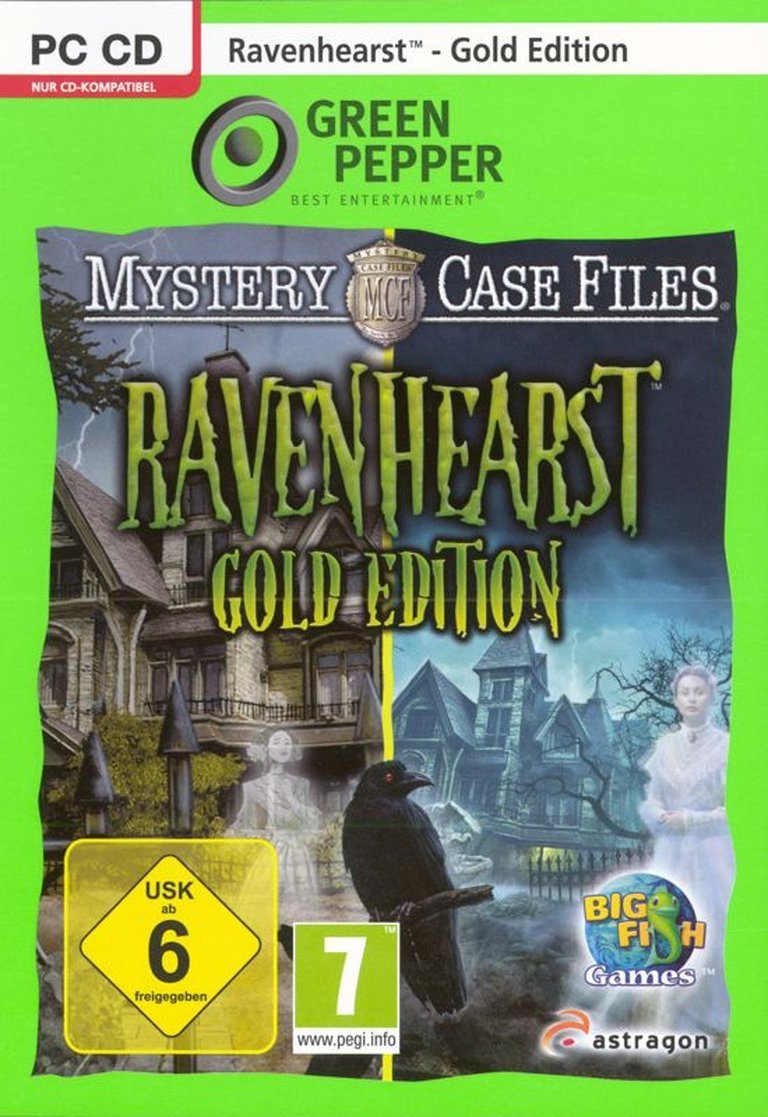
Mystery Case Files: Ravenhearst – Gold Edition is a compilation bundle released in 2010 for Windows, featuring two titles from the popular hidden object adventure series: ‘Mystery Case Files: Ravenhearst’ (2006) and ‘Mystery Case Files: Return to Ravenhearst’ (2008). Players delve into atmospheric mysteries, solving puzzles and uncovering secrets in the eerie Ravenhearst Manor, blending exploration, object-finding challenges, and narrative-driven gameplay typical of the series.
Mystery Case Files: Ravenhearst – Gold Edition Reviews & Reception
gamepressure.com (91/100): A recently acquired diary may hold the key to unraveling the history of this unsettling place, yet all the pages are missing. Only a Master Detective could possibly unlock the secrets held within Ravenhearst!
mobygames.com (80/100): Players Average score: 4.0 out of 5 (based on 1 ratings with 0 reviews)
jayisgames.com (86/100): Mystery Case Files: Ravenhearst is a perfect addition to any puzzle collection
metacritic.com (43/100): Never steps outside of its comfort zone
vgtimes.com (55/100): Players: 5.5/10
Mystery Case Files: Ravenhearst – Gold Edition: Review
A Haunting Compendium of Hidden Object History and Gothic Intrigue
Introduction
In the mist-veined annals of casual gaming history, few franchises loom as large as Mystery Case Files. This gothic-infused pioneer of the hidden object genre carved its name into the genre’s foundations with clattering skeleton keys and whispered secrets. At its heart lies Ravenhearst, a name that still echoes through the halls of Haunted House fiction. Mystery Case Files: Ravenhearst – Gold Edition (2010) packages two landmark titles—Mystery Case Files: Ravenhearst (2006) and Mystery Case Files: Return to Ravenhearst (2008)—into a single, sepulchral bundle. This review posits that this compilation isn’t merely a relic but a vital artifact, encapsulating the zenith of early HOPA (Hidden Object Puzzle Adventure) design: a blend of Victorian melancholy, labyrinthine puzzles, and the genre’s nascent flirtation with narrative ambition.
Development History & Context
Developed by Big Fish Games Studios, a titan of the casual gaming boom of the mid-2000s, Ravenhearst emerged during a watershed moment. The studio had already cemented its reputation with Mystery Case Files: Huntsville (2005), which shattered sales records with over $1 million in downloads within three months. Yet Ravenhearst represented a daring evolution. Technological constraints of the era—limited by dial-up-era download sizes and modest system requirements—forced ingenuity. Artists crafted intricate, hand-painted scenes teeming with macabre detail, while designers leaned into Rube Goldberg-esque door puzzles to elevate the genre beyond mere object hunts.
Released in December 2006, the original Ravenhearst leveraged Big Fish’s digital distribution dominance at a time when retail casual games were still fighting for shelf space. Its sequel, Return to Ravenhearst (2008), doubled down with live-action FMV sequences—a bold, resource-intensive gamble for a genre often dismissed as “time-waster” fare. By 2010, the Gold Edition compilation arrived via ak tronic Software & Services GmbH, targeting European markets with a physical CD-ROM release. Its arrival coincided with Big Fish’s pivot toward mobile and episodic content, making this bundle a swan song for PC-centric HOPA design.
Narrative & Thematic Deep Dive
Ravenhearst unfurls the tragedy of Emma Ravenhearst, an American teacher drawn into a doomed romance with the enigmatic Charles Dalimar in 1894 Blackpool. Her fragmented diary—recovered page by page—reveals a tale of manipulation, gaslighting, and eventual murder. The Gold Edition weaves this narrative across both games: the first frames Emma’s ghost pleading for liberation from her manor’s curse, while Return unearths Dalimar’s occult pursuits and Emma’s lingering wrath.
Unlike the popcorn mysteries of contemporaries, Ravenhearst leans into gothic archetypes with remarkable sincerity. Themes of entrapment—both literal (hidden rooms, spectral chains) and emotional (Emma’s psychological torment)—permeate every crumbling corridor. Echoes of Jane Eyre and Rebecca resonate in Dalimar’s brooding tyranny, while FMV cutscenes in Return (featuring actors like Davie-Blue Bacich) inject pathos into pixelated archaeology. Dialogue, though sparse, crackles with Victorian restraint: “He promised me the world, yet buried me beneath it,” Emma intones, her entries oscillating between fragile hope and chilling resignation.
The sequel amplifies the stakes, framing the player as an agent of the Crown investigating fresh vanishings tied to Dalimar’s dark experiments. It’s a narrative matryoshka: diaries, letters, and spectral echoes layer a tapestry of sorrow that elevates the series beyond mere genre trappings.
Gameplay Mechanics & Systems
The Gold Edition’s core loop is quintessential HOPA: scour cluttered rooms for listed objects, solve environmental puzzles, and unlock new areas dripping with dread. Yet both games innovate within these confines:
- Ravenhearst (2006) introduced multi-stage door puzzles, demanding players reassemble mechanisms like a clockwork carousel or a zoetrope-inspired lock. These sequences—requiring spatial logic and chain-reaction thinking—remain standout moments.
- Return to Ravenhearst (2008) expanded exploration into a semi-open manor, allowing free movement between rooms—a first for the series. Its puzzles leaned into adventure-game logic: combine inventory items, decode musical scores, or rewire Tesla coils.
The hidden object scenes oscillate between inspired and infuriating. Items are often devilishly obscured (a “tuba” camouflaged in wallpaper swirls; a “scalpel” tucked into book spines), demanding pixel-hunting precision. A limited hint system—recharging glacially—can frustrate, but the “Relaxed Mode” (unlimited time) softens the edges for narrative-driven players.
Critically, the UI is a product of its era: cursor-driven, minimalist, and occasionally clunky. Tooltips are scarce, and some puzzles (e.g., the infamous Tic-Tac-Toe lock in Return) suffer from unclear win conditions. Still, these friction points are outweighed by the satisfaction of cracking a vault-like door or uncovering a diary’s grim truth.
World-Building, Art & Sound
The Ravenhearst manor is a Gothic playground: dust-swirled libraries, vine-strangled conservatories, and shadow-drenched bedrooms evoke Hammer Horror grandeur. Return amplifies this with weather effects—rain lashes stained-glass windows; thunder rattles chandeliers—while expanding locales to include crypts and hedge mazes.
Visual design is meticulously handcrafted, marrying Edwardian opulence with decay. The palette is steeped in murky greens, blood reds, and arsenic yellows, punctuated by ghostly blues in spectral sequences. While some assets show their age (low-res textures, rigid animations), the art direction’s cohesion compensates.
Sound design is equally atmospheric: creaking floorboards, distant whispers, and Pamela Bruner’s mournful piano score drape every scene. Return’s orchestral arrangements—swelling with dissonant strings—heighten the dread, while Emma’s voice actress delivers diary entries with trembling vulnerability. The Gold Edition’s three-channel audio mixer (music/effects/ambience) remains a thoughtful touch, letting players tailor the terror.
Reception & Legacy
At release, Ravenhearst was a phenomenon: its 2006 debut sold 100,000 copies in six weeks, becoming the third-best-selling PC title during Black Friday 2007. Critics praised its “haunting production” (Gamezebo) and “innovative puzzles” (IGN), though some scorned its pixel-hunting tendencies. Return earned an Academy of Interactive Arts & Sciences nomination for “Casual Game of the Year” in 2009, cementing the series’ critical legitimacy.
The Gold Edition itself garnered scant press—compilations rarely do—but player reviews (4.0/5 on MobyGames) highlight its value as a gateway to HOPA’s golden age. Its legacy is undeniable: Ravenhearst’s DNA threads through modern narrative-driven hidden object titles like Rusty Lake and Tiny Bunny, while the series itself has ballooned to 28 entries as of 2025, with recent games (House That Love Built) revisiting the manor’s lore.
Yet its true impact lies in democratizing adventure gaming. By marrying approachable mechanics with gothic depth, Ravenhearst lured mainstream audiences into interactive storytelling—a bridge between Myst’s elitism and mobile gaming’s accessibility.
Conclusion
Mystery Case Files: Ravenhearst – Gold Edition is more than a nostalgia trip; it’s a testament to hidden object gaming’s narrative potential. While the genre has evolved—embracing 3D environments and voice-acting slickness—this compilation captures a raw, ambitious moment when casual games dared to be literary. Its flaws (dated UI, occasional obscurity) are eclipsed by atmosphere, ambition, and the haunting gravity of Emma Ravenhearst’s tragedy.
For historians, it’s essential: a showcase of how constraint bred creativity. For players, it remains a ghostly invitation—to wander candlelit halls, piece together fragmented lives, and confront the shadows lurking in Casual Gaming’s attic. In video game history’s grand manor, Ravenhearst’s door still creaks open, whispering secrets worth rediscovering.