
- Release Year: 2010
- Platforms: Windows
- Publisher: eGames, Inc., Freeze Tag, Inc.
- Genre: Compilation
- Game Mode: Single-player
- Average Score: 72/100
Description
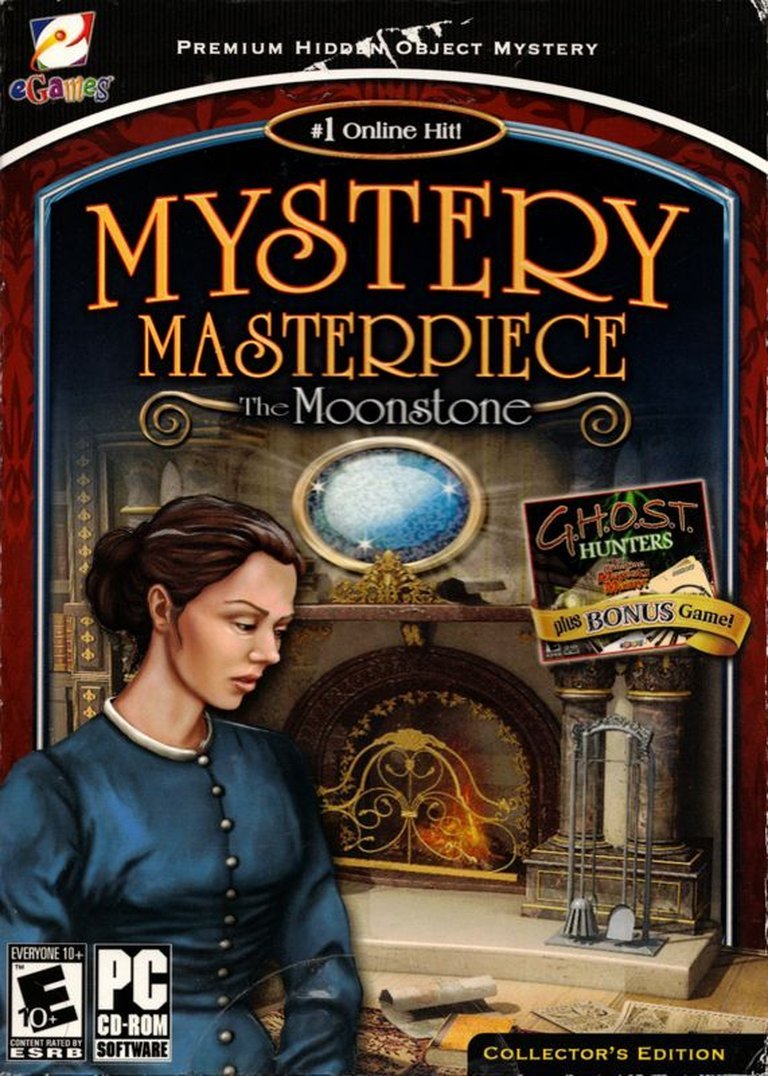
Mystery Masterpiece: The Moonstone (plus Bonus Game G.H.O.S.T. Hunters) is a compilation that includes two mystery-themed games. The main game, Mystery Masterpiece: The Moonstone, tasks players with solving the theft of a valuable jewel by investigating suspects and uncovering clues. The bonus game, G.H.O.S.T. Hunters: The Haunting of Majesty Manor, adds a supernatural twist as players explore a haunted mansion to uncover its ghostly secrets. Both games blend puzzle-solving and adventure elements in immersive, story-driven settings.
Gameplay Videos
Mystery Masterpiece: The Moonstone (plus Bonus Game G.H.O.S.T. Hunters) Guides & Walkthroughs
Mystery Masterpiece: The Moonstone (plus Bonus Game G.H.O.S.T. Hunters) Reviews & Reception
store.steampowered.com (72/100): A thrilling hidden object whodunnit with a mostly positive reception.
Mystery Masterpiece: The Moonstone (plus Bonus Game G.H.O.S.T. Hunters): A Comprehensive Retrospective
Introduction: A Hidden Object Classic Revisited
Mystery Masterpiece: The Moonstone (plus Bonus Game G.H.O.S.T. Hunters) is a 2010 compilation that bundles two distinct hidden object adventures: the 2009 detective mystery Mystery Masterpiece: The Moonstone and the 2007 paranormal thriller G.H.O.S.T. Hunters: The Haunting of Majesty Manor. This review will focus primarily on The Moonstone, a game that stands as a fascinating artifact of the late 2000s casual gaming boom, blending literary adaptation with interactive detective work. While often overlooked in the shadow of more mainstream titles, The Moonstone offers a uniquely structured narrative experience that merits deeper examination.
Development History & Context: The Rise of Hidden Object Games
Developed by Freeze Tag, Inc. and published by eGames, Inc. and HH-Games, Mystery Masterpiece: The Moonstone emerged during a golden age for hidden object games (HOGs). The late 2000s saw an explosion of casual titles, particularly in the mystery and adventure genres, driven by digital distribution platforms like Big Fish Games and Steam. Freeze Tag, known for its family-friendly and accessible games, sought to capitalize on this trend by adapting classic literature into interactive formats.
The game is directly inspired by Wilkie Collins’ 1868 novel The Moonstone, often considered one of the first detective novels in English literature. The developers aimed to translate the novel’s intricate plot and Victorian atmosphere into a gameplay experience that would appeal to casual gamers. The technological constraints of the era—modest system requirements (Windows XP/Vista, 512 MB RAM, 128 MB graphics)—meant the game relied on static 2D scenes rather than 3D environments, a common limitation for HOGs of the time.
Narrative & Thematic Deep Dive: A Victorian Whodunit
The Moonstone places players in the role of Detective Cuff, tasked with solving the theft of the eponymous diamond from the Verinder family mansion. The narrative unfolds across nine suspects, each with their own motivations, secrets, and alibis. The game’s structure is episodic, with each “case” dedicated to investigating a different character:
- Rachel Verinder – The heiress who inherited the Moonstone.
- Gabriel Betteridge – The family butler with a hidden past.
- Franklin Blake – Rachel’s childhood friend and potential love interest.
- Drusilla Clack – A religious zealot with a grudge.
- Godfrey Ablewhite – A philanthropist with financial troubles.
- Rosanna Spearman – A servant with a criminal history.
- Dr. Milton Candy – The family physician with questionable ethics.
- Raj Gupta – A traveling performer with ties to the diamond’s origins.
- Ezra Jennings – Dr. Candy’s ailing assistant.
The game’s dialogue and character interactions are minimal, relying instead on environmental storytelling and evidence collection to convey the narrative. Each suspect’s chapter is self-contained, allowing players to explore their respective areas of the mansion and uncover clues that either implicate or exonerate them. The writing, while not as nuanced as Collins’ original novel, effectively captures the Gothic tension and moral ambiguity of Victorian mystery fiction.
Themes of greed, deception, and class struggle permeate the story. The Moonstone itself serves as a MacGuffin, symbolizing both wealth and curse, a motif that aligns with the era’s fascination with colonialism and exoticism. The game’s conclusion—where players must accuse the correct suspect—reinforces the idea that truth is often hidden beneath layers of deception.
Gameplay Mechanics & Systems: The Hidden Object Formula
The Moonstone adheres closely to the hidden object genre’s core mechanics, with a few innovative twists:
Core Gameplay Loop:
- Static Scenes: Players explore pre-rendered 2D environments, searching for items listed in a sidebar.
- Inventory System: Tools and clues are collected and stored for later use, often requiring players to revisit scenes.
- Puzzle Integration: Mini-games and puzzles (e.g., reassembling letters, decoding ciphers) break up the hidden object segments.
Innovative Elements:
- Non-Linear Investigation: Unlike many HOGs, The Moonstone allows players to tackle suspects in any order, encouraging replayability.
- Evidence Board: A central hub where players review collected clues, reinforcing the detective fantasy.
- Tool-Based Interaction: Items like magnifying glasses, brushes, and axes are used to uncover hidden evidence, adding a layer of interactivity beyond simple item hunting.
Flaws & Limitations:
- Repetitive Structure: The game’s episodic nature can feel formulaic, with each suspect’s chapter following a similar pattern.
- Limited Feedback: The lack of dynamic dialogue or character reactions reduces immersion.
- Hint System: While unlimited, the hint recharge timer can frustrate players stuck on particularly obscure items.
World-Building, Art & Sound: Victorian Aesthetics
The game’s visual design is a standout feature, capturing the opulence and claustrophobia of a Victorian mansion. Each room is meticulously detailed, from the ornate furniture of Rachel’s bedroom to the gritty realism of the servants’ quarters. The art style leans into Gothic romanticism, with muted colors and dramatic lighting that evoke the era’s aesthetic.
Sound design is minimal but effective. A piano-heavy score underscores the mystery, while ambient sounds (e.g., creaking floorboards, distant thunder) enhance the atmosphere. The lack of voice acting is noticeable but understandable given the game’s budget and scope.
Reception & Legacy: A Cult Classic
Upon release, The Moonstone received mixed but generally positive reviews. Critics praised its faithfulness to the source material and engaging puzzle design, though some criticized its repetitive gameplay. On Steam, the game holds a “Mostly Positive” rating (72% positive from 11 reviews), with players highlighting its relaxing pace and satisfying detective work.
The game’s legacy is modest but enduring. It represents a bridge between literature and gaming, proving that classic stories could be adapted into interactive formats without losing their essence. While it didn’t spawn sequels, its success helped solidify Freeze Tag’s reputation in the casual gaming space.
Conclusion: A Hidden Gem Worth Uncovering
Mystery Masterpiece: The Moonstone is a flawed but fascinating entry in the hidden object genre. Its literary roots, Victorian atmosphere, and non-linear investigation set it apart from more generic HOGs. While its gameplay can feel repetitive, the satisfaction of piecing together clues and uncovering the truth makes it a worthy experience for fans of mystery games.
Final Verdict: A 7.5/10 – A well-crafted adaptation that honors its source material while delivering a engaging detective experience. Best enjoyed by those who appreciate slow-burn mysteries and atmospheric storytelling.
For modern players, The Moonstone serves as a time capsule of the late 2000s casual gaming scene, offering a glimpse into how developers experimented with narrative and gameplay in the hidden object genre. While it may not be a masterpiece, it’s certainly a hidden gem worth uncovering.