
- Release Year: 2011
- Platforms: Windows
- Publisher: Frogster Interactive Pictures AG, HanbitSoft, Inc.
- Developer: T3 Entertainment, Inc.
- Genre: Role-playing (RPG)
- Perspective: Diagonal-down
- Game Mode: MMO, Single-player
- Gameplay: Action RPG, Crafting, Experience point system, Free to play, Indirect combat, Massively Multiplayer, Randomly generated dungeons, Real-time, Skill Tree
- Setting: Fantasy
- Average Score: 52/100
Description
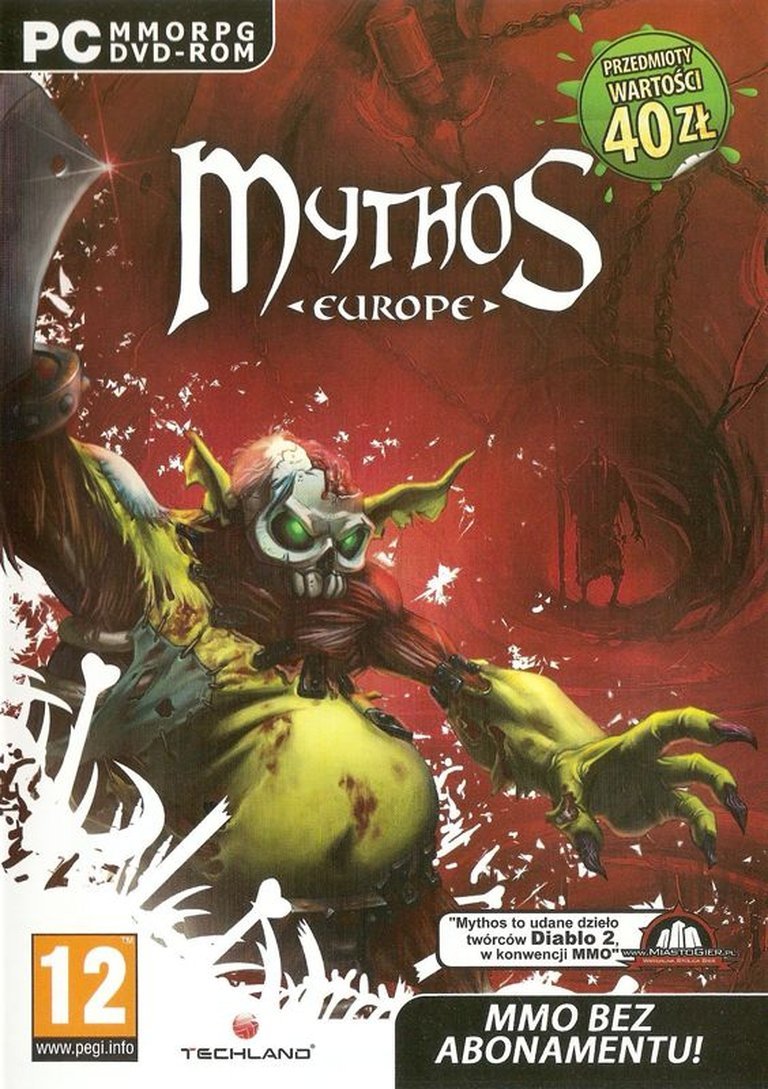
Mythos is an online action RPG set in the monster-plagued fantasy realm of Uld, where players take on the role of adventurers from one of four races (gremlin, cyclops, satyr, or human) and three classes (mage, fighter, or archer). The game emphasizes real-time dungeon crawling through randomly generated, instanced dungeons, with combat that is largely automated after selecting basic actions like attacks or spells. Outside of dungeons, players gather in cities to form groups, take on quests, and prepare for further expeditions. Character progression follows a traditional experience point system with level-ups allowing for stat and skill tree customization, while loot and crafting—using recipes and ingredients—provide gear customization. Originally free-to-play with microtransaction-based boosts, the 2022 re-release shifts to a commercial, singleplayer-only model, retaining the core gameplay of loot-driven dungeon clearing and character empowerment.
Where to Buy Mythos
PC
Mythos Free Download
Patches & Updates
Mods
Guides & Walkthroughs
Reviews & Reception
metacritic.com (52/100): Mythos is a very mediocre game. It’s not a bad creation but it lacks some standard qualities.
pcgamer.com (43/100): Occasionally satisfying combat cant overcome a bland world, unbalanced skills and obtuse crafting systems. What a mess.
mobygames.com (63/100): Mythos is an online role-playing game with a very basic storyline: The land Uld is hounded by monsters and the players have to kill them.
Mythos: Review
Introduction: The Forgotten Heir to the Diablo Throne
In the pantheon of action RPGs, a few games achieve true immortality, their influence radiating through decades of design. Diablo (1996) was one such title, birthing a genre built on loot, randomization, and the relentless dopamine drip of monster mashers. But what happened when the masters of that genre – the architects of Hellgate: London, the Seattle offshoot of Diablo‘s creators, and the mind behind FATE – set out to build a spiritual successor? The answer, tragically, is a game that should have been a landmark, but instead became a cautionary tale about ambition, crumbling studios, and the cyclical nature of failure and rebirth: Mythos (2011).
Mythos is a game of extraordinary paradoxes. It is a free-to-play MMORPG that, conceptually, feels like a dense, single-player Action RPG. It is a game developed by multiple studios (Flagship Seattle, then T3 Entertainment/Redbana, then Hanbitsoft), yet its core design, forged in its Flagship Seattle days, remains surprisingly coherent. It is a game created with the explicit vision of recapturing the Diablo magic by its lead architect, Travis Baldree, yet released into a world that had long since moved on to Diablo III, Torchlight II, and the reincarnation of Baldree’s vision in the very studio formed from Mythos‘ ashes: Runic Games (Torchlight, Tomb Raider, ChronoBlade). At its heart, Mythos is not just a game about a monster-infested world of Uld, but a meta-narrative about the struggle to bring a visionary game to light in an unforgiving industry.
My thesis is this: Mythos is a critically flawed, structurally unsound, and commercially failed game, yet it is also profoundly significant. It is a diary of a dream – a collaboration between genius and oblivion. Its core gameplay, a distillation of Gen 1 ARPG principles, showcases brilliance blighted by premature birth under a fractured corporate lineage, yearning for a World-Architect’d scope that its MMO restraints could never realize. Its ultimate legacy isn’t in its commercial success (it achieved none), but in its pathological demonstration of why the core ARPG design invented by Baldree & colleagues works, and why the MMO framework fundamentally doesn’t. It’s a monument to ossified design principles, a warning about studio collapse, and an essential chapter in the evolution of hack-and-slash ARPGs, best studied not as a product, but as a historical event.
Development History & Context: Birth Amidst the Collapse of Hellgate
The Mythos story is less about code release and more about corporate apocalypse. Its roots lie in the late 2000s, in the Seattle offshoot of Flagship Studios, formed largely by ex-Blizzard North veterans (the very team that crafted Diablo and Diablo II). This team, led by Travis Baldree (creator of FATE, future Runic Games co-founder) and Max Schaefer (another core Diablo architect), wasn’t just aiming to capitalize on Hellgate: London‘s (2007-2008) engine and technology. Their ‘Project Tugboat’ (the original codename) was a parallel, smaller-scale testbed – a refiner of their beloved ARPG principles for an online world. By late 2006, Tugboat had blossomed into a fully independent title, Mythos, to be built on the same Pangea engine powering Hellgate. This was key: Mythos wasn’t a dig: network ARPG; it was the same foundational tech stack as Hellgate, repurposed for a leaner, more focused ARPG.
Flagship’s dream was simple, yet audacious: recreate Diablo’s magic online. Randomized instancing, loot entropy, satisfying class builds (initially three: Mage, Fighter, Archer, later expanded with Storm Hunter, Spellhowler, etc.), and that addictive core loop. A closed beta started in 2007, with an open beta expected mid-2008. July 19, 2008: The Betrayal. Flagship Studios, wracked by financial troubles (largely due to the catastrophic failure of Hellgate: London) imploded. Mythos entered limbo, its beta clients closed. The 14-person Seattle team, literally the heart of Mythos‘ design, dissolved. Almost immediately, Baldree, Schaefer, and 12 others founded Runic Games. Baldree’s public statements (e.g., WarCry Interview) confirm they pivoted to build a new single-player ARPG: Torchlight, explicitly citing Mythos‘ limitations and Flagship’s collapse as the catalyst. Torchlight (2009) is the soul of Mythos incarnate: snappier combat, richer loot, a tighter narrative, and no MMO gating.
But Mythos wasn’t dead. The IP and assets transferred to HanbitSoft, a Korean MMO publisher. In 2009, HanbitSoft’s subsidiaries T3 Entertainment and Redbana took over leadership. “Alboos,” a designer on the new team, stated they were restructuring Mythos to be “more suited as an online game.” This was a cataclysmic shift in philosophy. The Flagship vision: randomized, loot-curse ARPG diegesis MMO, where the joy was in shared, emergent, quick-play sessions (hallmarks of Baldree’s FATE and the Diablo ethos). The Redbana/T3 vision: a western-style Standard Korean MMO gacha experience – grind, level caps, real-money power, shallow progression queues. Beta registration opened in 2009. The 2011 release (April 12th, open beta; April 28th, “official” launch) was the zombie of a brilliant idea. The code base integrated bits of Baldree’s genius, but it was shackled to Korean MMO design dogma, the tech borrowed, the vision warped.
Narrative & Thematic Deep Dive: The Void Where a Story Should Be
Mythos‘ narrative is the most revealing flaw of the Redbana/T3 reformation: there is no narrative. Or rather, there is only the thinnest, pixel-thick veneer.
The Lipstick on the Skeleton
The core premise: “The land Uld is hounded by monsters and the players have to kill them.” This isn’t just lackluster; it’s a desecration of the Flagship Pacific vision.. The Flagship Seattle team, drawing directly from *Diablo‘s success, understood the value of diegetic integration: the game world exists because the core loop is the world. The dungeons aren’t “maps” – they’re the remnants of a shattered civilization, the domains of dead gods, the nightmares of a corrupt land.
Mythos‘ “story” is a text file of primary quests (GameFAQs confirms this: “primary quests or no?” “Dejanji” replies: “Not really unless you count the quests the townspeople… give as the story for each town/area”). There are quest givers with lore dialogues (if you squint): the Temple of Elore, the town of Sanctuary, mentioning Tinus, chroniclers, and forgotten kings. But these are diyesthetic speed bumps, not narrative beats. They are the equivalent of paid-to-see websites that force you to read a few paragraphs of “story” before the loot tables.
Thematic Vacuum & the Obscene Scale of Limitation
Fundamentally, Mythos lacks themes. Compare this to the games that shaped ARPGs and its contemporaries:
– Diablo II (2000): Evil as a physical manifestation of forgotten sins, the fragility of man against cosmic forces, the perversion of divine power.
– FATE (2005): Baldree’s own work, a tight, thematically rich narrative centered on a single monster’s curse and the hero’s journey to break it.
– Recettear: An Item Shop’s Tale (2007): A game entirely about the ecological & economic cost of adventuring.
– Torchlight (2009): A gorgeously realized steampunk/eldritch horror pastiche; every carcass on the floor is a clue to a deeper world.
Mythos has only the form of decay: recurring dungeons, loot prettiness, and monster stats. There is no exploration of Uld’s societal decay, the monsters’ origins, the psychology of loot greediness, or the existential dread of a world where the only purpose is killing for better gear. The “Shadow War” hinted at on the now-broken Mythosgame.com, with Factions like the Brotherhood of Belial and Priory, suggests a deeper multiversal struggle – the very essence of the “Mythos” concept from the Reddit thread (lore > plot!). This was the Flagship Seattle vision: a palpable, mythologically rich world. The Redbana/T3 version? A reskinned FATE MMO with better loot tables. The “Epic campaigns using the narrative guide” mentioned on the site are player-created, not authored – a symptom of the lack of a real, master-directed story.
The Final Tragedy: The Cthulhu Connection
The game’s name, “Mythos”, is a deep cut. It directly references the Cthulhu Mythos, H.P. Lovecraft’s communal universe of eldritch horror, forbidden knowledge, and cosmic insignificance. The Factions (Brotherhood of Belial, Path of Chronozon, Silver Venators, Soul Hunters, Wyldborne) feel like borrowed elements from Lovecraftian wargames (e.g., Cubicle 7’s Mythos), not integrated themes. The setting (Gothic archways, tentacled bosses, “Mythos” resource) is thematic window dressing. The game offers no true existential dread, no madness spirals, no body horror – the very soul of Lovecraft. A game titled Mythos that misunderstands its namesake is a museum without exhibits. This isn’t just bad narrative; it’s an intellectual bankruptcy.
Gameplay Mechanics & Systems: The Germanic Beat of a Korean Gacha Hammer
Mythos’ gameplay is a Frankenstein monster, stitched from the genius of Baldree to the gacha mechanics of T3/Redbana. Its core systems reveal the tension.
The Flagship Core: ARPG Essence
- Class System (Mage, Fighter, Archer, etc.): Deep. Each has unique ability trees. As noted by PC Games (Germany): “Fähigkeitenbäume große Unterschiede auf.” (Skill trees have great differences) – indicating real mechanical differentiation. The 5/2 stat allocation (5 general / 2 specialty) echoes Diablo II‘s simplicity. The combat loop is direct: “indirect… players only choose… standard, special, spell… click on monster – rest is automatic.” This is pure Diablo 2.0: the decision (attack type) is chosen by the player, the execution (animation, hit check) by the AI. But crucially, it’s snappier and more direct than most Western MMOs (which are more about status effects and slow, crowd-control fights). This reflects Baldree’s FATE DNA – simple inputs, complex outcomes.
- Itemization & Crafting: The “hundreds of items… loot drops… treasure chests… big chest… key” is Diablo’s leyline. Randomization of suffix/prefix, quality tiers, the “basic” loot, the boss chest – this is the genre’s core dopamine engine, untouched. Crafting (recipes, ingredients) adds a layer of emergent complexity, a nod to Diablo’s blacksmith.
- Progression: The experience point system, infinite grind, skill tree points, and the implicit “kill monsters, get loot, use loot, repeat” is the platonic ideal of the ARPG loop.
The Redbana/T3 Flesh: MMO / Gacha Insanity
This is where everything collapses. The Redbana/T3 reformation:
– Killing the Open World: The only open areas are cities. All dungeons are randomly generated instances. This isn’t just a limitation; it’s a core design betrayal. The Flagship dream was a shared world with emergent, communal loot-hunting (like Diablo‘s “Ancient’s Prophecy” multi-player sessions, or Torchlight‘s Tangledisland). The Redbana version turns every dungeon into a private loot tunnel, destroying the social, communal essence of ARPGs. It turns the game into a “Dungeon Grinder” – a phrase that is the epitome of failure in the genre.
– The “Free-to-Play” / Paygate Model: The shop sells “advantages with real money, e.g. identification spells or experience boosts.” Destiny’s Child were punks; this is the literal transhumanization of capitalism within a game. It gates basic progression (XP boosts are paywalled!?) behind real money. It destroys the ludic integrity of the reward loop – if you pay, you skip the core of the game. It’s video game hell.
– The “Progression Gate” & Endgame: Gameplay (Benelux) notes: “te weinig afwisseling.” (Too little variation). Eurogamer: “The best thing about Mythos is that it is free. Then again, you’d probably get more hours of play out of a free trial for almost any other MMO.” This is the Redbana/T3 design philosophy laid bare: shallow content with artificial depth via pay/player aggression. There are no dungeons with thematic names, lore integration, or environmental puzzles. The variation is map randomization, number scaling, and mission types (kill, escort, etc.) – the soulless, algorithmic loot core of Korean MMOs. The “variation” Gameplay mentions is the depth of the loot pool, not the player’s experience of it.
The UI & Control: The Flagship Grit, Buffed by Korean Optimization
The UI is Diablo-esque: Hotbar, life/mana potions, skill bars. But it’s buffed with Korean MMO standards: cleaner, more responsive, better tooltips, better inventory management. The diagonal-down perspective is faithful to the 90s ARPG heyday. Controls (keyboard, mouse) are standard, functional.
World-Building, Art & Sound: The City in the Ruins
The Aesthetic: Gothic Metal & The Cruelty of Scale
The art direction is Gothic Pulp, leaning hard on Dark Souls Lite. Think heavy armor, dimly lit crypts, stained glass, skulls in chains, crucified dragons. It’s not horror, but definitely not cartoony. The cities (Sanctuary, Bastion) are clusters of gargoyle-topped spires, rain, fog, and torchlight – clearly inspired by the Hellgate: London art book pages for “The London Underground” level. The monsters are highly detailed: grotesque hybrids, possessed beasts, classical demons. The “big chest” loot animation (a triumphant fanfare, a glowing prize) is designed to trigger the loot addiction. This is the Flagship aesthetic: rich in texture, devoid of soul.
The World of Uld: Rooms, Not a Ruin
But the world isn’t a ruin; it’s a collection of rooms. The cities are the only open-world elements, and they are sad, lonely outposts – “sanctuaries” that feel more like loading screens than places. This is the physical manifestation of the MMO instance model: no world to explore, only zones to teleport to. Compare this to the infinite, labyrinthine, hand-curated ruins of Diablo II, or Torchlight‘s hand-sculpted maps, or even FATE‘s seamless dungeons. Mythos‘ world is ethereal, non-existent. It’s not a world; it’s a menu of instances.
Sound Design: The Roar of the Void
Sound, designed by Derrick Kim (AIL/Miles, FMOD), is critical. The combat sound design is functional: weapon thumps, spell booms, loot clinks. But the ambient city sound – rain, wind, distant moaning – is excellent. It mimics the Flagship aesthetic. The loot fanfares are pure dopamine-hit engineering. The dungeon crawl loop is the engine of a near-vibrant game, if only the environment weren’t so procedurally generated and the world so flat.
Reception & Legacy: The Ghost of the 63% Metascore
Launch & Critical Reception (63% Metascore)
The game launched to a 63% Metascore (4 reviews):
– GameStar (75%): Praised its core loop, calling it “groß” (big). Compared it to Dungeon Runners (2007), lamenting its lack of self-irony (vs. Dungeon Runners‘ satire). See it as a “free kill-fest” until Diablo III.
– PC Games (71%): Admitted the shallow story (“Story lasst sich kaum nachvollziehen”) and dialogue (“Dialoge zu den monotonen Sammelquests… wegklicke”), the unclear progress (“Steigenweise wird auch überhaupt nicht klar”), and “viel Zeit mit stupidem Herumlaufen”. But: “taugt [Mythos] als kostenlose Unterhaltung” – a {free-time-passer}. Praised deep skill trees.
– Gameplay (65%): “potentieel zit in Mythos,” but “te veel problemen” and too little variation (“te weinig afwisseling”). Hoped for change.
– Eurogamer (40%): The killshot. “The best thing about Mythos is that it is free… you’d probably get more hours… out of a free trial for almost any other MMO.” Called getting involved a “mysmtake” (“mythstake”). Noted the T2 release timeline (Torchlight II was 2 months away).
Player Reception: A Niche Cult, Not a Hit
Player score: 4.4/5 (2 ratings). Extremely low sample size, but the fact that two players rated it 4.4 speaks volumes. These are the die-hards – the ARPG purists who could tolerate the MMO gating, the paywalls, the lack of a narrative, for the loot gravity – a population on the scale of Baldree’s original FATE fanbase. This is the testimony of the core.
The Discontinuation (2011-2014): The Business Model Failure
Frogster shut Europe servers October 27, 2011, after just over a month. T3 launched Mythos Global beta Feb 2, 2012. Jan 22, 2014: Full shutdown. Why? The Korean MMO model failed the West. The real-money shop, shallow content, and grind alienated Western ARPG fans. The lack of a world, story, or satisfying endgame (a desperate need for ARPG players) crushed retention. The fundamental mismatch between vision and execution killed it.
Legacy: The Runic Games Prophecy Fulfilled
Mythos‘ legacy isn’t in its servers. It’s in the studio that birthed it, then discarded it, then RENEWED IT. Runic Games, founded by the Mythos Flagship Seattle team. Travis Baldree’s Torchlight (2009) is not a “spiritual successor”. It is the Manifesto of Mythos‘s *artistic death and rebirth. *Torchlight fixed every flaw of Mythos: private instances, no meaningful loot progression, paywall to fun, weak world. It added rich hand-crafted maps, narrative beats, loot depth, and crushing mob balance. It proved Baldree’s core ARPG principles were golden – they just needed a single-player, non-gacha, narrative-driven framework. Mythos is the cautionary tale that birthed Torchlight.
The 2022 Hanbitsoft Steam release (single-player) is irony incarnate. It dumps the MMO, shop, and most social systems. It’s a stripped-down loot timer, a FATE clone. In removing the Redbana/T3 layer, it reveals the last fossil of the original Flagship vision – a vastly inferior Torchlight. It’s not a renaissance; it’s a museum exhibit of a failed revolution.
Conclusion: The Dual Postmortem – A Necronomicon of ARPG Lesson
Mythos is two games.
The first is the Flagship Seattle vision: a seamless, loot-driven, diegetic, shared-world ARPG MMO, designed by the Diablo masters, Travis Baldree, and the FATE creator. It was a near-miss – a Bhangra dance in the graveyard of Hellgate: London. It had the core mechanics (clipping, loot, class depth, randomized instances as shared loot zones) to be a genre-redefining game. Its failure was borne of a studio collapse and a shattered team.
The second is the Redbana/T3 vision: a “Dungeon Grinder” MMO with Korean business model insanity – gacha loot, pay-to-XP, infinite algorithmic content, zero narrative. This is the game that launched: a corpse. Its failure was born of a broken philosophy, a cultural mismatch, and a fundamental misunderstanding of the ARPG genre.
The Final Verdict: Annex to the Necronomicon of ARPG History
In the canon of video game history, place Mythos not on a pedestal, but in the Necronomicon of Cautionary Tales – next to Earthrise (2010), Conan (2007), and Warhammer Online (2007). It is not a “Bad Game”. It is a “Tragically Flawed Game” – a Darwin Award winner in game design. It proved the undying truth of Baldree’s design principles with its mechanical bones, then buried them under the shallow grave of Korean MMO dogma.
It is, critically, unalive. Commercially, it failed. Artistically, it died in 2011. But its historical significance is immense. It is the missing link between Diablo II (2000) and Torchlight (2009). It is the dark side of the “indie ARPG resurgence” – the cautionary tale of how not to monetize a pure ARPG. It showed, posthumously, why leaving the world to be discovered (by players) is essential to the genre (as the Reddit thread’s wisdom dictated: “lore > plot!”). It proved that core ARPGs cannot be “freemium” without destroying their soul. And it stands as a *monument to the creative destruction of corporate failure and the perfect environment for the genius of Travis Baldree to finally, fully bloom at Runic Games, ironing out *Mythos‘ every flaw with the dials turned to 11.
Mythos is not a game you play. It is a game you study. For ardent ARPG fans, scholars of game development, and historians of the genre, its 63% Metascore is the most important 1 of all: it is the score that measures the distance between a visionary Team 1 (Flagship Seattle) and a greedy, reductive Team 2 (Redbana/T3). In that score, the future of ARPGs was forever changed. Its name, Mythos, is both its greatest irony and its greatest triumph. It wasn’t kind, nor cosmic, nor horrific.
But it was a lesson. And lessons, in the genre of the loot prayer, are the rarest drops of all.