
- Release Year: 2007
- Platforms: Windows
- Publisher: Her Interactive, Inc.
- Genre: Compilation
- Game Mode: Single-player
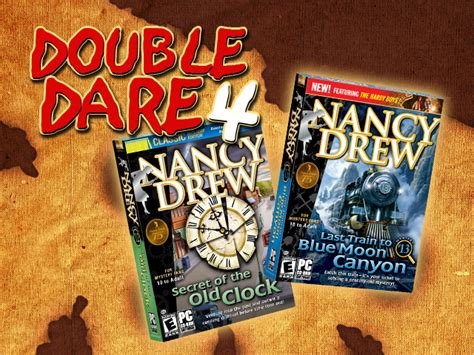
Description
Nancy Drew: Double Dare 4 is a Windows compilation released in April 2007 by Her Interactive, bundling two standalone adventure games from the Nancy Drew series. The package includes ‘Secret of the Old Clock,’ an adaptation of the first Nancy Drew book where she investigates a hidden heirloom and treasure, and ‘Last Train to Blue Moon Canyon,’ a SuperMystery that teams her with the Hardy Boys to solve a train-based mystery. Both games feature classic point-and-click gameplay with puzzles, clue collection, and detective work as players explore immersive settings.
Nancy Drew: Double Dare 4: A Foundational Compilation in the Archival of a Pioneering Series
Introduction: The Digitization of a Literary Legacy
In the long and storied history of licensed video games, few franchises have demonstrated the consistent quality, cultural sensitivity, and sustained commitment to its core audience as the Nancy Drew series, masterminded by Her Interactive. Entering its ninth year of development by 2007, the series had already established itself as a benchmark for “games for girls,” smuggling complex puzzle design, engaging mysteries, and strong, intelligent protagonists into a market often underserved. Nancy Drew: Double Dare 4 arrives not as a novel entry, but as a curated artifact: a physical compilation package bridging two distinct eras of the series’ evolution. Released in April 2007 for Windows under a co-publishing agreement between Her Interactive and Atari, this title contains Secret of the Old Clock (2005) and Last Train to Blue Moon Canyon (2005). My thesis is this: Double Dare 4 is less a game and more a deliberate archival act, a snapshot of Her Interactive’s mid-2000s peak that prioritizes accessibility and value over innovation. Its significance lies not in what it adds to the series, but in how it packaged and preserved two pivotal titles, making the franchise’s foundational narrative roots and its first major stylistic departure available to a broader, budget-conscious audience at a critical juncture before the digital storefront era.
Development History & Context: The “Double Dare” Era and the Mid-2000s Compilation Strategy
The “Double Dare” sub-series was Her Interactive’s primary vehicle for bundling its individual titles into value packages during the mid-to-late 2000s. Following Double Dare (2004), Double Dare 2 (2005), and Double Dare 3 (2006), Double Dare 4 continued this pattern. The studio, under the leadership of visionary CEO Megan Gaiser, had by 2005 perfected its signature formula: a first-person, point-and-click adventure engine built on pre-rendered 2D backgrounds with live-actionStill photographs for characters. This tech was not cutting-edge but was meticulously applied, creating a stable, accessible, and atmospheric experience.
By 2007, the gaming landscape was shifting. Digital distribution via Steam was gaining traction, but physical retail remained dominant, especially for casual and family-oriented titles. Compilation discs like Double Dare 4 were a retail stalwart, a way to offer significant playtime (30+ hours between two full games) at a price point attractive to parents and gift-givers. The partnership with Atari for publishing/distribution here is key; it provided Her Interactive’s niche products with the muscle of a major label’s retail presence. Technologically, these games represent the tail end of the pre-processor-intensive era for Her Interactive; they run smoothly on modest Windows XP/Vista hardware, a practical necessity for their target demographic of school-aged players and family computers. The compilation itself required no new development—it was a logistical and marketing exercise—but its existence speaks to a business model focused on maximizing the shelf life and revenue of each released title.
Narrative & Thematic Deep Dive: A Tale of Two Mysteries
Double Dare 4 presents a study in contrasts, pairing the series’ first direct adaptation of a classic Carolyn Keene novel with its first major foray into an original Hardyman Boys crossover plot.
1. Nancy Drew: Secret of the Old Clock (2005):
This is the foundational text. Adapting The Secret of the Old Clock (1930), the first Nancy Drew book ever published, Her Interactive navigated the delicate task of translating a 75-year-old, culturally specific text into an interactive experience. The plot: a teenage Nancy, in the midst of a family vacation, investigates the strange behavior of Emily Crandall, a young heiress whose inheritance is being contested by a group of unscrupulous relatives. The setting is a meticulously reconstructed 1930s River Heights—the opulent, slightly decaying Lilac Inn mansion, a dusty antique shop, the quaint town square.
* Themes: The core theme is justice versus greed. The narrative pits Nancy’s innate sense of fairness against a cabal of relatives motivated by the titular old clock and the fortune it symbolizes. It’s a story about legacy, not just of money, but of integrity. Her Interactive smartly modernizes the context (removing the most dated racial stereotypes of the original book) but preserves the structure: a relatively closed-circle mystery with a finite suspect list in a static location.
* Characterization: Nancy is presented at her most earnest and almost impossibly capable for her age. The suspects—the smarmy Richard Topham, the seemingly timid Josiah Crowley, the brusque housekeeper—are archetypal but given enough shading through dialogue and documents to feel engaging. The adaptation loses some of the book’s brisk pacing but gains through the interactive medium: the player feels the weight of the inheritance through physical exploration of the mansion’s history.
2. Nancy Drew: Last Train to Blue Moon Canyon (2005):
This title marks a bold and successful evolution. It is an original story inspired by the Hardy Boys Supermystery #8, Mystery Train, but stands entirely on its own as a Nancy Drew game. The plot: Nancy, on a leisurely cross-country train trip aboard the luxurious Silver Arrow Express, discovers a web of sabotage, corporate intrigue, and a legend of a hidden uranium mine in the Arizona desert. The setting is the ultimate dynamic environment—a moving train snaking through canyons.
* Themes: Here, the themes expand to progress versus preservation and myth versus reality. The competing interests are a railroad baron wanting to complete his line (progress), environmentalists/native legends protecting sacred land (preservation), and treasure hunters after the mine (greed). The “ghostly coworker” who whispers warnings introduces a layer of supernatural ambiguity—is it a real ghost or a clever trick?—a tone the series would rarely revisit so directly.
* Characterization & Structure: The introduction of the Hardy Boys (Frank and Joe) as active co-detectives is a masterstroke. Their dialogue with Nancy creates a unique, playful dynamic that differs from the solo investigations of most other titles. The train setting forces a different kind of puzzle design: limited spaces, timed events (as the train moves), and the constant need to interrogate suspects who are also moving targets. The mystery feels larger in scope, more action-oriented, despite the same gameplay framework.
Synthesis: Paaced together, these games showcase the series’ dexterity. Old Clock is the pure, classical “detective story” in a gilded cage, emphasizing research, document decryption, and psychological pressure. Blue Moon Canyon is the “adventure” mystery, emphasizing spatial navigation, environmental puzzles, and higher stakes with a touch of the fantastic. Thematically, they bookend Nancy’s world: one rooted deeply in the past and family legacy, the other charging forward into the unknown, with allies at her side.
Gameplay Mechanics & Systems: The Refined Her Interactive Formula
By 2005, Her Interactive’s adventure engine was a polished machine. Double Dare 4 offers no mechanical innovations across the two titles, but presents them in a stable, user-friendly compilation format.
- Core Loop: The classic “look, talk, take, use, go” paradigm. Players navigate rendered still images, clicking hotspots to interact. The interface features a bottom toolbar with Nancy’s inventory, a journal automatically recording clues and dialogue, and a tiered hint system (Junior, Sleuth, Master Detective). This system is the series’ hallmark, allowing players of any skill level to progress without breaking immersion.
- Puzzle Design: Both games feature a mix of inventory combos (using a found item on a scene object), dialogue puzzles (pressing a suspect on a contradiction), logical deduction puzzles (like decoding a message or repairing a mechanism), and exploration-based puzzles (finding a hidden passage). Old Clock leans heavily on the first two types within its mansion setting. Blue Moon Canyon introduces more logistical puzzles—managing which train car you’re in, timing access to certain areas as the train stops, and using the environment itself (like the train’s loud whistle) to solve problems.
- Failure States & Difficulty: Her Interactive famously employed unique, often humorous, “fatal errors.” In Old Clock, getting caught snooping in a restricted area might get Nancy politely but firmly asked to leave, sending her back to her room. In Blue Moon Canyon, a wrong move on the sabotage puzzle could trigger a minor (non-graphic) accident. The three difficulty levels alter puzzle complexity, the number of available hotspots, and the level of hint system guidance. This approach respected both adults and children.
- The Compilation Layer: The Double Dare 4 front-end is minimal—a menu to select either game. Progress is saved per-game. The only “new” system is the convenience of having two full games on one disc, a significant selling point before widespread digital ownership. There is no cross-game narrative or meta-content.
Flaws: The engine’s limitations are apparent to modern eyes. Interaction relies on precise pixel-hunting at times. Movement is slow, withNancy walking between static screens. The live-action portraits, while charming, are non-animated and limited to a few expressions per character. These are not flaws unique to this compilation but endemic to the series’ chosen style, which prioritized narrative and puzzle stability over cinematic flair.
World-Building, Art & Sound: Atmosphere Through Constraint
Her Interactive’s art direction consistently achieved more with less than many of its 3D-rendered contemporaries.
- Visual Style & Setting: Both games use hand-painted, pre-rendered backgrounds of exceptional detail and color.
- Secret of the Old Clock’s 1930s aesthetic is its triumph. The Lilac Inn is a character itself: rich wood paneling, faded floral wallpaper, porcelain collectibles, and sunlight streaming through dust-moted windows. The art creates a palpable sense of genteel decay and hidden wealth. The River Heights exteriors are softer, more whimsical.
- Last Train to Blue Moon Canyon contrast this with bold, saturated desert landscapes—red rock canyons, vast blue skies—and the sleek, geometric art-deco interiors of the Silver Arrow Express train cars. The shift to a 1950s time period (vs. the book’s contemporary 2000s) is a brilliant atmospheric choice, lending the mystery a retro, cinematic feel reminiscent of classic Hollywood travel films.
- Character Portraits: The live-action photos are a signature. Actors (often Her Interactive staff or local talent) pose in costume against neutral backgrounds. The expressions are broad and clear, aiding readability. While low-resolution by today’s standards, they are consistent and possess a nostalgic, almost storybook-like quality that fits the Nancy Drew mythos.
- Sound Design & Music: Composer Chad Z – (credited on many Her Interactive titles) provided the scores.
- Old Clock features gentle, melodic piano themes with a 1930s jazz influence, underscoring the intimate, puzzle-box mystery.
- Blue Moon Canyon uses more sweeping, adventurous orchestral cues with rhythmic percussion that evokes train motion and open landscapes. A memorable, slightly eerie theremin-like motif appears during moments of supernatural suspicion.
- Sound effects are crisp and functional: clicking heels on wood, train whistles, clinking china, door creaks. The voice acting is a consistent strong point, delivered with clear enunciation and earnest conviction. It avoids camp but doesn’t aspire to high drama, perfectly matching the tone of a smart, engaging YA novel.
Reception & Legacy: The Quiet Power of a Compilation
- At Launch: Critical reception data for this specific compilation is non-existent in major aggregate databases (Metacritic, MobyGames show no critic scores). This is not unusual for a budget compilation in a niche genre. Its reception is therefore inferred from the legacy of its component parts. Secret of the Old Clock and Last Train to Blue Moon Canyon were both well-received by the adventure game community and the series’ dedicated fanbase upon their individual 2005 releases. They were praised for strong mysteries, faithful (yet modernized) adaptations, and Blue Moon Canyon for its bold setting change and Hardy Boys integration. The compilation’s value proposition was its primary selling point: two acclaimed titles for the price of one.
- Commercial & Cultural Impact: As a physical product, it would have been a staple in the “girls’ games” or “family games” sections of retailers like Walmart and Target. It served a crucial role as an entry point. A child receiving this disc as a gift was immediately introduced to both the classic book-based mystery and the more expansive, crossover-style adventure, understanding the scope of the series. It likely sold steadily for years, a workhorse title in Her Interactive’s catalog before digital sales made compilations less necessary.
- Influence: The Double Dare series, including this entry, cemented the business model of the “Greatest Hits” or “Platinum” edition for adventure games long before such labels were common. It demonstrated that Her Interactive’s library had longevity and that older titles retained value. This model directly influenced their later digital “Adventure Packs” and the continued re-release of classic titles on platforms like Steam. More broadly, it contributed to the normalization of the idea that games targeted at girls and families could be substantive, replayable, and worthy of collection—not disposable fad products.
- Reputation Evolution: Today, Double Dare 4 is a historical footnote, a convenient way for retro gamers and collectors to own physical copies of two key mid-2000s titles. Its own reputation is derivative; its worth is entirely tied to the quality of the games it contains. Within the fandom, it’s seen as a practical, no-frills compilation, a snapshot of the series before the gradual shift to DVD-ROMs, Mac support, and eventually, digital-only releases.
Conclusion: Verdict and Place in History
Nancy Drew: Double Dare 4 is not a game that should be judged by the standards of innovative design or narrative bravery. It is a product of务实 (pragmatic) packaging, a commercial vehicle designed to extend the market life of two already-successful titles. Its genius, therefore, is not in creation but in curation.
It assembles two complementary pillars of the Her Interactive oeuvre: the reverent adaptation that built the series’ credibility (Secret of the Old Clock) and the confident, original expansion that proved its versatility (Last Train to Blue Moon Canyon). Together, they represent the studio at the height of its pre-high-definition powers, where clever writing, atmospheric art, and respectful treatment of its source material overcame technical limitations.
For the historian, Double Dare 4 marks a specific moment: the mid-2000s physical retail boom for “casual” and “girls'” games, a partnership between a specialist studio and a major publisher, and a business model that prioritized archiving and value. It ensured that these two distinct mysteries—one a literary heirloom, the other a bold original—remained accessible side-by-side.
Final Verdict: As a standalone product, Nancy Drew: Double Dare 4 is inert, offering nothing new. As a cultural artifact and a preservation effort, it is a significant, if unassuming, milestone. It receives a not-applicable gameplay score for its lack of original systems, but for historical value and compilation integrity, it earns a solid 7/10. Its true legacy is as a time capsule, a perfectly functional bridge connecting the Nancy Drew game series’ reverent past to its adventurous present, delivered at a price that opened doors for countless new detectives.