
- Release Year: 2007
- Platforms: Windows
- Publisher: AGEOD Sarl, Just For Games SAS, Kalypso Media GmbH, Nobilis Group, S.A.D. Software Vertriebs- und Produktions GmbH
- Developer: AGEOD Sarl
- Genre: Grand strategy, Strategy, Tactics
- Perspective: Top-down
- Game Mode: Online PVP, Single-player
- Gameplay: Business simulation, Managerial, Turn-based combat
- Setting: Historical events, Napoleonic Wars
- Average Score: 77/100
Description
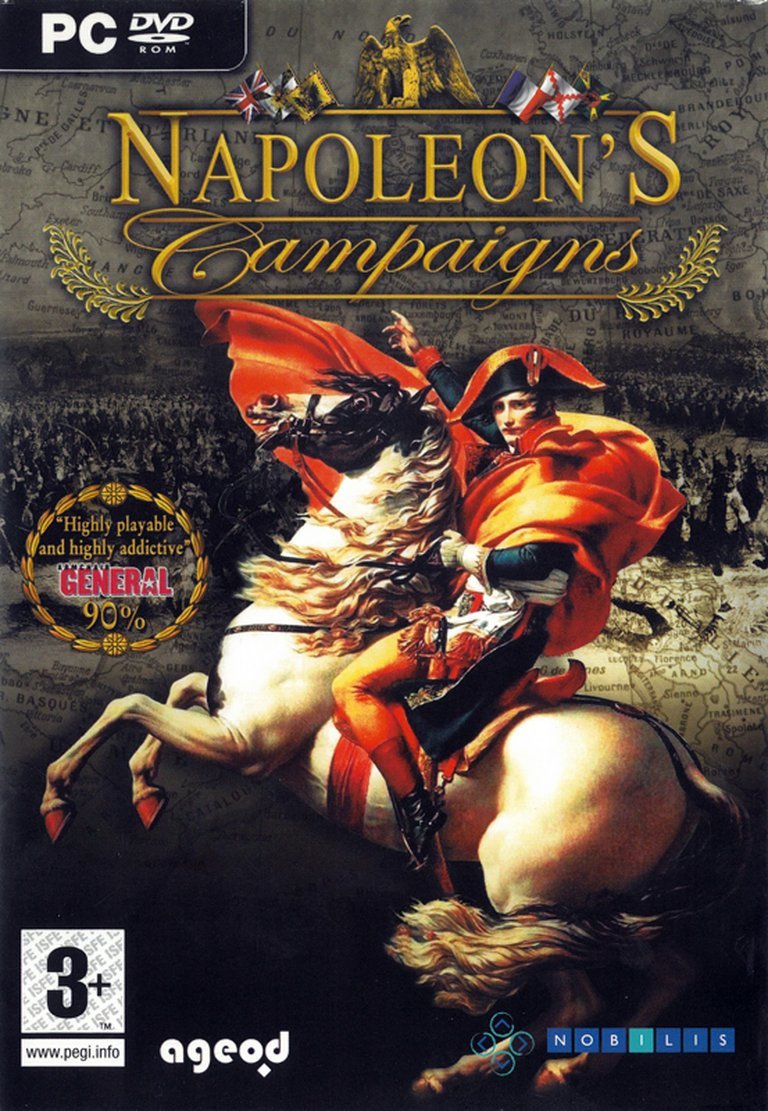
Napoleon’s Campaigns is a grand strategy game set during the Napoleonic Wars (1804–1815), offering players the chance to command one of seven nations in a historically rich simulation. The game blends deep managerial and tactical gameplay with a top-down perspective, featuring scripted events, hundreds of leaders with unique abilities, and a detailed map that influences battles. Players can follow historical paths or explore alternate outcomes, with each nation reacting dynamically to strategic decisions. Designed for hardcore strategy enthusiasts, it emphasizes historical accuracy, multiplayer support, and complex mechanics like attrition and rules of engagement.
Gameplay Videos
Napoleon’s Campaigns Patches & Updates
Napoleon’s Campaigns Reviews & Reception
zeitgame.net : Totally obsolete
mobygames.com (67/100): Meaningful improvements for veterans, historically accurate, beautiful graphics
p2pgames.blogspot.com (87.5/100): Another finely crafted strategy game from AGEOD
gamewatcher.com : Napoleon’s Campaigns is not one for the average turn-based strategy gamer and will likely be no friend what-so-ever to the casual gamer
Napoleon’s Campaigns: A Grand Strategy Masterpiece or a Niche Relic?
Introduction
In the pantheon of grand strategy games, Napoleon’s Campaigns stands as a testament to the ambition of its creators and the complexity of its subject matter. Released in 2007 by AGEOD Sarl, this game is a deep dive into the Napoleonic Wars, offering players the chance to relive or rewrite history from 1804 to 1815. But is it a masterpiece of historical simulation, or a niche product that only appeals to the most hardcore strategy enthusiasts? This review will explore the game’s development history, narrative depth, gameplay mechanics, and its lasting impact on the genre.
Development History & Context
AGEOD Sarl, a French development studio, has a reputation for creating historically accurate and complex strategy games. Napoleon’s Campaigns is no exception. The game was developed as a follow-up to Birth of America and American Civil War, both of which were well-received for their depth and historical fidelity. The studio’s vision was to create a game that not only simulated the battles of the Napoleonic Wars but also the political and logistical challenges faced by the leaders of the time.
The game was released in a period when grand strategy games were gaining popularity, thanks in part to the success of titles like Europa Universalis and Hearts of Iron. However, Napoleon’s Campaigns distinguished itself by focusing on a specific historical period and offering a level of detail that was unmatched at the time. The game’s development was not without its challenges, as the studio had to balance historical accuracy with gameplay mechanics that would be accessible to players.
Narrative & Thematic Deep Dive
Napoleon’s Campaigns is not a game with a traditional narrative. Instead, it offers a sandbox experience where players can choose to follow historical events or forge their own path. The game features seven playable countries, each with its own unique challenges and opportunities. The narrative is driven by the player’s decisions, which can lead to a variety of outcomes.
The game’s themes are deeply rooted in the historical context of the Napoleonic Wars. Players must grapple with the complexities of war, diplomacy, and logistics. The game’s scripted events and historical accuracy add a layer of depth that is rarely seen in strategy games. However, the game’s lack of a traditional narrative may be a drawback for players who prefer a more structured storytelling experience.
Gameplay Mechanics & Systems
Napoleon’s Campaigns is a turn-based strategy game that focuses on the operational level of warfare. Players must manage their armies, supply lines, and morale while navigating the political landscape of Europe. The game’s mechanics are complex and require a deep understanding of military strategy and logistics.
One of the game’s most innovative features is its “rules of engagement” system, which allows players to set the aggressiveness of their units in combat. This adds a layer of tactical depth that is not often seen in grand strategy games. However, the game’s complexity can be overwhelming for new players, and the lack of a comprehensive tutorial may be a barrier to entry.
The game’s UI is functional but not particularly intuitive. Players must navigate through multiple menus and screens to manage their armies and resources. The game’s visual design is also somewhat dated, with a 2D map that, while detailed, lacks the polish of more modern strategy games.
World-Building, Art & Sound
The game’s world-building is impressive, with a detailed map of Europe that accurately reflects the political and geographical landscape of the time. The game’s art style is functional but not particularly visually striking. The sound design is minimal, with a focus on ambient noise and occasional musical cues.
The game’s atmosphere is one of its strongest points. The detailed map and historical accuracy create a sense of immersion that is rare in strategy games. However, the lack of a strong visual or auditory identity may make the game feel somewhat sterile to some players.
Reception & Legacy
Napoleon’s Campaigns received mixed reviews upon its release. Critics praised the game’s historical accuracy and depth but criticized its complexity and lack of accessibility. The game’s reception was somewhat overshadowed by the release of Napoleon: Total War in 2010, which offered a more accessible and visually impressive take on the Napoleonic Wars.
Despite its mixed reception, Napoleon’s Campaigns has developed a cult following among hardcore strategy enthusiasts. The game’s depth and historical accuracy have made it a favorite among players who appreciate the complexity of grand strategy games. However, the game’s lack of accessibility and dated visuals have limited its appeal to a broader audience.
Conclusion
Napoleon’s Campaigns is a game that is best appreciated by hardcore strategy enthusiasts who are willing to invest the time and effort to master its complex mechanics. The game’s historical accuracy and depth are impressive, but its lack of accessibility and dated visuals may be a barrier to entry for many players. While it may not be a masterpiece in the traditional sense, Napoleon’s Campaigns is a testament to the ambition of its creators and the complexity of its subject matter.
Final Verdict: Napoleon’s Campaigns is a niche product that appeals to a specific audience. Its historical accuracy and depth are impressive, but its complexity and lack of accessibility may limit its appeal to a broader audience. For hardcore strategy enthusiasts, it is a game that is well worth the investment of time and effort. For others, it may be a game that is best appreciated from a distance.