
- Release Year: 2019
- Platforms: Windows
- Publisher: Grumbismal Games
- Developer: Grumbismal Games
- Genre: Action
- Perspective: 1st-person
- Gameplay: Platform, Stealth
- Setting: Fantasy
Description
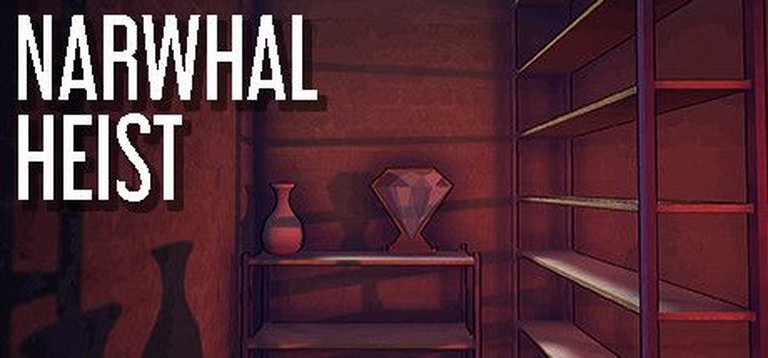
Narwhal Heist is a comical first-person stealth-platformer set in a fantasy world where players control Wally the Narwhal, a secret agent on a mission to rob houses, stores, and other locations to collect ransom money for his kidnapped wife and son. With his horn serving as both a tool for reaching objects and a liability that can shatter fragile items, Wally must stealthily navigate environments, avoid detection from cameras and people, and complete various contracts to succeed against the criminal Professor Wigglywams.
Where to Buy Narwhal Heist
PC
Narwhal Heist: Review – A Cel-Shaded Caper Drowned in Unfulfilled Potential
Introduction: The Unlikeliest Heist of All
In the crowded landscape of indie games, few premises are as immediately arresting—or as inherently silly—as that of Narwhal Heist. Conceived by the mysterious solo studio Grumbismal Games, this 2019 release presents a fantasy where a narwhal, driven by familial devotion, turns to a life of crime. The hook is not just the absurdity of its protagonist, but the brilliant, brutal core mechanic: your single, majestic tusk is both your primary tool and your greatest liability. As a piece of game design, Narwhal Heist is a fascinating, often-frustrating experiment in constraint-based stealth-platforming. As a historical artifact, it represents the volatile promise of Early Access—a game that announced lofty goals of community-driven iteration and a deep meta-system, only to seemingly vanish from active development, leaving behind a curious, incomplete, and now free-to-play relic. This review argues that Narwhal Heist is less a failed game and more a compelling, broken blueprint; a testament to a unique vision that was ultimately scuttled by its own narrow scope and the turbulent realities of indie sustenance.
Development History & Context: The Grumbismal Gambit
Narwhal Heist exists almost entirely as the vision of its creator, “Grumbismal,” a solo developer operating under the Grumbismal Games banner. This immediately places it within a long tradition of passion projects: single-minded, auteur-driven games that leverage accessible tools to explore a single, potent idea. The chosen tool here was Unreal Engine 4, a powerful but complex engine, suggesting a developer confident in their technical ability or at least willing to grapple with its steep learning curve for the sake of a specific visual style—the game’s prominent cel-shaded aesthetic, which gives its fantasy world a charming, comic-book-like quality.
The game emerged into an Early Access landscape in July 2019 that was both empowering and perilous. The model had matured beyond its experimental phase, with players and critics savvy to its promises and pitfalls. Grumbismal’s stated intent was explicitly iterative: “Narwhal Heist is heavily designed around player feedback.” Their planned roadmap was ambitiously detailed, projecting a full release within “two or three months” with expanded content (8 story levels, side missions, a level editor) and a robust in-game shop. This timeline, from the vantage point of 2025, reads as quintessential Early Access optimism, perhaps underestimating the resources required to build a “deep Black Market system” and consistent level design. The last significant update noted on MobyGames was in April 2023, and the Steam page now bluntly states: “This game is no longer being developed. As a result, it has been made free to play.” This quiet cessation is the defining context for the game’s legacy. It was not a catastrophic crash but a slow fade, leaving a promising skeleton fully playable but forever frozen in a late-beta state, its grander systems—like the promised “in-depth Black Market”—never materialized.
Narrative & Thematic Deep Dive: Crime, Family, and the Weight of a Tusk
The narrative of Narwhal Heist is delivered with a lightweight, comedic touch that perfectly complements its absurd premise. Our protagonist, Wally the Narwhal, is a former secret agent (or ” rogue” agent, as the blurb ambiguously states) turned desperate family man. The inciting incident is pure pulp: the villainous Professor Wigglywams, an “ex-spy and notorious criminal,” has kidnapped Wally’s wife and son, demanding a $5,000,000 ransom. This establishes the dual thematic cores of the game: the economics of desperation and the absurd lengths of paternal (or perhaps spousal) love.
Wally’s liaison is an “unnamed agent,” a voice of cryptic motivation who hands out contracts. This character functions as both mission control and a faint, ironic commentary on Wally’s situation—he is a weaponized asset, a blunt instrument for a shadowy puppet master, all to save his own family. The narrative progression through the “seven base contracts” is a classic crime-heist escalation, moving from a humble house robbery to the corporate fortress of “Wigglywams Inc.” Each location is a vignette in Wally’s descent (or ascent?) into a life of crime. The tone never aims for gritty realism; instead, it leans into the inherent comedy of a marine mammal in a wetsuit and tie awkwardly navigating human interiors, his very biology a constant source of slapstick peril. The theme, therefore, is less about the morality of crime and more about the comical tragedy of being fundamentally, physically unsuited for the task you’ve been forced into. Wally’s struggle is a constant battle against the physics and fragility of the human world, a metaphor for any parent feeling out of their depth.
Gameplay Mechanics & Systems: ATightrope Walk on Ice
The genius and Achilles’ heel of Narwhal Heist are its intertwined, punishing mechanics.
1. The Horn: A Double-Edged Sword (Literally). Wally’s tusk is his interaction tool. It allows him to reach high switches, pull distant objects, and potentially solve puzzles. However, the rule is absolute: any contact with a “fragile” object—which includes nearly all decorations, glass, and ceramics—results in instant shattering and immediate arrest. This creates a gameplay loop of extreme spatial anxiety. Players must mentally map every environment, identifying trap objects (vases, lamps, aquariums, glass tables) and plotting routes that involve precise, minimalistic movements. It’s a stealth game where patience and precision are paramount, and frustration is a constant companion. There is no margin for error; a twitch, a misjudged turn, a collision with a curtain tassel is a game over.
2. The Wet & Slippery Condition. Wally arrives at each mission “soaking wet” from his fish tank. This isn’t just flavor; it’s a core control modifier. Wet means slippery. Movement has a persistent, momentum-based slide, making fine adjustments difficult and turning stairs, ledges, and narrow platforms into liability mines. This mechanic brilliantly compounds the tension from the horn fragility. You’re not just trying to avoid things with your horn; you’re constantly fighting your own inertia to get close enough to interact without touching the wrong thing. It turns basic navigation into a skill-based challenge.
3. Stealth & Detection. The stealth layer is straightforward but unforgiving. Tripping motion detectors, being seen by cameras, or making eye contact with NPCs blows your cover. Combined with the fragility rules, this means the optimal path is often the least obvious one—crawling under tables, using dark corners, exploiting blind spots. It’s less about traditional stealth and more about environmental puzzle-solving with a stealth skin. Failure states are binary: get seen or break something, and you’re “apprehended.”
4. Progression & The Promised Black Market. Here is where the game’s “Early Access” status cripples its systemic depth. The Steam description tantalizes with a Black Market where earned cash could buy upgrades, new game modes, and cosmetics. In the released state, this system appears to be either minimal or non-functional. The core loop is simply: complete a contract -> earn money -> (theoretically) spend it. The absence of tangible upgrades or meaningful spenders makes the in-game currency feel hollow after the initial few levels. The intended meta-layer of character progression and build variety is the game’s most glaring missing piece. Similarly, speedrunning was a stated design pillar, with levels built for “skill-based” mastery. The precise, punishing mechanics certainly cater to a hardcore audience seeking optimization, but without a robust leaderboard or community (as suggested by the empty Steam discussion forums), this potential remains latent.
5. Level Design & Variety. The seven contracts do promise unique mechanics and obstacles, a necessity to combat repetition. From a house to a construction site, each locale theoretically forces players to adapt their fragile, slippery approach. However, without access to the later promised levels and with the project abandoned, we can only judge the likely consistent quality of this design from the documented intent. The core risk is that the same two mechanics (fragile horn, slippery movement) could become monotonous if not constantly refreshed by novel environmental gimmicks.
World-Building, Art & Sound: A Cohesive, Comedic Aesthetic
Narwhal Heist’s greatest unqualified success is its art direction. The cel-shaded visual style is not just an aesthetic choice; it’s a tonal masterstroke. It softens the potential frustration of the gameplay with a look that feels like a playable cartoon. The world is vibrant, slightly exaggerated, and perpetually comedic. Seeing the earnest, round-form Wally, a glossy black-and-white cetacean in a tiny suit, against these painterly environments is consistently funny and visually engaging.
The setting is a fantasy-tinged modern world. We see mundane human locations (houses, banks, stores) rendered with a slight fantastical flair, fitting for a universe where a talking narwhal can be a secret agent. This avoids dissonance and keeps the tone light. The atmosphere is one of playful mischief, never dark or oppressive, which is crucial for a game so reliant on trial-and-error failure.
On the sound design, specifics are scarce from the sources, but the described audio (from the Steam blurb) indicates full English voice support. The likely success here would be in the delivery of Wally’s presumably silent, physical comedy and the chirpy, ironic tones of the unnamed agent. Music, undocumented but implied by the style, would need to be upbeat and quirky to match the visuals. Any misstep in audio could have broken the delicate comedic spell, but the chosen aesthetic suggests a coherent, if simple, audio-visual package that serves its purpose without ambition beyond tone-setting.
Reception & Legacy: The Sound of One Hand Clapping
Narwhal Heist exists in a statistical void. Metacritic lists “Critic reviews are not available.” On Steam, it has only 4 user reviews at the time of writing, all “Positive” according to aggregated sites like Steambase, which calculates a perfect 100/100 Player Score from those 11 reviews (a figure likely inflated by the small sample and recent free-to-play switch). The Steam Community Hub is ghostly quiet, with discussions pinned on performance tweaks and a lone query “What are you?”—a fitting question for this enigmatic title. There are no Let’s Plays or widespread critical discourse to speak of.
This paucity of reception is its legacy. It did not fail spectacularly; it simply failed to register. Its influence on the industry is, unfortunately, nil. It did not spawn clones or inspire a genre. Its ideas—the fragile tool mechanic, the slippery movement—remain isolated curiosities. Its closest thematic relatives might be physics-based comedy games or precision platformers, but its specific blend is unique. In the grand timeline of video game history, Narwhal Heist is a footnote, a “what-if.” It serves as a case study in Early Access risks: a clear, compelling pitch, a strong core loop, but a failure to build a sustaining community or deliver on a promised meta-game that would give players reason to persist beyond the initial curiosity. Its transformation to a free game is both a mercy (allowing curious players to experience its oddity) and an epitaph (confirming its commercial and developmental death).
Conclusion: The Tusk That Could Have Been
Narwhal Heist is a game of profound contradictions. It is ingeniously designed and fundamentally frustrating. It presents a world of comedic potential and a narrative of high-stakes drama, yet its emotional impact is muted by the repetitive pressure of its mechanics. It was announced with a vision of deep, community-shaped progression and left as a static, incomplete museum piece of that very vision.
Its place in history is not one of greatness, but of fascinating incompletion. For the game historian, it is a perfect artifact of a specific moment in indie development: the optimistic, solo-dev, Early Access era of the late 2010s. It demonstrates how a single, brilliant mechanical idea—”your horn breaks everything”—can anchor an entire game, but also how that idea must be nourished by content, systems, and community to avoid becoming a repetitive, if clever, chore.
As a playable experience in 2025, it is a curiosity. The first few levels offer a genuine, grin-inducing challenge rooted in spatial reasoning and delicate control. But the lack of meaningful progression and the apparent abandonment of its promised features make it a difficult game to recommend with enthusiasm. It is best appreciated as a design document made flesh, a proof-of-concept for a “comical stealth-platformer” whose best jokes were in its premise and whose deepest tragedy is that we will never see the full scope of the heist it intended to pull off. Wally’s family remains, as far as we know, still captive, and the Black Market remains, forever, closed for business.