
- Release Year: 1999
- Platforms: Windows
- Publisher: Sierra On-Line, Inc.
- Developer: Papyrus Design Group, Inc.
- Genre: Driving, Racing
- Perspective: 1st-person, Behind view
- Game Mode: LAN, Single-player
- Gameplay: Simulation
- Setting: Real-world
- Average Score: 40/100
Description
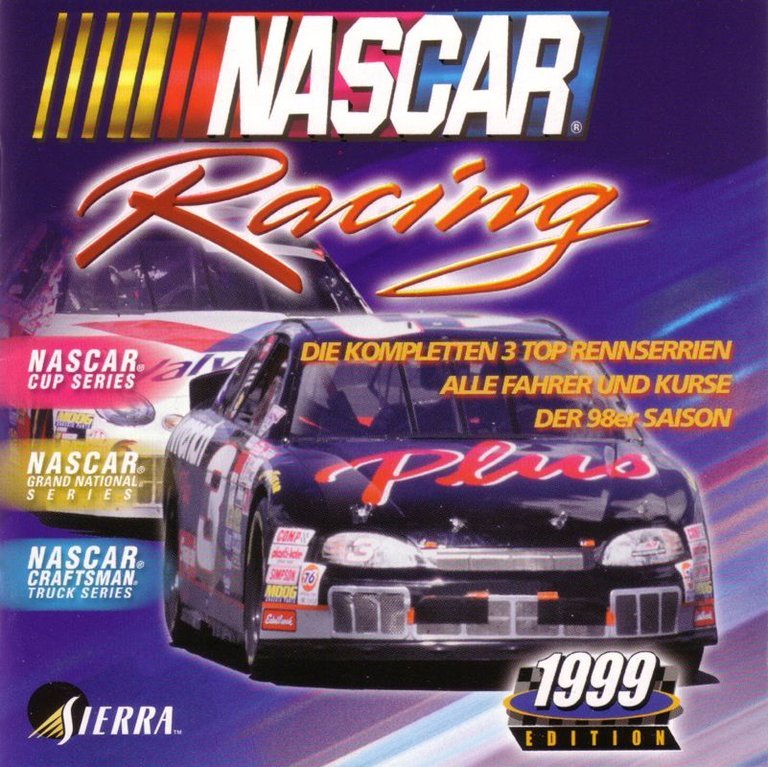
NASCAR Racing: 1999 Edition is a licensed racing simulation that immerses players in the thrill of professional stock car racing, featuring three official NASCAR series—Winston Cup, Busch Grand National, and Craftsman Truck Series—across 34 authentic tracks, including 11 new additions. Developed by Papyrus Design Group and published by Sierra, it emphasizes realistic driving physics, strategic gameplay, and multiplayer options for up to 8 players via network, catering to die-hard NASCAR fans seeking a deep and authentic experience.
Gameplay Videos
NASCAR Racing: 1999 Edition Free Download
NASCAR Racing: 1999 Edition Mods
NASCAR Racing: 1999 Edition Reviews & Reception
gamerevolution.com (40/100): Only blind, hardcore racers need apply.
NASCAR Racing: 1999 Edition: A Bridge Too Far in the Genesis of Modern Sim Racing
1. Introduction: The Paradox of Progress
In the chronology of American motorsport simulation, few titles embody a more telling contradiction than NASCAR Racing: 1999 Edition. Released at the dawn of 1999, it arrived not as a revolutionary leap, but as a meticulously updated monument to a rapidly aging paradigm. For Papyrus Design Group, the venerable Massachusetts studio synonymous with the democratization of hardcore racing simulations, this entry represented both the zenith of their established NASCAR formula and a clear signal that the technological tide was turning against their trusted engine. Here was a game that promised the most complete licensed experience of America’s premier stock car series—bundling the Winston Cup, Busch Grand National, and Craftsman Truck Series into one package—yet was immediately lambasted for visuals that felt two years obsolete. This review will argue that NASCAR Racing: 1999 Edition is a critical pivot point: a game whose profound simulation pedigree and comprehensive content were ultimately undermined by technological stagnation and corporate scheduling, cementing its legacy not as a classic, but as a poignant transitional artifact. It faithfully preserved the intricate, strategic soul of NASCAR simulation while failing to embrace the graphical and systemic innovations its contemporaries were achieving, leaving it a game for the purist’s mind but a casualty for the evolving senses of the gaming public.
2. Development History & Context: The Weight of Legacy
The studio behind this title, Papyrus Design Group, was nothing short of legendary in the racing sim space. Co-founded by David Kaemmer, a figure often cited as the father of the modern racing simulation, Papyrus had already delivered genre-defining classics like Indianapolis 500: The Simulation (1989) and the IndyCar Racing series. Their masterpiece, Grand Prix Legends (1998), had redefined historical racing simulation with its groundbreaking physics and immersive atmosphere, powered by a new, flexible engine. However, NASCAR Racing: 1999 Edition did not use this new GPL engine. Instead, it was built upon the heavily iterated codebase of NASCAR Racing 2 (1996).
This decision speaks volumes about the development context. Papyrus, under publisher Sierra On-Line (specifically the Sierra Sports division), was working within a tight annualized release cycle for its NASCAR franchise. The 1998-1999 window was one of intense competition. While 3D acceleration via cards like the 3dfx Voodoo2 and NVIDIA RIVA TNT was becoming standard, Papyrus’s primary NASCAR engine was a software renderer that had been incrementally patched. The source material repeatedly notes its “seriously outdated 3D engine” (GameRevolution) and “lahme Grafik” (shoddy graphics) (PC Action). The team, led by Project Director David Matson and Lead Engineer Charlie Heath, was clearly expending immense effort on content expansion—34 tracks (11 new), updated 1998 season data, and three full series—but the foundational rendering technology was not overhauled. This was a business and scheduling reality, not a lack of vision. As Race Sim Central astutely notes, the game was “unfortunately a graphically updated NASCAR Racing 2 underneath the surface.” It existed in a limbo between the depth of its simulation and the accelerating graphical expectations set by arcade racers (Need for Speed III) and the stunning Grand Prix Legends itself.
3. Narrative & Thematic Deep Dive: The Simulation as Story
As a pure simulation, NASCAR Racing: 1999 Edition possesses no traditional narrative, scripted characters, or dialogue. Its “story” is entirely emergent, generated by the player’s interaction with its deeply systemic world. The thematic core is the grueling, strategic marathon of stock car racing—a stark contrast to the high-speed, glamour-focused narratives of open-wheel or arcade titles.
Thematic Analysis:
* The Grind of Superspeedways: The game’s structure enforces its primary theme. A 400-lap race at Talladega or Daytona is not a breakneck sprint but a protracted battle of inches, drafting, and patience. The “story” is one of attrition, fuel management, tire wear, and mental fortitude. The player experiences the unique meta-narrative of NASCAR: the tension between the cat-and-mouse game of the pack and the sudden, violent chaos of “The Big One.”
* Technical Craftsmanship as Heroism: The extensive setup menus—adjusting spoiler angles, tire pressures, brake bias, and gear ratios—are the game’s true “character development.” Success is not just about reflexes but about empirical problem-solving. The player’s journey is one from a novice copying setups to a veteran engineer tuning a car for the specific demands of a high-banked oval versus a road course like Watkins Glen. The “dialogue” is the feedback from the car: the loose condition exiting Turn 2, the tight push on the front straight.
* Licensed Mortality: The inclusion of real 1998 drivers (Dale Earnhardt, Jeff Gordon, Dale Jarrett Jr.) and tracks grounds this systemic narrative in reality. There is an inherent, melancholic theme here that is unique to licensed sports games: these digital representations are time capsules. The game captures a specific, fading moment in NASCAR history—the final Winston Cup season before the “modern era” of corporate sponsorship saturation and the Car of Tomorrow. Playing with the ’98 grid is an act of digital archaeology.
* The Absence of Spectacle: Unlike its arcade cousins or even Grand Prix Legends (which featured grandstands and detailed pit crews), NASCAR ’99 offers a sparse, almost abstract track environment. The stands are often pop-up sprites, the infield barren. This inadvertently reinforces the theme of the race as a pure, isolating mechanical contest. The spectacle is not in the pageantry but in the 40-ton ballet of sheet metal, which the player must learn to command.
4. Gameplay Mechanics & Systems: Depth Beneath the Dated Facade
This is where the game redeems itself, and where its dedication to simulation shines through the graphical fog.
Core Gameplay Loop:
The loop is deceptively simple: select a series (Cup, Busch, Trucks), a track, a car/driver, qualify, race, and manage pit stops. Its genius lies in the staggering complexity hidden within each step.
Vehicle Dynamics & Physics:
The physics engine is universally praised in the source material as “very good” (PC Player) and a commendable strength. It differentiates the heavy, unstable Craftsman trucks from the nimble Busch cars and the powerful Winston Cup stockers. The simulation of tire wear, grip loss (“loose” or “tight” conditions), and aerodynamic drafting is profound. Mastering the art of “using the air”—getting a tow on a superspeedway to slingshot past a leader—is not a gimmick but a core, learnable skill based on real physics principles. The game offers two primary modes: “Realistic,” with full damage and stringent handling, and “Arcade,” with lenient damage and easier control—a pragmatic if clumsy solution for accessibility.
Car Setup & Strategy:
The setup system is exhaustive and daunting. Players can alter:
* Aerodynamics: Spoiler angle, which drastically changes downforce and top speed.
* Suspension: Spring rates, sway bars, shock compression/rebound.
* Brakes: Bias (front/rear distribution).
* Gearing: Individual gear ratios, crucial for balancing acceleration and top speed on specific tracks.
* Tires: Pressure and compound selection (in practice), affecting wear and grip.
This transforms the game from a driving test into a multi-variable engineering puzzle. The pit strategy is equally deep: decisions on fuel, tire changes (two or four), and tape adjustments (for handling) are strategic gambles against AI behavior and race length.
Artificial Intelligence:
The AI presents a classic, contradiction-filled profile. As GameRevolution notes, initially they seem impressive, executing drafting and passing maneuvers logically. However, their flaw is in reaction to the player’s atypical behavior. They are sophisticated in a pack but brittle against unpredictable human actions, such as moving slowly for a pit stop or recovering from a spin. They plan maneuvers on a human timescale, not reacting instantly to sudden gaps or slow-moving vehicles, breaking immersion. This creates a “chance for human vs. AI” where the player can exploit these scripted patterns, particularly on restarts.
User Interface & Menus:
The UI is a relic. A dense, Windows 95-style menu system buried under layers of tabs. While functional for veterans, it is impenetrable for newcomers. The in-race HUD is minimal, showing only essential speed, gear, and position data. There is no real-time telemetry overlay, a feature becoming common in sims. This reinforces the game’s hardcore ethos: you feel the car, you don’t watch graphs.
Innovations & Flaws:
* Innovation (for the series): Bundling all three NASCAR series was a significant value proposition. The inclusion of the Craftsman Truck Series, with its distinct handling and often used on shorter tracks, added tremendous variety. The extensive track list, though missing iconic names like Daytona and Pocono (noted by Race Sim Central), was still substantial.
* Flaws: The game is plagued by “pop-up” (objects rendering suddenly at close range) and severe “mip-mapping flaws” (texture shimmering and blur at distance), as repeatedly cited. These are not just aesthetic; they impair lap-time consistency and visual reference for braking points. The lack of significant visual upgrade from NASCAR 2 was its cardinal sin. Furthermore, as PC Joker pointedly asked, why not release the updates as a cheaper add-on? This speaks to a business model that felt extractive to owners of the previous game.
5. World-Building, Art & Sound: The Authenticity of Austerity
The game’s atmosphere is one of stark, functional authenticity, stripped of cinematic flair.
Visual Presentation:
The car models are the standout visual asset. Each manufacturer’s silhouette—the rounded Ford Thunderbird, the sharp Chevrolet Monte Carlo—is recognizable. The liveries are accurate to the 1998 season sponsors. However, the world they race in is a low-polygon, texture-strapped nightmare. Trackside objects (catch fencing, grandstands, trees) are almost universally simple 2D sprites that pop in aggressively. The resolution is low, the color palette often muted and washed out. The “red screen” issue reported by abandonware users is a notorious driver compatibility bug that turns the entire world monochromatic—a fitting metaphor for the game’s struggles on modern hardware. There is no sense of a living venue; it is a racetrack as a pure geometric circuit.
Sound Design:
The audio is a relative high point. Engine notes are distinct and aggressive, changing with camera position (in-car vs. external). The roar of a pack of 39 engines on a superspeedway is genuinely immersive and loud. Tire scrub, bumps, and collision sounds provide crucial auditory feedback missing from the visual channel. The soundtrack, however, is limited to a generic rock loop during menus—a missed opportunity to channel the Southern rock and country ethos of NASCAR culture.
Atmosphere & Setting:
The atmosphere is therefore built entirely through simulation, not presentation. The tension comes from the pack of cars visible in your mirrors, the subtle vibration of the steering wheel (with a force-feedback wheel), and the knowledge of what 200 mph drafting entails. It feels less like a spectacle and more like a test. This austere approach will appeal to a specific mindset—the same that appreciates the sparse dashboards of real race cars—but it failed to compete with the cinematic presentation of rivals like Grand Prix Legends, which featured detailed pit crews, moving grandstands, and a palpable sense of history at each track.
6. Reception & Legacy: Mixed Signals on the Starting Grid
Contemporary Reception (1998-1999):
The critical reception was tepid to poor, averaging 67% on MobyGames. The split was telling:
* German Press (GameStar 79%, PC Action 73%): More forgiving, focusing on the “hohe Simulationstiefe” (high simulation depth) and value of the three-series package, despite noting the graphics lag.
* Anglophone Press (GameRevolution 50%, PC Player 58%): Unsparingly harsh. Calvin Hubble’s “seriously outdated 3D engine” was the refrain. Game Revolution‘s verdict that it was for “only blind, hardcore racers” became a defining, albeit reductive, summary.
The common thread was consensus on two pillars: unmatched simulation depth for NASCAR and graphics that belonged to the previous generation.
Adrenaline Vault made the crucial distinction, calling it “the most accurate and realistic NASCAR simulation available” while stating it “desperately needs a facelift… to be competitive with the best non-NASCAR computer racing games.” This is the crux. Against NASCAR Revolution (EA) or the upcoming NASCAR Racing 3, it was losing the arms race for visual fidelity, even if it won the battle for physics.
Long-term Legacy & Historical Significance:
NASCAR Racing: 1999 Edition has no mainstream cult following. It is remembered primarily in two contexts:
1. As a Bridge: It is the last major Papyrus NASCAR title before the graphical revolution of the Grand Prix Legends engine, which would power NASCAR Racing 3 (2001) and the subsequent series. It stands as the end of an era.
2. As a Hardcore Relic: Within niche simulation communities, it is appreciated for its raw, uncompromising physics and the unique challenge of its pre-GPL engine. Its modding scene, while limited, persists, with user-created carsets and compatibility fixes (like dgVoodoo) keeping it playable on modern systems, as evidenced by the active comment threads on abandonware sites.
3. The Papyrus Lineage: Its development cycle and reception directly influenced Papyrus’s strategy. The studio would not release another major NASCAR sim until NASCAR Racing 3, which finally brought the GPL engine’s visuals and physics to the series. The lineage of that engine, through Kaemmer’s later company iRacing, is the true, gleaming legacy of Papyrus’s technical ambition. 1999 Edition is the sturdy, if rusty, bridge to that future.
7. Conclusion: A Qualified, Nostalgic Verdict
NASCAR Racing: 1999 Edition is not a good game by any contemporary standard. Its visuals are an assault on the modern eye, its interface a fossil, and its core activity—circling an oval 200 times—inherently niche. Yet, to dismiss it is to misunderstand its purpose and its era. It is a game built by and for a specific, passionate community: the sim racing purist who cares more for the tactile relationship between car and track than for cinematic beauty.
Its thesis—that NASCAR simulation required immense depth in setup, strategy, and pack dynamics—was executed flawlessly. The feeling of 40 heavy stock cars shuffling and drafting at 190 mph remains uniquely tense and rewarding. In this, it succeeded where arcade-oriented NASCAR games failed. Its failure was one of presentation and timing. Released in a window where Gran Turismo and Need for Speed were redefining racing game expectations, and a year after its own studio released the visual masterpiece Grand Prix Legends, it looked like a lazy cash-in, even if the development history suggests it was a labor of love on a dead-end engine.
In the grand history of video games, NASCAR Racing: 1999 Edition is a transitional footnote. It preserved the sacred complexities of stock car simulation but did so with the aesthetic grace of a 1996 title. It is a fascinating case study in the divergence of simulation depth and technological polish. For the historian, it is essential: a snapshot of a major studio grappling with its own legacy and the changing tides of hardware. For the player in 2024, it is a museum piece to be admired for its mechanical ambition and endured for its technical shortcomings—a testament to the fact that in sim racing, the soul can sometimes outlive the body, but just barely. Its final, definitive verdict is a paradox: a dated, flawed product that remains, in its specific niche, authentically brilliant.