
- Release Year: 2003
- Platforms: Macintosh, Windows
- Publisher: Aspyr Media, Inc., Imagineer Co., Ltd., Sierra On-Line, Inc.
- Developer: Papyrus Design Group, Inc.
- Genre: Driving, Racing, Simulation
- Perspective: 1st-person, 3rd-person (Other)
- Game Mode: LAN, Online PVP, Single-player
- Gameplay: Car customization, Track racing, Vehicle simulation
- Setting: Southern United States
- Average Score: 87/100
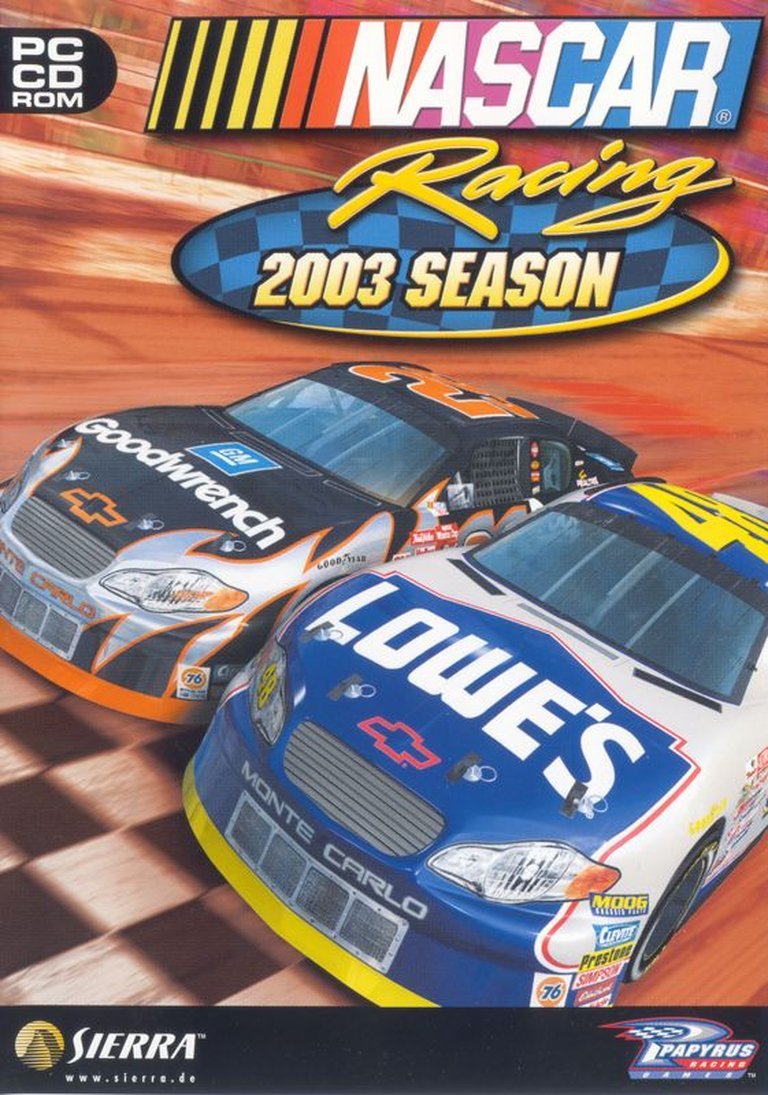
Description
NASCAR Racing 2003 Season is a realistic racing simulation game that immerses players in the high-speed world of professional stock car racing, featuring 23 authentic NASCAR tracks including updates to New Hampshire International Speedway and Infineon Raceway. Developed with enhanced graphics and physics in collaboration with Goodyear and Jasper Motorsports, it offers tutorials, driving aids, and adaptive AI to challenge players at all skill levels, supporting up to 42 players in online multiplayer races across real-time, direct-control vehicular combat on licensed tracks.
Gameplay Videos
NASCAR Racing 2003 Season Free Download
Crack, Patches & Mods
Guides & Walkthroughs
Reviews & Reception
metacritic.com (89/100): The masters of the universe of PC racing game development have gone out the same way they came in – with a stunning achievement!
en.wikipedia.org (89/100): established a daunting new standard for PC racing simulations that may take years to eclipse
gamepressure.com (82/100): a worthy successor to the excellent NASCAR 4
gamespot.com (88/100): it is nevertheless a worthy finale for the series
NASCAR Racing 2003 Season: Review
Introduction
Imagine the thunderous roar of 43 stock cars hurtling around a 2.5-mile oval at over 200 mph, tires screeching as drivers nudge bumpers in a high-stakes ballet of speed and strategy—this is the visceral thrill that NASCAR Racing 2003 Season (NR2003) captures like no other game before or since. Released in February 2003 by Papyrus Design Group and Sierra Entertainment, NR2003 stands as the swan song of one of PC gaming’s most revered simulation franchises, a title that distilled the raw intensity of Winston Cup racing into a digital masterpiece. As the final entry in Papyrus’ storied NASCAR series, it arrived amid whispers of the studio’s impending closure, yet it delivered an unflinching tribute to the sport’s heritage. My thesis: NR2003 isn’t just a racing game; it’s a monumental achievement in simulation design that set an enduring benchmark for realism, modding, and community-driven longevity, influencing everything from iRacing to modern esports while cementing Papyrus’ legacy as the gold standard for motorsport authenticity.
Development History & Context
Papyrus Design Group, founded in the early 1990s by David Kaemmer and a cadre of engineering enthusiasts, had already etched its name into gaming history with groundbreaking sims like Grand Prix Legends (1998), which earned cult status for its punishing realism. By 2003, their NASCAR series—spanning from the original NASCAR Racing (1994) to NASCAR Racing 4 (2001)—had become the definitive digital embodiment of stock car racing, blending licensed authenticity with proprietary physics engines. NR2003 was helmed by design director Richard Yasi, who pulled out all stops knowing it might be their last: partnerships with Goodyear Tire & Rubber Company and Jasper Motorsports (the #77 Winston Cup team) informed a revamped physics model, incorporating real-world tire wear, aerodynamics, and track-specific nuances like ruts at Bristol or banking at Daytona.
Technological constraints of the era shaped the game’s DNA. Built on Papyrus’ Papy3D engine (evolved from prior titles), NR2003 targeted Windows 98/ME/2000/XP and Mac OS X, requiring a Pentium III 800 MHz CPU, 128 MB RAM, and a Direct3D/OpenGL-compatible GPU with 32 MB VRAM. This was peak early-2000s PC hardware—ambitious for its time, demanding tweaks for framerates on anything less than high-end GeForce 3 or Radeon 8500 cards. Multiplayer via Sierra’s online service supported up to 42 players, a feat achieved through optimized netcode, but it predated broadband ubiquity, relying on modem/LAN connections that could stutter under load.
The gaming landscape in 2003 was a sim racer’s paradise amid arcade dominance. While EA’s Need for Speed Underground (November 2003) glamorized street racing with flashy visuals, and Microsoft’s Project Gotham Racing (Xbox, 2001) blended sim-arcade hybrids, Papyrus doubled down on hardcore simulation. This was post-Gran Turismo 3 (2001), where realism was king, but NR2003’s focus on oval track mastery and draft-heavy pack racing set it apart. Released just as Electronic Arts was poised to snag the exclusive NASCAR license (effective 2004), NR2003 felt like a defiant mic drop—Sierra pulled it from shelves in March 2004, and Papyrus shuttered in May, with Kaemmer acquiring the source code for iRacing.com’s foundation.
Narrative & Thematic Deep Dive
As a pure simulation, NR2003 eschews traditional narrative arcs, scripted cutscenes, or character-driven drama in favor of emergent storytelling through the rhythms of NASCAR’s 2003 Winston Cup season. There’s no overarching plot—no underdog racer rising from obscurity, no interpersonal rivalries voiced in dialogue trees—but the “narrative” unfolds in the player’s hands-on immersion in a meticulously recreated motorsport ecosystem. You embody one of 42 licensed drivers (from Jimmie Johnson in the #48 Lowe’s Chevy to Dave Blaney in the #22 Bill Davis Ford), stepping into a world where every race is a chapter in the pursuit of the championship checkered flag.
Thematically, NR2003 delves into the blue-collar ethos of NASCAR: relentless endurance, mechanical precision, and the razor-thin margin between glory and catastrophe. Themes of adaptation and mastery resonate deeply—tutorial “Driving Lessons” serve as narrative tutorials, narrated by veteran voices explaining real-world techniques like throttle control on restrictor-plate tracks or drafting at Talladega. Without voiced dialogue or character arcs, the “story” emerges from dynamic interactions: AI opponents exhibit adaptive behaviors, like aggressive blocking from a frustrated Rusty Wallace or calculated passes by Jeff Gordon, fostering a sense of rivalry built on performance stats rather than lore.
Underlying motifs celebrate American motorsport’s cultural fabric—the Southern U.S. tradition of stock cars as everyman’s racing, evoking themes of community and competition. Pit stops become tense vignettes of strategy, where crew chief radio chatter (pulled from real NASCAR audio) urges tire changes under yellow flags, heightening the drama of fuel mileage gambles. Flaws in this “narrative” approach include its austerity: no career mode progression or personal backstory means replayability hinges on self-imposed challenges, like a full 36-race season. Yet this restraint amplifies the themes—racing isn’t about heroes; it’s about the machine, the track, and the split-second decisions that define legends. In an era of story-heavy games like Final Fantasy X, NR2003’s thematic purity underscores simulation as interactive history, letting players script their own epics amid the roar of V8 engines.
Gameplay Mechanics & Systems
At its core, NR2003’s gameplay loop revolves around authentic NASCAR simulation: practice sessions for setup tuning, qualifying laps to secure grid position, and grueling races demanding sustained focus over 200-500 miles. Modes include single races (customizable laps, weather, cautions), full-season championships (mirroring the 2003 Winston Cup with 36 events), and testing for car tweaks— no arcade shortcuts, just pure progression through skill and iteration. “Combat” manifests as tactical pack racing: drafting for speed bursts (up to 10 mph gains at superspeedways), side-drafting to unsettle rivals, and door-to-door battles where a slight overcorrection spins you into the wall.
The physics engine, refined with Goodyear’s input, is a triumph of innovation—tires degrade realistically based on temperature, track rubber, and aggression, forcing players to nurse setups through long greens. Car progression involves deep telemetry: adjust camber, caster, toe, gear ratios, and spoiler angles via a comprehensive garage interface, with effects visible in lap times and handling telemetry. UI elements shine in their functionality—the dashboard view displays real-time gauges for RPM, fuel, and damage, while spotter radio provides immersive calls like “Car inside, low!” Multiplayer elevates this, with up to 42 online racers via LAN/Internet (pre-2007 Sierra servers; now modded for modern nets), turning sessions into chaotic, skill-testing spectacles.
Innovations include adaptive AI that scales difficulty dynamically—novices get “Catch Up” mode for closer packs, while experts face pros who pit strategically and avoid predictable lines. Driving aids (traction control, ABS, auto-shifting) ease entry, with arcade mode for casual spins. Flaws persist: no career progression beyond seasons means grinding feels repetitive without mods, and the UI, while intuitive for sim fans (mouse/keyboard or wheel support), can overwhelm newcomers with dense menus. Crashes are spectacularly unforgiving—realistic deformation affects aerodynamics—but rare gore or variety limits spectacle compared to arcade titles. Overall, the systems cohere into a loop of preparation, execution, and analysis, where mastery yields euphoric “clean air” leads, making NR2003 a benchmark for depth.
World-Building, Art & Sound
NR2003’s “world” is the 2003 NASCAR circuit: 23 licensed tracks (from Daytona’s tri-oval to Sonoma’s twisting road course), plus a fictional “Coca-Cola Superspeedway” DLC added in May 2003. Atmosphere pulses with authenticity—day/night cycles (e.g., night races at Richmond) cast dynamic shadows, while weather options (clear, rain) alter grip and visibility. Visual direction leverages Papy3D’s strengths: high-res textures capture asphalt cracks and tire marks at New Hampshire or banking at Atlanta, with improved shading and reflections on 2003-era cars (Ford Taurus, Chevy Monte Carlo). Cockpit views immerse via detailed interiors—dash vibrations sync with bumps—though third-person chases highlight pack dynamics beautifully. Art style prioritizes realism over flair; models lack modern polish (e.g., aliasing on older GPUs), but 42-car fields maintain 30-60 FPS on era hardware, a technical marvel.
Sound design elevates the immersion: engine roars vary by RPM and track (e.g., Bristol’s concrete echo), sourced from real V8s for thunderous authenticity. Spotter/crew radio chatter, using actual NASCAR voices, adds narrative flavor—”Clear on the inside!”—while tire squeals, crashes (metal-on-metal crunches), and crowd ambiance build tension. Pit noise—jack impacts, air wrenches—feels lived-in, contributing to the Southern motorsport vibe. These elements forge an atmosphere of high-stakes spectacle: a green-flag restart at Talladega feels electric, the AI’s adaptive challenges mirroring real pack racing. Drawbacks include dated audio looping and no dynamic music, but the soundscape’s fidelity makes NR2003 a sensory time capsule, where every rev evokes the sport’s heartbeat.
Reception & Legacy
Upon launch, NR2003 garnered widespread acclaim, earning an 89/100 Metacritic aggregate and 84% MobyGames critic average from 15 reviews. PC Gamer awarded 95%, hailing it as “the finest in the series” and 2003’s Best Racing Game for its “daunting new standard.” IGN’s 9.3/10 praised its sim purity: “A tool useful for years.” GameSpy (4.5/5) lauded the “thrilling races” but noted framerate hiccups, while Computer Gaming World (3.5/5) critiqued it as a “full-priced patch” over 2002. Player scores averaged 3.9/5 on MobyGames (20 ratings), with fans raving about modding potential (custom cars, cockpits) and realism on Mac OS X ports. Commercially, it sold ~100,000 U.S. units (per Edge), trailing NASCAR Racing 4‘s 260,000 but boosting the series to 900,000 total 2000s sales—modest against EA’s console dominance, yet a PC sim triumph.
Legacy has only grown: Post-shutdown, the 1.2.0.1 patch (September 2003) unlocked modding, birthing a vibrant community (sites like Soggi.org, StunodRacing) with carsets, tracks, and leagues sustaining play into 2025. Its source code seeded iRacing (2008), influencing modern sims like Assetto Corsa. Reputation evolved from “finale disappointment” to “undying classic”—viral memes (e.g., “Ritz car” mods) and esports leagues keep it alive, outshining EA’s arcade-skewed successors (NASCAR Thunder 2004 scored 88 but lacked depth). NR2003’s influence spans the industry: it proved sims’ longevity via community, inspiring procedural tracks in Forza and adaptive AI in Gran Turismo. In NASCAR gaming history, it’s the pinnacle—more replayable than predecessors, more authentic than EA’s era, and a testament to Papyrus’ vision.
Conclusion
NASCAR Racing 2003 Season weaves exhaustive realism with innovative systems into a sim that transcends its era, from adaptive AI and tire-true physics to a moddable ecosystem that refuses obsolescence. While narrative austerity and dated visuals limit broad appeal, its thematic depth in motorsport’s grind, coupled with stellar sound and atmospheric tracks, delivers unmatched immersion. Critically acclaimed and commercially solid, its legacy as a community cornerstone and iRacing progenitor secures its place in video game history as the ultimate NASCAR sim—a defiant, enduring crown jewel that no successor has fully eclipsed. Verdict: Essential for racing enthusiasts; 9.5/10—timeless mastery on four wheels.