
- Release Year: 2009
- Platforms: Windows, Xbox 360
- Publisher: Fun Infused Games
- Developer: Fun Infused Games
- Genre: Action
- Perspective: Side view
- Game Mode: Co-op, Single-player
- Gameplay: Arcade, Platform, Shooter
Description
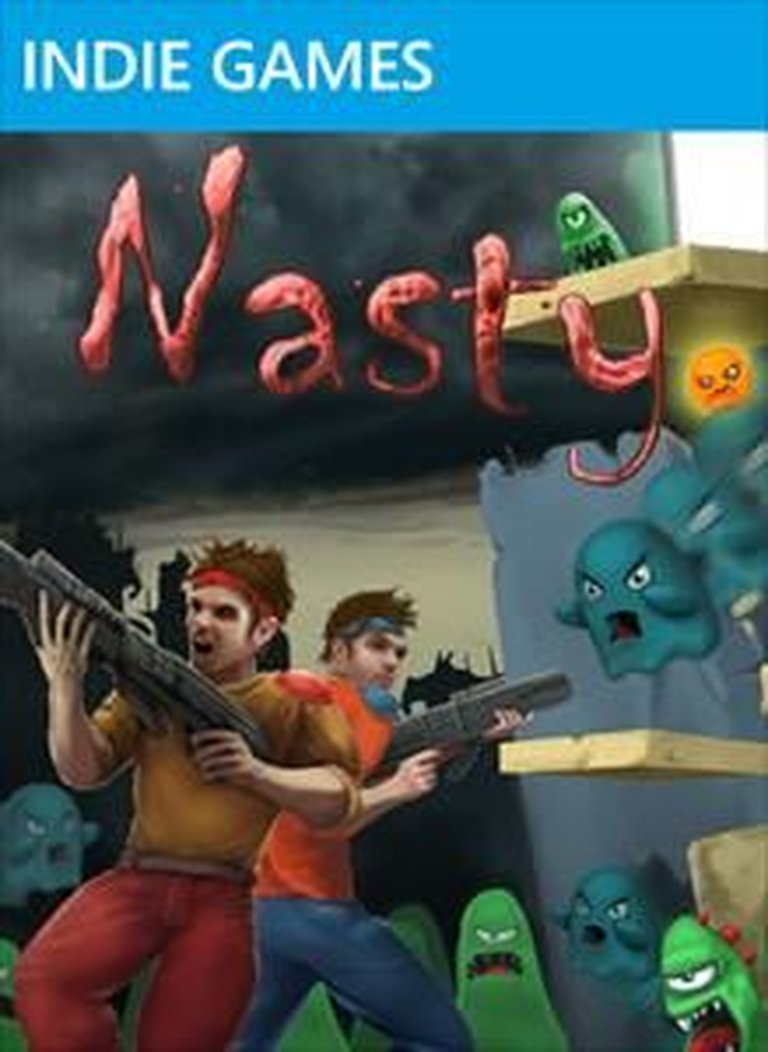
Nasty is a 2009 Xbox 360 arcade platform shooter developed and published by Fun Infused Games, later ported to Windows in 2019, featuring side-view fixed/flip-screen gameplay where players control a main character battling various enemies across levels with scalable difficulty and a replayable story mode that provides hours of challenging fun.
Where to Buy Nasty
PC
Nasty Reviews & Reception
gamergeddon.com : these make a nice distraction from the main game and are good fun to take on.
smallcavegames.blogspot.com : Mashing your way though 100+ levels by yourself or with a friend is undeniably a good time
Nasty: Review
Introduction
In the chaotic dawn of the Xbox Live Indie Games (XBLIG) era, where hobbyist developers unleashed a torrent of pixelated passion projects onto Microsoft’s digital storefront, few titles captured the raw, unfiltered joy of classic arcade shooters quite like Nasty. Released in 2009 as a 400 Microsoft Points download, this side-scrolling platform shooter from Fun Infused Games arrived amid a flood of experimental indies, evoking the spirit of Bubble Bobble while arming its heroes with guns instead of bubbles. Its legacy endures not as a blockbuster, but as a testament to solo-dev ingenuity—a game that prioritizes tight, replayable action over bombast, ported a decade later to Steam for a paltry $0.99. Nasty proves that in an industry obsessed with sprawling narratives and photorealism, simple, addictive gameplay loops can still triumph, offering 100 levels of frantic co-op shooting that feel as fresh today as they did in the Xbox 360’s heyday.
Development History & Context
Fun Infused Games, a modest outfit helmed primarily by Kris Steele, birthed Nasty during the golden age of XBLIG—a 2008-2013 phenomenon that democratized game development via Xbox Live Arcade. Steele wore multiple hats as game designer, programmer, level artist, “so-so enemy” artist, and even sound effects creator (sourcing some from SoundSnap.com), embodying the era’s DIY ethos. Collaborators like Philippe Chabot (main character and “good enemy” artwork) and Liam Tarpey (music and jingles) rounded out a 11-person credit list, with Media Militia handling menu textures. This was indie gaming before Kickstarter ubiquity: constrained by Xbox 360’s XNA framework (later MonoGame for the 2019 Windows port), developers like Steele navigated limited budgets, no marketing muscle, and a marketplace saturated with over 1,000 titles yearly.
The gaming landscape of 2009 was dominated by AAA behemoths like Modern Warfare 2 and Uncharted 2, but XBLIG fostered retro revivalism amid the rise of iOS casuals and flash games. Technological limits—no online multiplayer, fixed/flip-screen visuals—mirrored arcade roots, forcing focus on core loops. Steele’s vision, inspired by Bubble Bobble‘s enemy-trapping frenzy but escalated with shooting mechanics, addressed a niche for local co-op shooters. Post-launch patches (up to v1.5) refined controls and collision, a rarity for XBLIGs often abandoned after release. Priced accessibly (later slashed to 80 points then Steam’s bargain bin), Nasty exemplified how indies filled gaps left by big studios, influencing later retro platformers like those in the MonoGame ecosystem.
Narrative & Thematic Deep Dive
Nasty‘s story is a minimalist triumph of arcade economy: the world teeters under siege from the evil Dr. Slug and his Flying Fortress of Doom, bent on human enslavement. Players control dual heroes—Guy and Bob (playable solo or in 1-2 player co-op)—tasked with infiltrating the fortress, blasting through legions of foes, and toppling bosses to restore order. No cutscenes, no dialogue trees; exposition drips via level intros and the Steam blurb’s bombastic promise: “Do you have what it takes to complete 100 levels of non-stop excitement and prove that good can triumph over evil?”
Thematically, it’s pure good-vs-evil pulp, echoing 1980s coin-ops where heroism is defined by high scores, not character arcs. Dr. Slug embodies cartoonish villainy—a slug overlord with a doom-fortress—while enemies (bouncing blobs, gun-toting ghosts, tanks) symbolize chaotic invasion. Subtle progression builds tension: early levels homage Bubble Bobble‘s bubbly foes, escalating to armed variants on higher difficulties, mirroring humanity’s fight against escalating threats. No moral ambiguity or ludonarrative dissonance here; the plot serves gameplay, reinforcing themes of perseverance and camaraderie (co-op shines). In an era of emerging narrative-heavy indies like Braid, Nasty rejects verbosity for “awesomeness: unrivaled, sweetness: pretty sweet,” prioritizing kinetic triumphs over emotional depth—a deliberate anti-story stance that amplifies its replayable purity.
Gameplay Mechanics & Systems
At its core, Nasty is a fixed/flip-screen arcade platform shooter, distilling Bubble Bobble‘s screen-clearing frenzy into bullet-hell precision. Direct-control heroes navigate one-screen arenas, gunning down all enemies to unlock exits before the Doom Bolt—a relentless pursuer—strikes. One-hit deaths demand mastery, balanced by 12 power-ups: multi-shot guns, rapid fire, super jumps, time freezes, invincibility, and fruit/diamonds for extra lives and scores.
Core Loops & Combat: Levels cycle shoot-dodge-collect, with wraparound walls adding tactical depth (escape pursuits or flank foes). Enemies vary richly—roaming “Bubble Bobble” types, jumping blobs, homing ghosts, destructible tanks—forcing adaptation. Bosses every 20 levels (giant ghosts, Hell Snakes, mega-tanks) demand pattern recognition. Difficulty scales brilliantly: Easy offers passive foes; Medium ramps aggression; Hard mutates enemies (e.g., ghosts split into minis, roamers gain guns), transforming playstyles without mere health tweaks.
Progression & Replayability: 100 unique levels (few repeats, saves every 10) span 2+ hours on Easy, far longer on Hard. Continues and checkpoint unlocks encourage persistence. Co-op (1-2 players) fosters chaos—friendly fire off, but cramped screens demand synergy. Battle mode (2-4 local players) adds Deathmatch, Last Man Standing, and Score Attack across 10 arenas, extending life via galactic rivalries.
UI & Flaws: Clean menus, scalable difficulty selector, and score trackers shine, but early versions had “floaty” jumps (patched for tap/short-hold precision). Minor collision glitches (falling through platforms, missed close-range shots) persist rarely, frustrating precision plays. No online or leaderboards limit modern appeal, yet tight loops and power-up risk/reward (grab high-score fruit amid swarms?) ensure addiction.
Innovations like difficulty-mutated enemies and wraparound navigation elevate it beyond clones, flaws notwithstanding.
World-Building, Art & Sound
The Flying Fortress of Doom pulses as a metallic labyrinth of industrial guts—corridors, voids, boss lairs—built via flip-screen transitions for claustrophobic intensity. Atmosphere evokes retro arcades: dim glows, enemy swarms evoke invasion panic, power-ups punctuate desperation. Visuals are pixel-perfect minimalism: Philippe Chabot’s crisp hero sprites and “good enemies” pop against Kris Steele’s utilitarian levels. Basic but evocative—ghostly pallor, tank treads, slug motifs—no wasted pixels, charming in its restraint.
Sound design amplifies frenzy: Steele’s SoundSnap-sourced effects deliver punchy shots, jumps, and explosions; Tarpey’s chiptune jingles loop infectiously for menus/intros/exits. No voiceover needed—audio cues (enemy alerts, power-up chimes) guide chaos, immersing via rhythm. Together, they craft “non-stop excitement,” where art’s simplicity spotlights mechanics, sound’s bite heightens peril, forging an arcade reverie that lingers.
Reception & Legacy
Launch reception was niche but glowing: Gamergeddon hailed it “great fun” with “scalable difficulty” for “many hours” replayability, worth 400 points for story mode alone (unscored). Small Cave Games awarded a B, praising level progression and variety despite “floaty” controls and weak power-ups, suggesting a price drop for broader appeal (later realized). No Metacritic aggregate (tbd), MobyGames lacks a score, collected by one player—XBLIG obscurity struck hard amid 2009’s indie deluge.
Commercially modest (Xbox trial/full versions flew under radar), its reputation grew via word-of-mouth and 2019 Steam port ($0.49 sales). Legacy ripples in MonoGame scene: Steele’s credits span 12 games (2D Voxel Madness, Hypership Out of Control!), influencing pixel shooters. It embodies XBLIG’s highs—accessible retro action—paving for Steam indies like Nasty Rogue (2019 homage?). No direct successors, but it underscores arcade endurance amid narrative bloat, a cult footnote for platformer historians.
Conclusion
Nasty is a pixelated powerhouse: 100 levels of co-op shooting bliss, flawlessly blending Bubble Bobble homage with shooter escalation, redeemed by patches and ports from launch quirks. Kris Steele’s solo-dev triumph captures XBLIG’s scrappy soul—unpretentious, addictive, eternally replayable. In video game history, it claims a vital niche: proof that amid AAA excess, a tight loop and evil slug fortress suffice for triumph. Verdict: 8.5/10 – Essential retro indie gem, buy on sale and grab a friend.