
- Release Year: 2006
- Platforms: Windows
- Publisher: Funbox Media Ltd., Strategy First, Inc.
- Developer: Sonalysts Combat Simulations, Sonalysts, Inc.
- Genre: Compilation
- Perspective: Cockpit view
- Game Mode: Single-player
- Gameplay: Naval combat, Real-time tactics, Simulation, Strategy, Submarine simulation
- Setting: Cold War, Modern, Naval
- Average Score: 57/100
Description
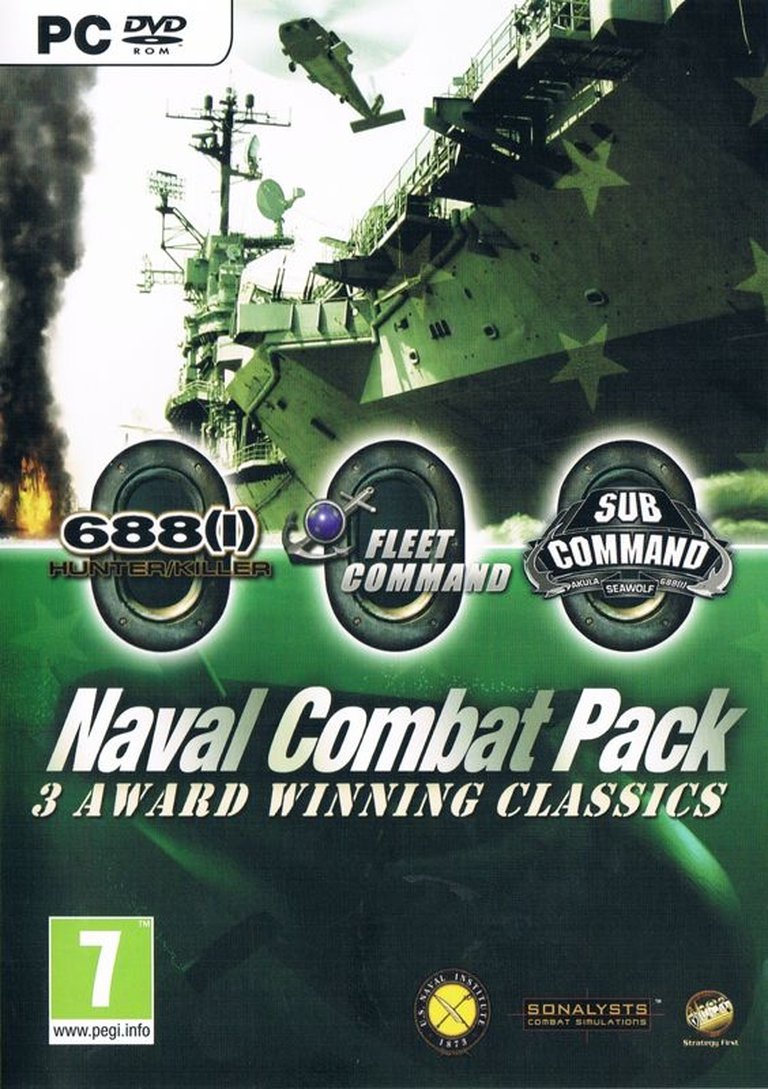
Naval Combat Pack: 3 Awards Winning Classics is a compilation of three acclaimed naval simulation games: Jane’s Combat Simulations: 688(I) Hunter/Killer, Jane’s Combat Simulations: Fleet Command, and Sub Command: Akula Seawolf 688(I). This collection offers a deep and realistic naval combat experience, allowing players to command submarines and fleets in various strategic and tactical scenarios.
Naval Combat Pack: 3 Awards Winning Classics Reviews & Reception
gamearchives.net (57/100): The Naval Combat Pack is a blend of simulation and strategy that allows the gamer to control every detail and give orders from the Captain’s chair.
pc.gamespy.com : The Naval Combat Pack is a blend of simulation and strategy that allows the gamer to control every detail and give orders from the Captain’s chair.
Naval Combat Pack: 3 Awards Winning Classics: Review
Introduction
In an era dominated by high-octane shooters and sprawling open worlds, the Naval Combat Pack: 3 Awards Winning Classics stands as a testament to the enduring appeal of simulation and strategic depth. Released in October 2006 by Strategy First, this compilation bundles three seminal naval simulations—Jane’s 688(I) Hunter/Killer, Jane’s Fleet Command, and Sub Command—developed by the defense contractorturned-giant Sonalysts Combat Simulations. More than a mere collection, it represents a golden age of gaming where authenticity reigned over spectacle. This review argues that the Naval Combat Pack is not merely a historical artifact but a masterclass in marrying technical precision with compelling gameplay, offering an unmatched immersion into the silent, high-stakes world of modern naval warfare. Its legacy lies in its ability to transform players from mere gamers into virtual admirals, where the clatter of sonar and the weight of tactical decisions create an experience as intellectually rigorous as it is thrilling.
Development History & Context
The Naval Combat Pack emerged from the unique intersection of military innovation and gaming evolution. Developer Sonalysts Combat Simulations (SCS), a Waterford, Connecticut-based firm with real-world contracts designing simulators for the U.S. Navy, brought unparalleled authenticity to its projects. Founded in 1973, SCS leveraged its defense expertise to translate complex naval systems into playable experiences, a move that directly influenced the pack’s three titles.
688(I) Hunter/Killer (1997), the pack’s progenitor, was groundbreaking for its use of real-world oceanographic data, submarine schematics, and sonar mechanics. By the late ’90s, PC gaming was experiencing a surge in realism-driven simulations, fueled by advancements in 3D graphics and processor power. Fleet Command (1999) capitalized on this, pioneering real-time strategy on the high seas with dynamic 3D environments and weather systems. Sub Command (2001) refined submarine simulation by introducing multi-platform gameplay, allowing players to toggle between tactical and strategic perspectives.
Strategy First, a Montreal-based publisher known for its niche titles, recognized SCS’s niche appeal. As Pro Sotos, Business Development Manager, noted, the compilation aimed to “share our small piece of PC gaming history” while offering “tremendous value” to military enthusiasts. The pack included a bonus DVD, “A Century of Silent Service,” featuring 90+ minutes of interviews (including former President Jimmy Carter) and archival footage, bridging gaming and historical education. Released at a budget price of $19.99, it capitalized on the post-Cold War fascination with naval technology, positioning itself as both a playable archive and a tribute to maritime history.
Narrative & Thematic Deep Dive
Each title in the pack weaves distinct narratives rooted in geopolitical tension, though their storytelling is conveyed through gameplay rather than traditional cutscenes.
-
688(I) Hunter/Killer: Missions are framed as tours of duty, with scenarios drawn from real-world political flashpoints. Players navigate Cold War-era tensions, tracking Soviet submarines in the Atlantic or intercepting cargo ships in the Pacific. The narrative thrives on isolation and pressure; sonar contacts emerge as cryptic pings, forcing players to interpret threats in claustrophobic silence. Dialogue is minimal—crew reports and tactical orders—but the tension is palpable. Themes center on the psychological toll of submarine warfare: the weight of decisions that could trigger global conflict, the isolation of the “hunter-killer” role, and the fragility of peace beneath the waves.
-
Fleet Command: Campaigns are ripped from contemporary headlines, with players balancing diplomacy and aggression in hotspots like the Taiwan Strait or the Persian Gulf. The narrative unfolds through operational briefings, where political objectives (e.g., “protect shipping lanes” or “enforce no-fly zones”) dictate strategy. Characters are abstract—admirals, enemy commanders—but their motivations are clear: national interest and survival. Themes explore the complexity of modern naval power, where aircraft carriers and destroyers become pieces in a geopolitical chessboard, collateral damage looms large, and victory is measured in stability, not body counts.
-
Sub Command: The narrative splits across two campaigns, one for the U.S. (Seawolf/688(I)) and one for Russia (Akula). Missions include high-stakes objectives like rescuing crippled subs or launching Tomahawk strikes on inland targets. The dialogue is sparse but immersive, with crew members relaying sensor data and battle status. Themes emphasize technological parity and the moral ambiguity of submarine warfare: the stealthy hunt, the ethical weight of long-range missiles, and the shared humanity of rival crews. Together, the pack paints a portrait of naval combat as a silent, cerebral dance of detection and deception, where victory is often won without a single shot fired.
Gameplay Mechanics & Systems
The pack’s genius lies in its scalability, offering both hardcore simulation depth and accessible strategy. Each title’s mechanics complement the others, creating a comprehensive naval combat ecosystem.
-
688(I) Hunter/Killer: Players man over 12 submarine stations, from sonar and fire control to helm and target motion analysis. The core loop involves interpreting passive sonar data, identifying contacts, and executing silent attacks. Innovations included real-world terrain data affecting sonar propagation and a crew management system where training levels impacted efficiency. Multiplayer supported up to 8 players in submarine-on-submarine duels. The interface was dense but navigable, with keyboard shortcuts automating routine tasks to prevent micromanagement fatigue.
-
Fleet Command: This real-time strategy title simplified naval command with point-and-click controls. Players deployed task forces (frigates, carriers, subs) on 3D battlefields, rotating and zooming to coordinate attacks. Weather, time of day, and sea states dynamically combat, affecting detection and range. Its innovation lay in intuitive design—no complex symbols—while allowing deep customization of loadouts and formations. Multiplayer focused on fleet-versus-fleet battles, emphasizing positioning and electronic warfare.
-
Sub Command: Bridged the gap between 688(I) and Fleet Command, letting players command three subs (Seawolf, 688(I), Akula) with distinct capabilities. The interface streamlined systems with automated crew, but retained depth in sensor management (sonar, radar, radar warning receivers). Missions like transiting under polar ice or rescuing distressed crews added variety. Tomahawk strikes introduced land-attack gameplay, while multiplayer expanded to include co-op operations.
Flaws included a steep learning curve for beginners and occasional AI quirks, such as enemy ships ignoring obvious threats. Yet these were minor quibbles against a foundation of systems that felt alive and interconnected. The pack’s true innovation was its unified vision: whether commanding a single sub or an entire fleet, every action had tangible, consequence-laden depth.
World-Building, Art & Sound
Sonalysts’ background as military contractors ensured unparalleled authenticity in world-building, art, and sound.
-
688(I) Hunter/Killer: Ocean depth and density were modeled from satellite data, creating realistic sonar propagation. Submarine interiors were rendered with meticulous detail, from periscopes to torpedo tubes. The monochrome sonar display and sonar pulses (clicks, pings, whale calls) generated tension; the creak of hulls and distant explosions amplified immersion.
-
Fleet Command: The 3D environments were revolutionary for 1999, with dynamic waves, ship wakes, and weather effects. Aircraft carriers launched jets with authentic sound cues, while missile trails streaked across sun-drenched or stormy skies. The sound design mixed authoritative radio chatter with the mechanical groans of warships, making surface battles feel chaotic and grand.
-
Sub Command: Over 250 3D objects—from Russian trawlers to French Mirage jets—filled its world. Lighting effects pierced the ocean’s gloom, illuminating subs and mines. Torpedo impacts were visceral, rattling the player’s virtual seat. The “A Century of Silent Service” DVD enhanced this world, placing gameplay within a historical context through interviews and archival footage.
Collectively, the pack evoked the duality of naval warfare: the serene beauty of open seas contrasted with the lurking terror of unseen threats. Visuals were pixelated by modern standards, but their fidelity to reality made them timeless.
Reception & Legacy
At launch, the Naval Combat Pack received muted mainstream attention but garnered fervent praise from niche communities. Metacritic lists no critic reviews, reflecting its status as a cult classic. However, its individual titles were award darlings: 688(I) won “Best Combat Sim of the Year,” Fleet Command claimed “Best Maritime Sim of 2001,” and Sub Command earned “Best Naval Sim” honors from GameSpy. Sales were modest but sustained, buoyed by Strategy First’s budget pricing and SCS’s military credibility.
Its legacy endures in its influence on subsequent naval games. Titles like Silent Hunter III and Dangerous Waters (developed by Sonalysts) built upon its mechanics, while modern strategy games adopted its emphasis on environmental interaction. The pack also pioneered the “simulation compilation” model, later seen in collections like Jane’s Combat Simulations. Decades later, it remains a benchmark for authenticity, cited by historians and modders as a template for simulating naval operations. Its greatest legacy, however, is cultural: it preserved the art of naval strategy for a generation, proving that the quietest depths often hold the most compelling stories.
Conclusion
The Naval Combat Pack: 3 Awards Winning Classics is more than a bundle of games—it is a time capsule of simulation’s golden age. By weaving together 688(I) Hunter/Killer, Fleet Command, and Sub Command, Strategy First and Sonalysts crafted an experience that is both a museum piece and a masterwork. The pack’s technical precision—real-world data, complex systems, and atmospheric design—remains unmatched, while its thematic depth explores the quiet drama of naval warfare with nuance. Flaws like a steep learning curve are forgivable in light of its ambition: to turn players into stewards of virtual oceans.
In an industry chasing spectacle, the Naval Combat Pack stands as a monument to authenticity. It earns its “award-winning” designation not through flashy graphics, but through the profound satisfaction of mastering sonar, outmaneuvering fleets, and commanding billions of dollars in hardware with a few keystrokes. For historians, it’s a digital archive; for gamers, it’s a challenge. For both, it is essential—a definitive entry in the canon of military simulation that proves the most riveting battles are often fought without a single explosion.