
- Release Year: 2005
- Platforms: Windows
- Publisher: United States Navy
- Developer: Whatif Productions LLC
- Genre: Action, Simulation
- Perspective: 1st-person
- Game Mode: Single-player
- Gameplay: Naval, Shooter, Stealth, Vehicular, watercraft
- Setting: Futuristic, Submarine
Description
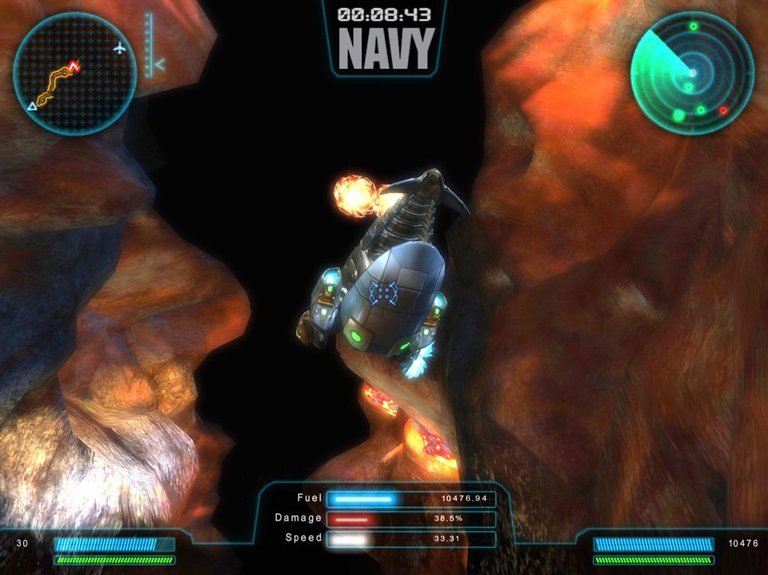
Navy Training Exercise: Strike and Retrieve is a free first-person shooter developed by Whatif Productions LLC for the United States Navy as a recruitment and training tool. Players pilot a remote-controlled submersible, the Nmech, on a covert mission to recover the Gorgon Box from a downed unmanned spy plane in a slightly futuristic underwater setting, racing against time, hazardous environments, and an unrelenting enemy also after the device.
Navy Training Exercise: Strike and Retrieve Patches & Updates
Navy Training Exercise: Strike and Retrieve Reviews & Reception
myabandonware.com : this game was sort of entertaining, but the server is long since gone.
Navy Training Exercise: Strike and Retrieve: A Sunken Relic of Military Advergaming
Introduction: The Ghost in the Machine
In the vast, often-overlooked archives of military-sponsored software, few titles embody the bizarre convergence of state recruitment, viral marketing, and interactive simulation quite like Navy Training Exercise: Strike and Retrieve (NTE: Strike and Retrieve). Released in 2005 by the obscure studio Whatif Productions LLC for the United States Navy, this free-to-play first-person shooter promised a thrilling underwater recovery mission. Yet, today, it exists primarily as a ghost—a partially lost artifact whose core executable is downloadable but rendered functionally inert by a defunct authentication server. This review is not just an analysis of a game’s mechanics or narrative, but an archaeological exercise. We will reconstruct the intent, execution, and ultimate fate of a title that was designed to recruit, marketed with an unprecedented viral campaign, and now serves as a cautionary tale about digital preservation and the fragility of advergames. My thesis is that NTE: Strike and Retrieve was a conceptually ambitious but technically constrained product of its time, whose historical significance lies less in its gameplay and more in its role as a pioneering—if now inaccessible—case study in interactive military marketing and the inherent vulnerabilities of server-dependent software.
Development History & Context: A Navy-Branded Pipeline
The Studio and the Vision: Whatif Productions LLC was a small, contract-based development studio. Credits list President/CEO/CTO Jake Kolb V, Lead Engineers Chris Dellario and Scott Henderson, and a team of programmers and artists. Their track record, as noted on MobyGames, includes other titles, but NTE stands out for its direct commissioning by the U.S. Navy—a rare and significant publisher credit. The vision, as articulated in promotional materials and post-mortems like Iain Lanivich’s case study, was explicitly inspired by the 1984 film The Last Starfighter. The game was conceived not as a training tool in the traditional sense, but as an “elite testing simulator” and, more crucially, a recruitment and engagement vehicle. The Navy sought to translate the glamour and tension of submarine and special operations service into an interactive format to capture the attention of a digitally native generation.
Technological Constraints: Built for Windows in 2005, the game was a product of the DirectX 9 era. The requirement for an internet connection for login and stat tracking was a cutting-edge but risky feature for a free download. This “always-on” dependency, while innovative for its time for a single-player game, was its greatest architectural flaw. The game’s specifications list support for keyboard, mouse, and “other input devices,” suggesting a complex control scheme befitting a simulated ROV (Remotely Operated Vehicle), but no evidence points to advanced force feedback or specialized hardware. The engine is unlisted, but graphical quality from available screenshots and the ModDB trailer suggests a mid-tier proprietary or licensed engine capable of underwater environments and basic models, but not cutting-edge for 2005.
Gaming Landscape: 2005 was a year of established franchises (Halo 2, Guitar Hero) and emerging genres. Stealth and simulation were thriving (Thief: Deadly Shadows, Silent Hunter III). NTE occupied a niche blending first-person action with vehicular simulation and stealth elements, but its primary competitor was not Call of Duty, but the broader landscape of free, browser-based advergames. Its ambition to be a downloadable, substantial experience was unusual for a government-sponsored title.
Narrative & Thematic Deep Dive: The Gorgon Box Enigma
The game’s plot is described in two slightly conflicting but complementary ways:
1. Moby Games/ModDB Version: A “top secret mission to recover the Gorgon Box located inside a downed, unmanned spy plane.” The player pilots an “Nmech” submersible against an “unrelenting enemy.”
2. Campaign Case Study/Lanivich Portfolio: Refers to the object as the “Aurora ASE-5,” a “piece of confidential data” to be retrieved from the spy plane. The viral teaser campaign was named “Gorgonbox,” making the term a central piece of the marketing mystique.
Synthesis: The narrative框架 is a classic Cold War-style thriller updated for the War on Terror. A top-secret U.S. reconnaissance asset (the spy plane, possibly an RQ-4 Global Hawk variant) crashes in the Atlantic. Its cargo—either a mysterious “Gorgon Box” or the “Aurora ASE-5” data module—is of paramount importance. The player, a Navy recruit (implied), is tasked with piloting a deep-diving ROV (the “Nmech”) into a hazardous undersea trench to locate the wreck, breach its security (“crack the security code”), and secure the asset before a shadowy foreign adversary (“another party”) does. The race is against time, pressure, marine predators, and enemy forces who are also on-site.
Themes: The narrative explicitly explores themes of technological superiority, covert operations, and the tension between man and machine (control via remote proxy). The setting in a “futuristic” or contemporary deep-trench environment touches on oceanic exploration and the unknown. The Gorgon Box/Aurora ASE-5 serves as a MacGuffin representing state secrets and technological one-upmanship. The game, therefore, positions the Navy not just as a fighting force, but as the ultimate solver of high-tech crises, requiring skill, nerve, and technical proficiency—a direct reframing of recruitment messaging.
Character & Dialogue: Given the first-person perspective and the nature of the source, no named protagonist or significant NPC dialogue is documented. The narrative is conveyed through mission briefings (presumably) and environmental storytelling within the submerged wreck site. The “enemy” is abstract and faceless, reinforcing the “us vs. them” dynamic of geopolitical intrigue.
Gameplay Mechanics & Systems: The ROV Simulator
Based on the fragmented descriptions from MobyGames (“Shooter, Stealth”), ModDB (“navigating challenging underwater terrain, surviving deep sea creature attacks”), and the user testimonial from CLBrown on MyAbandonware, we can reconstruct the core loops:
- Core Loop: Pilot the Nmech ROV from a launch point → Navigate a complex, maze-like underwater trench/canyons → Locate the downed spy plane → Solve a “security code” puzzle to access the cargo hold → Retrieve the Aurora ASE-5/Gorgon Box → Transport it to an “Allied Pickup Zone” while avoiding or neutralizing threats.
- Movement & Control: The player controls a submarine-like vehicle. Physics likely involve momentum, buoyancy, and restricted maneuverability in tight spaces—a vehicular simulation layer atop the FPS perspective.
- Threats & “Combat”:
- Environmental: Deep-sea terrain hazards (caves, stalactites, thermal vents), pressure (implied time limit or health drain), darkness/low visibility.
- Fauna: Aggressive “deep sea creature attacks.” CLBrown’s recollection is key: these creatures are “HUGE (and toothy),” suggesting encounters with large, genetically enhanced or simply massive sea life (giant squid, prehistoric predators) that charge the ROV. The “shock-prod” weapon is a non-lethal (or lightly lethal) tool for stunning/repelling wildlife, fitting the “stealth” descriptor. It’s not a shooter in the conventional sense; violence is reactive and defensive.
- Human Enemy: The “opposing force” likely operates rival submersibles or employs stationary defenses. Engagement may involve stealthy evasion, environmental sabotage, or direct confrontation with the shock-prod or perhaps limited torpedoes/charges.
- Progression & Systems: The game is linear mission-based. Progression is about completing the single, primary objective. The “hidden codes” mentioned in the campaign description that “unlocked weapons and attributes in-game” suggest a meta-progression system tied to the real-world viral campaign. Successfully finding codes on Navy.com would grant in-game advantages, blurring the line between external marketing and internal game reward.
- UI & Innovation: No UI details survive. The “server login” requirement is the most infamous “system,” tracking player stats for the Navy’s analytics. This was an innovative (if heavy-handed) form of player metrics collection for a recruitment tool. The innovation was in the holistic campaign, not necessarily in the gameplay UI.
Flaws: The dependency on a live server for basic functionality was a catastrophic design flaw from a preservation standpoint. The “stealth” in an undersea environment against AI that may not have been sophisticated is a probable weak point. The game’s length and replayability were likely limited to the single mission.
World-Building, Art & Sound: A Tense, Abyssal Atmosphere
Setting & Atmosphere: The entire game takes place in the claustrophobic, pitch-black depths of the Atlantic trench. The atmosphere is one of high-stakes isolation and bio-phobic dread. The world-building is environmental: the wreck of the high-tech spy plane juxtaposed against primordial, hostile sea life. The “futuristic” hint from the Czech review suggests a near-future aesthetic (circa 2005-2010) for the Nmech and the spy plane.
Visual Direction: From the scarce screenshots, the art style is functional and atmospheric, not photo-realistic. Emphasis is on:
* Lighting: Bioluminescence from creatures, the ROV’s spotlights cutting through murk, headlights on the wreck.
* Scale: Making the player vehicle and sea creatures feel massive and ponderous.
* Industrial Design: The Nmech likely looks like a cross between a deep-sea research sub and a military drone—utilitarian, armored, with glowing interfaces.
* The Wreck: A detail-rich, damaged high-tech object on the ocean floor, serving as the level’s climax.
Sound Design: This is where the experience would have shone. Sound in underwater games is pivotal. The design would have employed:
* Diegetic Sounds: The creaking of the ROV’s hull, whirring of thrusters, sonar pings, dripping water.
* Ambient Dread: Low-frequency rumbles (distant leviathans?), silence punctuated by-creaks and groans from the trench.
* Threat Cues: The clicking of a giant squid’s beak, the roar of a predator, alarm klaxons from the enemy.
* Communications: Crackling radio chatter from command (now lost to history), and the iconic, terrifying sounds from the Jaws soundtrack for shark-like threats.
The combined effect would have been a masterclass in tension, using audio to sell the terror of the abyss when visuals were limited.
Reception & Legacy: A High-Scoring Ghost
Critical Reception at Launch: MobyGames lists a single critic score: 94/100 from Freegame.cz. The translated review praises its “very interesting” nature, “moderately futuristic environment,” and the fact it “offers a very lot.” The sole deduction is for “slightly higher hardware requirements.” This is a significant score for a niche advergame, suggesting it was competent and engaging within its narrow scope. The lack of widespread critical coverage indicates it was treated as a promotional curiosity, not a mainstream title.
Commercial & User Reception: As a freeware public domain title distributed via the official Navy website (nte.navy.com) and major gaming portals, its “commercial” success is irrelevant. Its distribution was a recruitment metric. User comments on MyAbandonware and ModDB are universally nostalgic but frustrated. CLBrown’s 2022 review is seminal: it confirms the game was “reasonably entertaining” and fun due to the “jarring” size of sea creatures, but deliberately highlights the fatal flaw—the dead login server. The community consensus is one of lost access, not failed quality.
Evolving Reputation & Influence: NTE: Strike and Retrieve is now a textbook case of digital obsolescence. Its reputation has shifted from “that free Navy game” to a “partially lost media” subject, as meticulously documented by the Reddit lostmedia community. Its influence is indirect but profound:
1. Marketing: The “Gorgonbox” viral campaign (with its 1-800 number, E3 street teams, and unbranded teasers) is cited as an award-winning benchmark in integrated digital marketing (IAC Awards, WebAwards, Telly Award). It demonstrated how to build buzz around a government product without overt branding.
2. Advergame Design: It showed the potential of using a full-featured, simulation-style game for recruitment, moving beyond flash-based mini-games.
3. Preservation Lesson: Its demise is a stark lesson on the perils of server-dependent single-player experiences. It is now used as an example in game studies and archival circles of how not to design for longevity.
4. Series Potential: It was intended as “the first of a series of NTE games,” but the server’s death killed any momentum or data continuity necessary for sequels.
Related Games Context: The “Strike” series lineage (Jungle Strike, Urban Strike) is a red herring—those are EA assets from the 90s. NTE is unrelated, merely sharing a naming convention that was common in military-themed games. Its true relatives are other military advergames like America’s Army, but NTE was more narrowly focused and less persistent.
Conclusion: The Final Salute to a Scuttled Simulator
Navy Training Exercise: Strike and Retrieve is a paradox. As a playable experience, it is, for all practical purposes, dead. The required authentication to its stats server is a permanently closed door, rendering the downloaded executable a beautiful, interactive tombstone. This is a profound failure, superseding any gameplay merits it may have had.
Yet, as a historical artifact, it is immensely important. It represents a peak of early-2000s confidence in digital outreach, a time when a government branch would commission a full 3D simulation and back it with a multi-channel viral marketing campaign costing hundreds of thousands (if not millions). The “Gorgon Box” campaign was clever, engaging, and effective in its moment. The game itself, from the fragmented evidence, was a taut, atmospheric, and unique hybrid of underwater exploration, survival horror, and stealth that successfully translated niche naval/RV operations into a compelling power fantasy.
Its ultimate fate is its legacy: a monument to impermanence. It serves as a critical study in what is lost when online services shut down, how advergames become orphaned, and why preservationists must battle to extract local, server-independent builds from defunct projects. For the player, it is an unplayable memory. For the historian, it is a rich, cautionary case study. For the Navy of 2005, it was likely a successful recruitment tool. For us in 2025, it is the sinking HMS NTE—a wreck on the digital ocean floor, its treasure locked inside, waiting for a key that no longer exists.
Final Verdict: In its historical context, a conceptually brilliant but fatally flawed advergame. As a playable game today: 0/10 (Unplayable). As a preserved artifact of marketing history and digital fragility: 9/10 (Essential Study).