
- Release Year: 2003
- Platforms: GameCube, PlayStation 2, Windows, Xbox
- Publisher: Electronic Arts, Inc.
- Developer: Electronic Arts Black Box
- Genre: Driving, Racing
- Perspective: First-person
- Game Mode: Online PVP, Single-player
- Gameplay: Automobile, Crafting, Customization, Street racing, Vehicle simulator, Vehicular
- Setting: Night, Urban
- Average Score: 88/100
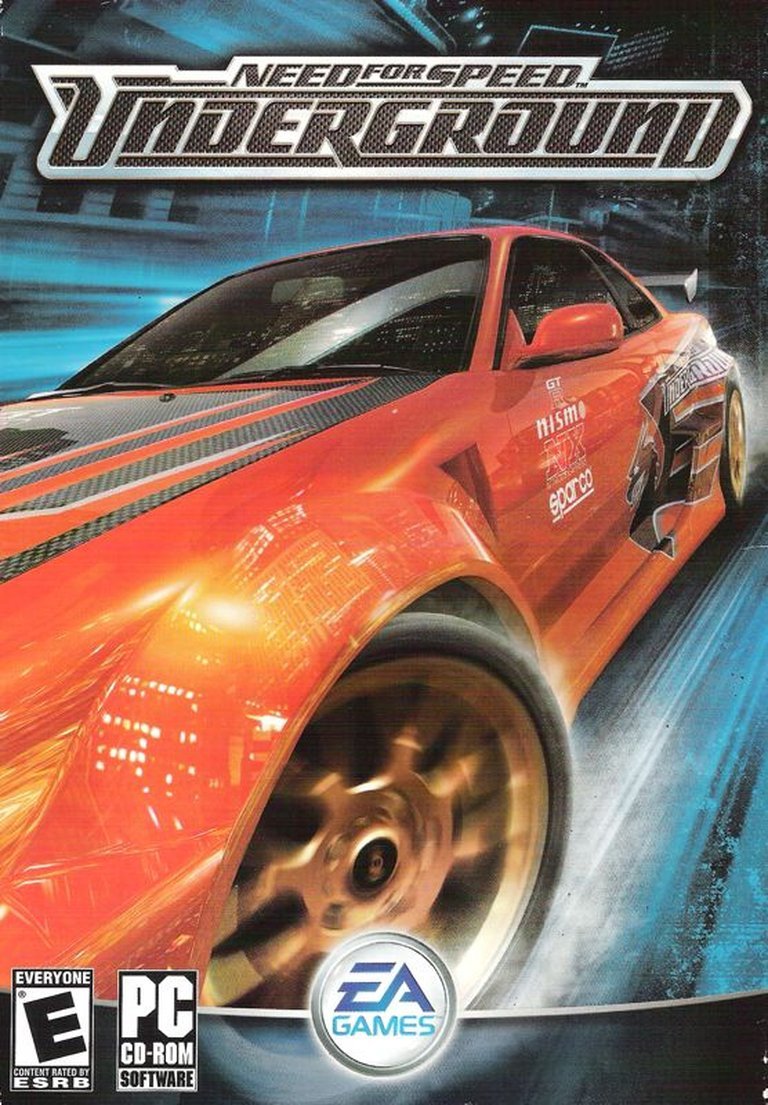
Description
Need for Speed: Underground, the seventh installment in the iconic racing series, thrusts players into the heart of illegal nighttime street racing culture, heavily influenced by The Fast and the Furious franchise. Gamers build and customize their own heavily modified import cars from the ground up, utilizing hundreds of real licensed parts and driving authentic licensed vehicles like the Mazda RX-7 and Nissan Skyline GT-R across over 100 single-player races set in a vibrant, neon-lit urban environment. The experience is amplified by a dynamic hip hop/hard rock soundtrack featuring artists such as Mystikal, Rob Zombie, and the Crystal Method.
Gameplay Videos
Need for Speed: Underground Free Download
Need for Speed: Underground Cracks & Fixes
Need for Speed: Underground Patches & Updates
Need for Speed: Underground Mods
Need for Speed: Underground Guides & Walkthroughs
Need for Speed: Underground Reviews & Reception
metacritic.com (100/100): Still the best arcade racer ever in 2025. Modding community is amazing. Allows for native 4k, unlocked frame rate and post processing effects to bring the game into the modern era.
imdb.com (80/100): This game is magic, soundtrack, personalizations for cars, gameplay, sound effects, everything is good.
gamesreviews2010.com (85/100): Need for Speed: Underground is considered to be one of the best racing games of all time.
Need for Speed: Underground Cheats & Codes
PC
Go to the main menu, go to the Statistics sub-menu, go back again (pressing DELETE or Backspace), and finally enter your desired cheat.
| Code | Effect |
|---|---|
| gimmesomecircuits | Unlock Circuits |
| gimmesomesprints | Unlock Sprint Circuits |
| gimmesomedrag | Unlock Drag Circuits |
| gimmeppablo | Unlock Petey Pablo |
| gotcharobzombie | Unlock Rob Zombie |
| havyamystikal | Unlock Mystikal |
| needmylostprophets | Unlock Lost Prophets |
| 119focus | Unlock Car (Focus) |
| 893neon | Unlock Car (Neon) |
| 899eclipse | Unlock Car (Eclipse) |
| 371impreza | Unlock Car (Impreza) |
| 222lancer | Unlock Car (Lancer) |
| 922sentra | Unlock Car (Sentra) |
| 667tiburon | Unlock Car (Tiburon) |
| 334mygolf | Unlock Car (Golf) |
| 77peugeot | Unlock Car (Peugeot) |
| 777rx7 | Unlock Car (RX7) |
| 350350z | Unlock Car (350Z) |
| 111skyline | Unlock Car (Skyline) |
| 221miata | Unlock Car (Miata) |
| 2000s2000 | Unlock Car (S2000) |
| 889civic | Unlock Car (Civic) |
| 228supra | Unlock Car (Supra) |
| 240240sx | Unlock Car (240SX) |
| 342integra | Unlock Car (Integra) |
| 239celica | Unlock Car (Celica) |
| 973rsx777 | Unlock Car (RSX) |
| allmylvloneparts | Unlock Level 1 Performance Upgrades |
| allmylvl2parts | Unlock Level 2 Performance Upgrades |
| seemylvl2parts | Unlock Level 2 Visual Upgrades |
| seemylvl1parts | Unlock Level 1 Visual Upgrades |
| driftdriftbaby | Unlock All Drift Tracks |
| slidingwithstyle | Drift physics in all modes |
| givemenismo | Get Nismo / Unique Vinyls |
PlayStation 2
Enter the following button sequences at the main menu. For hexadecimal codes, use a CodeBreaker or Action Replay device.
| Code | Effect |
|---|---|
| right, square, left, R1, square, L1, L2, R2 | Unlocks all drag tracks |
| left, left, left, left, right, R2, R1, L2 | Unlocks all drift tracks |
| down, R1, R1, R1, R2, R2, R2, square | Unlocks all circuit tracks |
| up, R2, R2, R2, R1, down, down, down | Unlocks all sprint tracks |
| X, circle, triangle, triangle, X, X, circle | Unlimited nitro |
| X, X, triangle, X | Get free parts |
| R1, up, up up, down, down, down, L1 | Drift physics in all races |
| FA7A006E 329F9E39 | Enable Code (Must Be On – CodeBreaker v1-5) |
| 9A142DBD 18C952E4 | Enable Code (Must Be On – CodeBreaker v6+) |
| 2A470ABF 05F5E0FF | Max Total Style Points |
| 1A451BFA 0000FFFF | Infinite Money |
| 2ABF0A27 05F5E0FF | Max Money |
| 2A6F09A6 05F5E0FF | Max Total Starts |
| 2A6B09A6 05F5E0FF | Max Total Wins |
| 2A5709A6 00000000 | No Total Losses |
| 0A93295A 00000007 | Debug Menu |
| 2A77342B 44801000 2A633425 00000000 | Infinite Nitrous Usage |
| 2A0B3FC1 2403270F 2AF73FC1 AE2303F0 2AF33FC1 AE2303F8 2A77342B 44801000 2A633425 00000000 | Always Max Nitrous Turbo |
Xbox
Type in the following codes in the main menu.
| Code | Effect |
|---|---|
| left, X, right, R, X, L, white, black | Unlock all drag tracks |
| right, right, right, right, left, black, R, white | Unlock all drift tracks |
| up, black, black, black, R, down, down, down | Unlock all sprint tracks |
| down, R, R, R, black, black, black, X | Unlock all circuit tracks |
| R, up, up, up, down, down, down, L | Drift physics in all races |
GameCube
Type in the following codes in the main menu.
| Code | Effect |
|---|---|
| down, R, R, R, X, X, X, Z | Unlock all circuit tracks |
| up, X, X, X, R, down, down, down | Unlock all sprint tracks |
| R, up, up, up, down, down, down, L | Drift physics in all races |
Gameboy Advance
Use the following codes with a CodeBreaker device.
| Code | Effect |
|---|---|
| 00000000 0002 | Mastercode 1 |
| 1006C284 0007 | Mastercode 2 |
| 33006A0C 0009 | 99x Drift Multiplier |
| 820008D4 FFFF 820008D6 7FFF | Unlimited Credits |
| 82000838 FFFF 8200083A FFFF | All Car & Track Upgrades Unlocked |
| 83005F0C 0000 83005F0E 0000 | Always Win Race (Race Time Is 0:0:01) |
| 83006A24 423F 83006A26 000F | Drift Score is 999,999 |
Need for Speed: Underground: Review
Introduction
In the pantheon of racing games, few titles have redefined a franchise as profoundly as Need for Speed: Underground. Released in November 2003, this seventh installment in EA’s long-running series abandoned the exotic supercars of its predecessors for the gritty, neon-drenched world of import-tuner street racing. Inspired by the cultural zeitgeist of The Fast and the Furious, Underground wasn’t just a game—it was a phenomenon that captured the imagination of a generation obsessed with custom cars and underground racing. Its legacy lies in its audacious shift: from sanctioned races to illegal nocturnal duels, from licensed exotics to tunable imports, and from arcade simplicity to a deep, RPG-like progression system. Yet, this reimagining was a double-edged sword, blending groundbreaking innovation with maddening compromises. This review dissects Underground‘s design, narrative, mechanics, and cultural impact, arguing that while its flaws are glaring, its triumphs cemented it as a watershed moment in racing history.
Development History & Context
Need for Speed: Underground emerged from the Vancouver-based studio EA Black Box (later known for Most Wanted and Carbon), tasked with reviving a franchise that had grown stale after Hot Pursuit 2 (2002). Developers aimed for a “complete reimagining,” inspired by the import-tuner scene popularized by The Fast and the Furious films. This shift wasn’t merely aesthetic; it was a radical departure from the series’ roots. Unlike previous titles featuring Ferraris and Lamborghinis, Underground focused on affordable, modifiable cars like the Honda Civic and Nissan Skyline, reflecting a cultural shift toward grassroots automotive culture. Technologically, the game pushed early 2000s hardware, leveraging the PS2, Xbox, GameCube, and PC to deliver “cinematic” lighting and motion blur—a technique supervised by Star Wars: Episode I pod-racing veteran Habib Zargarpour. The ambition was clear: to create a “movie-like” experience, with a $5.8 million marketing budget amplifying its street-racing swagger. However, constraints were evident. EA censored the soundtrack (using radio-edited tracks) and neutered the “danger” of illegal racing to maintain a broad appeal, inadvertently creating a sanitized version of the subculture it sought to emulate.
Narrative & Thematic Deep Dive
The narrative, though thin, provided crucial context for the gameplay. Players begin as a nameless racer in Olympic City (a fictional amalgam of Seattle, Vancouver, and other urban landscapes), introduced by Samantha—a guide who bridges the player to the underground scene. The plot revolves around ascending the ranks by defeating rival crews, culminating in a showdown with Eddie, the arrogant leader of The Eastsiders. Key moments include betrayals: Eddie forces the player to race Samantha, resulting in her totaled Honda Civic, and T.J., a mechanic, steals it. The player eventually wins back the car, restoring Samantha’s trust, before defeating Eddie’s girlfriend, Melissa, in a final circuit race. Themes of ambition, redemption, and respect permeate the story, but they’re executed with the subtlety of a sledgehammer. Characters are archetypes: Eddie embodies toxic masculinity, Samantha serves as a moral compass, and Melissa challenges the player’s legitimacy. Dialogue is cringeworthy, filled with forced “attitude” that feels like a 90s after-school special (“Yo, check out my ride!”). The narrative’s greatest flaw is its lack of depth—it’s a flimsy framework for racing, yet it effectively tied customization and progression into a cohesive goal: becoming an “underground legend.”
Gameplay Mechanics & Systems
Underground‘s core loop—race, earn cash, customize, repeat—was its genius. The game introduced a staggering 111 single-player races across five modes:
– Circuit/Knockout: Lap-based races on loop tracks.
– Sprint: Point-to-point sprints emphasizing precision.
– Drag: Technical straight-line races requiring gear-shift timing.
– Drift: Skill-based scoring for sustained slides.
– URL (Outrun): “Catch me if you can” chases against rivals.
Innovation came via car customization. Players could tune performance (engine, turbo, nitrous) and visual aesthetics (vinyls, neon, body kits) with parts from 52 real-world brands (e.g., HKS, Sparco). The Style Points system, inspired by Project Gotham Racing, rewarded stunts like drafting or near-misses, with multipliers based on car “flashiness.” This turned customization into a meta-game, where a “tricked-out” ride earned more points, blurring the line between racing and self-expression.
Yet, the mechanics were divisive. Physics were arcade-heavy: cars fishtailed uncontrollably, and collisions sent them flying 10 feet into the air. Damage was limited to detached license plates (except in drag races, where totaled engines ended races), stripping races of consequence. Rubberband AI—where opponents magically catch up—frustrated players, turning victories into pyrrhic triumphs. Despite this, the variety of modes kept the experience fresh, and nitrous oxide (a series first) added strategic depth.
World-Building, Art & Sound
Underground‘s world, Olympic City, was a triumph of atmosphere. Developers rendered a nocturnal metropolis of wet streets, neon signs, and towering skyscrapers, creating a “garish, neon jungle” that evoked late-night street-racing culture. Environments, though repetitive, were visually striking. Motion blur and reflective surfaces enhanced the sense of speed, though textures on buildings were bland. Art direction leaned into excess—neon underglows, vinyls, and grid girls (pre-race models) amplified the MTV-esque aesthetic.
Sound design was equally polarizing. The soundtrack, featuring 26 tracks from hip-hop (Lil Jon’s “Get Low”), rock (Rob Zombie), and EDM (The Crystal Method), mirrored the game’s identity. Yet, radio edits neutted the “edge,” and voice acting was universally panned as “poorly written” and “forced.” Still, the roar of tuned engines and gear shifts provided visceral satisfaction. As one critic noted, the game “sounds and looks beautiful,” even if its presentation was “bland” and “inoffensive.”
Reception & Legacy
Underground was a critical and commercial juggernaut. Aggregated scores peaked at 85% (Metacritic for PS2), with praise for customization, sense of speed, and mode variety. Game Informer hailed it as “the best damn racing game to roll down the avenue,” while Computer Gaming World named it “Racing Game of the Year.” Sales soared to 15 million copies, making it the highest-selling NFS title at the time. Yet, critics cited flaws: repetitive tracks, AI cheating, and the absence of cops or meaningful damage. Player reviews were mixed, with some calling it “almost a masterpiece” and others dismissing it as “the worst in the series.”
Underground’s legacy is undeniable. It revitalized the NFS franchise, spawning sequels (Underground 2, Most Wanted) and popularizing the tuner subgenre. Its customization systems influenced racers like Forza Horizon, and its story-driven approach added narrative depth to the genre. Culturally, it immortalized the Fast & Furious ethos, merging cars, music, and street style into a defining moment of early 2000s gaming. As EA later noted, it “brought the series back to its roots” while forging new ones.
Conclusion
Need for Speed: Underground is a paradox: a flawed masterpiece that redefined racing. Its sanitized portrayal of illegal racing, simplistic physics, and repetitive tracks are significant blemishes. Yet, its ambition, customization depth, and infectious energy created an experience that resonated with millions. By blending arcade thrills with RPG-like progression, it transformed racing from a niche genre into a cultural phenomenon. While it may lack the sophistication of later titles like Most Wanted, Underground remains a landmark—a neon-lit testament to how a game can capture the zeitgeist and rewrite the rules of its genre. For all its compromises, it earned its place in history not just as a great racing game, but as a definitive piece of 2000s pop culture.