
- Release Year: 2003
- Platforms: Windows
- Publisher: Enlight Interactive Inc., Excalibur Publishing Limited, FX Interactive, S.L., Haemimont Games AD, Pointsoft GmbH, Russobit-M, Toptronics AB, US – ACTION, s.r.o.
- Developer: Haemimont Games AD
- Genre: Strategy, Tactics
- Perspective: Diagonal-down
- Game Mode: LAN, Online PVP, Single-player
- Gameplay: Business simulation, Formation-based combat, Hero units, Managerial, Real-time
- Setting: Ancient Roman, Historical events
- Average Score: 78/100
Description
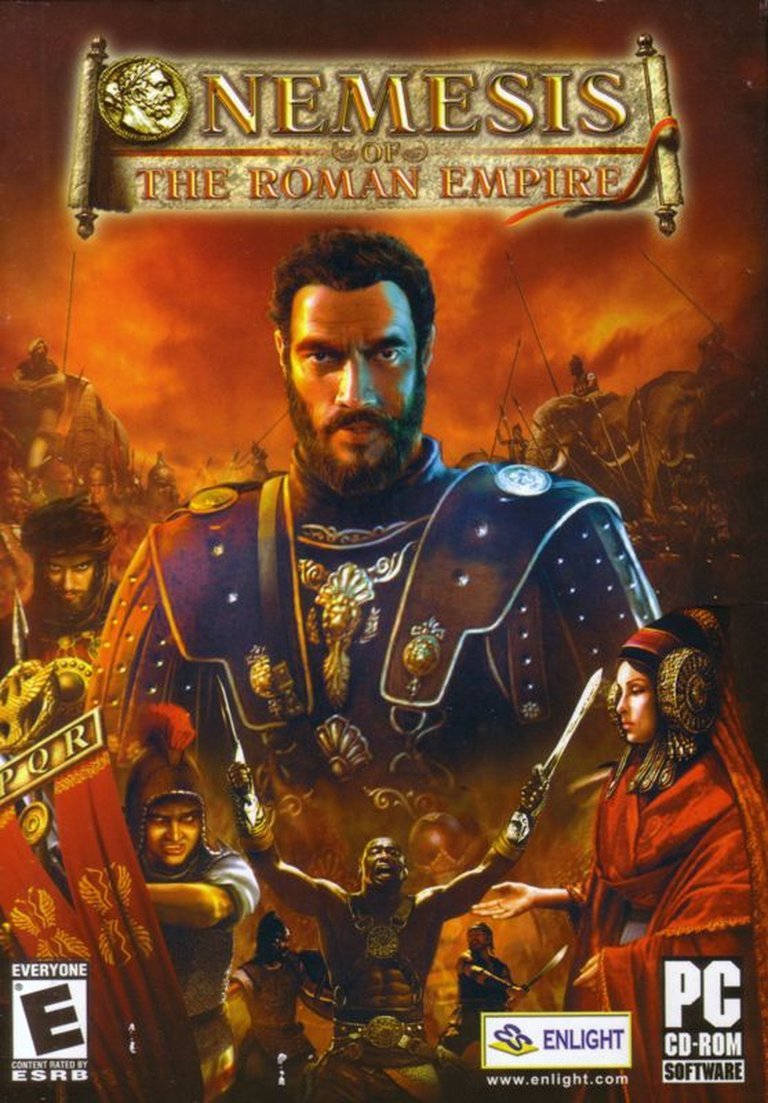
Nemesis of the Roman Empire is a real-time strategy game set during the Punic Wars, focusing on tactical combat rather than base-building. Players can command four factions—the Romans, Gauls, Iberians, or Carthaginians—across two historical campaigns, including Hannibal’s legendary march across the Alps. The game features hero-led armies, pre-built structures for resource management, and a skirmish mode with multiplayer support for up to eight players.
Gameplay Videos
Nemesis of the Roman Empire Patches & Updates
Nemesis of the Roman Empire Guides & Walkthroughs
Nemesis of the Roman Empire Reviews & Reception
metacritic.com (74/100): It doesn’t have the prim and polish that games like “Age of Mythology” and “WarCraft III” might have, but the core strategy is definitely there.
ign.com (80/100): A good game that needs a bit of help to become a great game.
mobygames.com (69/100): The sequel to Celtic Kings: Rage of War (2002), Nemesis of the Roman Empire is another real-time strategy game set in the ancient Mediterranean world.
gamewatcher.com : The game may come across as ‘Age of Empires’ on steroids, but it is actually quite different from that game system.
worthplaying.com (90/100): A triumphant return to form for the series.
Nemesis of the Roman Empire Cheats & Codes
PC
Press [Enter] during gameplay and type one of the following codes to activate the corresponding cheat function.
| Code | Effect |
|---|---|
| _black | Black screen |
| debugselected | Debug selected unit |
| usr | Describe selected unit |
| gaikafd | Display green tiles over the non-objects and black tiles under objects |
| printmemstats | Display memory statistics |
| mousepos | Display mouse position |
| gmp | Display pointer coordinates |
| dumpobj | Display selected units ability |
| addfd | Display white tiles all over non-object areas; black tiles over object areas |
| desync | Dump desync_test.txt file |
| dumpfunctoxml | Dump dump_try.xml file |
| quit | Exit game |
| exportobjs () | Exports all objects into indicated file |
| exportterrain () | Exports all terrain into indicated file |
| flatterrain | Flat terrain |
| pause | Pause and resume game |
| pr () | Print indicated string |
| removedecors | Remove bushes, trees, and other decorations |
| remfd | Reverses AddFD code |
| screenshot | Save .BMP format screenshot |
| save | Save game |
| spawn(,) | Spawn indicated number of units |
| setplayer | Switches player in multi-player mode |
| testadventure | Test adventure integrity |
| togglefog | Toggle fog of war |
| togglevis | Toggle houses and decorations |
| ttest | Translation test |
| ae | View level properties |
| advexplorer | Built-in MYTH option |
| rayoflight | Display ‘Abe ti me buzikash s tezi parametri maj,a?’ message |
| _dbgsel | Display danger for current selection |
| esg | Display information about enemy squads |
| settlementcount | Display settlement count |
| explorer | MYTH function |
| shrinkentities | MYTH function |
| prelit | Show BuildLight() value |
| _toggleinvrects | Show rects over units |
| showflatterrain | Strange terrain |
Nemesis of the Roman Empire: A Tactical Masterpiece Lost in Time
Introduction
In the early 2000s, the real-time strategy (RTS) genre was dominated by titans like Age of Empires, WarCraft III, and Command & Conquer. Amidst this competitive landscape, Nemesis of the Roman Empire (2003), developed by Bulgarian studio Haemimont Games, emerged as a bold and unconventional entry. A sequel to Celtic Kings: Rage of War (2002), Nemesis dared to defy genre conventions by eschewing base-building and resource-gathering mechanics, instead focusing on tactical depth, logistics, and large-scale battles. While it never achieved the mainstream acclaim of its contemporaries, Nemesis of the Roman Empire remains a fascinating and underappreciated gem—a game that challenged the status quo of RTS design and offered a unique blend of historical strategy and role-playing elements.
This review will delve deeply into Nemesis of the Roman Empire, examining its development history, narrative and thematic ambitions, gameplay mechanics, world-building, critical reception, and lasting legacy. By analyzing its strengths and flaws, we can better understand why this game remains a cult favorite among strategy enthusiasts and how it carved out its own niche in the annals of gaming history.
Development History & Context
The Rise of Haemimont Games
Nemesis of the Roman Empire was developed by Haemimont Games, a Bulgarian studio founded in 1997. The company had already made a name for itself with titles like Tzar: The Burden of the Crown (2000) and Celtic Kings: Rage of War (2002), both of which showcased the studio’s knack for blending historical strategy with innovative mechanics. Celtic Kings was particularly notable for its focus on tactical combat over economic micromanagement, a philosophy that would be further refined in Nemesis.
The development of Nemesis was led by Gabriel Dobrev, who served as both lead designer and producer. The game was built on the same engine as Celtic Kings, which allowed Haemimont to iterate quickly but also limited the visual and technical advancements that could be made. Despite these constraints, the team aimed to expand the scope of the original game by introducing new factions, refining the logistics system, and enhancing the AI.
The Gaming Landscape of 2003
The early 2000s were a golden age for RTS games, with titles like Age of Mythology (2002), WarCraft III: Reign of Chaos (2002), and Rise of Nations (2003) pushing the genre forward. These games emphasized deep economic systems, hero units, and cinematic storytelling—elements that Nemesis deliberately avoided. Instead, Haemimont Games sought to create a more streamlined, tactics-focused experience that prioritized battlefield strategy over resource management.
This design philosophy was risky. At a time when players expected RTS games to include base-building and tech trees, Nemesis offered a radically different approach. The game’s lack of a traditional installer (players had to manually copy files from the CD) and its reliance on an aging 2D engine further distanced it from the polished, 3D-driven experiences of its competitors. Yet, these limitations also allowed Haemimont to focus on what truly mattered: creating a game where every battle felt like a high-stakes tactical challenge.
Release and Localization
Nemesis of the Roman Empire was first released in Spain in November 2003 under the title Imperivm II: La Conquista de Hispania, published by FX Interactive. The game later saw a North American release in March 2004, distributed by Enlight Software. The title’s multiple regional names—Celtic Kings: The Punic Wars in Europe, The Punic Wars: A Clash of Two Empires in the UK, and Imperivm: Le Guerre Puniche in Italy—reflect its broad appeal across different markets.
Despite its niche appeal, Nemesis achieved commercial success in Spain, where it sold over 250,000 copies and earned a “Platinum” award from the Asociación Española de Distribuidores y Editores de Software de Entretenimiento (aDeSe). This success was partly due to the game’s historical setting, which resonated with European audiences familiar with the Punic Wars.
Narrative & Thematic Deep Dive
The Punic Wars: A Historical Backdrop
Nemesis of the Roman Empire is set during the Punic Wars (264–146 BCE), a series of three conflicts between the Roman Republic and the Carthaginian Empire. The game’s narrative revolves around two primary campaigns: the Carthaginian campaign, which follows Hannibal Barca’s legendary march across the Alps into Italy, and the Roman campaign, which depicts Rome’s eventual triumph over Carthage.
The game’s title itself—Nemesis of the Roman Empire—hints at its central theme: the rivalry between Rome and Carthage. Carthage, once the dominant power in the Mediterranean, is portrayed as Rome’s greatest adversary, a civilization whose military prowess and strategic brilliance nearly toppled the rising Roman Republic. The game’s narrative does not shy away from the brutality of these wars, emphasizing the high stakes of each battle and the personal ambitions of key historical figures like Hannibal and Scipio Africanus.
Campaign Structure and Storytelling
Nemesis features two main “adventure” campaigns, each comprising multiple missions that unfold across vast, detailed maps. The Carthaginian campaign is the more dramatic of the two, tasking players with recreating Hannibal’s daring invasion of Italy. Missions include crossing the treacherous Alps, outmaneuvering Roman legions, and securing supply lines in hostile territory. The Roman campaign, by contrast, focuses on Rome’s defensive and counteroffensive strategies, culminating in the siege of Carthage itself.
The game’s storytelling is minimalist but effective. Unlike contemporary RTS titles that relied on cinematic cutscenes, Nemesis uses in-game text and brief historical context to set the stage for each mission. This approach keeps the focus on gameplay rather than narrative spectacle, reinforcing the game’s tactical emphasis. However, the lack of voice acting and polished dialogue (a common criticism in reviews) sometimes undermines the immersion, particularly in the English localization, where misspellings and awkward phrasing were noted.
Themes of Power, Survival, and Logistics
At its core, Nemesis of the Roman Empire is a game about survival. The absence of base-building means that players must constantly secure and defend pre-existing structures—villages, forts, and outposts—to maintain their armies. This mechanic underscores one of the game’s central themes: the importance of logistics in warfare. Unlike other RTS games where resources are abstracted or infinitely renewable, Nemesis forces players to think like ancient generals, ensuring that their troops are fed, paid, and reinforced.
The game also explores the theme of empire-building through conquest rather than construction. Players do not build cities; they capture them. This design choice reflects the historical reality of the Punic Wars, where control over key territories and supply routes often determined the outcome of battles. The game’s emphasis on hero units—charismatic leaders who can turn the tide of battle—further reinforces the idea that warfare in this era was as much about leadership and morale as it was about sheer numbers.
Gameplay Mechanics & Systems
A Radical Departure from Traditional RTS Design
Nemesis of the Roman Empire is, at its heart, a tactical RTS that strips away many of the genre’s conventional elements. There is no base-building, no resource-gathering peasants, and no tech trees. Instead, the game focuses on capturing and controlling pre-existing structures, managing supply lines, and commanding large armies in real-time battles.
This design philosophy sets Nemesis apart from its contemporaries. While games like Age of Empires and WarCraft III required players to balance economic growth with military expansion, Nemesis eliminates the economic micromanagement entirely. Players start each mission with a stronghold and a handful of buildings (barracks, blacksmiths, temples, etc.), and their primary objective is to capture additional villages, forts, and outposts to secure resources and expand their influence.
The Logistics System: A Double-Edged Sword
The most innovative—and divisive—aspect of Nemesis is its logistics system. Unlike other RTS games where resources are passively generated, Nemesis requires players to actively manage the flow of food and gold across the map. Villages produce food, which must be transported via caravans to the player’s stronghold or forts. Gold is generated in the stronghold (through taxation) or in outposts (through investment), and it too must be moved manually.
This system adds a layer of strategic depth that is rare in RTS games. Players must protect their supply caravans from enemy raids, intercept enemy caravans to disrupt their economy, and carefully plan their expansions to ensure that their armies remain supplied. However, the logistics system is also one of the game’s most frustrating aspects. Caravans are slow and vulnerable, and losing a single food shipment can cripple an army. The AI, while competent, often exploits this weakness, making some missions feel unfairly punishing.
Hero Units and Formations
Hero units are another standout feature of Nemesis. These powerful commanders can lead up to 50 units into battle, providing bonuses to their morale, combat effectiveness, and experience gain. Heroes can also form their units into different formations (e.g., phalanx, wedge, or defensive line), which is crucial for adapting to different combat situations.
The hero system adds a role-playing element to the game, as heroes gain experience and become more powerful over time. However, the system is not without its flaws. Units without a hero leader are significantly weaker and often fail to engage in combat effectively. This can lead to frustrating situations where lone units refuse to attack or defend, leaving them vulnerable to enemy forces.
Combat and Siege Warfare
Combat in Nemesis is large-scale and chaotic, with battles often involving hundreds of units. The game’s unit variety is impressive, with each faction (Romans, Carthaginians, Gauls, and Iberians) boasting unique troops, from Roman legions and Carthaginian war elephants to Gaulish cavalry and Iberian skirmishers.
Siege warfare is another highlight. Players can construct catapults on the fly by grouping infantry units, allowing for dynamic siege tactics. Forts and strongholds can be captured by surrounding them with troops, a process that involves “yelling” at the structure until its loyalty drops. While this mechanic is somewhat abstract, it adds a unique flavor to the game’s conquest system.
Multiplayer and Skirmish Modes
Nemesis includes a robust multiplayer mode, supporting up to eight players via LAN or internet. The game’s skirmish mode features a random map generator, providing endless replayability. The scenario editor also allows players to create custom missions, though this feature was underutilized due to the game’s niche appeal.
The AI in skirmish and multiplayer modes is notably aggressive and intelligent, often outmaneuvering players with superior tactics. While this makes for a challenging experience, it can also feel overwhelming, particularly for newcomers.
World-Building, Art & Sound
A Living Ancient World
Nemesis of the Roman Empire excels in creating a sense of place. The game’s maps are vast and detailed, featuring diverse terrains such as dense forests, mountainous regions, and coastal areas. Pre-built structures like villages, forts, and temples are scattered across the landscape, each serving a strategic purpose.
The game’s isometric perspective and 2D graphics, while dated by 2003 standards, are functional and clear. Unit designs are distinct, allowing players to easily identify different troop types even in the heat of battle. The art style leans toward realism, with a muted color palette that evokes the gritty, brutal nature of ancient warfare.
Sound Design: A Missed Opportunity
The sound design in Nemesis is one of its weakest aspects. The game’s music is serviceable but unmemorable, failing to capture the epic scale of the Punic Wars. Voice acting is sparse and often poorly executed, with awkward delivery and misspellings in the English localization. Battle sounds—clashing swords, marching troops, and siege engines—are functional but lack the immersive quality found in other RTS games of the era.
Reception & Legacy
Critical Reception: A Divided Response
Nemesis of the Roman Empire received mixed reviews upon release, with critics praising its innovative mechanics but criticizing its technical limitations and lack of polish. The game holds a Metacritic score of 74, indicating “average” reception.
Positive Reviews:
– GameSpy (90%) praised the game’s tactical depth and challenging AI, calling it “a great game that shouldn’t be missed.”
– GameSpot (80%) highlighted the logistics system and hero mechanics as standout features, noting that the game “stands apart from the numerous RTS clones on the market.”
– WorthPlaying (90%) lauded the game’s blend of RTS and RPG elements, stating, “I really enjoyed this game, as evidenced by the 40 hours I spent playing it in the first 5 days I had it.”
Mixed Reviews:
– PC Gamer (68%) acknowledged the game’s solid strategy but criticized its lack of depth and story.
– Computer Gaming World (50%) was harsh in its assessment, calling the game “an excellent proof of concept” but noting that it “lacks the polish and presentation of most commercial releases.”
Negative Reviews:
– IGN (22%) was particularly critical, arguing that the game’s mechanics were too similar to its predecessor and that it lacked innovation.
Commercial Success and Cult Following
Despite its mixed reception, Nemesis of the Roman Empire found a dedicated audience, particularly in Europe. Its commercial success in Spain (over 250,000 copies sold) demonstrated that there was a market for a tactics-focused RTS. The game’s cult following persists to this day, with fans praising its unique approach to the genre and its challenging gameplay.
Influence on Future Games
While Nemesis did not spawn a direct sequel, its ideas influenced later Haemimont Games titles, such as Imperivm III: The Great Battles of Rome (2004) and Glory of the Roman Empire (2006). The game’s emphasis on logistics and hero-led armies can also be seen in later RTS titles like Praetorians (2003) and Rome: Total War (2004), though these games incorporated more traditional base-building elements.
Conclusion: A Flawed but Brilliant Strategy Experience
Nemesis of the Roman Empire is a game that defies easy categorization. It is neither a perfect masterpiece nor a forgotten failure; rather, it is a bold experiment that succeeded in some areas while stumbling in others. Its radical departure from traditional RTS design—eliminating base-building and emphasizing logistics and tactics—makes it a standout title in the genre. Yet, its technical limitations, lack of polish, and occasionally frustrating mechanics prevent it from achieving true greatness.
For strategy enthusiasts willing to overlook its flaws, Nemesis of the Roman Empire offers a deeply rewarding experience. Its focus on large-scale battles, hero-led armies, and supply-line management creates a sense of immersion that few RTS games can match. The Punic Wars setting is rich with historical detail, and the game’s campaigns provide a compelling (if challenging) journey through one of antiquity’s most famous conflicts.
Ultimately, Nemesis of the Roman Empire is a game that deserves to be remembered—not as a lost classic, but as a daring innovation that pushed the boundaries of what an RTS could be. It may not have the polish or popularity of its contemporaries, but its unique vision and tactical depth ensure its place in the pantheon of underappreciated strategy gems.
Final Verdict: 7.5/10 – A flawed but brilliant tactical RTS that rewards patience and strategic thinking.