
- Release Year: 2019
- Platforms: Macintosh, Nintendo Switch, PlayStation 4, Windows, Xbox One
- Publisher: Whitethorn Digital
- Developer: DevNAri LLC
- Genre: Action
- Perspective: Diagonal-down
- Game Mode: Single-player
- Gameplay: Music, Platform, rhythm
- Setting: Fantasy
- Average Score: 59/100
Description
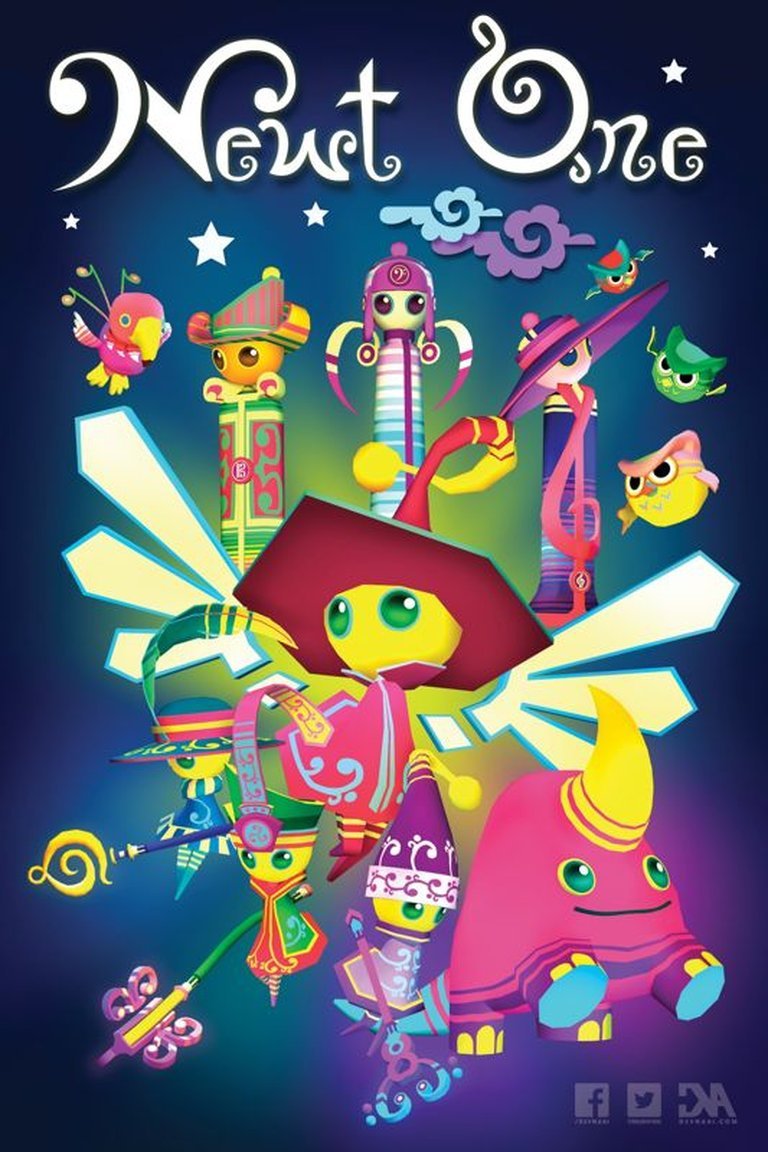
Newt One is a nonviolent musical platformer set in the fantasy world of Groovy Hue, which fell into a silent, colorless state after the Great Slumber. Players control Newt, a new tone, on a rite of passage to restore the land’s music, life, and color through rhythm-based exploration and platforming challenges.
Gameplay Videos
Where to Buy Newt One
PC
Newt One Guides & Walkthroughs
Newt One Reviews & Reception
metacritic.com (58/100): It’s perfectly fine for what it is, I guess, and it’s clear that a lot of love went into making the game, but unless you have really low standards when it comes to 3D platformers, you’re unlikely to share in that feeling.
thegeekgetaway.com : Unfortunately, Newt One’s novelty as a sweet, relaxing platformer wears off quickly as the game progresses.
opencritic.com (60/100): Newt one has an interesting gameplay premise, regretfully that’s all it ends up becoming.
Newt One: A Discordant Symphony of Ambition and Execution in the Indie Platformer Landscape
Introduction: The Promise of a Palette-Cleansing Experience
In a decade dominated by morally ambiguous protagonists and increasingly complex systemic violence, the arrival of Newt One in September 2019 presented a deliberately antithetical proposition. Developed by the two-person studio DevNAri and published by Whitethorn Digital, this “nonviolent, relaxing, & colorful journey” promised a return to the pure, unadulterated joy of platforming, where progress was measured not in conquest but in restoration. Its core conceit—a silent world reborn through music and color as a player explores—was a compelling, almost therapeutic manifesto for a subset of gamers weary of the era’s darker trends. Yet, as the disparate reviews from outlets like Game Hoard, Defunct Games, and The Geek Getaway reveal, Newt One is a fascinating case study in how a singular, heartfelt vision can be undermined by fundamental flaws in execution. This review will argue that Newt One is not a lost classic but a poignant artifact of indie development ambition, a game whose profound thematic sincerity is consistently at odds with its uneven mechanical and technical realization, ultimately limiting its legacy to a well-intentioned curiosity rather than a genre benchmark.
Development History & Context: A Partnership Forged in Minneapolis
Newt One emerged from the Minneapolis indie scene, a ecosystem known more for its tight-knit community than its blockbuster hits. The game’s genesis, as detailed on the official Whitethorn Games site, is straightforward: artist Ari Carrillo posted a desire to make a game around 2015, which programmer and musician Dev Jana, experimenting with interactive sound systems, answered. This partnership—DevNAri—was formed on complementary skills rather than expansive resources. They were working in Unity, an engine that had democratized 3D development but also necessitated careful management for performance and polish on lower budgets.
The technological context of 2019 is crucial. This was post-Super Mario Odyssey, a high-water mark for 3D platforming fluidity and creativity. The indie space was crowded with titles like A Hat in Time and Yooka-Laylee vying for the “collectathon” throne. Newt One‘s decision to eschew combat entirely and focus on non-linear exploration was a brave, niche differentiator. However, its development cycle, including an Early Access period starting February 2019 and a full release that September, suggests a project that may have stretched a small team thin. The game garnered significant praise on the local and festival circuit (winning “Best Soundtrack” and “Best Gameplay” at 2D Con 2017, “Game of the Show” the same year), indicating that itsdemo-ing charm was potent in short bursts. This festival success likely built expectations that the full product, a 24-level (4 worlds x 6 levels) experience, struggled to fulfill, revealing the gap between a promising prototype and a feature-complete, polished game.
Narrative & Thematic Deep Dive: A Story at War with Itself
The narrative of Newt One is delivered through sparse, static cutscenes featuring character portraits and text in decorative speech bubbles—a low-budget but stylistically fitting choice for its minimalist aesthetic. The plot is a classic hero’s journey: the “Great Slumber” has silenced the vibrant, musical land of Groovy Hue, and Newt, a “new tone,” must awaken the world and find the missing Elders to restore harmony.
Thematically, the game is an unabashed paean to positivity, nonviolence, and the restorative power of art (here, music and color). Its central mechanic—coloring a monochrome world by touching objects—is a literal metaphor for bringing hope and life to a dormant place. The collected items, musical notes, and rescued parrots (birds symbolize freedom and joy), reinforce this.
However, the narrative introduces a jarring, dissonant element that critically undermines its core message. As noted by The Geek Getaway, early dialogue reveals a high-stakes, existential threat: failure means Newt and his rhinoceros friend will be “completely erased from existence.” This looming dread of cosmic annihilation is tonally incompatible with the game’s otherwise gentle, “live-laugh-love” surface. It reads like an afterthought—a clumsy attempt to inject urgency into a premise that doesn’t need it. Where games like Journey or Kid Icarus: Uprising (with its more complex morality) weave theme and stakes seamlessly, Newt One‘s story feels schizophrenic. It wants to be a soothing escape but also reminds you of a fatalistic cosmic penalty. This narrative incoherence is the first major crack in the game’s foundational ice.
Gameplay Mechanics & Systems: The Floaty Foundation
The core gameplay loop is simple: navigate 3D platforming stages, touch every darkened surface to color it and restore auditory life to the zone, and reach the goal. The “non-linear” claim is modest; levels are self-contained clouds or floating islands, but the path to 100% completion is largely linear, requiring thorough exploration of a single, connected space.
Newt One attempts to layer complexity through a trinity of temporary power-ups found in stages:
1. The Drum: Allows a charge attack that paints a large area and can transform certain hazards (like water) into temporary platforms (ice).
2. The Wings: Grant enhanced jump height and gliding.
3. The Staff: A late-game boon that automatically paints adjacent tiles, drastically reducing tedium.
These tools are sensible ideas to mitigate the core task’s potential monotony. The inclusion of a built-in timer for speedrunners is another commendable nod to a hardcore audience within a casual framework.
However, the execution is where the systems falter dramatically, as echoed in nearly every critical review:
- Control Feel: The most persistent complaint is the “floaty” and imprecise movement. Newt slides across platforms with minimal friction, making precise jumps notoriously difficult. Jumping, conversely, is described as “stiff and unresponsive.” This contradictory control scheme—slippery movement paired with unyielding jumps—creates a constant, frustrating tension. It forces players to fight the physics rather than dance with them, directly opposing the game’s relaxing aspiration.
- Hitbox and Collision Issues: The Geek Getaway specifically cites “wonky hitboxes” on environmental objects like trees, causing Newt to get stuck and fail perfect runs. This indicates a lack of polish in collision detection, a basic but critical element of any platformer.
- Repetitive Level Design: The four world themes (Grass/Forest, Desert/Glacier, Clouds, Ice) offer aesthetic variety, but the level geometry and puzzles are criticized as samey. As Defunct Games succinctly states, levels often “boil down to three core mechanics: wait for moving platforms, find owls to build new slippery platforms, and use a drum.” The owl mechanic (likely a bird that creates ice paths) is mentioned by multiple sources, suggesting it’s a primary puzzle tool that sees insufficient variation. The “protective bubbles” that require breaking a stone are noted as a “nuisance” rather than a meaningful challenge.
- Goal Recognition Bug: A critical technical flaw cited by The Geek Getaway is the game’s failure to recognize Newt touching the goal pole on the first attempt, sometimes freezing or breaking the stage. This is a game-breaking bug that has no place in a released product.
- Progression & Rewards: Completion rewards are minimal: cosmetic outfit color swaps for reaching note milestones (50 notes per realm) and a proliferation of 165 achievement badges. The elusive “parrot costume” for rescuing all birds is mentioned but hard to confirm. This paltry reward structure fails to incentivize the meticulous completionism the 100% goal demands, especially when coupled with the frustrating controls. The short, ~3-hour length is noted, but without meaningful reasons to return, the game’s lifespan is brief.
World-Building, Art & Sound: A Gorgeous Facade
This is Newt One‘s unequivocal strength and the primary source of its charm. The art style, crafted by Ari Carrillo, is a low-poly, vibrant, and cute aesthetic that perfectly aligns with its family-friendly, nonviolent branding. The transformation from muted grayscale to full, saturated color as Newt paints the world is the game’s central spectacle and its most successful mechanic. Visually, it delivers on the promise of a “colorful journey.”
The sound design, composed by Dev Jana with contributions from violinist Millicent Walsh, saxophonist Topher Dunlap, and pianist Eric Sample, is where ambition and reality clash most visibly. The intended design is a dynamic music system that adapts and layers instruments as the player colors more of the world, creating a literal soundtrack of progress. The realized design, as reported by critics, is deeply flawed. Multiple reviews state that the music merely increases in volume, with the dynamic layering being either extremely subtle or non-existent. The Geek Getaway‘s initial criticism was later amended after a commenter noted that extra instruments do blend in around 60% completion when using good headphones. This suggests a technically present but poorly mixed, imperceptible system that fails its core design goal. Furthermore, each of the four worlds gets only one musical theme for all six levels, leading to repetition. The result is “enchanting” in concept but ultimately “flat” and repetitive in practice, a missed opportunity that severs the critical link between gameplay and audio feedback.
The setting of Groovy Hue, a musical land, is conceptually strong but underdeveloped. The Elders are macguffins, and the world’s history is told only in the opening text. There’s no environmental storytelling or lore to discover, making the world feel like a beautiful stage set rather than a lived-in place.
Reception & Legacy: A Festival Darling That Faltered at Retail
Newt One‘s reception is a study in the divide between demo and full product, and between different critical priorities.
At Launch: Critical scores were mixed-to-negative. On Metacritic, it holds scores of 58 (Gaming Age), 45 (Nintendo World Report), and 4.5/10 (Switch Atlantic). The aggregated MobyGames score is a damning 43% from a single critic. Common threads in criticism were: floaty controls, repetitive level design, lack of polish (bugs, UI issues like unreadable text), and a failure to deliver on its dynamic music promise. Praise was reserved almost exclusively for its art style, core premise, and nonviolent ethos.
User Reception: On Steam, it holds a “Mostly Positive” rating (75% of 28 reviews at the time of writing), a notably more forgiving score than the critic aggregate. This suggests the game found a receptive audience among players seeking a casual, stress-free, and aesthetically pleasing experience, for whom control precision and deep mechanics were secondary to the relaxing vibe. The price point ($9.99, frequently discounted to $1.99) also lowers the barrier to entry, framing it as a low-risk, charming impulse buy.
Legacy and Influence: Newt One has had no discernible influence on the broader 3D platformer genre. Its festival awards in 2016-2018 indicate it was a standout in the very indie circuit, celebrated for its unique hook and aesthetic. However, its lack of mechanical innovation, poor controls, and technical issues prevented it from transliterating that festival buzz into lasting critical acclaim or commercial momentum. It exists now as a benchmark for “ambitious but flawed” indie projects. In the Whitethorn Games catalog (which includes titles like Calico and Aground), it is a curious outlier—a pure 3D platformer in a lineup often focused on simulation and narrative-driven experiences. Its legacy is that of a well-meaning curiosity; a game that asked an important question (“Can a platformer be entirely about restoration, not destruction?”) but provided an answer hampered by execution.
Conclusion: A Well-Intentioned but Flawed Artifact
Newt One is a game of profound contradictions. It champions nonviolence and auditory joy but drowns in repetitive geometry and stiff controls. It promises a dynamic world soundtracked by your actions but delivers a quiet, looping melody that only perceptibly swells. Its vibrant, colorful art invites exploration, yet its floaty physics and hitbox issues make that exploration a constant, frustrating negotiation.
As a historical artifact, it represents a specific, heartfelt indie vision from the late 2010s: a desire to create a safe, positive space in gaming, prioritizing aesthetic and thematic comfort zones over mechanical challenge or complexity. It succeeds in creating a vibe—a serene, colorful world that is pleasant to look at. However, as a video game, it fails on multiple fundamental levels. The controls are not just imperfect; they are antagonistic to the precision its own design demands. The repetition of puzzles and environments turns what could be a meditative process into a tedious chore. The narrative’s self-sabotaging tone and the music’s unfulfilled promise deepen the sense of a noble idea hamstrung in its implementation.
The final, definitive verdict must acknowledge this schism. For a player seeking a low-stress, visually delightful experience to unwind with for a few hours, and who can overlook sloppy controls, Newt One may offer a measure of its intended tranquility. For anyone