
- Release Year: 1996
- Platforms: DOS, Genesis, PlayStation, SEGA Saturn, SNES, Windows
- Publisher: Electronic Arts, Inc.
- Developer: Ceris Software, Electronic Arts Canada, High Score Productions, Visual Concepts Entertainment, Inc.
- Genre: Sports
- Perspective: Diagonal-down / Top-down
- Game Mode: LAN, Online PVP, Single-player
- Gameplay: Hockey simulation, Multiplayer, Player creation, Trading
- Setting: Hockey, Sports
- Average Score: 79/100
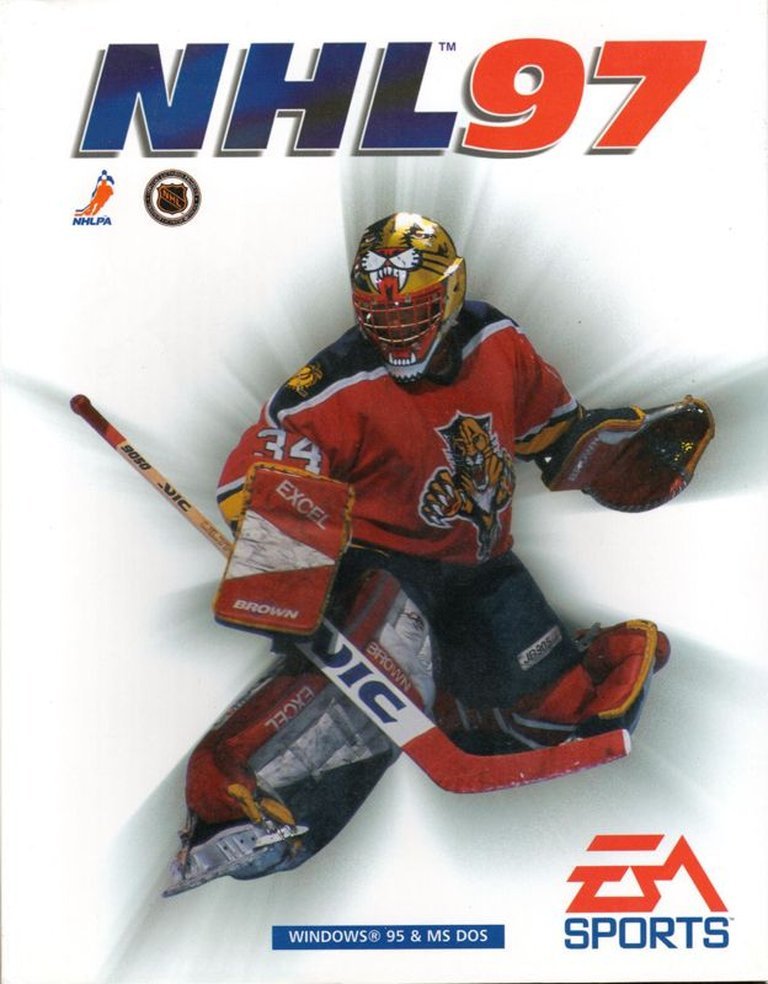
Description
NHL 97 is the 1997 edition of EA Sports’ hockey simulation series, featuring significant graphical improvements over its predecessor, including polygonal players and a refined ‘virtual stadium’ system with new camera angles. The game offers multiplayer support for up to 8 players via network or Gravis’ GrIP system, custom player creation and trading, and licensed multimedia elements like the ‘Goalie Mask Viewer,’ which showcases detailed helmet designs of 30 goalies.
Gameplay Videos
NHL 97 Free Download
NHL 97 Patches & Updates
NHL 97 Reviews & Reception
en.wikipedia.org (87/100): NHL 97 uses a full 3D engine, with motion captured polygonal players.
metacritic.com (71/100): NHL 97 is one of the most downright exciting sports titles I’ve ever played.
NHL 97 Cheats & Codes
PlayStation
Enter codes during face-off, before the puck drops on the ice.
| Code | Effect |
|---|---|
| L1, L2, R1, X | Speeds up gameplay |
| L1, L2, R1, L1 | More penalties |
| L1, L2, R1, R1 | More penalty shots |
| L1, L2, R1, L2 | More accurate shots |
| L1, L2, R1, R2 | Easier goals |
| L1, L2, R1, Circle | More fights |
| L1, L2, R1, Square | More instant replay views |
| L2, L2, L1 + R2, R1, Circle | Super home team |
| L2, L2, L1 + R2, R1, X | No collisions |
| L2, L2, L1 + R2, R1, R2 | Quick game (20-second periods) |
| NETHOCKEY | Players appear as nets |
PC
Hold [Shift] and type ‘WAGD’ to enable cheat mode, then press the following keys during gameplay.
| Code | Effect |
|---|---|
| H | Home team scores goal |
| V | Visiting team scores goal |
| P | Ends period |
| G | Ends game |
| O | Goes to overtime |
| I | Causes an injury |
| F | Causes a fight |
| T | Shrinks players |
| SHIFT-T | Makes players larger |
| 1 | Two minute penalty |
| 2 | Four minute penalty |
| 4 | Five minute penalty |
| 5 | Penalty shot |
Sega Saturn
Enter ‘NETHOCKEY’ as your name before beginning gameplay.
| Code | Effect |
|---|---|
| NETHOCKEY | Players appear as nets |
NHL 97: A Pivotal Moment in Sports Gaming History
Introduction
In the annals of video game history, few sports titles have left as indelible a mark as NHL 97. Released in 1996 by Electronic Arts, this game wasn’t just another annual update—it was a revolution. At a time when sports simulations were still finding their footing in the transition from 2D to 3D, NHL 97 emerged as a trailblazer, setting new standards for realism, presentation, and sheer excitement. For hockey fans, it wasn’t merely a game; it was an experience that captured the speed, intensity, and drama of the NHL like never before.
NHL 97 arrived at a critical juncture in gaming. The mid-90s were a period of rapid technological advancement, with developers pushing the boundaries of what was possible on both 16-bit consoles and the burgeoning 32-bit systems. EA Sports, already a dominant force in the sports genre, sought to leverage these advancements to create a hockey game that felt as dynamic and immersive as the real thing. The result was a title that not only met but exceeded expectations, delivering a product that was both a commercial success and a critical darling.
This review will delve deep into NHL 97, exploring its development, gameplay innovations, artistic achievements, and lasting legacy. We’ll examine how it stood out in a crowded market, why it resonated so deeply with players, and how it influenced the future of sports gaming. Whether you’re a longtime fan or a curious historian, join us as we revisit one of the most important hockey games ever made.
Development History & Context
The Studio and the Vision
NHL 97 was a collaborative effort across multiple studios under the EA Sports umbrella, each tailoring the game to their respective platforms. EA Canada led the charge on the PC version, leveraging their expertise in sports simulations to push the boundaries of what was possible on home computers. Visual Concepts, a studio that would later become synonymous with sports gaming excellence, handled the PlayStation and Sega Saturn ports, focusing on optimizing the game for the unique capabilities of these 32-bit consoles. Meanwhile, High Score Productions and Ceris Software took on the 16-bit versions for the Sega Genesis and Super Nintendo Entertainment System (SNES), respectively, ensuring that the game remained accessible to a broader audience.
The vision for NHL 97 was clear: to create the most realistic and immersive hockey simulation to date. The development team aimed to capture the speed, physicality, and strategic depth of the NHL, while also introducing new features that would set the game apart from its predecessors. Central to this vision was the Virtual Stadium engine, a refined version of the technology introduced in NHL 96. This engine enabled dynamic 3D rendering of arenas, player models, and camera angles, allowing for a more cinematic and engaging presentation.
Technological Constraints and Innovations
The mid-90s were a time of transition in gaming hardware. The PlayStation and Sega Saturn, both released in 1994 and 1995 respectively, represented the cutting edge of 32-bit technology, offering capabilities far beyond their 16-bit predecessors. However, these systems were still in their infancy, and developers had to contend with limited memory, processing power, and graphical capabilities.
For NHL 97, the development team faced the challenge of balancing realism with performance. On the PC, PlayStation, and Sega Saturn, the game utilized motion-captured polygonal player models, a significant leap forward from the 2D sprites of earlier entries. These models allowed for more fluid animations, realistic skating mechanics, and dynamic interactions between players. However, the Genesis and SNES versions were constrained by their 16-bit architecture, forcing the team to retain the 2D sprite-based graphics of previous games while enhancing animations and gameplay mechanics.
One of the most notable innovations in NHL 97 was the introduction of play-by-play commentary, voiced by renowned Canadian sportscaster Jim Hughson. This feature added a layer of immersion previously unseen in hockey games, making matches feel more like authentic broadcasts. Additionally, the game introduced special player skills, such as Joe Sakic’s “wrong-footed wrist shot” and Rob Ray’s ability to check opponents while maintaining puck control. These signature moves not only added depth to the gameplay but also highlighted the unique talents of NHL stars.
The Gaming Landscape of 1996
The release of NHL 97 in late 1996 coincided with a period of intense competition in the sports gaming market. EA Sports was already a dominant force, with franchises like Madden NFL, FIFA Soccer, and NBA Live establishing the company as a leader in the genre. However, the hockey market was more fragmented, with titles like NHL FaceOff ’97 (Sony) and NHL Powerplay ’96 (Virgin Interactive) vying for attention.
NHL 97 entered this competitive landscape with a clear advantage: its official NHL licensing. This allowed the game to feature real teams, players, and arenas, giving it an authenticity that rival titles struggled to match. The inclusion of alternate jerseys for select teams, such as the Mighty Ducks of Anaheim and the Pittsburgh Penguins, further enhanced the game’s appeal to fans.
The game’s release timing was also strategic. Launching in the fall of 1996, just as the NHL season was getting underway, NHL 97 capitalized on the excitement surrounding the sport. The holiday season provided an additional boost, with the game becoming a popular gift for hockey enthusiasts.
Narrative & Thematic Deep Dive
The Story of a Season
While NHL 97 is primarily a sports simulation, it does incorporate narrative elements that enhance the player’s connection to the game. The Season Mode allows players to take on the role of a general manager, guiding their team through an 82-game schedule, making trades, and managing injuries. This mode creates a sense of progression and investment, as players strive to lead their team to the playoffs and ultimately the Stanley Cup.
The game’s Playoff Mode further amplifies this narrative, simulating the high-stakes drama of the NHL postseason. Players must navigate a 16-team bracket, competing in best-of-seven series to determine the champion. The tension of elimination games, the pressure of overtime, and the elation of victory all contribute to a compelling storytelling experience.
Themes of Competition and Excellence
At its core, NHL 97 is a celebration of competition and excellence. The game captures the intensity of NHL hockey, where every shift, every hit, and every shot can be the difference between victory and defeat. The Skills Competition Mode reinforces this theme, allowing players to test their abilities in drills such as the hardest shot, accuracy shooting, and puck handling relay. These challenges highlight the individual talents of NHL stars, emphasizing the skill and dedication required to excel in the sport.
The game also explores the theme of teamwork and strategy. Successful play in NHL 97 requires more than just individual skill; it demands coordination between teammates, effective line changes, and adaptive tactics. The inclusion of special player skills and signature moves adds another layer of strategy, as players must learn to leverage the unique abilities of their roster to gain an edge over opponents.
The Role of Authenticity
Authenticity is a recurring theme in NHL 97. From the licensed teams and players to the realistic arenas and commentary, the game strives to create an experience that feels true to the NHL. The Goalie Mask Viewer, which allows players to examine the custom-painted masks of 30 NHL goalies, is a testament to this commitment to detail. Even the alternate jerseys, a relatively new concept in the NHL at the time, reflect the game’s dedication to capturing the look and feel of the league.
This authenticity extends to the gameplay itself. The physics of the puck, the mechanics of checking, and the AI behavior of opponents all contribute to a simulation that feels genuine. While the game is not without its flaws—such as the occasional glitch or exploitable mechanic—it succeeds in creating a world that hockey fans can immerse themselves in.
Gameplay Mechanics & Systems
Core Gameplay Loop
At its heart, NHL 97 is a game about speed, skill, and strategy. The core gameplay loop revolves around controlling a team of five skaters (plus a goalie) and competing against an opponent in a fast-paced, physical contest. The game’s two-button control scheme allows for a variety of actions, including skating, shooting, passing, and checking. The simplicity of the controls belies the depth of the gameplay, as mastering the nuances of timing, positioning, and teamwork is essential for success.
The puck physics in NHL 97 are a standout feature. The puck slides realistically across the ice, bouncing off boards and players in a manner that feels authentic. However, the shot speed is notably slower than in real-life NHL games, a concession to the technological limitations of the era. This slower pace can make the game feel more deliberate, emphasizing strategy over sheer speed.
Combat and Physicality
Hockey is a physical sport, and NHL 97 captures this aspect with its checking and fighting mechanics. Body checks are a key part of the gameplay, allowing players to disrupt opponents and gain possession of the puck. The game’s motion-captured animations ensure that checks feel impactful, with players reacting realistically to collisions.
Fighting, while optional, adds another layer of physicality to the game. Certain players are more prone to dropping the gloves, and fights can break out spontaneously during gameplay. While the fight animations are somewhat rudimentary by modern standards, they contribute to the game’s overall atmosphere of intensity and rivalry.
Character Progression and Customization
NHL 97 offers a range of customization options that allow players to tailor their experience. The General Manager Mode enables players to create and trade players, adjust lineups, and manage team strategies. This level of control adds depth to the game, allowing players to build their ideal roster and experiment with different tactical approaches.
The game also features player creation tools, allowing users to design custom players with unique attributes. This feature was particularly innovative at the time, giving players the ability to insert themselves or their friends into the game. The Skills Competition Mode further enhances this customization, as players can test their created players in various drills and challenges.
User Interface and Accessibility
The user interface (UI) in NHL 97 is designed to be intuitive and accessible. The menu system is straightforward, with clear options for selecting game modes, adjusting settings, and managing teams. The in-game HUD provides essential information, such as the score, time remaining, and penalty status, without overwhelming the player.
One of the game’s most praised features is its camera system. NHL 97 offers multiple camera angles, including a top-down view that was notably absent in NHL 96. This variety allows players to choose the perspective that best suits their playstyle, whether they prefer a more strategic overview or an immersive, close-up view of the action.
Innovative and Flawed Systems
While NHL 97 is celebrated for its innovations, it is not without its flaws. The AI behavior of opponents can be inconsistent, with some players exhibiting unrealistic tendencies, such as overly aggressive checking or passive defensive play. The goalie AI is particularly notable, with some netminders being nearly infallible, while others are prone to glaring mistakes.
The game also features a notorious glitch that allows players to score with 100% accuracy by shooting the puck against the boards at the hash marks of the left circle. While this exploit can be fun to use, it undermines the game’s balance and realism.
Despite these flaws, NHL 97 remains a landmark title in sports gaming. Its innovative use of 3D graphics, motion-captured animations, and play-by-play commentary set new standards for the genre, influencing countless games that followed.
World-Building, Art & Sound
Setting and Atmosphere
NHL 97 excels in creating an immersive hockey atmosphere. The game features all 26 NHL teams from the 1996-97 season, each with their own home arenas, complete with accurate details such as team logos, banners, and crowd reactions. The Virtual Stadium engine ensures that each arena feels distinct, with unique lighting, textures, and layouts that reflect the real-life venues.
The atmosphere of the game is further enhanced by the crowd animations and sound effects. The roar of the crowd, the sound of skates on ice, and the crash of bodies against the boards all contribute to a sense of being in a real NHL arena. The organ music, a staple of hockey games, plays during stoppages in play, adding to the authenticity.
Visual Direction
The visual direction of NHL 97 is a standout feature, particularly on the PC, PlayStation, and Sega Saturn versions. The game’s polygonal player models are a significant improvement over the 2D sprites of earlier entries, allowing for more fluid animations and realistic movements. The motion-captured skating, shooting, and checking animations are particularly impressive, capturing the nuances of real hockey gameplay.
The Genesis and SNES versions, while limited by their 16-bit hardware, still manage to deliver a visually appealing experience. The enhanced animations and detailed player sprites ensure that the game remains engaging, even on older consoles. The top-down camera angle, a fan favorite, returns in NHL 97, providing a strategic overview of the action.
Sound Design
The sound design in NHL 97 is another area where the game excels. The play-by-play commentary by Jim Hughson is a major highlight, adding a layer of immersion that was unprecedented in hockey games at the time. Hughson’s calls are dynamic and responsive, reacting to goals, hits, and penalties in real-time. While the commentary can be repetitive, it succeeds in creating the feeling of watching a real NHL broadcast.
The sound effects are equally impressive. The crunch of a body check, the swish of a slapshot, and the clang of the puck off the post all sound authentic, enhancing the game’s realism. The crowd noise is also well-implemented, with cheers and jeers reacting appropriately to the on-ice action.
The music in NHL 97 is a mix of rock and electronic tracks, composed by Jeff van Dyck for the PC version and Mark Chosak and David Whittaker for the console versions. The upbeat, high-energy soundtrack complements the fast-paced gameplay, adding to the game’s excitement. The menu music, in particular, is memorable, with its catchy riffs and driving beats setting the tone for the action to come.
Reception & Legacy
Critical Reception
NHL 97 was met with widespread critical acclaim upon its release. The game received an average critic score of 84%, with praise directed at its graphics, gameplay, and presentation. The PC version, in particular, was lauded for its technical achievements, with reviewers highlighting the fluid animations, realistic physics, and immersive commentary.
PC Gamer awarded the game a 93/100, calling it “the best sports simulation you can buy for the PC.” The magazine praised the game’s depth, realism, and excitement, noting that it “fessels wochenlang an den Bildschirm” (keeps you glued to the screen for weeks). GameSpot gave the PC version an 8.7/10, commending its lifelike graphics, comprehensive licensing, and customizable settings.
The console versions received similarly positive reviews, though with some caveats. The Genesis version was praised for its fast-paced gameplay and intuitive controls, with GamePro awarding it a 4.5/5. The PlayStation and Sega Saturn versions, while visually impressive, were criticized for their sluggish puck physics and occasional glitches. Electronic Gaming Monthly gave the PlayStation version an 8.75/10, noting its immersive 3D arenas and responsive passing, but docking points for frame rate issues.
Commercial Success
NHL 97 was a commercial success, selling over 200,000 copies across all platforms. The Windows version was particularly successful, ranking as the 20th best-selling computer game of 1996 in the United States. The game’s holiday release timing and official NHL licensing contributed to its strong sales, making it a popular choice for hockey fans.
The game’s success was further bolstered by industry accolades. It won Best Sports Game at the 1996 PC Gamer Awards and the 1996 Spotlight Awards, solidifying its reputation as a landmark title in sports gaming.
Evolution of Reputation
Over the years, NHL 97 has maintained a positive reputation among fans and critics alike. While later entries in the NHL series would refine and expand upon its mechanics, NHL 97 is often remembered as a pivotal moment in the franchise’s history. Its innovative use of 3D graphics, motion-captured animations, and play-by-play commentary set new standards for the genre, influencing countless games that followed.
The game’s legacy is also evident in its enduring popularity. Even today, NHL 97 is fondly remembered by fans who grew up playing it, with many citing it as one of the best hockey games ever made. Its signature moves, special player skills, and immersive presentation continue to resonate with players, making it a timeless classic.
Influence on Subsequent Games
NHL 97 had a profound influence on the NHL series and sports gaming as a whole. Its successful transition to 3D graphics paved the way for future entries, such as NHL 98 and NHL 99, which further refined the visual and gameplay mechanics introduced in NHL 97. The game’s international teams and skills competition modes also became staples of the series, appearing in various forms in subsequent titles.
The play-by-play commentary, a groundbreaking feature in NHL 97, became a standard in sports games, with later entries expanding on the concept with more dynamic and detailed commentary. The special player skills and signature moves introduced in NHL 97 also became a recurring theme in the series, allowing players to leverage the unique abilities of NHL stars.
Beyond the NHL series, NHL 97 influenced the broader sports gaming genre. Its successful blend of realism, accessibility, and excitement set a benchmark for other sports titles, encouraging developers to push the boundaries of what was possible in sports simulations.
Conclusion
NHL 97 is more than just a hockey game; it is a landmark title in the history of sports gaming. Released at a time of rapid technological advancement, it pushed the boundaries of what was possible in a sports simulation, delivering an experience that was both realistic and exhilarating. Its innovative use of 3D graphics, motion-captured animations, and play-by-play commentary set new standards for the genre, influencing countless games that followed.
While NHL 97 is not without its flaws—such as inconsistent AI behavior and occasional glitches—it succeeds in capturing the speed, intensity, and drama of NHL hockey. Its depth of customization, immersive presentation, and engaging gameplay make it a title that continues to resonate with fans decades after its release.
In the pantheon of sports gaming, NHL 97 stands as a pivotal moment, a game that not only met the expectations of its time but exceeded them. It is a testament to the power of innovation, the importance of authenticity, and the enduring appeal of hockey. For these reasons, NHL 97 deserves its place as one of the greatest sports games ever made.
Final Verdict: 9/10 – A Timeless Classic
NHL 97 is a must-play for any fan of hockey or sports gaming. Its groundbreaking features, immersive presentation, and engaging gameplay make it a title that has stood the test of time. While later entries in the series would refine and expand upon its mechanics, NHL 97 remains a landmark achievement, a game that captured the essence of hockey like never before. Whether you’re a longtime fan or a curious newcomer, NHL 97 is an experience worth revisiting.