
- Release Year: 1996
- Platforms: PlayStation, SEGA Saturn, Windows
- Publisher: Virgin Interactive Entertainment (Europe) Ltd., Virgin Interactive Entertainment, Inc., Virgin Interactive Entertainment (Japan), Inc.
- Developer: Radical Entertainment Inc.
- Genre: Sports
- Perspective: Diagonal-down
- Game Mode: Hotseat, Single-player
- Setting: Hockey
- Average Score: 75/100
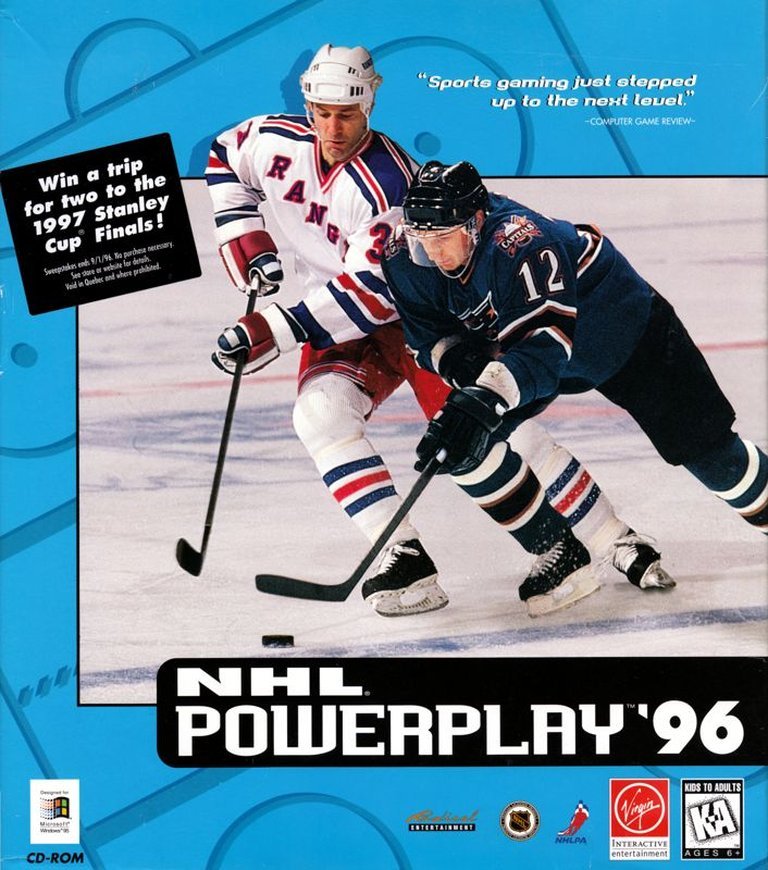
Description
NHL Powerplay ’96 is a hockey sports game developed by Radical Entertainment and published by Virgin Interactive, serving as an early competitor to EA’s NHL series. Featuring motion-captured players and an NHL Player’s Association license, the game offers managerial options, seasonal play, tournaments, and the debut of a World Tournament mode where NHL players represent their national teams. It distinguishes itself with a classic overhead ‘behind the goal’ camera view, prioritizing gameplay familiarity over multiple angles, while boasting early 3D graphics for its time. Released in 1996 for Windows, PlayStation, and SEGA Saturn, it aimed to blend realism with accessible arcade-style hockey action.
Gameplay Videos
NHL Powerplay ’96 Free Download
NHL Powerplay ’96 Guides & Walkthroughs
NHL Powerplay ’96 Reviews & Reception
metacritic.com (90/100): In 1995 NHL Powerplay 96 was easy the best hockey game on the PS1.
gamespot.com (54/100): All in all, Powerplay ’96 is just another average hockey game.
espn.com (81/100): What makes NHL Powerplay ’96 remarkable is its terrific computer artificial intelligence, both in your teammates and in your opponents.
NHL Powerplay ’96 Cheats & Codes
Sega Saturn
Enter codes at the main menu or team select screen.
| Code | Effect |
|---|---|
| A + Y + C | Unlocks the Rad Army team with a 99 rating |
PlayStation
Enter codes at the team select screen.
| Code | Effect |
|---|---|
| R2, R2, R2, L2, L2, L2 | Play as the Red Army Team |
| R2, R2, R2, L2, L2, L2, SELECT | Play as the Rad Army Team |
NHL Powerplay ‘96: Review
Introduction
In the frostbitten arena of mid-90s sports gaming, NHL Powerplay ‘96 emerged as a bold challenger to EA’s uncontested NHL dynasty. Developed by Radical Entertainment and published by Virgin Interactive, this 1996 title dared to innovate where others mimicked, leveraging nascent 32-bit technology to deliver one of the first full 3D hockey simulations. Yet its legacy is a study in contrasts: lauded for pioneering ambition yet criticized for unpolished execution. This review dissects how NHL Powerplay ‘96 carved its niche—celebrating its groundbreaking World Tournament mode and fluid motion-captured animations while scrutinizing its divisive camera system and uneven pacing—ultimately cementing its role as a transitional artifact in sports gaming history.
Development History & Context
The Studio & Vision
Radical Entertainment, later famed for Prototype and Scarface: The World Is Yours, was still a fledgling studio in 1996. Tasked by Virgin Interactive to rival EA’s NHL juggernaut, Radical prioritized accessibility and technological novelty. With a 65-person team helmed by producer Vincent Nason and art director Lauren Rifkin, the goal was clear: harness the raw power of 32-bit consoles to create a hockey game that felt alive.
Technological Constraints & Innovation
The mid-90s gaming landscape was obsessed with polygonal excess, yet NHL Powerplay ‘96 took a counterintuitive approach. While rivals like NHL FaceOff touted “unlimited camera angles,” Radical stuck to the overhead “behind the goal” view popularized by EA—a pragmatic choice that prioritized gameplay clarity over visual spectacle. The game was among the first to use motion-captured animations, lending fluidity to checks, passes, and slapshots. However, hardware limitations dictated compromises: low-resolution textures, jagged player models, and a framerate that struggled under graphical load (especially on PlayStation).
The Competitive Arena
Launching in 1996, NHL Powerplay ‘96 entered a market dominated by EA’s NHL ‘94-‘96 and Acclaim’s NHL Breakaway. Radical’s ace was its NHL Players’ Association (NHLPA) license, real-team rosters, and the debut of a World Tournament mode—allowing players to draft NHL stars onto national teams—a first for the genre. Yet its late 1996 release clashed with EA’s NHL ‘97, forcing it to stand out through depth, not dominance.
Narrative & Thematic Deep Dive
The Emergent Story of Hockey Glory
As a sports sim, NHL Powerplay ‘96 lacks a traditional narrative, but its World Tournament mode constructs an emergent saga of national pride. Leading Team Canada, Sweden, or the U.S. through bracket play evoked a pseudo-Cold War rivalry, amplifying stakes beyond the Stanley Cup. Textual commentary (“A heroic save!”) and bench reactions after goals added cinematic flavor, akin to a director peppering a documentary with dramatic beats.
Themes of Authenticity vs. Arcade Flair
The game wrestled with a core tension: balancing simulation realism with arcade accessibility. While managerial options (line adjustments, stamina tweaks) catered to hardcore fans, the absence of mid-season stats tracking (Video Games Germany noted this as an “Armutszeugnis” [indictment]) highlighted gaps in depth. Yet, the focus on “hockey IQ”—emphasizing positional play, dump-and-chase strategies, and power-play tactics—elevated it above button-mashing peers.
Gameplay Mechanics & Systems
Core Loop & Controls
The moment-to-moment gameplay hinges on responsive, if imperfect, mechanics:
– Skating: Praised for weightiness but criticized as sluggish (Sports Video Game Reviews derided its “interpretive dance” camera).
– Puck Handling: Players often overshot the puck, demanding precision.
– Shot Variety: Slapshots, wristers, and one-timers felt satisfying, with goalies acting as formidable (sometimes too flawless) obstacles.
The control scheme mapped intuitively to gamepads, easing newcomers in while allowing veterans to exploit advanced moves like defensive pinches and saucer passes.
AI & Multiplayer
Radical’s touted AI delivered mixed results. Teammates intelligently filled lanes, yet opponents fell into repetitive traps (GameSpot noted they “didn’t learn from mistakes”). The six-player local multiplayer was a standout, presaging modern couch-competitive staples.
Modes & Longevity
- Exhibition: Quick-play matches with customizable rules.
- Season/Playoff: Manage a full NHL campaign, albeit with sparse stat tracking.
- World Tournament: The crown jewel, offering global bragging rights—a blueprint for future EA FIFA World Cup modes.
World-Building, Art & Sound
Visual Design: Beauty in Constraints
NHL Powerplay ‘96’s early 3D graphics divided critics. The polygonal players—blocky yet animated with motion-captured fluidity—were groundbreaking for 1996 (Next Generation hailed their “lifelike” quality). Arenas featured crisp ad boards, dynamic crowds, and realistic ice textures, though low draw distances and pop-in marred immersion. Platform comparisons emerged: Saturn editions boasted richer crowds, while PlayStation versions had smoother textures.
Sound Design: Functional but Flat
Crowd noise swelled during power plays but lacked consistent energy (Das Offizielle PlayStation Magazin called it “müde” [tired]). The commentator’s sparse lines grew repetitive, and the absence of goal sirenes (Video Games Germany) dulled celebrations. Yet the “thwack” of puck-on-glass and bone-crunching checks lent visceral feedback.
Reception & Legacy
Critical Divide
Reviews were polarized:
– Praise: Electric Playground awarded 100%, crowning it “the hockey title to buy.” Next Generation ranked it #40 on its 1996 Top 100 Games list, lauding its “precision and strategy.”
– Critique: GameSpot (5.4/10) deemed it a “cold, soulless game,” while Sports Video Game Reviews graded it an “F” for its erratic camera.
Averaging 76% across 19 critic scores (per MobyGames), it was a modest hit that outsold expectations on Saturn but faltered against EA’s hegemony.
Industry Impact
Though eclipsed by NHL ‘97, its innovations reverberated:
– World Tournament Mode inspired international modes in later sports titles.
– 3D Foundation: Paved the way for NHL 2K and ESPN NHL Hockey.
– Camera Philosophy: Proved that fewer, smarter angles trumped gimmicky views.
By 1998’s sequel (NHL Powerplay ‘98), the series had refined its formula—but Radical’s debut remains a cult gem for its audacity.
Conclusion
NHL Powerplay ‘96 is a time capsule of ambition and growing pains. It dared to reimagine hockey sims with 3D tech and global stakes, yet stumbled under hardware constraints and EA’s shadow. Today, its legacy lies not in polish but pioneering spirit—a proof-of-concept for the fluid, strategic hockey sims that followed. For historians, it’s a vital bridge between 16-bit sprites and the polygonal era; for players, a nostalgic curiosity best appreciated with patience and a multitap. In the power play of gaming history, it may not have scored the winning goal, but it drew the penalty that changed the game.
Final Verdict:
A 7.5/10—flawed but foundational, and essential for understanding 90s sports gaming’s evolution.