
- Release Year: 1998
- Platforms: Windows
- Publisher: Mind Magic Productions
- Developer: Tantrum Entertainment, Inc.
- Genre: Driving, Racing
- Perspective: 1st-person / 3rd-person
- Game Mode: Single-player
- Gameplay: Car tuning, Drag Racing, Simulation
- Average Score: 60/100
Description
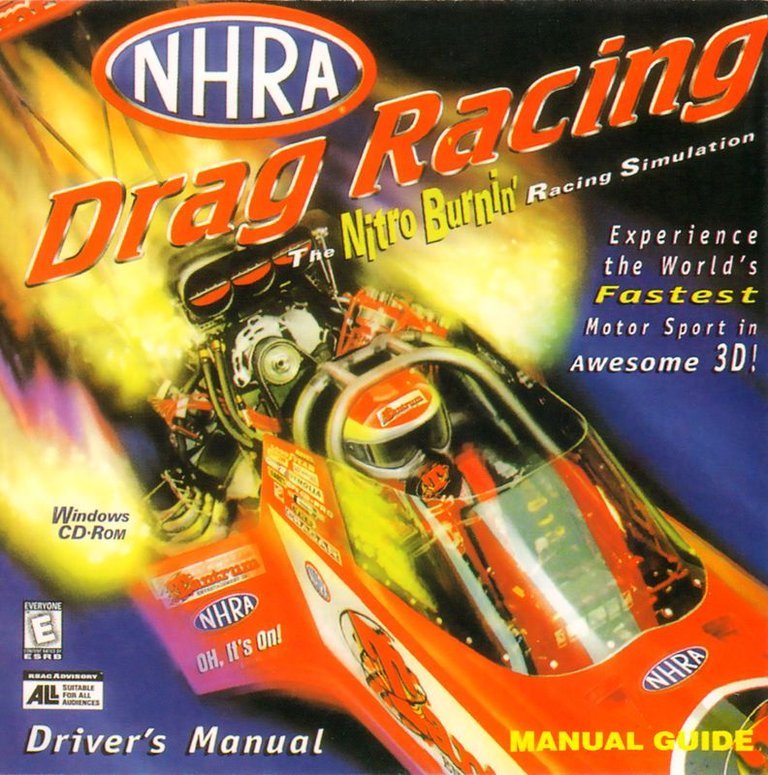
NHRA Drag Racing is a 3D simulation of professional drag racing, officially licensed by the NHRA, where players compete in 22 authentic events across 19 real-world tracks from a first-person perspective. Piloting nitro-burning dragsters or funny cars, racers must fine-tune vehicle parts to conquer quarter-mile sprints lasting just six seconds, with weather conditions dramatically affecting handling and performance.
NHRA Drag Racing Free Download
NHRA Drag Racing Reviews & Reception
en.wikipedia.org (64/100): Drag racing fans probably wouldn’t be disappointed and would probably boost the gameplay mark, but a racing title without handling will wear thin fast with any other gamers
gamespot.com (57/100): The samey-samey feel of every event only makes you wish that you were either at a real drag race or watching one on television.
handwiki.org (64/100): Drag racing fans probably wouldn’t be disappointed and would probably boost the gameplay mark, but a racing title without handling will wear thin fast with any other gamers
NHRA Drag Racing: Review
Introduction
Imagine the thunderous roar of a nitro-fueled dragster exploding off the line, hurtling down a quarter-mile strip at over 300 mph in mere seconds, where a single mistimed launch or twitch of the wheel spells disaster. This is the visceral allure of NHRA drag racing, and in 1998, Tantrum Entertainment dared to bottle that adrenaline rush into NHRA Drag Racing, an officially licensed PC simulation that thrust players into the heart of America’s premier drag racing circuit. As the first major video game to bear the NHRA seal, it arrived amid a late-’90s racing scene dominated by circuit racers like Need for Speed and Gran Turismo, carving a niche for straight-line speed demons. Yet, for all its ambitions, NHRA Drag Racing is a double-edged sword: a pioneering authenticity trip for die-hard fans that stumbles under technological limitations and repetitive design. This review argues that while it captures the raw essence of drag racing’s high-stakes brevity, its era-bound flaws relegate it to a curious artifact rather than a timeless classic, influencing a string of NHRA-licensed sequels but never transcending its niche.
Development History & Context
Tantrum Entertainment, a fledgling studio founded in 1996, cut its teeth with NHRA Drag Racing, marking this as their debut title under publisher Mind Magic Productions. Development kicked off as early as September 1997, with NHRA announcements hyping a May 1998 release that slipped to June 30 (or August, per some records), culminating in a public debut at the May Fram Route 66 Nationals. Real-world stars Ron Capps and Whit Bazemore beta-tested the game, lending credibility and ensuring mechanical fidelity—dragsters and funny cars behaved with authentic nitro burnouts, launches, and parachute deployments.
The late-’90s PC gaming landscape was a wild frontier of 3D acceleration: OpenGL-powered titles like Quake II pushed hardware limits, but consumer rigs varied wildly, with reviewers noting sluggish performance on 8MB video cards (16MB recommended for that 300 mph illusion). Tantrum’s vision was pure simulation—mirroring real NHRA events across 19 tracks and 22 sanctioned races—amid a market craving licensed sports sims. Competitors like NASCAR Racing emphasized endurance circuits, leaving drag racing underserved. Constraints abounded: no multiplayer (a glaring omission), CD-ROM media sans audio tracks (per archival ISOs), and input limited to keyboard, mouse, or wheel. Tantrum collaborated closely with NHRA for track details, sponsor lore, and telemetry-inspired tuning, but budget realities yielded a single-player focus. This context birthed a game authentically niche yet hampered by load times (20 seconds per retry) and era-specific jank, setting the stage for sequels like NHRA Drag Racing 2 (2000) from the same team.
Narrative & Thematic Deep Dive
NHRA Drag Racing eschews traditional storytelling for experiential immersion, a deliberate choice befitting its sim roots—no overwrought plots, voiced protagonists, or branching campaigns here. Instead, the “narrative” unfolds through progression modes: test drives for tuning tweaks, single races for quick thrills, and tournaments demanding financial management of sponsors, crew chiefs, and upgrades. Players embody an aspiring NHRA contender, climbing from isolated quarter-mile blasts to full event circuits, with detailed in-game lore on tracks (e.g., weather-impacted strips) and real stars providing aspirational flavor text.
Thematically, it’s a meditation on precision amid chaos: drag racing’s six-second sprints symbolize life’s high-wire acts, where mastery of power, traction, and environment trumps endurance. Weather as a dynamic foe underscores unpredictability—rain-slicked tracks demand clutch adjustments, echoing real NHRA variables like track temperature or air density. Crew chiefs offer “unique tuning styles,” personifying team dynamics without deep characterization; sponsors tie into capitalist undercurrents, where victory funds the next nitro hit. Dialogue is sparse—functional menus and race preps—but evocative, with real-race audio evoking the sport’s blue-collar heroism. Critically, the absence of narrative depth amplifies repetition: no rival backstories or rivalries humanize AI opponents, reducing themes to mechanical purity. For historians, this minimalist approach prefigures modern sims like Forza Motorsport‘s career modes, prioritizing authenticity over Hollywood flair, though it alienates casuals seeking emotional hooks.
Gameplay Mechanics & Systems
At its core, NHRA Drag Racing distills drag racing to a taut loop: burnout (heat tires), stage (pre-launch creep), launch on green, maintain traction through gears, deploy parachute. Races last ~6 seconds, forcing pixel-perfect throttle modulation amid weather variances—too much power spins tires, too little cedes leads. Vehicle selection spans nitro dragsters (“rails”) and funny cars, each tunable via engine, suspension, and clutch settings, with environmental sliders for realism. Four camera views (1st-person cockpit, 3rd-person chase, etc.) enhance strategy, while Racepak-like telemetry (implied in sequels, nascent here) previews runs.
Progression shines in tournaments: earn cash for parts, hire crew, chase NHRA glory across 19 tracks. UI is functional but clunky—load screens drag retries, interfaces feel dated sans polish. Innovative: weather simulation and fine-tuning reward gearheads; flawed: no multiplayer, repetitive AI, and hardware demands (slow on low-end cards). Controls support wheels for immersion, but keyboard/mouse feels arcade-y. Loops innovate by emphasizing setup over driving—90% garage tinkering, 10% sprint—foreshadowing management sims. Yet, critics lambast the “no speed feeling” and “straight-line boredom,” with faults like poor collision or explosion physics. Patches absent, it demands patience, excelling for fans mastering ETs (elapsed times) but frustrating others.
| Mechanic | Strengths | Weaknesses |
|---|---|---|
| Tuning | Deep environmental adjustments; crew styles add variety | Overly fiddly UI; no telemetry depth |
| Racing Loop | Authentic burnout/launch/parachute; weather impact | 6-sec races + loads = repetition |
| Modes | Test/single/tournament progression | No multiplayer; shallow finances |
| Controls/UI | Wheel support; multiple views | Hardware-sensitive; dated menus |
World-Building, Art & Sound
The “world” is NHRA’s quarter-mile universe: 19 real tracks (detailed lore included) bathed in smoke, flames, and nitro haze. Atmosphere nails dragstrip grit—crowd murmurs, pre-race tension—but linearity limits exploration; no open pits or free-roam. Visuals, 3D polygonal with OpenGL, impress era-peers: billowing burnout smoke, exhaust flames, speed-blur effects evoke 300 mph rushes (on capable hardware). Art direction prioritizes functional realism—detailed chassis, sponsor decals—over beauty, with 1st/3rd views amplifying cockpit shakes. Low-end rigs stutter, muting thrills.
Sound design elevates: real-race recordings deliver bone-rattling nitro roars, tire shrieks, and parachute whooshes, immersing via raw audio fidelity. No CD audio tracks (ISO-confirmed), but engine wails and crowd ambiance forge tension. These elements synergize for “high-speed sensation” (GameSpot), track vibes palpable despite simplicity. Flames/smoke contribute chaos visuals, weather fogs adding peril—yet critics decry “unimpressive eye candy” and choppy audio, true on period hardware but nostalgic today via emulation.
Reception & Legacy
Launch reception was middling: MobyGames aggregates 55% critics (9 reviews)—Power Unlimited’s 75% lauds brevity for fans; PC Gamer’s 70% suits “die-hards”; lows like Adrenaline Vault’s 40% slam “limitations” and repetition. GameSpot (57%) captures consensus: thrilling speed, but “short-lived” sans multiplayer, wishing for TV spectating. Player scores hover 2.8-6.1/10, praising authenticity (“best for type”) while griping graphics/controls. Commercially obscure—collected by few—yet spawned NHRA Drag Racing 2 (2000), Main Event (2001, online focus), up to Speed for All (2022, criticized as shallow).
Legacy: Pioneered drag sims, influencing IHRA/sequels with tuning/telemetry emphasis. Niche cult status endures via abandonware (MyAbandonware, Archive.org), emulable on modern PCs. It exposed genre pitfalls—brevity vs. engagement—paving for deeper management in NHRA Quarter Mile Showdown (2006). Industry-wide, boosted licensed motorsports, proving drag racing viable despite linearity. Reputation evolved from “fan-only” to historical footnote, preserved in MobyGames/Wikipedia as Tantrum’s earnest first swing.
Conclusion
NHRA Drag Racing roars as a bold 1998 artifact: Tantrum’s sim captures NHRA’s explosive purity—tuning mastery, weather gambles, fleeting glory—but crashes on repetition, tech limits, and absent depth. For historians, it’s foundational, birthing a subgenre amid PC 3D dawn; for players, a nostalgic niche gem rewarding patience over polish. Verdict: 6/10—essential for drag aficionados, skippable otherwise, cementing its place as the quarter-mile spark that flickered but never fully ignited video game history. Fire it up via ISO for a time capsule thrill, but brace for loads.