
- Release Year: 2016
- Platforms: Windows
- Publisher: Blaze Epic
- Developer: Blaze Epic
- Genre: Action
- Perspective: Side view
- Gameplay: Platform, Puzzle elements
Description
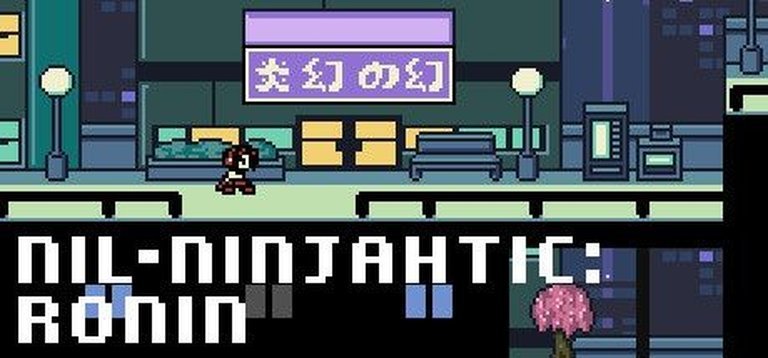
Nil-Ninjahtic: Ronin is a pseudo 8-bit action platformer that shifts from the ninja theme of previous series entries to a samurai-like protagonist. Players navigate through various screens with environmental platforming and puzzle-solving, engage in duels with samurai and other enemies, and experience straightforward level progression with frequent checkpoints, unlimited continues, and retro 8-bit graphics and soundtrack.
Gameplay Videos
Where to Buy Nil-Ninjahtic: Ronin
PC
Nil-Ninjahtic: Ronin Guides & Walkthroughs
Nil-Ninjahtic: Ronin: A solitary stone in the retro-platformer landslide
Introduction: The Shadow of a Single Developer
In the vast, overcrowded bazaar of the 2016 Steam storefront, where algorithmic discovery and marketing budgets often dictate visibility, Nil-Ninjahtic: Ronin exists as a quiet testament to a bygone era of indie development. It is the story of a game made not by a team, but by a single individual—Larry Stover, operating as Blaze Epic—who, in an age of accessible tools and saturated genres, chose to build a personal, focused, and deliberately niche experience. This review posits that Ronin’s true significance does not lie in revolutionary mechanics, critical acclaim, or commercial success, but in its role as a pure, unfiltered artifact of a specific developer’s vision. It is a game that asks not “what can we do?” but “what do I want to make?”—and then proceeds to answer that question with meticulous, hands-on craft. Its legacy is that of a solitary brick, laid with precision, in the ever-expanding wall of retro-inspired platformers.
Development History & Context: The Solo Auteur in the GameMaker Age
Nil-Ninjahtic: Ronin emerged from the crucible of the mid-2010s indie scene, a period defined by two contradictory forces: the unprecedented accessibility of development tools like GameMaker Studio, and an increasingly noisy market hungry for the next “viral” hit. The studio, Blaze Epic, is a one-person operation. According to developer communications on platforms like IndieDB and itch.io, Larry Stover single-handedly handled design, programming, art, and composition—a “full-stack” approach to game creation that echoes the maverick spirit of early bedroom coders but within a modern framework.
The game was originally conceived as “Ninjahtic Side Story,” a subtitle indicating its intended position as a complementary piece to the earlier Ninjahtic (2015) and Ninjahtic Mind Tricks (2015). The shift to Nil-Ninjahtic: Ronin signals a deliberate differentiation, a break from series conventions. Developed in GameMaker Studio, the technological constraints were self-imposed: a “pseudo 8-bit” aesthetic that harkens back to the NES era but with the flexibility of a modern engine. This choice was less about technical limitation and more about stylistic and practical necessity for a solo dev. Creating a full 16-bit or HD-2D title would exponentially increase asset and time requirements. The “pseudo” moniker is key—it’s an homage, not a restoration, allowing for a cleaner, more manageable visual pipeline.
The gaming landscape of early 2016 was saturated with retro platformers (Shovel Knight had set a high bar in 2014, Celeste was a year away). Ronin did not seek to compete on scope or polish. Instead, it represents a “micro-game” philosophy: a compact, complete experience built around a single, strong mechanical twist—the samurai protagonist—and sold at a rock-bottom price point (initially $1.99). Its context is that of the “altgame” or “personal game” movement, where commercial viability is secondary to expressive creation.
Narrative & Thematic Deep Dive: The Weight of the Blade
Where Ninjahtic titles presumably starred agile, shuriken-wielding assassins, Ronin introduces a thematic and mechanical pivot toward the samurai. This is not merely a cosmetic change; it informs the game’s entire philosophical core. The narrative, delivered through sparse in-game text and implied environment, revolves around a masterless warrior (ronin) navigating perilous, seemingly abstract landscapes. There is no grand save-the-world plot. The story is one of duty, perseverance, and solitary struggle—the ronin’s lot.
Thematically, the game explores contrast and complementarity:
* Ninja vs. Samurai: The series’ identity is rooted in the ninja—stealth, trickery, projectiles. The ronin represents directness, honor, and melee precision. The description’s note that “usage of the environment is still the focus” suggests a synthesis: the ronin uses his katana not just for combat, but for platforming—perhaps deflecting projectiles or interacting with environmental objects—blending the samurai’s martial focus with the ninja’s environmental cunning.
* Open-Ended vs. Linear Progression: A major stated departure is the shift from the “open-ended nature” of predecessors to “straightforward” level progression. This mirrors the ronin’s path: no branching secret routes, but a single, clear, punishing road forward. The narrative theme of a solitary, unwavering journey is thus mechanically embedded.
* Puzzle as Meditation: The “puzzle elements” are not mere obstacles but reflective trials. Solving them requires observation and timing—a zen-like focus befitting a warrior. The frequent checkpoints and infinite continues create a frictionless loop of attempt, failure, and learning, emphasizing mastery over punishment.
Dialogue and character are nonexistent in a traditional sense. The protagonist is an empty vessel, an avatar for the player’s perseverance. The enemies—other samurai—are not villainous but adversarial forces in a world of perpetual conflict. The world itself is the antagonist: a series of harsh, geometric tests. The minimalism is profound; it forces the player to project their own narrative of struggle onto the clean, pixelated stages.
Gameplay Mechanics & Systems: The Calculus of a Cut
The core gameplay loop is deceptively simple: run, jump, attack with a katana (likely a short-range, deliberate swing), and interact with platforms/enemies. The innovation lies in the integration of these elements and the tone of the challenge.
- Movement & Platforming: The “fixed / flip-screen” perspective (likely single-screen stages) creates a puzzle-platformer feel where each screen is a discrete problem to solve. The ronin’s movement must be precise. The samurai identity suggests a heavier, less floaty jump than a typical ninja, demanding commitment to each leap.
- Combat: Described as “dueling with samurai,” combat is likely duels of timing and spacing, not frantic hack-and-slash. Enemies are “varying types,” implying a need to learn patterns. The short-range weapon forces players into dangerous proximity, heightening tension. It’s a test of courage and precision, not attrition.
- Progression & Difficulty: “Challenging difficulty, frequent checkpoints, and unlimited continues” is a crucial design triad. The difficulty is mechanical, not punitive. Frequent checkpoints after each screen (or major obstacle) mean failure is a brief setback, not a huge time loss. This encourages experimentation and rapid iteration. The “unlimited continues” formally removes any resource management, focusing the challenge purely on skill acquisition. This is the philosophy of a “fair” but stern teacher.
- Puzzle Integration: The “puzzle elements” are woven into the platforming. Solutions likely involve using the katana to hit switches, deflect projectiles back at their sources, or create temporary platforms. The environment is an interactive toolset.
- UI & Feedback: For a solo project, the UI is likely minimalist—health (if present), score, and perhaps a simple stage indicator. The 8-bit aesthetic extends to feedback: hit flashes, screen shake, and sound cues are paramount for clarity in a demanding precision game.
Flaws & Innovations: The most significant “flaw” is also its defining feature: the straightforward, linear level design may feel restrictive to players expecting the exploratory secrets of the earlier Ninjahtic games. However, this is a conscious trade-off for focused, curated challenge. The true innovation is in the holistic design. Every element—the samurai theme, the linear stages, the precise combat, the forgiving continues—serves the core experience of a solitary warrior overcoming a series of duels and trials. It is a game perfectly calibrated to its own narrow vision.
World-Building, Art & Sound: The Aesthetic of Austerity
The “pseudo 8-bit” style is not a lazy retro emulation but a deliberate, clean aesthetic. The graphics are likely composed of large, clear pixels with a limited but coherent palette. This serves gameplay above all: hazards, platforms, and enemies are instantly readable. The world is stark, perhaps featuring monochromatic backgrounds with accent colors for interactables. The environmental storytelling is minimal but potent—a lone pine tree, a broken bridge, a torii gate—hints at a larger, melancholic Japanese-inspired mythos left to the player’s imagination.
The sound design, composed by Stover himself (as noted on itch.io), is critical. An 8-bit soundtrack for a ronin would lean away from peppy jungle beats toward more somber, pentatonic melodies. Expect sparse, percussive tracks with shakuhachi (bamboo flute) samples or FM synthesis renditions of koto strings. Sound effects are sharp and satisfying: the shing of the katana, the clang of parries, the soft thud of a landing. The audio is not atmospheric Background Music; it is an active participant in the game’s tense, meditative rhythm. The recommendation of an Xbox 360 controller speaks to a desire for analog precision in movement and a tactile feel for the katana swing, bridging retro aesthetics with modern input comfort.
Reception & Legacy: The Quiet Ripple
Nil-Ninjahtic: Ronin exists in the vast, uncritical middle ground of Steam. With an estimated owner count of “Less than 20,000” (lestrades.com) and a SteamDB listing showing modest activity, its commercial reach was minimal. Steam review aggregates place it at “Mostly Positive” (75/100 on Steambase from ~36 reviews), a solid but unspectacular score for a niche title. The lack of critic reviews on Metacritic and minimal discussion on its Steam forums underscore its status as a cult curiosity rather than a mainstream darling.
Its legacy must be analyzed on two planes:
- Within the “Ninjahtic” Series: It is the series’ thematic outlier, the one that consciously diverged. For the small community that followed Blaze Epic’s work, it represents an interesting experiment—what happens when you change the protagonist’s entire martial philosophy? It likely satisfied fans looking for more of the core platforming but may have puzzled those expecting “more of the same.”
- Within the Indie Ecosystem: Ronin is a drop in the ocean of the 2010s retro-platformer boom. It did not influence giants like Celeste or Hollow Knight. Its legacy is that of a successful personal project. It demonstrates that within GameMaker’s walls, a single developer can still craft a complete, coherent, and mechanically distinct game that finds its small audience. It is proof of concept for the “micro-series”—multiple games sharing a core engine/feel but exploring different thematic riffs (Ninja, Ronin). Its presence in storefronts alongside titles like Terra Nil (2023) in “Related Games” algorithms is a testament to the enduring, if obscure, footprint of solo dev branding.
Conclusion: A Defiant Gesture
Nil-Ninjahtic: Ronin is not a forgotten masterpiece. It is not a flawed gem. It is, instead, a defiantly complete thought. In an industry increasingly geared toward live service, content sprawling, and audience mining, this $2 game from 2016 feels like an artifact from a parallel universe where the goal is simply to finish a personal idea and share it. Its “pseudo 8-bit” samurai platforming is a vehicle for Larry Stover’s specific design philosophy: focus over feature creep, clarity over complexity, and a mechanical challenge that respects the player’s time through frequent checkpoints.
Its place in history is not on a pedestal but in a dossier: a case study in sustainable solo development, in thematic unity in game design, and in the quiet satisfaction of a project seen through to its end. It is the game equivalent of a haiku—strictly formed, emotionally spare, and wholly the work of one hand. For the player who Stover describes as “experiencing the inner workings of my mind,” Ronin is a successful transmission. For the historian, it is a clear, concise data point: this is what one person, with GameMaker and a clear vision, can still make in the modern era. Its value is not in how many played it, but in the purity of its creation.