
- Release Year: 2004
- Platforms: Windows
- Developer: Ihsan Ul Haque
- Genre: Strategy, Tactics
- Perspective: Side view
- Game Mode: Single-player
- Gameplay: Fixed, Flip-screen, Point and select, Turn-based
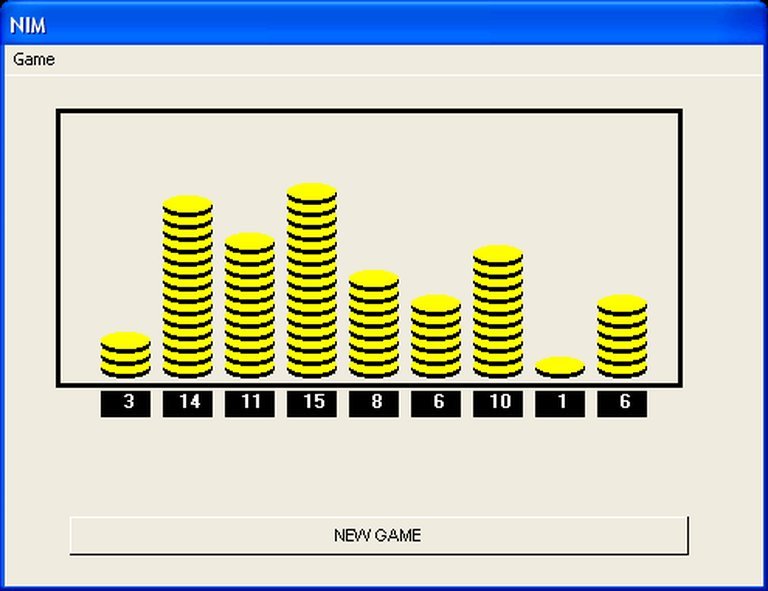
Description
Nim is a turn-based strategy game for Windows where players take turns removing discs from multiple piles, with the player who takes the last disc losing. The game allows customization of pile count (2-9) and discs per pile (1-16), and includes a hint function to assist players. It features a simple point-and-click interface and is part of the classic Nim mathematical tradition.
Where to Buy Nim
PC
To solve this problem, we need to count the number of subarrays in which the number of occurrences of the most frequent element is at least a given integer ( k ). The solution involves iterating over all possible subarrays and checking the frequency of the most frequent element in each subarray. Although this approach has a time complexity of ( O(n^2) ), it is straightforward and effective for smaller input sizes as specified in the problem constraints.
Approach
- Problem Analysis: The problem requires counting all subarrays where the most frequent element appears at least ( k ) times. A subarray is a contiguous part of the array.
- Intuition: For each possible starting index ( l ) in the array, we can expand the subarray to include elements from ( l ) to each subsequent index ( r ). For each such subarray, we maintain a frequency dictionary to track the occurrences of each element. We also keep track of the maximum frequency encountered in the current subarray.
- Algorithm Selection: We use nested loops to iterate over all possible subarrays. The outer loop sets the starting index ( l ), and the inner loop expands the subarray by including elements from ( l ) to ( r ) (where ( r ) ranges from ( l ) to the end of the array). For each subarray, we update the frequency of the current element and check if the maximum frequency meets or exceeds ( k ). If it does, we increment our count.
- Complexity Analysis: The algorithm has a time complexity of ( O(n^2) ) due to the nested loops, where ( n ) is the length of the array. The space complexity is ( O(n) ) for storing the frequency dictionary in the worst case.
Solution Code
Explanation
- Initialization: We initialize
ansto 0, which will store the count of valid subarrays. - Outer Loop (Starting Index): The outer loop iterates over each possible starting index ( l ) of the subarray.
- Frequency Tracking: For each starting index ( l ), we initialize a frequency dictionary
freqto keep track of the count of each element in the current subarray and a variablemax_freqto store the highest frequency encountered. - Inner Loop (Ending Index): The inner loop expands the subarray by including elements from ( l ) to each subsequent index ( r ). For each element added at index ( r ), we update its frequency in
freqand check if this frequency exceedsmax_freq, updatingmax_freqif necessary. - Check Condition: After updating the frequency, we check if
max_freqis at least ( k ). If true, we incrementanssince the current subarray meets the condition. - Result: After processing all subarrays,
anscontains the total count of valid subarrays, which is returned as the result.
This approach efficiently checks all possible subarrays while dynamically tracking the frequency of elements, ensuring we count all subarrays where the most frequent element appears at least ( k ) times. Although not optimal for very large inputs, it is clear and works well within the problem constraints.