
- Release Year: 2023
- Platforms: Nintendo Switch, Windows
- Publisher: CFK Co., Ltd.
- Developer: ASTEROID-J
- Genre: Action
- Perspective: Side view
- Gameplay: Platform
- Setting: Cyberpunk, dark sci-fi
- Average Score: 84/100
Description
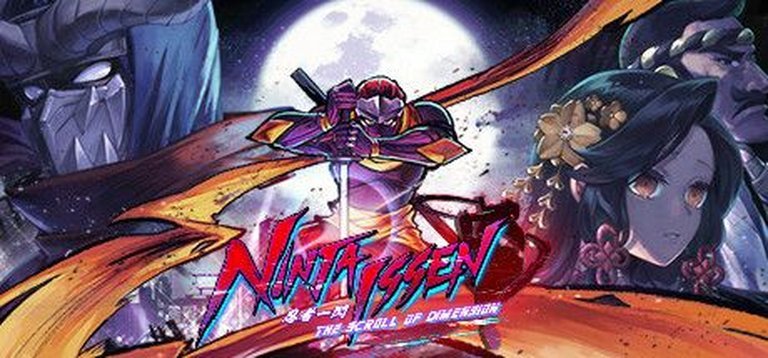
Ninja Issen is a retro-style ninja platformer that pays homage to classic 8-16 bit games, featuring hyper action, 1 vs. many battles, and dynamic boss fights. Set in a dark, cyberpunk future metropolis filled with neon lights and robots, players control Kiba, a rogue ninja falsely accused of assassinating his clan’s grand master, as he fights to survive against pursuers in a visually striking, fast-paced world.
Gameplay Videos
Where to Buy Ninja Issen
PC
Ninja Issen Guides & Walkthroughs
Ninja Issen Reviews & Reception
metacritic.com (80/100): 2D ninja action games don’t get much more fully-featured than Ninja Issen: The Scroll of Dimension and its arsenal of skills is great fun.
opencritic.com (80/100): 2D ninja action games don’t get much more fully-featured than Ninja Issen: The Scroll of Dimension and its arsenal of skills is great fun.
Ninja Issen Cheats & Codes
Ninja Issen (Steam PC Version)
Enter codes at the main menu via Settings > Unlock. Press Tab to activate the code field.
| Code | Effect |
|---|---|
| ARMORX99 | Infinite Health |
| WEAPONZ12 | Unlock All Weapons (DLC included) |
| LEVELSKIP5 | Skip 5 Main Levels |
| GHOSTRUSH | Visual Filter + Triple Enemies |
| BOSSUNLOCK | Unlocks Akuma Trial Boss Arena |
| RESUPPLY | Max Ammo + Currency Boost |
| CHIPMOD99 | Enables Debug Chip + Glitches |
| FILTERCRT | CRT Retro-Style Filter |
| SHINOBI777 | Unlocks a retro visual filter |
| GHOSTEDGE2025 | Instantly enables Nightmare difficulty |
Ninja Issen (Console Version)
Enter codes at the main menu via Settings > Unlock. Press and hold L2 + R2 to activate the input box.
| Code | Effect |
|---|---|
| ARMORX99 | Infinite Health |
| WEAPONZ12 | Unlock All Weapons (DLC included) |
| LEVELSKIP5 | Skip 5 Main Levels |
| GHOSTRUSH | Visual Filter + Triple Enemies |
| BOSSUNLOCK | Unlocks Akuma Trial Boss Arena |
| RESUPPLY | Max Ammo + Currency Boost |
| CHIPMOD99 | Enables Debug Chip + Glitches |
| FILTERCRT | CRT Retro-Style Filter |
| SHINOBI777 | Unlocks a retro visual filter |
| GHOSTEDGE2025 | Instantly enables Nightmare difficulty |
Ninja Issen: The Scroll of Dimension – A Retro-Futurist Ode to Shinobi and Strider
Introduction: A Ghost from the Past, Blasting into the Future
In an era where game development is often a colossal, multi-studio endeavor, Ninja Issen: The Scroll of Dimension arrives as a striking anomaly—a passion project forged in the digital crucible of a single developer’s ambition. Released in late 2023 for PC and stealth-dropped on the Nintendo Switch in early 2025, this title is not merely a throwback; it is a meticulously crafted, hyper-kinetic love letter to the 8- and 16-bit golden age of action-platformers, specifically the lineage of Sega’s Shinobi and Capcom’s Strider. Its thesis is bold: to marry the tight, demanding, screen-filling combat of classic ninja epics with a modern, stylish cyberpunk-aesthetic and a deep, customizable combat system. While its execution reveals the tell-tale signs of a solo development journey—some rough edges and a concise campaign—Ninja Issen ultimately succeeds as a thrilling, score-attack-oriented experience that recalls a bygone era while feeling surprisingly fresh. It stands as a testament to the enduring power of a core gameplay loop perfected, even when wrapped in a volatile package.
Development History & Context: The Solo Warrior’s Odyssey
Ninja Issen is the brainchild of ASTEROID-J, a solo developer based in South Korea. This origin story is fundamental to understanding the game’s character. Crafted in Unity, a engine synonymous with indie accessibility, the game represents a “bedroom developer” ethos scaled to a commercial release. Its development trajectory was marked by grassroots validation: the game first garnered significant attention by winning the prestigious “Best Indie Game” award at the 2022 Made with Unity Korea competition. This accolade served as a crucial launchpad, providing visibility and credibility.
The subsequent years were spent refining the demo and showcasing the title at a string of major Korean and international events, including G-star 2022, 2023 PlayX4, BIGS 2023, and the Tokyo Game Show 2023. This tour built a palpable sense of anticipation among enthusiasts of retro action games. The publishing was handled by CFK Co., Ltd., a company known for bringing unique Japanese and Korean indie titles to global audiences. The release schedule itself tells a story of strategic patience: a November 22, 2023 launch on Windows via Steam was followed by a Nintendo Switch port released seemingly without major fanfare on February 20, 2025—a gap suggesting additional polish or platform-specific optimization for the handheld hybrid.
The gaming landscape of 2023 was ripe for such a title. A wave of successful retro revivals (Shovel Knight, The Messenger) and neo-retro masterpieces (Cuphead) had established a market for challenging, aesthetically deliberate 2D action. Ninja Issen entered this空间 not as a historical re-rendering, but as a new IP synthesizing the genre’s best elements: the omnipresent 1-vs.-many chaos of Shinobi, the acrobatic mobility of Strider, and the crisp, responsive combat of modern indie darlings.
Narrative & Thematic Deep Dive: Revenge Across Time and Steel
The plot of Ninja Issen is a classic anime and arcade game framework, but one delivered with a surprising commitment to context through extensive dialogue sequences and story panels reminiscent of Comix Zone. You are Kiba, the elite top ninja of a traditional clan. The inciting incident is a brutal betrayal: he is falsely accused of assassinating his own grandmaster. Pursued by his former comrades, including his arch-nemesis Suikyu (the true conspirator and second-in-command), Kiba engages in a desperate battle that ends with him gravely wounded and, through a mysterious temporal phenomena, catapulted into a dystopian, cyberpunk metropolis—a world of neon, chrome, and rampant technology.
This sci-fi setting is not merely backdrop; it is thematic core. Rescued by Hanzo, a cyborg engineer who owns the shop “Hanzo’s Hot Sushi,” Kiba is rebuilt with cybernetic augmentations. This fusion of ancient ninja discipline with future-tech weaponry is the game’s central metaphor. The narrative grapples with themes of identity (a warrior out of time), corruption (the clan’s internal decay), and the very nature of strength—is it found in tradition or in technological transcendence? The supporting cast embodies these conflicts: Asran, the princess of Kiba’s clan and daughter of the slain leader, is also a victim of the time rip, creating a personal stake in both the past murder and the present escape. The journey becomes a dual quest: to clear his name in the past and to survive and understand the future he’s trapped in.
The story, while delivered through occasionally lengthy dialogue, maintains a B-movie charm. It understands its roots in campy, high-concept action. The cyberpunk metropolis—sometimes referred to in sources as “Lust Angels”—is a character itself, a glittering, oppressive jungle of holographic advertisements, military facilities, and rogue robot armies, representing the ultimate impersonal enemy that Kiba’s personal code of honor must cut through.
Gameplay Mechanics & Systems: The Art of the One-Man Army
Ninja Issen’s brilliance lies in its combat and mobility systems, which feel both comfortably familiar and inventively expanded. The core loop is unapologetically about overwhelming force. From the outset, Kiba is an engine of destruction, designed to dispatch “1 vs. many” scenarios with stylistic flair.
The Arsenal:
* Katana: The primary melee weapon. It is fast, has good range for a sword, and is the foundation of all close-quarters combat. Its true potential is unlocked through motion.
* Shuriken: A ranged projectile with two critical functions: hitting distant enemies and, crucially, deflecting incoming enemy projectiles back at their source. This parry mechanic adds a vital layer of defensive strategy.
* Ninja Skills (The “Hyper Action”): These are the game’s signature and what elevate it beyond a standard slash-’em-up.
* Issen (One Flash): A high-speed, lunging dash attack that slices through multiple enemies and certain obstacles in a straight line. It’s the quintessential “screen-clearing” move but requires positioning.
* Teleport: By throwing the katana to a designated point, Kiba instantly teleports there. This is not just a mobility tool; it is a core puzzle-solving and evasion mechanic, used to cross large gaps, bypass traps, and reposition in the heat of battle.
* Fire Circle: Conjures a rotating orb of fire around Kiba, damaging any enemy that touches it. Perfect for tight corridors or when completely surrounded.
* Phantom: Grants temporary invincibility, allowing Kiba to phase through attacks or safely navigate hazardous areas. It has a cooldown, making it a tactical resource.
The genius is in the freeform combination of these tools. A typical engagement might involve clearing a path with Issen, teleporting behind a shielded enemy, deflecting a barrage of laser bolts with shuriken, and finishing with a Fire Circle spin. The game encourages creative expression within its chaos.
Progression & Structure:
Progression is largely skill-based and execution-driven, rather than a complex RPG tree. The narrative is linear, split into distinct stages that culminate in boss battles. These bosses are a highlight, each with a multi-phase structure. Upon depleting a boss’s health bar, it enters Phase 2, often with new, more aggressive attack patterns and, in some cases, destructible parts that can alter its behavior if targeted. These fights require pattern recognition, efficient use of all skills (especially Teleport for evasion and Phantom for survival), and strategic striking.
UI & polish issues: As noted by critics, particularly GameBlast, the game sometimes suffers from graphical clutter. The retro-filtered, dense cyberpunk backgrounds can make it difficult to distinguish between foreground platforms, background elements, and certain hazards or enemy attacks. This is a significant flaw in a precision platformer where parsing the environment is key to survival. The volume is also noted as short—around 3-4 hours—which is typical for a pure action game but may leave some wanting more.
World-Building, Art & Sound: Neon-Drenched Retro Mayhem
The aesthetic of Ninja Issen is its most immediately arresting feature. It masterfully employs a “retro graphics filter” over a modern, high-resolution 2D art style. This creates a unique visual signature: the environments are bursting with the neon lights, holographic billboards, and looming industrial structures of cyberpunk, but they are rendered with a deliberate, pixel-art-inspired crispness and limited palette that evokes the Sega Genesis and SNES eras. The result is a world that feels both nostalgically familiar and strikingly new—imagine the urban decay of Shinobi III‘s stages colliding with the electric futurism of Streets of Rage 2‘s cityscapes.
The enemy and character designs are equally effective. Kiba’s traditional garb contrasts brilliantly with the cybernetics of Hanzo and the mechanized foes—military-suited soldiers, jetpack-wielding astro-ninjas, laser-turret bots, and hulking hovertrucks—that populate the streets. The boss designs are particularly memorable, often large-scale mechanical monstrosities or elite cyber-ninjas that demand respect.
The sound design complements this perfectly. The soundtrack is a driving, synth-heavy score that pulsates with energy during combat and settles into brooding, atmospheric tracks for exploration. Sound effects are crisp and satisfying: the shing of the katana, the thwip of shuriken, the roar of engines, and the electronic bzzt of energy weapons all provide crucial auditory feedback. It fully commits to the “loud, proud, and electronic” cyberpunk ethos.
Reception & Legacy: A Cult Classic in the Making
At launch, Ninja Issen received a moderately positive critical reception, with an average score of 71% based on three critic reviews. The consensus highlighted its strengths and weaknesses in tandem:
* Video Chums (80%) praised it as one of the most “fully-featured” 2D ninja action games, lauding its “arsenal of skills.”
* INVEN (73%), a Korean outlet, noted its successful pursuit of “레트로 사이버펑크풍 감성” (retro cyberpunk sensibility) but candidly pointed out the graphical obscurity (making platforms/traps hard to read) and short length, ultimately recommending it as a “부담없이 즐길 수 있는” (accessible, stress-free) retro experience.
* GameBlast (60%), in a Portuguese review, was more critical, stating that despite evident developer care, the game “lacks more polishing time” and that the bugs “really compromise the final experience.”
This divergence in scores mirrors the game’s dual nature: a brilliantly designed core action system wrapped in a technically imperfect package.
The user reception, however, tells a more enthusiastic story. On Steam, the game holds a “Very Positive” rating with 93% of 78 reviews being positive as of early 2026. This stark contrast to critic scores suggests that for the core audience—players seeking a pure, challenging, old-school action fix—the game’s strengths utterly overshadow its flaws. Players seem to revel in mastering its combat flow and overlooking minor glitches or brevity.
Its legacy is still being written, but its influence is clear in the niche it occupies. It joins the ranks of successful solo-developed indie action games (like Katana ZERO or Blazing Chrome) that prove a single visionary can still compete on gameplay depth. It serves as a potent reminder to publishers like CFK that appreciating and distributing such passion projects has value. By directly channeling the spirit of Shinobi and Strider while injecting a distinct cyberpunk personality and a modern skill system, Ninja Issen carves out its own identity. It likely won’t redefine the industry, but it will be cited by genre enthusiasts as a must-play exemplar of the modern retro-action movement, and a benchmark for what one dedicated developer can achieve with Unity and a clear vision.
Conclusion: A Flawed Flash, But a Brilliant One
Ninja Issen: The Scroll of Dimension is a game of exhilarating contradictions. It is a short, sometimes visually messy game built around an enormous, intricately satisfying combat system. It is a solo-developed title that feels, in its best moments, like a lost classic from the 90s arcade golden age. Its narrative is engagingly cheesy yet committed, its world a dazzlingly busy cyberpunk playground that occasionally obscures the very platforming it demands.
For the historian, it is a fascinating case study in modern retro design—taking established genre mechanics and expanding them thoughtfully (the skill system is a masterclass in expansion without bloat) while adhering to a strict aesthetic and difficulty philosophy. For the player, it is a pure, unadulterated action experience. The thrill of stringing together Teleport – Issen – Shuriken Deflect – Fire Circle to annihilate a room is immense and hard-won.
Its technical shortcomings and brief runtime are real liabilities. However, when judged by the primary metric of an action-platformer—the “gamefeel” of its combat—Ninja Issen is an unqualified success. It captures the essence of what made Shinobi and Strider timeless: a dance with death where your every move must be precise, aggressive, and stylish. In delivering that essence with such fidelity and creative addition, ASTEROID-J has crafted a cult classic in waiting—a game whose flaws are visible but whose heart, soul, and blade cut with exhilarating precision. It is not a perfect game, but it is undoubtedly a great one, and a vital, energetic postscript to the legacy of ninja platformers.