
- Release Year: 2005
- Platforms: Windows
- Publisher: Bay 12 Games
- Developer: Bay 12 Games
- Genre: Simulation
- Perspective: 3rd-person (Other)
- Game Mode: Single-player
- Gameplay: Interactive, Point-and-click
Description
No More Stumpie-Wumples is a freeware horror simulation game released in 2005 for Windows, where players assume the role of a psychopathic godling responsible for summoning and brutally exterminating adorable creatures called Stumpie-Wumples—each with unique backstories—through methods like acid baths, blowtorch incineration, guillotine execution, or factory machinery maiming. The game features dark narratives, post-mortem desecration mechanics, and creator Tarn Adams’ explicit warnings against playing due to its disturbing premise.
No More Stumpie-Wumples Reviews & Reception
retro-replay.com : Perfect for fans of twisted humor and unapologetic gore, No More Stumpie-Wumples delivers endless hours of macabre entertainment.
No More Stumpie-Wumples: A Digital Pantheon of Cruelty
Introduction
In the vast, often sanitized landscape of interactive entertainment, few titles dare to confront the player with unmediated moral depravity. No More Stumpie-Wumples, released in November 2005 by the enigmatic Bay 12 Games, stands as a digital monument to this transgression. A freeware “murder simulator” birthed from the same mind behind the celebrated Dwarf Fortress, it casts players not as heroes or anti-heroes, but as bored, omnipotent deities tasked with annihilating cherubic, sentient beings. This is not a game about victory or mastery; it is a bleak, incisive commentary on power, desensitization, and the banality of digital cruelty. Its legacy lies not in commercial success or critical acclaim, but in its unflinching willingness to plumb the darkest recesses of interactive experience. This review will dissect No More Stumpie-Wumples as both a historical artifact and a still-disturbing work of provocative art, arguing that its grim simplicity and unapologetic malice secure its place as a profoundly uncomfortable, yet essential, entry in video game history.
Development History & Context
No More Stumpie-Wumples emerged from the singular vision of Tarn Adams, a developer already known for his ambitious, complex simulation projects under the Bay 12 Games banner. Created in the shadow of Dwarf Fortress (then in its formative years), it represents a stark, almost jarring departure. The game was developed during an era defined by the rise of indie darlings and the flourishing of freeware experimentation, yet it flew in the face of prevailing trends. While contemporaries like Katamari Damacy offered whimsy and Shadow of the Colossus grappled with tragic heroism, Adams crafted a focused exercise in digital sadism.
Technologically, the game is a study in minimalist constraint. Built for Windows (with system requirements as low as Windows 98), it eschews complex 3D engines or intricate physics. Its graphics are rudimentary 3D sprites, its sound a collection of stark, often jarring effects. This technical simplicity, however, was a deliberate choice, serving the game’s thematic core: the focus is entirely on the act of destruction, free from the distraction of elaborate worlds or deep systems. Adams documented his own ambivalence, famously appending a disclaimer in the game’s files: “Tarn Adams recommends that you not play the game. Tarn Adams recommends that you delete the game immediately,” prefaced by the chilling epigraph from WarGames: “The only way to win is not to play.” This self-referential warning underscores the developer’s understanding of the project’s inherent toxicity, positioning it less as a “game” and more as a disturbing artifact born from a dark creative impulse.
Narrative & Thematic Deep Dive
No More Stumpie-Wumples possesses no traditional narrative arc, heroes, or villains. Instead, its narrative is a recursive cycle of summoning, biography, annihilation, and reflection. The player assumes the role of a disembodied “psychopathic godling” within a sterile, featureless void. This entity’s motivation is boredom, its power absolute. It summons “Stumpie-Wumples” – small, round, vaguely humanoid creatures rendered in deceptively cute, cartoonish styles. Each Stumpie-Wumple arrives with a brief, mundane biography: “Bartholomew, 42, enjoys gardening with his wife, Mildred,” or “Gertrude, 68, dreams of opening a bakery.” These micro-stories are the game’s narrative heart. They invest the victims with a flicker of humanity, transforming them from disposable sprites into individuals with hopes, relationships, and histories. This deliberate contrast between the adorable presentation and the horrific fate that follows creates a profound and unsettling tension.
The narrative is driven by the cycle of death and the game’s own meta-commentary. After a Stumpie-Wumple is dispatched (via drag-and-drop into one of four brutal contraptions), the game presents a curt, almost clinical assessment of the act: “Do you feel anything?” or “Why did you do that?” These direct, invasive questions shatter the fourth wall, forcing the player to confront their own complicity. They transform the gameplay loop from a simple power fantasy into an interrogation of the player’s ethical boundaries. The “story” isn’t about what happens to the Stumpie-Wumples; it’s about what happens to the player as they perpetrate the atrocities. The themes are stark and unforgiving: the corruption of absolute power, the banality of evil when abstracted through a digital interface, and the terrifying capacity for desensitization. It posits that true victory in this context isn’t efficiency or high scores, but the refusal to engage – a bleak inversion of conventional game design. The creator’s own regret, voiced in the disclaimer, becomes part of the narrative, framing the game as a cautionary tale about the dangers of unchecked creative impulses or digital indulgence.
Gameplay Mechanics & Systems
The gameplay loop of No More Stumpie-Wumples is brutally simple, almost ritualistic, and devoid of traditional progression or challenge. The core mechanic is a single, repeated action:
- Summoning: A new batch of Stumpie-Wumples appears on screen. Each is distinct in color and initial position.
- Selection & Biography: The player clicks on a Stumpie-Wumple. Its name and a short biography (career, family, hobbies) are displayed. This pause is crucial, a moment intended to trigger hesitation or reflection.
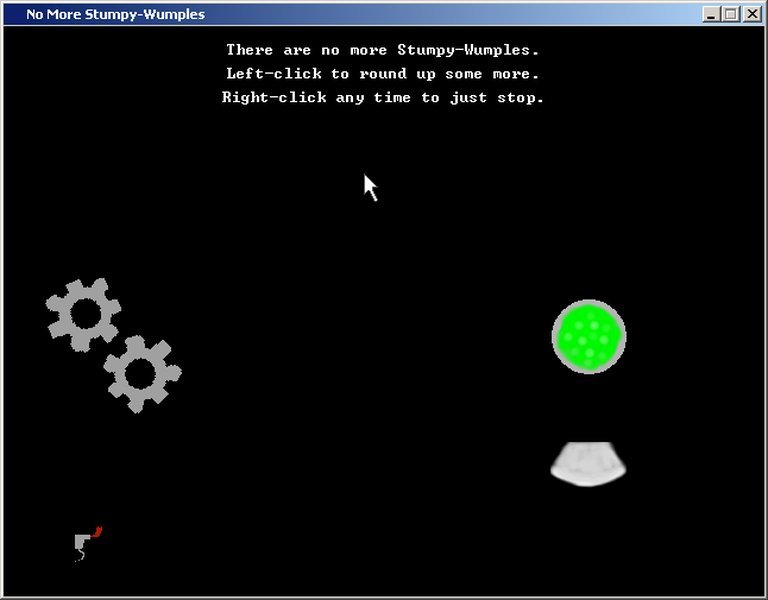
- Execution: The player drags the selected Stumpie-Wumple and drops it onto one of four icons representing death devices: a bubbling acid vat, a roaring blowtorch, a guillotine blade, or grinding factory gears. The execution is triggered instantly by the drop.
- Consequence: The chosen animation plays out (e.g., the figure dissolves in acid, ignites in flames, is decapitated, or is torn apart). The Stumpie-Wumple then reappears on screen as either a stark skull or a color-drained, ghostly husk, now positioned near the device that killed it. These remains can be dragged and dropped again, subjecting them to further indignities (e.g., dunking a skull back into acid).
- Cycle Completion & Reset: When all Stumpie-Wumples in the current batch are dead (and potentially desecrated), the player can click a button to summon a completely new batch, restarting the cycle with fresh victims.
There are no scores, no unlockable methods of death, no character progression, and no difficulty settings. The “challenge” is purely psychological, stemming from the player’s internal reaction to the act and the game’s persistent questioning. The UI is minimalist and functional: icons for the death devices, buttons for resetting the batch, and text boxes for the biographies and post-execution queries. The mouse is the sole input, making the drag-and-drop action intuitive yet disturbingly casual. This design strips away all traditional gaming scaffolding, leaving only the raw, repetitive act of creation and annihilation. The lack of mechanical depth is not a flaw but the point; it mirrors the godlike, consequence-free power the player wields and amplifies the moral vacuum.
World-Building, Art & Sound
No More Stumpie-Wumples builds its world through stark symbolism and pervasive atmosphere, rather than expansive lore or detailed environments. The “world” is a void – a gray, featureless space punctuated only by the execution devices and the Stumpie-Wumples themselves. This emptiness is paramount. It signifies the godling’s isolation and the victims’ complete lack of context or history beyond the biographies. The execution chambers (acid vat, blowtorch station, guillotine, factory gears) are crude, industrial structures rendered in cold, metallic grays. They stand in stark, jarring contrast to the vibrant, primary colors of the Stumpie-Wumples’ clothing and simple features. This visual dissonance amplifies the horror: the cute, innocent creatures are systematically fed into impersonal, horrifying machinery.
The art direction is deceptively simple yet effective. The Stumpie-Wumples are intentionally designed to evoke sympathy – their large, rounded heads, stubby limbs, and simple, wide-eyed expressions resemble beloved cartoon characters. This cuteness is a weapon; it makes their annihilation more viscerally uncomfortable. The execution animations are surprisingly detailed for the era and the game’s scope: the acid bubbles and corrosive effects, the flickering blowtorch flame, the heavy swing of the guillotine blade, the churning, grinding gears. These animations provide a grotesque, almost satirical, visual payoff to the act. Post-mortem, the stark white skulls or grayed-out husks serve as constant, silent reminders of the player’s actions.
Sound design is sparse but potent. There are no musical scores. The audio consists solely of the environmental sounds of the execution devices – the hiss of the blowtorch, the bubbling of the acid, the metallic thunk of the guillotine, the grinding whir of the factory – and occasionally, a faint, unsettling digital hum beneath it all. The silence between actions is as loud as the kills, creating an oppressive atmosphere. The absence of cries, screams, or any vocalization from the victims is chilling; it emphasizes their complete helplessness and reduces them to objects in the godling’s sandbox. This minimalist audio-visual palette creates an experience that is simultaneously cartoonish and deeply disturbing, a surreal purgatory where the only constants are the cycle of life, death, and the void.
Reception & Legacy
At launch, No More Stumpie-Wumples received virtually no critical attention. It was a freeware title from a niche developer, overshadowed by mainstream releases and the burgeoning indie scene. Its niche audience, drawn to Adams’ other work or its extreme premise, was small. Based on limited player ratings (an average of 3.5 out of 5 from just two sources on MobyGames), reception was mixed, likely reflecting the game’s polarizing nature – either appreciated as a bold, disturbing experiment or dismissed as a pointless, offensive shock piece. Its commercial impact was negligible.
Its true legacy, however, has unfolded over time, cemented not through sales or reviews, but through its notoriety and its place within the broader Bay 12 Games ecosystem. It became a notorious footnote, a dark curiosity discussed in forums and retrospectives about Tarn Adams’ unconventional output. Its influence is less direct stylistic imitation and more thematic resonance. It stands as a stark precursor to broader industry conversations about the ethics of player agency, the normalization of violence in games, and the potential for games to provoke discomfort rather than entertain. Its creator’s documented regret and the “WarGames” epigraph became part of its mythos, framing it as a piece of digital art born from a complex relationship with the medium itself. While part of a loose “No More…” series (No More Rainbows, No More Snow, etc.), Stumpie-Wumples remains the most extreme and philosophically challenging, its freeware status ensuring its continued, albeit limited, circulation as a disturbing artifact – a reminder that video games can be platforms for exploring the darkest corners of human imagination.
Conclusion
No More Stumpie-Wumples is not a “good” game in any conventional sense. It offers no challenge, no progression, no joy, and no redemption. Its graphics are dated, its mechanics repetitive, and its purpose relentlessly grim. Yet, to dismiss it as mere shock value is to fundamentally misunderstand its unsettling power. It is a meticulously constructed anti-game, a digital meditation on power, empathy, and the banality of cruelty within an interactive medium. By stripping away all traditional gaming elements and focusing on the raw, repetitive act of annihilating sympathetic beings presented with biographies, Tarn Adams forces the player into an uncomfortable confrontation with their own actions and motivations. The game’s brilliance lies in its simplicity and its refusal to offer catharsis or justification.
Its place in video game history is secured not by its entertainment value, but by its unflinching provocation. It stands as a cautionary tale and a unique artistic statement, proving that games can be potent vehicles for exploring uncomfortable truths about human nature and the potential consequences of unchecked digital power. While its extreme nature limits its audience and ensures it will never be widely embraced, No More Stumpie-Wumples endures as a profoundly important, deeply disturbing artifact. It is a game that doesn’t ask you to win, but rather to stop. And in that terrifying, inverted challenge, it achieves a level of disturbing brilliance few titles dare to attempt.