
- Release Year: 2002
- Platforms: Windows
- Publisher: PopCap Games, Inc.
- Developer: PopCap Games, Inc.
- Genre: Puzzle
- Perspective: Side view
- Game Mode: Single-player
- Gameplay: Match-3, Tile matching
- Setting: Biblical, Religious
Description
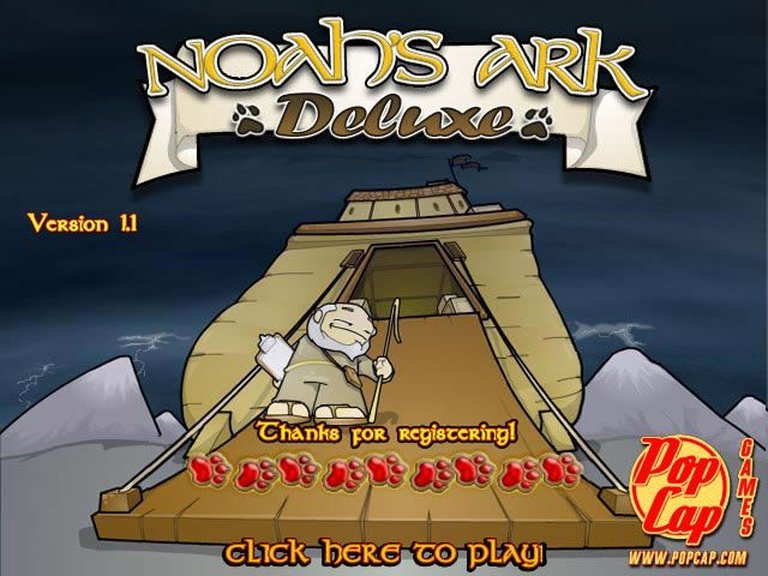
Noah’s Ark Deluxe is a puzzle game inspired by the biblical flood story, where players must match pairs of animals to save them from rising floodwaters before they reach Noah’s ark. The game features three modes: Action (matching pairs with a water timer), Strategy (matching pairs that cause blocks to drop), and Puzzle (Match-3 gameplay). Players clear the board by matching identical animals via connected paths, earning points based on remaining water distance, with difficulty levels affecting water speed and animal diversity.
Gameplay Videos
Noah’s Ark Deluxe: A PopCap Puzzle Classic Revisited
Introduction
In the vast pantheon of casual gaming, few studios loom as large as PopCap Games, pioneers who transformed simple concepts into global phenomena. Among their lesser-known gems, Noah’s Ark Deluxe (2002) stands as a charming, thematically ambitious puzzle that reimagines the biblical flood narrative as a tile-matching challenge. While overshadowed by titans like Bejeweled and Zuma, this shareware title offers a fascinating case study in thematic integration, mechanical diversity, and the early 2000s puzzle boom. This review delves into the game’s creation, gameplay, and legacy, arguing that its nuanced blend of three distinct puzzle modes and cohesive narrative framing makes it an underrated entry in PopCap’s catalog—a testament to the studio’s ability to weave meaning into addictive mechanics.
Development History & Context
Emergence from PopCap’s Golden Age
Released on October 15, 2002, Noah’s Ark Deluxe emerged during PopCap’s formative period, when the studio was cementing its reputation as a master of accessible, web-born puzzle experiences. Developed entirely by an intimate six-person team—including industry veterans Jason Kapalka (game design), Richie Cresswell (programming), and Ian Livingstone (music)—the game reflected PopCap’s signature ethos: distilled, replayable gameplay with broad appeal. Kapalka, the creative force behind Bejeweled, leveraged his expertise in “match-and-clear” systems but sought to differentiate it through thematic storytelling, a rarity in the genre.
Technological Constraints & Innovations
Built for Windows as a shareware download, the game operated within the limitations of early-2000s technology. Its fixed/flip-screen visuals and real-time pacing demanded lightweight code to ensure smooth performance on modest PCs. Notably, the team utilized software libraries (via Brian Fiete) to optimize animation and collision detection, enabling fluid tile interactions without lag. The “water-rising” mechanic—where a flood meter on the left side of the screen served as a dynamic time limit—was a clever repurposing of falling-block puzzle logic, pushing players to match pairs before the deluge overwhelmed Noah’s ark.
Gaming Landscape Context
Noah’s Ark Deluxe arrived amid the casual gaming revolution, following PopCap’s breakout hit Bejeweled (2001) and preceding Zuma (2003). The puzzle genre was exploding, driven by web distribution and audience expansion beyond traditional gamers. Yet, while competitors focused on abstract mechanics, PopCap infused spiritual themes—a bold move in an era where religious content in games was largely confined to niche markets or educational titles. This positioned the game as both a commercial experiment and a cultural artifact, blending biblical storytelling with addictive gameplay for a mainstream audience.
Narrative & Thematic Deep Dive
The Ark as Storytelling Engine
Unlike most puzzle games, Noah’s Ark Deluxe grounds its mechanics in a coherent narrative. Players are cast as divine assistants tasked with matching pairs of animals (two of each species) to “rescue” them before God’s flood engulfs the earth. The water-rising meter isn’t just a timer—it embodies the impending judgment, with points awarded based on how close players keep the flood to the ark. This creates thematic tension: each successful match feels like a small act of salvation, while failure represents the world’s doom.
Characterization and Symbolism
Though devoid of traditional characters, the game’s animals serve as symbolic protagonists. Lions, elephants, and doves aren’t just tiles; they represent biodiversity and divine creation. The absence of human characters (including Noah himself) is a deliberate design choice, inviting players to project themselves into the role of a higher power, indirectly echoing Noah’s stewardship. The “Stampede Round” bonus levels further this theme, where players frantically click trios of identical animals to prevent them from being “trampled” by a rising stack—a metaphor for chaos versus divine order.
Underlying Themes
The game explores themes of stewardship, responsibility, and faith. Matching pairs requires patience and foresight, mirroring Noah’s own preparation. The Strategy mode’s mechanic of animals “dropping” and reshuffling the board after a match introduces entropy as a challenge, reflecting humanity’s struggle against disorder. Even the Puzzle mode’s Match-3 gameplay implies cosmic harmony, as creating order from chaos (via line-matches) becomes a sacred duty. While the narrative is minimalist, its integration of biblical symbolism elevates the game beyond mere diversion, making it a surprisingly thoughtful meditation on salvation and diligence.
Gameplay Mechanics & Systems
Core Mechanics: Three Modes, One Covenant
Noah’s Ark Deluxe distinguishes itself through three distinct, thematically aligned puzzle modes, each offering unique strategic depth:
-
Action Mode: The primary loop involves matching pairs of identical animals via a clear path (horizontal/vertical, no diagonals). Animals don’t need adjacency—players can click or drag any two, provided no blocks obstruct their connection. This “pathfinding” mechanic rewards spatial reasoning, while the water-rising timer creates urgency. When no moves remain, the game auto-removes animals (with point penalties), introducing risk-reward decisions: hold out for a high-scoring pair or accept a loss to continue? The periodic “Stampede Rounds” inject chaos, demanding rapid clicks to prevent a stack of identical animals from reaching the screen’s top—a nod to the biblical chaos preceding the flood.
-
Strategy Mode: Nearly identical to Action but with one critical twist: matched animals cause blocks above to “drop,” potentially freeing trapped pairs or creating new obstacles. This gravity-based element reshuffles the board dynamically, turning simple matches into chain-reaction opportunities. The absence of Stampede Rounds shifts focus from reflexes to long-term planning, as players must anticipate cascading consequences. It’s a masterclass in emergent complexity, where a single move can unravel or solidify the board’s state.
-
Puzzle Mode: A radical departure, this mode adopts the Match-3 formula popularized by Bejeweled. Players swap adjacent animals to form lines of three or more, with matches disappearing and new tiles falling from above. The flood meter is replaced by a “no moves” game-over condition, emphasizing pattern recognition over speed. While structurally simpler, it offers a meditative counterpoint to the frantic Action mode, reflecting the tranquility of the ark adrift.
Progression and Difficulty
Difficulty scales via water-speed (Action/Strategy) and animal diversity (all modes). Higher speeds intensify pressure, while more species types increase the complexity of pathfinding or pattern-matching. Shareware limitations capped progression, but the game’s replayability stemmed from its endless mode and high-score leaderboards, encouraging players to master its nuances.
UI and Controls
The interface prioritizes clarity: a fixed-screen layout displays the puzzle board, ark, and flood meter, with intuitive mouse or keyboard controls. Animal designs are instantly recognizable, and visual feedback (e.g., glowing matches) ensures responsiveness. While rudiant by today’s standards, its simplicity was a virtue, minimizing distractions and keeping focus on the core mechanics.
Innovation and Flaws
The game’s greatest innovation is its thematic integration—turning a biblical story into systemic tension. The pathfinding mechanic in Action mode was refreshingly original, offering spatial puzzles unseen in contemporaries like Super Collapse!. However, the lack of a story mode or progression beyond high scores limited long-term engagement. Additionally, the Puzzle mode’s derivative Match-3 formula felt dated even in 2002, lacking the polish of PopCap’s own Bejeweled.
World-Building, Art & Sound
Visual Direction: Vibrant and Symbolic
PopCap’s art, led by Tysen L. Henderson, employs a bright, cartoonish aesthetic that aligns with its family-friendly tone. Animals are rendered as stylized, expressive icons—lions with manes, elephants with trunks—ensuring instant recognizability. The ark itself is a constant visual anchor, rendered with warm wood textures and a dove motif, symbolizing hope against the encroaching flood. The board’s flip-screen design uses a muted background to make the animals pop, while the flood meter’s rising blue water adds dynamic tension. Though simplistic by modern standards, the art effectively distills its biblical setting into accessible, joyful imagery.
Atmosphere and Sound Design
Ian Livingstone’s soundtrack complements the visuals with gentle, looping melodies that evoke both serenity and urgency. Plink-and-plunk sound effects for matches are satisfyingly tactile, while the Stampede Rounds use frantic, escalating percussion to mirror chaos. The absence of voice acting or dialogue is deliberate, allowing players to immerse themselves in the game’s silent drama. The overall atmosphere is one of focused calm—akin to the ark itself—a bubble of order in a world unraveling.
Thematic Cohesion
The art and sound work in unison to reinforce the narrative. The flood’s visual progression (from ripples to torrential waves) and the water’s gentle lapping sounds create a palpable sense of impending doom, making each match feel like an act of defiance. Even the Puzzle Mode’s tranquil soundtrack contrasts with the frantic Action mode, subtly differentiating its gameplay loop within the shared thematic framework.
Reception & Legacy
Launch Reception: A Modest Splash
Upon release, Noah’s Ark Deluxe garnered minimal critical attention, overshadowed by PopCap’s Bejeweled and the impending Zuma. Player reviews on platforms like MobyGames averaged a lukewarm 2.5/5, with some praising its creativity but others dismissing it as a “B-tier” puzzle. As shareware, its commercial impact was modest, failing to achieve the viral success of PopCap’s flagship titles. However, it found niche appeal among Christian gamers and puzzle enthusiasts drawn to its unique theme.
Evolution of Reputation
Over time, the game’s reputation has undergone a quiet reevaluation. Retro gaming communities, such as MyAbandonware and Retrogek, highlight its “charming” and “thoughtful” take on the Noah’s Ark story, with MyAbandonware users awarding it a 4.59/5 rating based on 86 votes. Scholars of casual gaming now recognize it as an early example of “meaningful mechanics,” where gameplay and theme intertwine—a concept later explored in games like Journey or Gris. Its inclusion in PopCap’s catalog alongside masterpieces like Bejeweled has cemented its status as a cult classic, appreciated for its ambition if not its commercial triumph.
Influence and Industry Impact
While Noah’s Ark Deluxe didn’t spawn direct sequels, its influence permeates PopCap’s later work. The water-rising timer prefigures Zuma’s path-tracking mechanics, and its three-mode structure echoes the studio’s penchant for variety in titles like Chuzzle. More broadly, it demonstrated that religious themes could be handled respectfully in mainstream gaming—a precursor to games like The Beginner’s Bible series. Its legacy endures as a reminder that even minor titles can offer profound thematic cohesion, proving that the best puzzles engage both mind and soul.
Conclusion
Noah’s Ark Deluxe is a fascinating microcosm of PopCap’s early genius—a game where biblical ambition and addictive mechanics collide in imperfect harmony. Its three puzzle modes offer surprising depth, from the spatial strategy of Action Mode to the meditative calm of Puzzle Mode, all unified by a flood-rising timer that transforms salvation into a high-stakes race. While its derivative Match-3 mode and limited replayability hold it back from true greatness, its thematic integration remains exemplary, proving that even the simplest puzzles can carry weighty meaning.
In the grand arc of video game history, Noah’s Ark Deluxe may not be a pillar, but it is a cornerstone—a testament to a time when PopCap dared to infuse casual play with purpose. For players seeking a nostalgic, thoughtfully crafted puzzle—or a unique lens on an ancient tale—it remains a hidden gem, a digital ark floating atop the casual gaming deluge. Verdict: A flawed but fascinating artifact that elevates simple puzzles into meaningful journeys.