
- Release Year: 1994
- Platforms: DOS, Linux, Macintosh, Windows
- Publisher: Electronic Arts, Inc., Night Dive Studios, LLC
- Developer: Flashpoint Productions, Inc.
- Genre: Adventure
- Perspective: Third-person
- Game Mode: Single-player
- Gameplay: Graphic adventure, Point and select, Puzzle elements
- Setting: Comic book, Detective, Horror, Mystery
- Average Score: 67/100
- Adult Content: Yes
Description
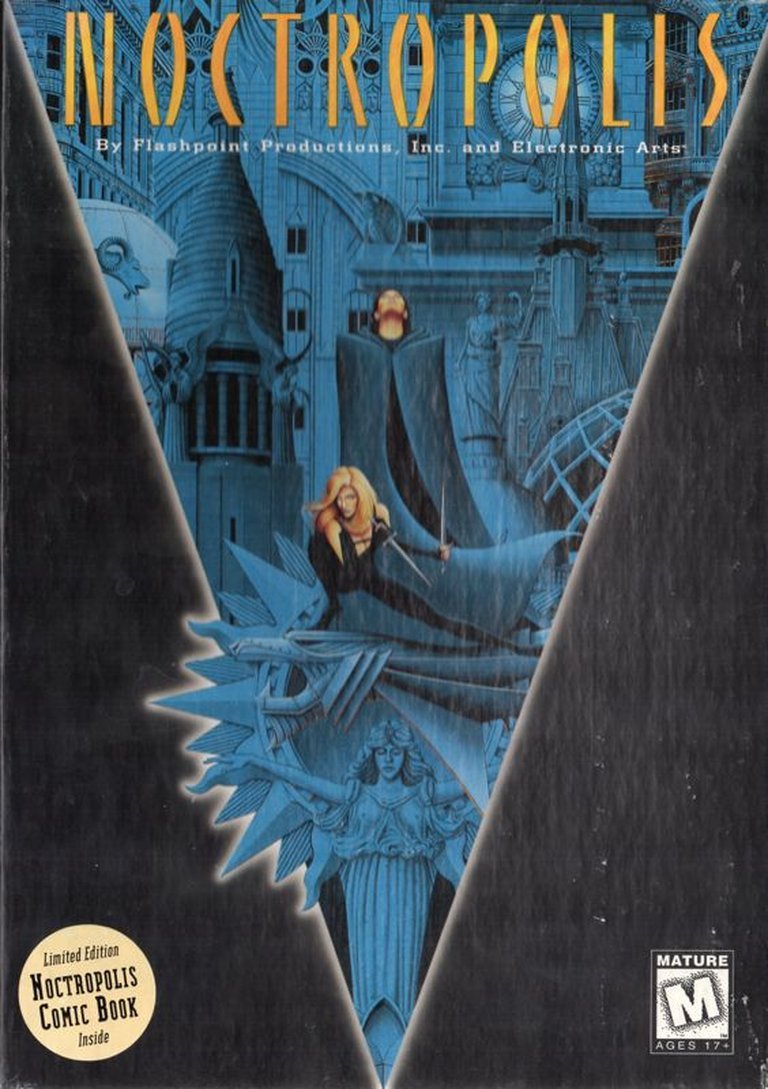
Noctropolis is a puzzle-solving adventure game set in a perpetually night-shrouded city, where Peter Grey, a comic book fan, is transported into the world of his favorite superhero, Darksheer. As Peter takes on the role of Darksheer, he must uncover the mystery behind the superhero’s disappearance and stop five escaped arch-villains from wreaking havoc. The game features a verb-based interface, live-action cutscenes, and a dark, comic-inspired narrative filled with puzzles and interactions.
Gameplay Videos
Where to Buy Noctropolis
Noctropolis Free Download
Noctropolis Guides & Walkthroughs
Noctropolis Reviews & Reception
imdb.com (50/100): Perhaps the most engaging computer game ever.
steambase.io (81/100): Noctropolis has earned a Player Score of 81 / 100.
Noctropolis: A Dark, Forgotten Gem of the FMV Adventure Era
Introduction
In the mid-1990s, the video game industry was in the throes of a multimedia revolution. The advent of CD-ROM technology allowed developers to push the boundaries of storytelling, blending live-action footage with interactive gameplay in ways previously unimaginable. Among the many titles that emerged during this era, Noctropolis stands out as a fascinating, if flawed, experiment—a game that dared to merge the aesthetics of comic books with the immersive potential of full-motion video (FMV). Developed by Flashpoint Productions and published by Electronic Arts in 1994, Noctropolis is a third-person point-and-click adventure that transports players into a gothic, perpetually night-shrouded city, where they assume the role of an unlikely hero thrust into a world of supervillains, moral ambiguity, and noir-inspired intrigue.
Noctropolis is a game of contrasts: it is visually stunning yet mechanically clunky, narratively ambitious yet thematically uneven, and boldly innovative yet hampered by the technological limitations of its time. It is a game that has cultivated a cult following over the years, praised for its atmospheric art direction and criticized for its obtuse puzzles and underdeveloped storytelling. This review seeks to explore Noctropolis in exhaustive detail, examining its development history, narrative depth, gameplay mechanics, artistic achievements, and lasting legacy. Through this analysis, we will argue that Noctropolis is a pivotal, if imperfect, artifact of the FMV adventure genre—a game that encapsulates both the promise and the pitfalls of its era.
Development History & Context
The Studio and the Vision
Noctropolis was the brainchild of Brent Erickson and Shaun Mitchell, two visionaries who sought to merge the worlds of comic books and interactive storytelling. Erickson, a seasoned game developer with experience on titles like Tex Murphy: Mean Streets and Martian Memorandum, brought a wealth of technical expertise to the project, particularly in the integration of live-action video with digital environments. Mitchell, on the other hand, was a comic book enthusiast and art director whose passion for illustrated narratives shaped the game’s distinctive visual style. Together, they founded Flashpoint Productions, an independent studio based in Olympia, Washington, with the goal of creating a game that would push the boundaries of the adventure genre.
The duo’s vision for Noctropolis was deeply influenced by the dark, noir-infused tales of Batman and other superhero comics of the era. They sought to create a game that would immerse players in a living comic book, blending the gothic aesthetics of classic detective stories with the larger-than-life drama of superhero lore. This ambition was further fueled by the CD-ROM boom of the early 1990s, which provided the storage capacity necessary for high-quality video, audio, and artwork—elements that would become central to Noctropolis’s identity.
Technological Constraints and Innovations
The development of Noctropolis was not without its challenges. The mid-1990s were a time of rapid technological advancement, but the tools available to developers were still rudimentary by modern standards. The game’s engine was built entirely in x86 assembly language, a low-level programming language that allowed for optimized performance but limited portability. This decision was necessitated by the lack of off-the-shelf engines capable of handling the game’s ambitious blend of FMV and 2D adventure elements.
One of the most significant technical hurdles was the integration of live-action footage with hand-painted backgrounds. The team employed a technique known as chromakeying, which involved filming actors against a green screen and then compositing them into the game’s digitized environments. This process was labor-intensive and required custom software written by Erickson himself. The backgrounds, meanwhile, were created using traditional art techniques—gouache, acrylic paints, and colored pencils—before being scanned into the game. This hybrid approach resulted in a visual style that was both striking and inconsistent, with the digitized actors often clashing with the more stylized comic-book aesthetics of the backgrounds.
The Gaming Landscape of 1994
Noctropolis was released at a time when the adventure game genre was undergoing a significant transformation. The success of titles like Myst (1993) and The 7th Guest (1993) had demonstrated the commercial viability of CD-ROM-based games, leading to a surge in FMV adventures. However, the genre was also becoming increasingly crowded, with many titles struggling to stand out amid the noise. Noctropolis entered this competitive landscape with a unique selling point: its blend of comic-book aesthetics and superhero themes, which set it apart from the more conventional horror and mystery titles of the era.
The game’s release in December 1994 coincided with the height of the “Dark Age of Comic Books,” a period marked by gritty, morally ambiguous storytelling and a focus on antiheroes. This cultural context is reflected in Noctropolis’s narrative, which explores themes of redemption, identity, and the blurred lines between heroism and villainy. The game’s mature themes—including violence, nudity, and sexual content—were also a product of its time, as developers sought to push the boundaries of what was acceptable in video games.
Narrative & Thematic Deep Dive
Plot Summary
Noctropolis follows the story of Peter Grey, a middle-aged, recently divorced bookstore owner who finds solace in the adventures of his favorite comic book hero, Darksheer. One evening, while reading the latest issue of the Darksheer series, Peter receives a mysterious package from a courier. The package contains a golden coin and a comic book that transports him into the world of Noctropolis, a gothic metropolis perpetually shrouded in darkness due to a lingering volcanic ash cloud. Upon arriving in Noctropolis, Peter learns that the original Darksheer has disappeared, leaving the city vulnerable to a cadre of supervillains who have been freed from imprisonment by the enigmatic Flux.
As Peter assumes the mantle of Darksheer, he must navigate the city’s labyrinthine streets, confront its villainous inhabitants, and unravel the conspiracy behind the original Darksheer’s disappearance. Along the way, he is aided by Stiletto, a fiercely loyal sidekick with a complicated past, and a cast of eccentric allies, including a psychic consultant and a UFO expert. The narrative culminates in a climactic battle against Flux, who is revealed to be the original Darksheer, now corrupted by his addiction to a substance known as Liquidark.
Themes and Motifs
Noctropolis is a game that grapples with a variety of complex themes, many of which reflect the cultural and artistic trends of the mid-1990s. At its core, the game is an exploration of identity and transformation, as Peter Grey—a disillusioned everyman—is thrust into a world where he must become a hero. This theme is reinforced by the game’s comic-book setting, which serves as a metaphor for the power of fantasy and escapism. Peter’s journey is one of self-discovery, as he learns to embrace his inner hero and confront the challenges of his new reality.
The game also delves into the moral ambiguity of heroism, particularly through its portrayal of the original Darksheer. The revelation that Darksheer has succumbed to the corrupting influence of Liquidark—a substance that grants him power but also consumes his soul—serves as a cautionary tale about the dangers of unchecked ambition. This theme is further explored through the game’s villains, many of whom are motivated by a desire for power, revenge, or control. The Succubus, for example, is a vampiric demoness who preys on the weak, while Master Macabre is a sadistic surgeon who derives pleasure from inflicting pain.
Another prominent theme in Noctropolis is the tension between light and darkness. The city of Noctropolis is perpetually shrouded in darkness, a metaphor for the moral ambiguity that permeates its streets. The game’s climax, in which Flux seeks to activate the Sun Spire and end the city’s eternal night, serves as a symbolic battle between these two forces. The original Darksheer’s transformation into Lumisheer—a being of light—further underscores this theme, as he seeks to impose his will on the city through the power of illumination.
Characters and Dialogue
The characters of Noctropolis are a mixed bag, with some standing out as memorable and others feeling underdeveloped. Peter Grey, the protagonist, is a relatable everyman whose journey from disillusionment to heroism is compelling, if somewhat predictable. His interactions with Stiletto, his sidekick, are particularly noteworthy, as they explore themes of trust, loyalty, and the complexities of human relationships. Stiletto herself is a fascinating character, a former supervillain who has turned to the side of good but still struggles with her past. Her use of “feminine charm” to distract enemies is a contentious aspect of her characterization, as it reinforces gender stereotypes and feels out of place in a game that otherwise seeks to subvert expectations.
The game’s villains, meanwhile, are a colorful and eclectic bunch, each with their own unique motivations and personalities. Flux, the primary antagonist, is a shadowy mastermind whose origins remain shrouded in mystery, adding an air of intrigue to the narrative. The Succubus, with her vampiric allure, is a seductive yet lethal foe, while Tophat, an eccentric magician, brings a touch of theatricality to the proceedings. Drealmer, a telepathic criminal who preys on his victims’ nightmares, is particularly unsettling, as his powers allow him to manipulate reality in ways that blur the line between fantasy and horror.
The dialogue in Noctropolis is a mixed bag, with some exchanges feeling natural and others coming across as stilted or overly melodramatic. The game’s use of live-action footage for conversations and cutscenes adds a layer of immersion, but the performances of the actors are uneven, with some delivering convincing portrayals and others feeling wooden or over-the-top. The game’s mature themes—including nudity, violence, and sexual content—are handled with a mix of subtlety and heavy-handedness, with some moments feeling earned and others coming across as gratuitous.
Gameplay Mechanics & Systems
Core Gameplay Loop
Noctropolis is a third-person point-and-click adventure game that follows many of the conventions of the genre. Players control Peter Grey as he explores the city of Noctropolis, interacting with characters, solving puzzles, and uncovering clues to advance the story. The game’s core gameplay loop revolves around exploration, inventory management, and dialogue-driven interactions, with players using a verb-based menu interface to perform actions such as examining objects, talking to characters, and using items.
The game’s interface is one of its most distinctive features, with a right-click menu that displays a series of commands embedded in an inverted triangle. This design choice is both innovative and frustrating, as it allows for a wide range of actions but can be cumbersome to navigate. The game’s lack of object highlighting—whereby items of interest are not visibly marked until the player clicks on them—adds an additional layer of challenge, as players must often engage in pixel-hunting to find crucial objects.
Puzzle Design
The puzzles in Noctropolis are a mixed bag, with some feeling clever and others coming across as obtuse or illogical. The game’s inventory-based puzzles require players to collect and combine items to overcome obstacles, such as using a makeshift spear to defeat a robotic guard or employing a wire to electrocute a hostile gargoyle. These puzzles often involve sequences of actions that must be performed in a specific order, with little guidance provided to the player.
Dialogue-driven interactions are another key component of the game’s puzzle design, with players using branching conversation trees to gather information and influence the outcomes of their encounters. These interactions are facilitated by a honeycomb-style interface, which allows players to select from a range of topics to discuss with non-player characters. The choices made in these conversations can have significant consequences, affecting the player’s relationships with other characters and the overall progression of the story.
Exploration puzzles, meanwhile, require players to navigate the city’s environments, discovering hidden objects and manipulating their surroundings to advance. These puzzles often involve pixel-hunting for near-invisible interactables, such as loose fence spars or secret passages, which can be frustrating for players who are not accustomed to the genre’s conventions.
Combat and Character Progression
Noctropolis is not a combat-heavy game, but it does feature a handful of encounters in which Peter must confront the city’s villains. These encounters are typically scripted events, with the outcome determined by the player’s ability to solve puzzles or make the correct dialogue choices. The game’s lack of traditional combat mechanics is a deliberate design choice, as it emphasizes the protagonist’s reliance on wit and ingenuity rather than brute force.
Character progression in Noctropolis is minimal, with Peter’s abilities and inventory remaining largely static throughout the game. The player’s primary means of advancement is through the acquisition of new items and the uncovering of new information, which allows them to access previously inaccessible areas and solve increasingly complex puzzles.
User Interface and Controls
The user interface in Noctropolis is functional but far from intuitive. The game’s verb-based menu system, while innovative, can be cumbersome to navigate, particularly for players who are not familiar with the genre’s conventions. The lack of object highlighting and the game’s reliance on pixel-hunting further compound these issues, making the gameplay experience feel more frustrating than immersive at times.
The game’s controls are similarly clunky, with movement and interaction often feeling sluggish and imprecise. The game’s use of live-action footage for conversations and cutscenes adds a layer of immersion, but the transitions between these sequences and the game’s static environments can be jarring, disrupting the flow of the gameplay.
World-Building, Art & Sound
Setting and Atmosphere
The city of Noctropolis is one of the game’s greatest strengths, a sprawling, gothic metropolis that feels alive with detail and atmosphere. The city’s perpetual darkness—caused by a lingering volcanic ash cloud—creates a sense of oppressive isolation, reinforcing the game’s themes of moral ambiguity and existential dread. The city’s architecture is a mix of gothic and art nouveau styles, with towering skyscrapers, gargoyle-adorned facades, and labyrinthine streets that evoke a sense of mystery and danger.
The game’s environments are rendered in stunning detail, with hand-painted backgrounds that blend comic-book aesthetics with a noir-inspired sensibility. The city’s key locations—such as the Noctropolis Police Department, the ancient mausoleums, and the hidden villain lairs—are all richly realized, contributing to the game’s immersive atmosphere. The perpetual night amplifies the sense of isolation and threat, with under-city ruins hinting at past cataclysms that have left the metropolis in decay.
Visual Direction
The visual direction in Noctropolis is a testament to the game’s ambition, blending hand-drawn comic-book aesthetics with digitized live-action footage. The game’s backgrounds are a particular highlight, with their intricate details and moody lighting creating a sense of depth and atmosphere. The digitized characters, while often clashing with the more stylized backgrounds, add a layer of realism to the proceedings, particularly in the game’s cutscenes and dialogue sequences.
The game’s use of different graphic styles—such as the comic-book panels that appear at the beginning of the game—further enhances its visual appeal. These panels, which are rendered in a cartoonish style, provide a stark contrast to the game’s more realistic environments, reinforcing the game’s themes of fantasy and escapism.
Sound Design and Music
The sound design in Noctropolis is a mixed bag, with some elements feeling immersive and others coming across as underwhelming. The game’s soundtrack, composed by Ron Saltmarsh and Andy Warr, is a highlight, with its atmospheric orchestral pieces evoking a sense of noir tension and gothic horror. The music is particularly effective in the game’s more dramatic moments, such as the climactic battle against Flux, where it heightens the emotional impact of the scene.
The game’s sound effects, meanwhile, are more hit-or-miss. While some—such as the metallic clanks of environmental interactions—add to the game’s immersive atmosphere, others feel underwhelming or out of place. The game’s voice acting is similarly uneven, with some performances feeling convincing and others coming across as wooden or over-the-top.
Reception & Legacy
Critical Reception
Upon its release in 1994, Noctropolis received mixed reviews from critics. While many praised the game’s atmospheric visuals and ambitious storytelling, others criticized its obtuse puzzles, clunky interface, and uneven performances. Charles Ardai of Computer Gaming World commended the game’s sumptuous graphics and dark, moody atmosphere but faulted its simplistic interface and juvenile shock value. A reviewer for Next Generation, meanwhile, praised the game’s story, puzzles, and gothic mood but noted flaws such as silly dialogue and illogical challenges.
The game’s reception was further complicated by its mature themes, which included nudity, violence, and sexual content. While some critics appreciated the game’s willingness to push boundaries, others felt that these elements were gratuitous and detracted from the overall experience.
Commercial Performance
Noctropolis was released during the height of the CD-ROM revolution, a period marked by explosive growth in multimedia titles. The game’s production involved substantial costs, including the hiring of actors, custom prosthetics, and hand-painted backgrounds, which strained the budgets of the era. While precise sales figures for Noctropolis have not been publicly disclosed, the game continued to sell well through “classic sales” channels in the late 1990s, indicating sustained long-term interest.
Legacy and Influence
Despite its mixed reception, Noctropolis has cultivated a cult following over the years, praised for its atmospheric art direction and criticized for its obtuse puzzles and underdeveloped storytelling. The game’s blend of comic-book aesthetics and FMV innovation has made it a notable artifact of the mid-1990s adventure game scene, and its themes of identity, transformation, and moral ambiguity continue to resonate with players.
In 2015, Night Dive Studios acquired the rights to Noctropolis and released an enhanced edition for modern platforms. This re-release featured a native port rewritten in C++ from the original assembly code, with improvements such as a remastered soundtrack, bug fixes, and modern compatibility updates. The enhanced edition has allowed new audiences to experience the game’s unique blend of atmosphere and innovation, ensuring that Noctropolis remains a relevant and influential title in the history of adventure games.
Conclusion
Noctropolis is a game of contrasts—a visually stunning yet mechanically clunky adventure that dares to blend the aesthetics of comic books with the immersive potential of full-motion video. It is a game that encapsulates both the promise and the pitfalls of its era, offering a unique and ambitious experience that is as frustrating as it is captivating.
At its best, Noctropolis is a masterclass in atmospheric world-building, with its gothic cityscape and noir-inspired storytelling creating a sense of immersion that is rare in adventure games. The game’s blend of comic-book aesthetics and FMV innovation is a testament to the creativity and ambition of its developers, who sought to push the boundaries of what was possible in interactive storytelling.
At its worst, Noctropolis is a victim of its own ambition, with obtuse puzzles, clunky controls, and uneven performances detracting from the overall experience. The game’s mature themes, while bold for their time, often feel gratuitous and underdeveloped, adding little to the narrative beyond shock value.
Despite its flaws, Noctropolis remains a pivotal artifact of the FMV adventure genre—a game that dared to dream big and, in doing so, left an indelible mark on the history of video games. Its legacy is one of innovation and experimentation, a reminder of a time when developers were willing to take risks and push the boundaries of what was possible. For those willing to overlook its shortcomings, Noctropolis offers a unique and rewarding experience—a dark, forgotten gem of the FMV adventure era.
Final Verdict: 7.5/10 – A Flawed but Fascinating Experiment in FMV Adventure Gaming