
- Release Year: 1996
- Platforms: PlayStation 3, PlayStation, PS Vita, PSP, SEGA Saturn, Windows
- Publisher: GungHo Online Entertainment, Inc., Micro Cabin Corp.
- Developer: Micro Cabin Corp.
- Genre: Action
- Perspective: Diagonal-down
- Game Mode: Single-player
- Gameplay: Arcade, Block-pushing, Color-matching, Puzzle elements
Description
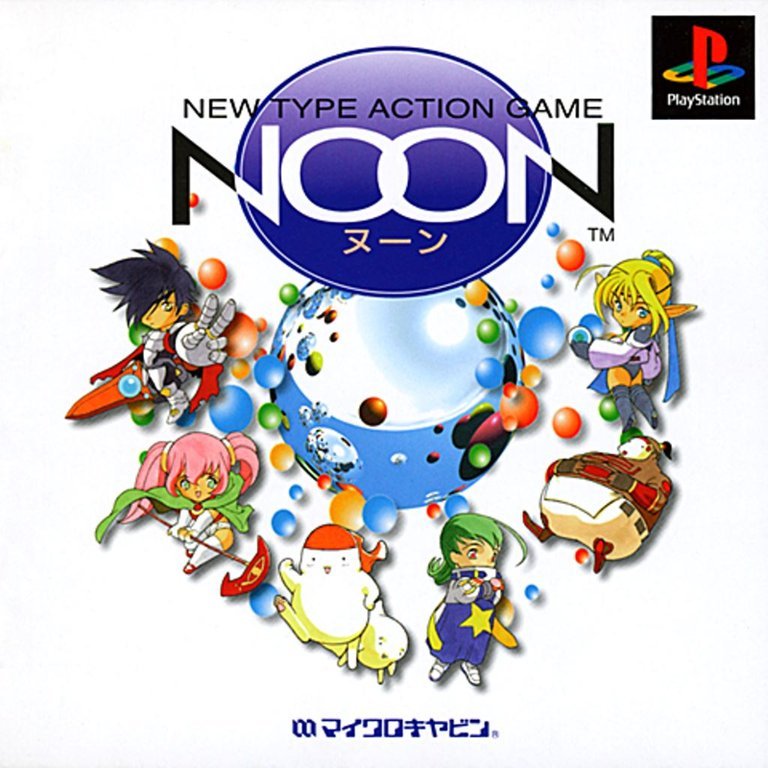
NOON: New Type Action Game is a competitive action puzzle title that combines the color-matching mechanics of Puyo Puyo with the block-pushing elements of Pengo. Players control characters on a diagonal-down, fixed-screen board with anime/manga visuals, pushing ‘Noon’ gems to line up matches, charge special attacks, and defend their home areas from being filled, across modes including a story campaign, 2-player versus, and solo score attack.
Gameplay Videos
NOON: New Type Action Game Reviews & Reception
lunaticobscurity.blogspot.com : I was having a pretty good time.
NOON: New Type Action Game Cheats & Codes
PlayStation NTSC-J
Enter codes using GameShark
| Code | Effect |
|---|---|
| 800D7EC8 00C8 | Infinite energy Player 1 |
| 800D7ECC 0000 | Enemy has no energy (Always lose) |
NOON: New Type Action Game: A Deep Dive into a Cult Classic Puzzle-_action Hybrid
1. Introduction: The Elegant Enigma of the Noon Gem
In the crowded pantheon of 1990s puzzle games, dominated by titans like Tetris, Puyo Puyo, and Columns, there exists a fascinating, nearly forgotten outlier: NOON: New Type Action Game. Released initially for Japanese PCs in 1996 and later ported to the PlayStation and SEGA Saturn, NOON is not merely another entry in the trend but a deliberate, idiosyncratic fusion of genres that defies easy categorization. Its very title, promising a “New Type Action Game,” hints at an ambition that outstrips its modest commercial footprint. This review argues that NOON is a significant case study in ’90s Japanese game design—a title that synthesized competitive puzzle mechanics with character-driven action, wrapped in a distinct anime aesthetic, and shadowed by a compelling development mystery. While it never achieved mainstream success, its innovative hybrid systems, coupled with its enigmatic origins, secure its place as a cult classic and a testament to the creative risks taken during the PlayStation/Saturn era’s golden age of experimental gaming.
2. Development History & Context: A Prototype’s Long Road to Consoles
The Studio and the Visionary
NOON was developed by Micro Cabin Corp., a Japanese studio with a varied portfolio spanning RPGs (Riglord Saga), action games, and adult titles. The key figure is Kōji Ōno, credited as the original creator. The most intriguing piece of its history, revealed through posthumous research by preservationists, is that the core concept for NOON existed three years prior to its official 1996 release. The pre-game boot screen proudly displays “Kouji Oono Original Version 1993”, a dedication that points to a prototype or earlier iteration.
The 1993 Prototype and Its Disappearance
The mystery, as meticulously chronicled by retro-gaming blogger “Jonny” of Lunatic Obscurity, is that no known commercial release of a NOON-predecessor exists for any console. diligent searching by the retro community eventually led to the identification of this 1993 original as “PC-9801『カラー君だ!’ (Karā-kun Da!, or “It’s You, Color-kun!”), a PC-9801 (a dominant Japanese PC platform) game by Kōji Ōno. This connects the game to the rich ecosystem of Japanese “microcomputer” (PC-98, X68000) gaming, a scene far less documented in the West than console games. The long gap between 1993 and the 1996 Windows/1998 console release suggests NOON was either a passion project refined over years or a smaller-scale PC title that Micro Cabin saw potential in for a mainstream console audience. This origin story transforms NOON from a mere puzzle game into an artifact of cross-platform evolution in 90s Japan.
Technological Context and the Puzzle Boom
The game’s 1996-1998 release window places it at the tail end of the great Puyo Puyo/Tetris clone boom but during the peak of the “fighting puzzle” genre (exemplified by Super Puzzle Fighter II Turbo). The jump to PlayStation and Saturn allowed for:
* Anime-cutscene presentation: Fully voice-acted story mode cutscenes (noted in credits for voice actors like Daisuke Gōri and Junko Noda) were a console staple.
* Enhanced audiovisuals: Colorful, detailed sprites and a CD-quality soundtrack (the PS1/Saturn version includes 27 audio tracks).
* 4-player support: Utilizing the Saturn’s MultiTap and PlayStation’s Multi-Tap, a feature highlighted in the game’s marketing (“playable up to 4 people”).
The “diagonal-down” perspective and “fixed/flip-screen” arena were practical choices for the era, allowing clear visibility of both players’ home grids—a critical design necessity.
3. Narrative & Thematic Deep Dive: Minimalist Story, Maximum Character
NOON‘s narrative is not its primary draw, but it provides essential context and personality. The game features six playable characters, each with their own story mode. According to the PS1/Saturn database entries, these are:
* Rimuria
* Gakimaru
* Color Colore
* Jerayre
* Rigamine
* Rongo Rongo
The official description states the campaign is about “action against the hero of six fights,” suggesting a classic tournament arc. The story is delivered through anime-style cutscenes with voice acting, a significant production value for a puzzle game. Themes appear to revolve around competition, elemental or color-based powers, and personal rivalries. The whimsical, fantasy-themed character names and the core mechanic of “Noon” gems fighting imply a world where color itself is a weapon. While the script itself isn’t available in the source material, the presence of “Scenario Support” credits (Tetsuya Seta, Miyuki Yamada) indicates a dedicated effort to give each fighter a personality and motivation, aligning with the era’s trend of giving even puzzle game avatars distinct identities (cf. Puzzle Fighter‘s cast). The narrative serves as a framework for the mechanics, framing each match as a character-driven duel where the “Noon” gems are the manifestation of their power.
4. Gameplay Mechanics & Systems: The Crucible of Action and Puzzle
This is where NOON truly justifies its “New Type” moniker. It creates a tense, active versus puzzle experience that merges two seemingly disparate genres: Puyo Puyo and Pengo.
The Core Arena and Win Condition
- The Board: A single, shared, isometric (diagonal-down) arena. Crucially, each player has a designated “home area”—a rectangular grid (blue for Player 1, green for Player 2, as observed in the blog playthrough) at their end of the screen.
- The Objective: Fill the opponent’s home grid completely with “Noon” gems or “garbage” (Ojama). When an opponent’s grid is entirely full, a 10-second timer begins. If it reaches zero, you win. If the opponent clears space before it expires, the timer stops and must be refilled to resume. This creates a dynamic, back-and-forth siege warfare, not a slow build-up of garbage.
The Two Methods of Clearing: “Squashing” and “Smashing”
As articulated perfectly in the Lunatic Obscurity review, NOON has two complementary systems:
1. Smashing (The Puzzle Mechanic): This is the Puyo Puyo lineage. Line up 3 or more gems of the same color in a straight line (horizontal, vertical, or diagonal—this is implied by “straight line” and standard for the genre). Then, initiate a melee attack (Square or Circle button) to destroy the chain. This sends “Ojama” (garbage blocks) to the opponent’s grid. A “Rainbow” or “Multi” gem is the wild card, allowing it to complete a chain with any single other color.
2. Squashing (The Action Mechanic): This is the Pengo influence. You can physically push or “kick” any gem (and later, garbage blocks) around the arena with your character. If you push a gem or block against a wall or another immovable object and hold it for a moment, it “squishes” and disappears. This is a direct, manual way to clear your own grid or disrupt the opponent’s layout.
The Special Meter and Character Abilities
Both Smashing (clearing chains) and Squashing (pushing to walls) charge a shared Special Meter. When full, pressing the X Button unleashes a character-specific Super Attack. The blog notes the variety: some spawn same-colored gems for a set-up, some spawn rainbows, some flood the opponent with garbage. This adds a layer of strategic fortification and surprise, making each of the six characters play differently—a significant depth for a puzzle game.
Additional Modes and Boss Fights
- Story Mode: Six single-player campaigns, each ending with a boss fight.
- VS Mode: 2-player (and with Multi-Tap, 4-player) competitive mode.
- Score Attack: Solo endurance.
- Tutorial Mode: Essential for mastering the dual systems.
- Boss Fights: The blog mentions a variant where the opponent has a health bar instead of a grid. Damage is dealt by “Smashing” gems, showing the system’s adaptability to different win conditions.
Innovation and Flaws
- Innovation: The seamless blend of active character movement (Pengo) with chain-reaction puzzle clearing (Puyo Puyo) was novel. The win condition based on grid saturation and a refillable timer creates relentless pressure. The Special Meter charging from both puzzle and action mechanics beautifully unifies the two playstyles.
- Potential Flaws: The system is complex. New players must learn to push gems, set up chains, and manage a character in real-time. The diagonal perspective, while clear, might feel awkward. The balance of the six unique Super Attacks is unknown without extensive play, but it suggests a healthy meta-game.
5. World-Building, Art & Sound: A Feast for the Senses
NOON is a masterpiece of 90s anime aesthetic applied to a puzzle framework.
* Visual Direction: The game employs vibrant, high-color pixel art. Character sprites are detailed and expressive during attacks and cutscenes. The arena backgrounds are fantastical and busy, fitting the “fantasy theme” from the PSX Data Center. The main menu, described as “a big cog-powered machine thing,” is a memorable piece of interactive art that sets a tone of intricate, clockwork-like mechanics. The “fixed/flip-screen” nature means each arena is a beautifully composed diorama.
* Art Style: Fits squarely in the “Anime/Manga” category. The six characters reflect common archetypes (magical girls, warriors, etc.) with colorful, exaggerated designs. The “Noon” gems themselves have a glossy, gem-like appearance.
* Sound Design: The use of 27 Red Book audio tracks on the CD-ROM means a full, dynamic soundtrack. It likely shifts between calm menu music, tense during play, and dramatic for story cutscenes and super moves. Sound effects for gem pushing, squashing, chain reactions, and super attacks are crucial for gameplay feedback and are given prominence by the audio track count. The voice acting in cutscenes adds a layer of production value rare for puzzle games, selling the character rivalries.
These elements do more than decorate; they sell the fantasy that you are not just moving gems, but commanding a magical avatar in a color-based duel. The presentation makes the complex mechanics feel heroic and consequential.
6. Reception & Legacy: Obscurity and a Cult Reappraisal
Contemporary Reception
Critical reception was extremely limited but positive. The only cited critic review is from SuperGamePower (a major Brazilian magazine), which awarded the PlayStation and Saturn versions an 80% score. The review’s tagline, as translated, states: “A good head and patience are two indispensable things for those who want to do well in Noon—a strategy game where the goal is to fill the enemy’s territory with little balls.” This accurately identifies the core skill set: strategic depth (cabeça boa) and psychological endurance (paciência). The game was a Japan-exclusive release on console, severely limiting its Western footprint. Its high current eBay price (~$360 for a new Saturn copy) reflects its scarcity and cult status.
Evolution of Reputation
For two decades, NOON existed in a state of near-total obscurity outside Japan. Its reputation was built on:
1. Scattered Database Listings: MobyGames, Segaretro, etc., listed it with sparse details.
2. The “Kōji Ōno 1993” Mystery: The pre-title screen credit fueled speculation and curiosity among preservationists.
3. The “Lunatic Obscurity” Breakthrough: The 2020 blog post was pivotal. It provided the first comprehensive English-language gameplay analysis, clarified the mechanics (“squashing” vs. “smashing”), and, most importantly, solved the mystery by linking the 1993 copyright to the PC-9801 game “Karā-kun Da!” This transformed NOON from an obscure title into a game with a documented,quirky development history—a prototype refined over half a decade.
Influence and Industry Place
NOON likely had no direct, major influence on the mainstream puzzle genre. Its complexity and Japan-exclusivity kept it from becoming a trendsetter like Puzzle Fighter. However, its legacy is in experimental hybridization:
* It demonstrates an early attempt to inject real-time character action into a genre increasingly dominated by passive well-fillers.
* Its “grid-saturation” win condition is a fascinating alternative to “top-out” or “health depletion.”
* It stands as a curation of 90s Micro Cabin’s capabilities—a studio willing to support a niche, mechanically dense project with full anime production values.
The 2018 digital re-releases on PSP, PS3, and PS Vita (via GungHo) confirm that the game has a dedicated enough following (likely within Japan’s retro gaming community) to warrant preservation on modern platforms, finally making it accessible to a global audience with emulation or imported hardware.
7. Conclusion: AForgotten Gem of Hybrid Design
NOON: New Type Action Game is not a lost masterpiece that reshaped the industry. It is, however, an undeniably expertly crafted and fiercely inventive cult title that deserves recognition. Its genius lies in the elegant, tension-filled synthesis of Pengo‘s physical block-pushing and Puyo Puyo‘s color-matching chains, all governed by a desperate race to flood the opponent’s home grid. The addition of character-specific super moves elevates it from a pure puzzle game to an action-puzzle fighter.
Its historical value is twofold: first, as a prime example of the PlayStation/Saturn era’s creative diversity, where even puzzle games were lavished with anime cutscenes and CD soundtracks. Second, and more compellingly, as a case study in game preservation and de-mystification. The journey from a mysterious 1993 PC-9801 prototype (Karā-kun Da!) to a 1998 console release, and finally to digital re-release in 2018, mirrors the journey of countless Japanese microcomputer games: obscurity, rediscovery, and gradual appreciation by a dedicated community.
The final verdict is this: NOON is a brilliantly designed, deeply satisfying, and historically intriguing relic. Its mechanics are a fresh take on versus puzzling even today, its presentation is bursting with 90s anime charm, and its backstory is a fascinating detective story in itself. For historians and connoisseurs of puzzle games, it is an essential, if hard-to-acquire, piece of the puzzle—a true “New Type” that existed in its own brilliant, colorful bubble, waiting decades for the world to catch up and understand its intricate, gem-filled depths.