
- Release Year: 2015
- Platforms: Android, Linux, Macintosh, Nintendo Switch, PlayStation 4, Windows, Xbox One
- Publisher: Devolver Digital, Inc., Team17 Digital Limited
- Developer: Roll7
- Genre: Action
- Perspective: Side view
- Game Mode: Single-player
- Gameplay: Arcade, Tactical shooter
- Setting: Europe
- Average Score: 80/100
Description
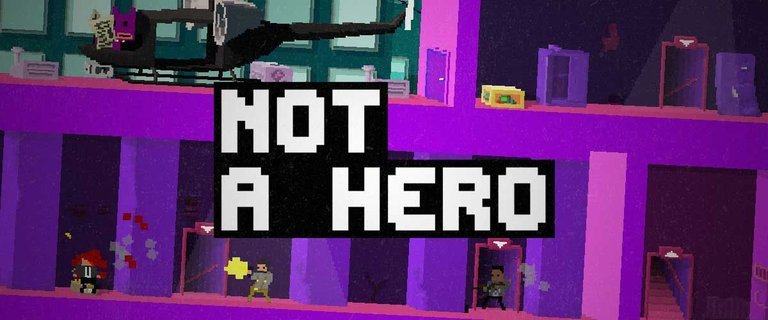
Not a Hero is a single-player 2D side-scrolling shooter with cover-based mechanics, set in a crime-ridden city where players take on the role of vigilante mercenaries hired by BunnyLord, an anthropomorphic rabbit running for mayor. The objective is to dismantle criminal gangs, eliminate drug cartels, and erase corruption through tactical missions in multi-floor buildings, using a roster of characters with unique abilities to boost BunnyLord’s approval ratings.
Gameplay Videos
Where to Buy Not a Hero
Not a Hero Free Download
Not a Hero Cracks & Fixes
Not a Hero Mods
Not a Hero Guides & Walkthroughs
Not a Hero Reviews & Reception
metacritic.com (80/100): A bright and fun side-scroller that you can lose hours in, or just play for a few minutes – either way, it will keep you coming back.
opencritic.com (80/100): Roll7’s 2D shooter ‘Not A Hero’ may occasionally frustrate, but nonetheless offers a fantastic, fluid and vibrant indie challenge full of bizarre humor.
Not a Hero: A Ruthlessly Satirical Masterclass in 2¼D Mayhem
Introduction: Ballots, Bullets, and a Purple Rabbit
In the crowded annals of indie shooters, few titles premise themselves on such a gloriously unhinged core concept as Roll7’s Not a Hero. Here is a game where the ultimate authority figure is BunnyLord, a time-traveling, anthropomorphic purple rabbit from 2048, whose plan to avert an alien apocalypse hinges on a single, brutal strategy: get elected mayor of a crime-ridden British analog by any means necessary. The player, as his newly hired “campaign manager” and executioner, must mow through gangsters, yakuza, and corrupt officials in a whirlwind of pixelated carnage, all in the name of boosting poll numbers. This is not a game about heroism in any traditional sense; it is a vicious, clever, and exhaustingly funny deconstruction of political posturing, violent entertainment, and the very mechanics of cover shooters. With its tight, demanding gameplay, a cast of memorably unhinged characters, and a satirical edge that cuts deeper than its absurd surface suggests, Not a Hero stands as a cult classic that defies easy categorization. This review will argue that while the game’s brevity and occasional design friction prevent it from achieving the timeless status of its spiritual cousin OlliOlli, its fearless commitment to its own chaotic vision and its innovative “2¼D” tactical framework cement it as a pivotal, if flawed, milestone in the indie action genre of the 2010s.
Development History & Context: From Clickteam Prototype to Devolver Darling
Not a Hero emerged from the fertile, DIY spirit of the British indie scene, specifically from the London-based studio Roll7, which had already garnered significant attention and credibility with the critical darling OlliOlli (2014). The project originated not as a grand commercial venture, but as “Ur Not a Hero,” a free prototype created by studio director and lead programmer John Ribbins in 2013. Ribbins, drawing from a personal “game list” of ideas conceived in 2012 (the same list that birthed OlliOlli), fused mechanics from three of his earlier experimental projects: the core cover-shooting from Ur Not a Hero, the indoor level layout from Jeffrey Archer, and BunnyLord’s procedurally generated, delightfully nonsensical dialogue from Hackathor.
This prototype DNA is crucial to understanding the final product. Not a Hero is, at its heart, a single, brilliantly executed idea—a 2D side-scroller with a functional cover system—expanded into a full commercial release. The technological engine, Clickteam Fusion 2.5, was a logical choice for a small team focused on 2D sprites and animation, but the game’s most distinctive visual feature, the “2¼D” or ISO-Slant perspective, was a bespoke solution. As detailed in multiple sources, artist Jake Hollands worked with the ISO-Slant add-on to create a pseudo-isometric view where characters could move between foreground and background planes, adding a layer of tactical depth and a unique visual signature. This was the first game to employ the technology, a testament to Roll7’s scrappy ingenuity. Hollands’ self-taught pixel art style, which he learned in a week before his interview, gives the game its vibrant, chunky, and intentionally “rough-around-the-edges” charm—a conscious rejection of overly polished indie aesthetics in favor of something with more “character,” even if the artist himself later expressed a desire to move beyond it.
The partnership with publisher Devolver Digital was a perfect match. Devolver, known for its savvy marketing of unorthodox, violent, and satirical indie titles (from Hotline Miami to Shadow Warrior), understood how to package Roll7’s crude genius. Their marketing was characteristically sharp, including the creation of a viral @VoteBunnyLord Twitter account that spewed politically charged, absurdist commentary, blurring the lines between game promotion and performance art. The announcement “hack” by the game’s antagonists, leading to a demo release, was another piece of meta-marketing that framed the game’s chaotic energy as part of its narrative fabric.
The development timeline was not without hiccups. A deliberate one-week delay was announced so Hollands could upgrade the game from 30 FPS to a buttery-smooth 60 FPS, a decision that speaks volumes about the team’s priority on gameplay feel and responsiveness—the lifeblood of any action game. Ports followed a standard indie lifecycle: PC (May 2015), Linux/macOS (October 2015), PlayStation 4 (February 2016), and an “Super Snazzy Edition” for Xbox One (May 2016) and Nintendo Switch (August 2018), the latter two including the bonus “Me, Myself and Bunnylord” campaign where the rabbit himself is playable. A PlayStation Vita port was sadly cancelled due to hardware constraints, a common fate for ambitious 2D indie titles on the struggling handheld.
Narrative & Thematic Deep Dive: The Politics of Violent Spectacle
Not a Hero’s plot is a concussive satire that uses its absurd premise to critique multiple targets simultaneously: political opportunism, the ethics of vigilante “justice,” and the player’s own appetite for simplified, violent problem-solving. BunnyLord, the purple rabbit from a dystopian 2048, claims his mayoral campaign in present-day “Vodkaville” is a necessary PR stunt to secure the electoral victory required to prevent an alien invasion. His methodology is straightforward: hire a crew of社会 misfits and Sociopaths to violently “clean up” the city’s three districts, each controlled by a cartoonish crime syndicate (the Russian mob in Vodkaville, the Pan-Asian Triad Yakuza in Sushitown, and the Yardie-inspired gang in Bredrin Park).
The narrative’s genius lies in its relentless, procedural commitment to the bit. BunnyLord’s pre-mission briefings are generated from a bank of insane, often grammatically fractured sentences (“BunnyLord has travelled back in time to falconpunch crime in its depressing balls!”), delivered with absolute, childlike conviction by either Ribbins or voice actors Damien Slash and Chiara Goldsmith. This creates a tone of surreal, improvised comedy where the line between profound stupidity and accidental wisdom is deliberately blurred. The satire works on two levels: first, as a parody of cynical political campaigning, where “ethics, accountability, and excessive gunfire” are the platform pillars. Second, and more subversively, it holds up a mirror to the player. You are not a hero; you are a blunt instrument for a megalomaniacal rabbit. Saving hostages or busting drug rings isn’t about morality—it’s a photo op. The game constantly reminds you that your actions are calculated for viral moments and approval ratings, culminating in the twisted reward of BunnyLord’s election victory and the “prevention” of the apocalypse, followed immediately by a post-credits scene where future BunnyLord arrives to declare the win was insufficient—he must now become “Global Megalord.” The satire never stops; even victory is merely a stepping stone to more grandiose, equally violent ambition.
The character roster is a masterclass in archetypal, xenophobically-leaning caricature, deployed with such unapologetic broadness that it becomes part of the joke. Each “anti-hero” is unlocked through gameplay and represents a different national or subcultural stereotype: Steve the Cockney, Cletus the “Scottish” hillbilly, Samantha the Welshwoman, Jesus the hypersexualized Hispanic, Mike the St. Helens alcoholic, Stanley the Afro-sporting paramilitary, Clive the lung-cancer-prone spy, Ronald Justice the homemade superhero, and Kimmy the katana-wielding Japanese assassin. Their dialogue and animations are a fountain of crude, self-aware humor. The game gleefully mocks the very stereotypes it employs, often having characters comment on their own clichés. This approach is not without controversy—the “Light Xenophobia” credit is starkly honest—but within the game’s universe of exaggerated madness, it feels less like malice and more like a deliberate, anarchic throwing of every offensive trope into a blender. It’s the humor of South Park applied to a video game campaign: offensive not for its own sake, but to highlight the absurdity of taking any of this seriously.
Gameplay Mechanics & Systems: The Dance of the Slide and the Shot
At its mechanical core, Not a Hero is a masterclass in focused, “easy to learn, difficult to master” design. It strips the modern 3D cover shooter down to its absolute fundamentals and rebuilds it in two dimensions with a unique control scheme built around three primary actions: Shoot, Slide/Tackle, and Execute. The inability to jump is a deliberate design choice that forces the player to engage with the environment through sliding—a movement that serves as both a dodge and a primary offensive tool.
The cover system is binary and brutally effective. Sliding into any environmental object (crates, doorways, low walls) locks the character into a cover state, making them mostly immune to gunfire from the front. The tension arises from the necessary vulnerability of peeking out to shoot. Enemies, from low-level thugs to elite samurai, use cover intelligently, advancing when you reload or ducking when you fire. Combat is a rhythmic dance of popping out, firing, sliding to a new position, and often sliding into an exposed enemy to stun them, followed by a point-blank execution (a trigger-pull while standing over them). This “slide-tackle-execute” loop is the game’s verbs, and mastering its timing and positioning is the key to survival.
The nine playable characters are not mere cosmetic swaps; they are fundamental alterations to this core loop, creating distinct playstyles that encourage replaying levels with new approaches:
* Steve (Jack of All Stats): The balanced starting character. Fast reload, good accuracy, 12-round pistol. The baseline.
* Cletus (Mighty Glacier): Slow but devastating shotgun. Can shoot through doors for area damage and environmental destruction. His power comes at the cost of mobility and slow reloads.
* Samantha (Action Girl): Can reload and shoot while moving, a unique and powerful trait for flanking and suppressive fire. Lower accuracy on the move balances her.
* Jesus (Difficult, but Awesome): Extremely fast run speed and can execute while moving. His hip-thrusting run is iconic, but his SMG lacks raw power.
* Mike (Glass Cannon): The fastest character with a powerful sawed-off shotgun. Insanely quick executions that don’t cost ammo. However, his gun has only two shots and he has very low health—a high-risk, high-reward choice.
* Stanley (Heavy Support): Slow-moving with a high-capacity, slow-reloading rifle. Excellent for providing covering fire from a protected position.
* Clive (Guns Akimbo): Can fire two pistols, one in each direction, or both forward. His reload animation—lighting a cigarette—is slow but stylish.
* Ronald Justice (Brawler): Wields a hammer for powerful melee bashes that can hit multiple enemies. Limited to a basic sidearm for ranged combat.
* Kimmy (Melee Specialist): Uses a katana dash for lethal close-range slices paired with an SMG. High speed, low health, perfect for hit-and-run.
This roster design is the game’s greatest strength. Unlocking each character by completing primary or secondary objectives creates a powerful “just one more level” drive, as you seek to add a new tool to your tactical toolbox. A level that felt impossible with Stanley’s sluggishness might become a satisfying speedrun with Mike, or a methodical clear with Samantha’s mobile firepower.
The progression system is straightforward but effective. Each of the 21 main levels (plus secrets) has one primary objective (kill boss, destroy drug lab) and three random secondary objectives (collect 3 items, finish under X time, rescue Y hostages). Completing these raises “approval ratings,” which unlock new characters. This ties progression directly to player skill and curiosity. Temporary weapon upgrades (exploding bullets, ricochet shots, drill rounds) found in levels add a layer of tactical spontaneity, though they are not always necessary.
The game’s greatest mechanical flaw, however, is its difficulty curve and惩罚机制. Health is a small, regenerating bar, but it takes only 2-3 hits to deplete. Death means restarting the entire level from the beginning—no checkpoints. While this encourages precision and mastery, it can lead to brutal trial-and-error, especially in later levels crammed with精英敌人 (teleporting ninjas, shotgun-wielding brutes who ignore slide tackles) and complex architecture. Some reviewers, like Polygon’s Griffin McElroy, found this frustrating, noting that the “31st attempt” might yield euphoric success but the “30th failed attempt” sours the experience. The random secondary objectives can also feel arbitrary or unfair (e.g., “take no damage” in a level with unavoidable environmental hazards or helicopter gunfire). The game’s mantra is “quick, violent restarts,” which aligns with its arcade spirit but can feel punitive rather than punishing in a fair way.
World-Building, Art & Sound: A Pixelated Paradise of Garbage
The world of Not a Hero is Vodkaville and its districts—a grimy, vibrant, and densely packed pixel-art metropolis. Jake Hollands’ art style is intentionally rough, with thick outlines, chunky sprites, and a limited but bold color palette that makes enemy types and interactive objects pop against the grimy backgrounds. The “2¼D” perspective is more than a gimmick; it creates genuine tactical depth. Enemies and pickups can be placed on background planes, requiring the player to slide into the foreground or background to engage them or avoid fire. This layered design makes the multi-floor buildings feel spacious and complex, far more so than a flat 2D plane would allow.
The atmosphere is one of cheerful nihilism. Explosions are comically large, enemy deaths are accompanied by satisfying “splorch” sounds and flying pixels, and the world is filled with humorous background details: the plant in BunnyLord’s office growing obsessively level by level, the panda that waves cutely in a cage you’re about to destroy, the milkshake flavors on the menu (“Vanilla, Strawberry, and Wombat/Turtle”). These touches reinforce the game’s thematic core: extreme violence as mundane campaign activity.
The sound design is equally distinctive. The soundtrack, curated like Hotline Miami’s from Bandcamp artists, is a relentless barrage of chiptune, hard electronic, and punk tracks that perfectly match the frantic pace. The weapon sounds are meaty and satisfying, from the crack of Steve’s pistol to the boom of Cletus’s shotgun. The voice acting, as noted, is a highlight—delivered with straight-faced absurdity by a small cast, particularly the random sentence generator for BunnyLord, which yields unforgettable lines of surreal political commentary.
Reception & Legacy: The Cult of the BunnyLord
Upon its May 2015 PC release, Not a Hero was met with largely positive reviews, reflected in its Metacritic scores of 75/100 (PC/Xbox One) and 74/100 (PS4). Critics consistently praised its incredibly tight controls, frantic pace, and the sheer joy of its combat system. IGN Italia called it “strepitoso” (stunning) and “dal ritmo incontenibile” (with an unstoppable rhythm). God is a Geek declared it “a cult-classic in the making.” The satirical writing and character humor were frequently highlighted, though some, like Polygon, found the jokes hit-or-miss and the difficulty “unforgiving.”
The most common criticisms were its short length (a 3-5 hour main campaign), repetitive level design (21 similar-looking, corridor-heavy buildings), and spiking difficulty that bordered on unfair. Games TM noted the lack of a competitive score-attack element to extend playtime, while The Escapist called it “flawed [and] repetitive, but works so well when it works.” This encapsulates the critical consensus: a brilliant, focused experience that doesn’t outstay its welcome but leaves you wanting more in terms of scope.
Commercially, it was a solid success for an indie title, reportedly moving over 100,000 copies in its first year and maintaining a “Very Positive” Steam rating (83%+) as of 2025. Its legacy, however, is more cultural than commercial. It is fondly remembered as the “angry, British cousin” of Broforce (a comparison made by multiple reviewers) and a spiritual successor to the fast-paced, top-down violence of Hotline Miami, but with its own unique tactical slant thanks to the cover-slide mechanic.
The game’s influence can be seen in Roll7’s own subsequent work. The momentum-driven, precision-focused design philosophy of Not a Hero clearly informed the flow and feel of OlliOlli World (2022), translating the “one more try” adrenaline rush from shooting to skateboarding. Its “less is more” approach to mechanics—a small set of deep, interlocking systems—is a hallmark of the studio’s design. For the wider industry, Not a Hero stands as a successful example of how to adapt a 3D genre (cover shooters) to 2D with intelligence and style, influencing later pixel-art shooters that sought to combine tactical depth with arcade speed.
Tragically, Roll7 was closed by Take-Two Interactive in 2024, meaning any hopes for a Not a Hero 2 are permanently dashed. The game thus stands as a final, exuberant shout from a talented studio that understood how to make action feel both mindless and brilliantly smart.
Conclusion: A Flawed, Essential Artifact of Indie Irreverence
Not a Hero is not a perfect game. Its campaign is brief, its environments can blur together, and its difficulty will alienate as many as it electrifies. But to dismiss it on these grounds is to miss its extraordinary achievement. It is a game that knows exactly what it is: a 2D cover shooter with a satirical premise so perfectly pitched that the mechanics and narrative become inseparable. The act of sliding into cover, popping up to fire, and executing a stunned enemy isn’t just good gameplay—it’s the physical enactment of BunnyLord’s philosophy: efficient, brutal, and spectacle-driven “problem-solving.”
The character roster provides staggering replay value, the soundtrack is a pulse-pounding masterpiece, and the humor, for all its juvenile swagger, has a surprising amount of conceptual wit behind it. It is a game that asks you to question why you enjoy its violence, even as it drenches you in the joyful, cartoonish gore of it. In an era of bloated open-world shooters, Not a Hero’s focused, arcade purity feels both nostalgic and radically modern.
Its place in history is secure. It is the definitive “2¼D cover shooter,” a bold experiment that proved a complex genre mechanic could thrive in a minimalist, side-scrolling format. It is a cult classic whose reputation has only grown as Roll7’s closure casts it as a last testament to a certain kind of British indie audacity. It is flawed, frantic, frequently fantastic, and utterly unforgettable. BunnyLord may not have become Global Megalord, but in the pantheon of video game assassins, his band of mercenaries has secured a permanent, if violently won, seat. Vote Yes for Not a Hero.