
- Release Year: 2013
- Platforms: Linux, Macintosh, Windows
- Publisher: Stabyourself.net
- Developer: Stabyourself.net
- Genre: Action
- Perspective: Top-down
- Game Mode: Single-player
- Gameplay: Arcade, Gravity
Description
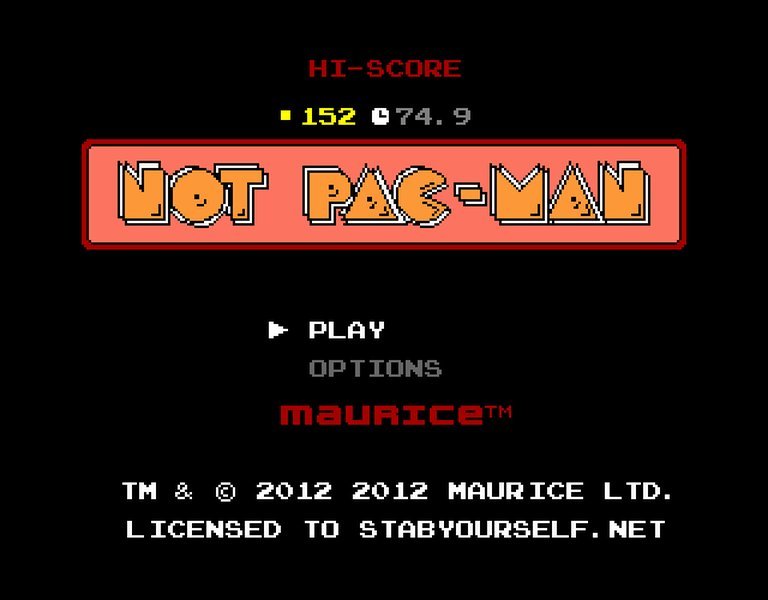
Not Pacman is a physics‑based twist on the classic arcade maze game, where the yellow hero and his ghostly pursuers are subject to gravity. Instead of steering Pac‑Man directly, players rotate the entire playfield to guide him through corridors, collect pellets and evade ghosts while an on‑screen timer tracks completion. The top‑down action game retains the original rules, offers multiple control options (keyboard, mouse, joystick or steering wheel), and is released as free‑to‑play freeware for Windows, Linux and macOS.
Gameplay Videos
Not Pacman Free Download
Not Pacman Reviews & Reception
linuxgamecast.com : Ragequit Inducing Retro Goodness
Not Pacman: Review
Introduction
The arcade classic Pac‑Man has been endlessly cloned, remixed and re‑imagined for more than four decades. In early 2013 a tiny indie collective called Stabyourself.net released Not Pacman, a “gravity‑bending” reinterpretation that drops the familiar yellow hero into a physics‑driven playground. Instead of steering Pac‑Man directly, the player rotates the entire maze, letting gravity pull the hero down corridors while he gobbles pellets and evades his spectral pursuers. The thesis of this review is that Not Pacman is a clever, if imperfect, proof‑of‑concept that showcases how a simple core loop can be transformed by a single mechanic—gravity—while simultaneously highlighting the challenges of preserving the addictive rhythm of the original.
Development History & Context
Studio & Creator Vision
Stabyourself.net is a modest, hobby‑oriented development group that also produced titles such as Not Tetris 2, Mari0, and Trosh. According to the project’s own site, the idea behind Not Pacman was to ask the rhetorical question “Ever wondered how Pac‑Man would be like with physics? No? Well, it’s revolutionary.” The goal was not to rewrite the maze‑chase formula but to re‑expose Pac‑Man to a new law of motion—gravity—while keeping the classic pellet‑eating and ghost‑avoiding objectives intact.
Technological Constraints
The game runs on the LÖVE 2D engine (version 0.7.2), a lightweight Lua‑based framework popular among indie developers for rapid prototyping. The source package is a single LOVE file that uses the engine’s built‑in physics (Box2D) to simulate gravity, collision, and momentum. Because LÖVE is cross‑platform, Not Pacman was released simultaneously on Windows, Linux, and macOS in 2013, with a subsequent port to the OpenPandora handheld (via the same LOVE binary).
Gaming Landscape of 2013
By the time Not Pacman arrived, the indie scene was awash with “Not”‑branded mash‑ups (e.g., Not Tetris 2). The market favored retro‑style re‑interpretations that leveraged modern physics engines to add novelty without sacrificing nostalgia. At the same time, Pac‑Man remained a cultural touchstone, still spawning modern revivals like Pac‑Man Championship Edition (2007) and Pac‑Man 99 (2020). Not Pacman thus entered a niche where retro homage met experimental gameplay, aiming to attract both long‑time fans and physics‑curious newcomers.
Narrative & Thematic Deep Dive
Plot & Characters
Not Pacman inherits the canonical cast: the yellow, mouth‑wide Pac‑Man, four colored ghosts (Blinky, Pinky, Inky, Clyde), and the endless sea of pellets. There is no new storyline, cut‑scenes, or dialogue; the game’s “narrative” is purely the player’s struggle against gravity and the frantic scramble to clear each level before the timer expires.
Themes & Subtext
-
Control vs. Chaos – By removing direct control of Pac‑Man and forcing the player to manipulate the environment, the game flips the original’s agency. The player becomes a god‑like architect, rotating the maze to guide the hero, echoing themes of determinism vs. free will that were already present in Pac‑Man’s original AI personalities.
-
Physics as Metaphor – Gravity, an invisible force that pulls all objects downward, mirrors the inevitable pull of time in the arcade original (the level timer). The player must balance speed and precision, reminding us that even a classic can be subject to unseen pressures.
-
Nostalgia Re‑contextualized – By preserving the pellet‑eating mechanic, Not Pacman pays homage to the “simple‑to‑learn, hard‑to‑master” ethos of the 1980 arcade, while forcing a new kind of spatial reasoning that feels both familiar and alien.
Gameplay Mechanics & Systems
Core Loop
- Rotate the Maze – Using keyboard arrows, mouse drag, joystick, or even a steering wheel, the player spins the entire level around its centre.
- Gravity‑Driven Motion – Pac‑Man and the ghosts are physics bodies; they fall toward the lowest point of the rotated maze, sliding along walls and corridors.
- Eat Pellets & Avoid Ghosts – The classic chase persists; Pac‑Man must consume all pellets while staying clear of ghosts.
- Timer & Scoring – An in‑game timer records the level completion time; the “advanced multi‑data scoring system” rewards fast runs and high pellet counts.
Control Schemes
The game advertises multiple input methods (keyboard, mouse, joystick, steering wheel). The most common setup is mouse drag or arrow keys. Some users reported that ghosts appear static (they do not follow Pac‑Man), increasing difficulty because only Pac‑Man’s motion is dynamic.
Character Progression & Power‑Ups
There is no progression system: each level is a self‑contained maze. Power pellets retain their original effect (ghosts turn blue), but because ghosts rarely move, the strategic value of power‑ups is reduced.
UI & HUD
A minimalist overlay shows:
- Score (accumulated pellets, ghosts eaten, and time bonuses)
- Timer (seconds elapsed)
- Level Indicator
No health bar or lives are displayed; death occurs instantly on ghost contact, echoing the original’s one‑life‑per‑collision design.
Innovative Elements
- Environmental Rotation – The only game of its era that lets the player rotate the whole playfield to direct a classic character.
- Physics‑Based Movement – Pac‑Man’s momentum, inertia, and collision response are handled by Box2D, creating a realistic “sliding” feel absent from the arcade version.
Flaws & Issues
- Static Ghost AI – Community comments (e.g., on the OpenPandora forum) note that ghosts “do not move at all,” which can make the game feel unbalanced and reduce the chase tension.
- Steep Learning Curve – Rotating the maze while predicting Pac‑Man’s trajectory is unintuitive for players accustomed to direct control.
- Limited Content – The game ships with a single set of mazes (the original Pac‑Man layouts) and no level editor or additional stages, limiting replayability.
World‑Building, Art & Sound
Visual Direction
Not Pacman retains the top‑down, pixel‑art aesthetic of the original Pac‑Man mazes, using the classic colour palette (bright yellow Pac‑Man, pastel ghosts, dark corridors). The graphics are unchanged except for the addition of a faint rotation cue (the whole screen spins). The simplicity helps keep the focus on the physics simulation.
Audio Design
The official description and the Stabyourself site do not list a dedicated soundtrack; the game appears to use classic Pac‑Man sound effects (dot munch, ghost wail, death) possibly sourced from the original ROM. No new music or ambient audio is present, reinforcing the “same as its predecessor” claim.
Atmosphere & Immersion
The gravity‑induced tilting creates a subtle sense of disorientation that heightens tension. However, because the visual and auditory assets are unchanged, the overall atmosphere feels nostalgic rather than immersive, relying on the player’s cognitive adaptation to the new physics.
Reception & Legacy
Critical Reception
As of the latest MobyGames entry, No professional critic reviews have been logged for Not Pacman. The “Player Reviews” section remains empty, reflecting the game’s low‑profile release and its status as a freeware hobby project.
Community Feedback
- OpenPandora forum posts (2013‑2014) describe the game as “crazy and interesting in equal measure” and “addicting,” but also point out the lack of ghost movement as a missed opportunity for deeper challenge.
- Users cite the steep difficulty and the novelty of rotating the maze as the primary draw.
Influence on Subsequent Games
Not Pacman did not spawn a direct series, but it contributed to a broader indie trend of “physics‑twist” retro remakes, where classic mechanics are reinterpreted through modern engines. Its use of LÖVE and Box2D demonstrated how small teams could prototype complex mechanics without large budgets.
Longevity
Because the title is public‑domain/freeware, it remains available for download on the Stabyourself site and open‑source repositories (e.g., OpenPandora). It serves as a reference implementation for developers interested in applying physics to 2‑D arcade clones.
Conclusion
Not Pacman is an experiment in gameplay re‑contextualization: it preserves the beloved pellet‑chasing loop while forcing the player to think in terms of gravity and rotation. The result is a fresh, mind‑bending challenge that feels both familiar and oddly alien.
Strengths
– Innovative use of environmental rotation and physics.
– Faithful visual and audio homage to the original Pac‑Man.
– Freeware distribution, encouraging community tinkering.
Weaknesses
– Static ghost AI reduces chase tension.
– Limited content and no level editor.
– High learning curve may deter casual fans of the classic.
In the annals of Pac‑Man derivatives, Not Pacman occupies a niche but noteworthy spot as a proof‑of‑concept that demonstrates how a single mechanic overhaul can radically alter player perception of a timeless formula. For historians and game journalists, it stands as a case study in indie reinterpretation—a modest, physics‑driven homage that, while not a commercial or critical hit, enriches the tapestry of Pac‑Man’s enduring legacy.
Verdict: Not Pacman is a clever, physics‑driven curiosity that deserves a place in any comprehensive Pac‑Man retrospective, especially for those interested in how classic arcade design can be twisted—literally—by modern game‑making tools.