
- Release Year: 2011
- Platforms: Linux, Macintosh, Windows
- Publisher: Stabyourself.net
- Developer: Stabyourself.net
- Genre: Puzzle
- Perspective: Fixed / flip-screen
- Game Mode: Hotseat, Single-player
- Gameplay: Falling block puzzle, Physics-based, Real-time
Description
Not Tetris 2 is a unique puzzle game that reimagines the classic Tetris formula with realistic physics, allowing blocks to be rotated and placed at any angle, adding momentum and chaos to the traditional gameplay. Players must carefully manage their stacks to complete lines, with the added twist of a two-player mode where opponents can disrupt each other’s progress by bouncing blocks into their opponent’s area. The game retains the core mechanics of Tetris while introducing fresh challenges and a competitive edge.
Gameplay Videos
Not Tetris 2 Guides & Walkthroughs
Not Tetris 2 Reviews & Reception
goldskulltulla.blogspot.com : Not Tetris 2 is definitely worth exper
Not Tetris 2: A Deconstruction of the Tetris Formula
Introduction
In the vast pantheon of Tetris variants, Not Tetris 2 (2011) stands as a fascinating anomaly—a game that simultaneously reveres and subverts the sacred geometry of its inspiration. Developed by Maurice and published by Stabyourself.net, this indie puzzle game is not merely a clone but a reimagining, one that injects physics-based chaos into the orderly world of falling blocks. While Tetris has been ported, remixed, and rebranded countless times, Not Tetris 2 dares to ask: What if Tetris wasn’t about precision, but about controlled chaos?
This review will dissect Not Tetris 2 through multiple lenses—its development context, its radical gameplay mechanics, its aesthetic homage to the Game Boy era, and its place in the broader Tetris ecosystem. By the end, we’ll determine whether this experiment is a brilliant deconstruction or a gimmick that collapses under its own weight.
Development History & Context
The Indie Puzzle Renaissance
Not Tetris 2 emerged during a golden age for indie puzzle games, a period where titles like Braid (2008), World of Goo (2008), and Portal (2007) redefined what the genre could be. These games often took familiar mechanics and twisted them into something new, and Not Tetris 2 followed this ethos. It was built using the LÖVE framework, an open-source engine that allowed for rapid prototyping—a perfect fit for a game that thrived on experimentation.
A Love Letter to Tetris’s Past
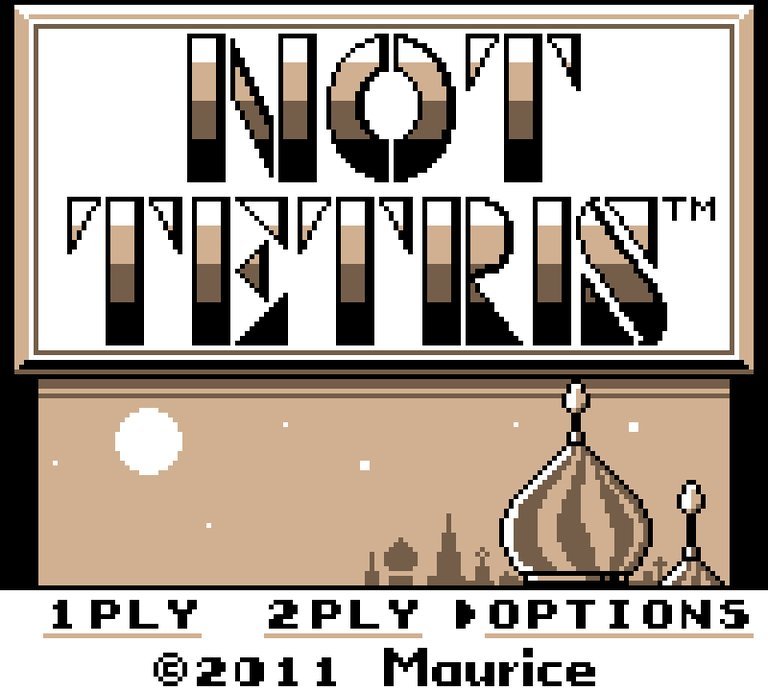
The game’s aesthetic is a deliberate throwback to the Game Boy version of Tetris (1989), complete with monochrome visuals and the iconic Korobeiniki soundtrack. This was no accident. The Game Boy iteration of Tetris wasn’t just a port—it was a cultural phenomenon, the killer app that sold millions of handhelds. By emulating its look and sound, Not Tetris 2 positioned itself as both a tribute and a subversion, a game that asked players to engage with Tetris in a way they never had before.
The Physics Experiment
The core innovation of Not Tetris 2 is its physics engine, which allows blocks to rotate freely, bounce off surfaces, and settle in ways that defy traditional Tetris logic. This wasn’t just a technical flex—it was a philosophical statement. While Tetris is about order, Not Tetris 2 is about entropy. The game’s tagline—“so that you never get a long piece when you need one”—hints at its mischievous design philosophy. The randomizer is intentionally cruel, ensuring that players can’t rely on muscle memory or pattern recognition.
Narrative & Thematic Deep Dive
The Absence of Story (And Why It Works)
Not Tetris 2 has no plot, no characters, and no dialogue. Yet, it tells a story through its mechanics. The game is a meta-commentary on frustration, a puzzle that refuses to be solved in the way players expect. The Tetris effect—the phenomenon where players see falling blocks in their sleep—is amplified here, not because the game is addictive, but because it resists mastery.
Themes of Chaos vs. Control
At its heart, Not Tetris 2 is about the tension between control and surrender. Traditional Tetris rewards precision; Not Tetris 2 punishes it. The physics engine ensures that even the most carefully placed block can ricochet into disaster. This isn’t a flaw—it’s the point. The game forces players to adapt, to embrace the mess, and to find beauty in the collapse.
Gameplay Mechanics & Systems
The Three Modes: A Study in Contrasts
Not Tetris 2 offers three distinct modes, each a different take on the Tetris formula:
-
Normal Mode
- The closest to traditional Tetris, but with a twist: lines clear when they’re 80% full (not 100%).
- Blocks can be rotated at any angle, leading to sliced pieces that fall unpredictably.
- Scoring is based on both the number of lines cleared and their density, rewarding players who pack blocks tightly.
-
Stack Mode
- A return to the original Not Tetris (2010) concept: no line clears, just endless stacking.
- The goal is to fit as many pieces as possible before topping out.
- A test of patience and spatial reasoning, where every placement matters.
-
Invade Mode
- A competitive two-player mode where blocks can bounce into the opponent’s playfield.
- A chaotic, almost Pong-like experience where defense is as important as offense.
The Physics Engine: Blessing or Curse?
The physics system is both the game’s greatest strength and its most divisive feature. Blocks don’t just fall—they tumble, spin, and collide with realistic momentum. This leads to:
– Unpredictable outcomes: A well-placed block might knock another out of position.
– Emergent gameplay: Players must improvise, using walls and existing stacks to guide pieces.
– Frustration: The lack of a lock delay means mistakes are punished instantly.
Scoring and Progression
Unlike traditional Tetris, where speed and efficiency are key, Not Tetris 2 rewards density and creativity. The scoring formula:
This means that packing blocks tightly is often more valuable than clearing lines quickly. It’s a system that encourages experimentation over optimization.
World-Building, Art & Sound
Aesthetic: The Game Boy Illusion
The game’s visual design is a pixel-perfect homage to the Game Boy Tetris, complete with:
– Monochrome graphics (with customizable palettes).
– The iconic Korobeiniki theme, along with the other two Game Boy tracks.
– Rocket cutscenes that trigger at high scores, a nod to the original’s rewards.
This aesthetic isn’t just nostalgia—it’s a frame for the game’s chaos. By wrapping its physics-based madness in the trappings of a classic, Not Tetris 2 makes its experimentation feel intentional, not gimmicky.
Sound Design: Minimalist but Effective
The soundtrack is lifted directly from the Game Boy version, which is both a strength and a limitation. The music is iconic, but it also means the game lacks an original auditory identity. The sound effects—blocks clinking, lines clearing—are similarly sparse but effective.
Reception & Legacy
Critical Reception: A Niche Favorite
Not Tetris 2 didn’t receive widespread critical attention, but within indie gaming circles, it was praised for its bold reimagining of Tetris. Players either loved its chaotic charm or found it too frustrating to engage with long-term.
Influence on Tetris Variants
While Not Tetris 2 didn’t spawn direct sequels, its physics-based approach influenced later puzzle games that experimented with realism in block-placement mechanics. Games like Tetris Effect (2018) and Puyo Puyo Tetris (2014) would later explore their own twists on the formula, but Not Tetris 2 remains unique in its commitment to chaos.
Conclusion: A Flawed but Fascinating Experiment
Not Tetris 2 is not a game for Tetris purists. It’s a provocation, a dare to players to rethink what they know about one of gaming’s most sacred texts. Its physics engine is both its greatest innovation and its most polarizing feature—some will find it liberating, others infuriating.
Final Verdict: 7.5/10
A brilliant but niche experiment that succeeds more as a conceptual art piece than a long-term puzzle game. Worth playing for its audacity alone, but unlikely to replace traditional Tetris for most players.
Legacy: Not Tetris 2 proves that even the most perfect games can be deconstructed—and that sometimes, the mess is the point.