
- Release Year: 2008
- Platforms: Windows
- Publisher: Noviy Disk
- Developer: Jam-Games.NET
- Genre: Puzzle
- Perspective: Diagonal-down
- Game Mode: Single-player
- Gameplay: Game show, quiz, trivia
- Setting: Comedy
- Average Score: 72/100
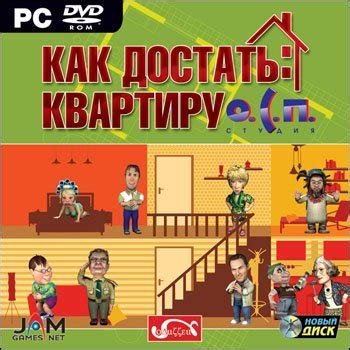
Description
O.S.P. Kak dostat’ kvartiru is a comedic puzzle game released in 2008, serving as a follow-up to Prank TV. The game revolves around staging elaborate pranks in various environments, with players infiltrating settings to create chaos. It features a point-and-select interface and a diagonal-down perspective, blending puzzle-solving with a game show/trivia/quiz style. While primarily an updated re-release of its predecessor, it includes three new levels and minor tweaks, maintaining its comedic narrative and mischievous gameplay.
Gameplay Videos
O.S.P. Kak dostat’ kvartiru Reviews & Reception
stopgame.ru (80/100): “O.S.P. Kak dostat’ kvartiru” – давно известный на телевидении бренд. В частности, комедийный сериал “33 квадратных метра” успел завоевать значительную аудиторию поклонников, несмотря на непритязательность заложенного в нем юмора.
gameguru.ru (65/100): Помогите пж с уровнем бармен можно ли у меня другая игра, я не пониманию, я сделала все кроме шейкера, а вилка и лёд у меня не берутся,как мне шейкер применить?
O.S.P. Kak dostat’ kvartiru: A Comprehensive Retrospective
Introduction
In the annals of Russian gaming history, few titles capture the spirit of early 2000s humor and puzzle design quite like O.S.P. Kak dostat’ kvartiru (2008). Developed by Jam-Games.NET and published by Noviy Disk, this game is a sequel to Prank TV and a spiritual successor to 33 kvadratnykh metra: Voyna s sosedyami. It embodies the chaotic, slapstick energy of its era, blending puzzle mechanics with a uniquely Russian brand of comedy. While often dismissed as a minor re-release, O.S.P. deserves a closer look for its cultural significance, gameplay quirks, and the way it reflects the gaming landscape of its time.
Development History & Context
The Studio and Vision
Jam-Games.NET, a relatively obscure Russian developer, crafted O.S.P. as a follow-up to their earlier Prank TV. The studio’s vision was clear: to create a game that mirrored the absurd, over-the-top humor of the O.S.P.-studio TV show, a popular Russian comedy series. The game’s title, translating to “How to Get an Apartment,” hints at its premise—using pranks and mischief to outmaneuver neighbors and secure living space.
Technological Constraints
Released in 2008, O.S.P. was constrained by the hardware of its time. The game’s minimal system requirements—a Pentium III 1 GHz processor, 256 MB of RAM, and a DirectX 9.0c-compatible GPU—reflect the era’s limitations. The diagonal-down perspective and point-and-click interface were practical choices, ensuring accessibility for a broad audience.
The Gaming Landscape
The late 2000s were a transitional period for Russian gaming. While Western markets embraced open-world epics and cinematic storytelling, Russian developers often focused on niche, humor-driven experiences. O.S.P. fits this mold, offering a lightweight, comedy-driven puzzle game that appealed to fans of the O.S.P.-studio brand.
Narrative & Thematic Deep Dive
Plot and Characters
The game’s narrative is thin but effective: the Zvezdunov family, after a car accident, must win a reality show called “War with Neighbors” to secure a new apartment. The premise is absurd, but it serves as a vehicle for the game’s core mechanic—pranking opponents. Each level introduces a new neighbor, from a bodybuilder to a fortune teller, each with their own quirks and vulnerabilities.
Themes and Humor
O.S.P. thrives on its comedic tone. The humor is slapstick, often relying on visual gags and exaggerated reactions. The game’s Russian roots are evident in its dialogue and character interactions, which are laced with cultural references and wordplay. Themes of perseverance, family, and the absurdity of bureaucracy (a staple of Russian comedy) permeate the experience.
Gameplay Mechanics & Systems
Core Gameplay Loop
At its heart, O.S.P. is a puzzle game. Players must explore environments, collect items, and use them to set up elaborate pranks. The gameplay is methodical, requiring patience and attention to detail. Each level is a self-contained puzzle box, with solutions often hinging on creative item combinations.
Combat and Progression
There is no traditional combat. Instead, the “conflict” is indirect—players must avoid detection while setting up traps. Progression is linear, with each level unlocking only after the previous one is completed. The lack of a save system (a common complaint among players) adds tension, as mistakes can force a restart.
UI and Innovation
The UI is functional but unremarkable. The point-and-click interface is intuitive, but the game’s slow movement speed and repetitive item usage can frustrate. Innovations are minimal; O.S.P. relies on its humor and puzzle design rather than mechanical depth.
World-Building, Art & Sound
Setting and Atmosphere
The game’s environments are varied, from gyms to bars to circus tents. Each level is thematically distinct, reflecting the neighbor’s personality. The art style is cartoonish, with bright colors and exaggerated character designs. The atmosphere is lighthearted, though the slow pace can dampen the energy.
Sound Design
The voice acting, performed by the O.S.P.-studio cast, is a highlight. The characters’ exaggerated reactions and comedic timing elevate the experience. The soundtrack is forgettable but serviceable, with upbeat tunes that match the game’s tone.
Reception & Legacy
Critical and Commercial Reception
O.S.P. received mixed reviews. Critics praised its humor and voice acting but criticized its repetitive gameplay and lack of innovation. Commercially, it was a modest success, appealing primarily to fans of the O.S.P.-studio brand.
Influence and Evolution
The game’s legacy is limited. It did not spawn sequels or inspire major imitators, but it remains a cult favorite among Russian gamers. Its influence is most evident in the Neighbors from Hell series, which shares similar mechanics and humor.
Conclusion
O.S.P. Kak dostat’ kvartiru is a product of its time—a lighthearted, puzzle-driven comedy that reflects the quirks of early 2000s Russian gaming. While it lacks the depth and polish of modern titles, its charm and humor make it a noteworthy artifact. For historians and fans of niche gaming, O.S.P. is a fascinating glimpse into a bygone era.
Final Verdict: A flawed but endearing relic, O.S.P. is best enjoyed as a curiosity rather than a masterpiece. Its humor and cultural context elevate it beyond its mechanical limitations, securing its place in Russian gaming history.