
- Release Year: 2016
- Platforms: PlayStation 4, Windows, Xbox One
- Publisher: Deck13 Interactive GmbH, Space Dust Studios Pty Ltd
- Developer: Space Dust Studios Pty Ltd
- Genre: Driving, Racing
- Perspective: Behind view
- Game Mode: LAN, Online PVP, Single-player
- Gameplay: Arcade, Automobile, Off-roading, Track racing, Vehicular
- Average Score: 72/100
Description
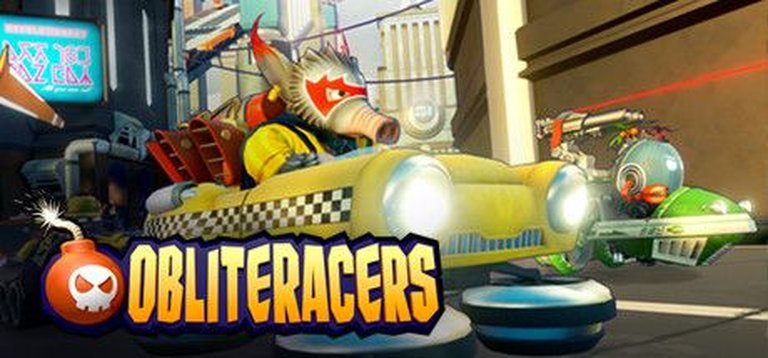
Obliteracers is a vibrant arcade party racer where up to 16 players compete on a single screen in elimination-focused races, using power-ups to attack, shove opponents off tracks, or force them off-screen, with modes like Survival and Knockout emphasizing chaotic, competitive fun over traditional racing objectives.
Gameplay Videos
Where to Buy Obliteracers
PC
Obliteracers Cracks & Fixes
Obliteracers Patches & Updates
Obliteracers Guides & Walkthroughs
Obliteracers Reviews & Reception
metacritic.com (78/100): Obliteracers is one of the most fun combat racing experiences I’ve had in years.
opencritic.com (67/100): Of course, for some, Obliteracers just won’t click.
Obliteracers: Review
Introduction: A Chaotic Love Letter to Couch Co-Op
In an era dominated by polished, online-focused multiplayer experiences and the evergreen titan of the kart racer genre, Obliteracers (initially known as Space Dust Racers) burst onto the scene in 2016 with a defiant, anachronistic, and brilliantly chaotic proposition: what if we crammed 16 players onto one screen and made obliteration, not racing, the primary goal? This review argues that Obliteracers is a fascinating, deeply flawed, yet undeniably impactful cult classic. It is a game that perfectly captures the spirit of the early-2000s party racer boom—think Micro Machines meets Mario Kart—while injecting a dose of modern technological ingenuity. Its legacy is not one of mainstream success, but of a passionate, design-forward experiment that prioritized unadulterated, local multiplayer mayhem over almost every other conventional game development pillar, earning it a permanent, if niche, place in the history of cooperative and competitive gaming.
1. Development History & Context: The “Brutal-Cute” Experiment from Down Under
Obliteracers was the debut project of Varkian Empire, a small independent studio based in Melbourne, Australia. The development was notably supported by the Victoria State Government and Film Victoria Australia, highlighting a trend of regional incentives fostering unique local game development. The team, led by Creative Director Nathan Thomas and Lead Gameplay Developer Michael Colin Davies, operated with a clear, focused vision: to create a high-energy, accessible party game that broke from the traditional “race to the finish” paradigm.
The game was built using Unreal Engine 4, a powerful and modern engine for the time (2016), which allowed for the game’s vibrant, detailed visual style despite the team’s modest size (63 developers credited). This choice contrasts with the simpler 2D sprites of its spiritual predecessors, signifying an ambition to match the aesthetic fidelity of AAA titles while maintaining a quirky, “brutal-cute” identity. The development context is crucial: 2016 was a period where the kart racer genre was largely considered stagnant, with Nintendo’s Mario Kart 8 (2014) reigning supreme. Games like Sonic & All-Stars Racing Transformed (2012) had tried to challenge it but failed to gain sustained traction. Obliteracers entered this landscape not by aiming for a broader audience, but by doubling down on hardcore local multiplayer enthusiasts and the “couch co-op” revival movement, embracing a “back to basics” philosophy of pure, frantic fun with a modern twist.
2. Narrative & Thematic Deep Dive: The Arena is the Story
Obliteracers possesses no traditional narrative campaign. Its “story” is purely diegetic and conveyed through its setting, character design, and tone. The game is set in the year 3015 AD, where Earth has been transformed by “racing-obsessed aliens” into a series of exotic racing circuits. This premise is delivered in a single sentence on the Steam store page and is functionally irrelevant to gameplay. The narrative exists solely to justify the absurdity.
The themes are therefore expressed through aesthetic and mechanical design:
* Thematic Core: Anarchical Competition. The complete subversion of racing’s objective—eliminating opponents is more valuable than finishing first—champions a philosophy of aggressive, survivalist mayhem. The various modes (Knockout, Survival, Endurance, Leader) are thematic explorations of different competitive philosophies: pure elimination (Knockout/Survival), relentless persistence (Endurance), and the precarious nature of power (Leader).
* “Brutal-Cute” Aesthetic: The character roster of 16 “exotic” aliens (ranging from cyborg hermit crabs to “guerrilla warfare birds”) embodies a central tension. Their designs are exaggerated, colorful, and silly (“cute”), yet their actions and the game’s core mechanic are violent (“brutal”). This juxtaposition softens the competitive aggression, framing it as a cartoonish bloodsport. Characters randomly shout “hilarious gibberish” during races (per the PopOptiq review), reinforcing a tone of absurd, consequence-free violence.
* The Spectacle of Elimination: The game’s primary reward is not a checkered flag, but the visual and auditory spectacle of annihilation—explosions, knocking foes off cliffs, the “dangerous trail” of fire. The narrative is written in the carnage each player creates.
In essence, the game’s “story” is the emergent narrative of each multiplayer session: the alliances formed, the revenge kills, the narrow escapes, and the chaotic, unfair victories. The theme is pure, unadulterated, good-natured rivalry.
3. Gameplay Mechanics & Systems: A Tight Loop of Mayhem
At its core, Obliteracers is a * round-based, top-down or behind-view arcade racer* where the screen scrolls to keep all players together, creating a “battle royale” on wheels before the term was popularized.
Core Loop & Controls:
The control scheme is elegantly simple: acceleration, brake/reverse, left/right steering, a jump/drift button, and separate buttons for Activate Power-up and Absorb/Shield. This simplicity is key to its accessibility. The drift mechanic is particularly important, as successful drifting builds a speed boost, encouraging risk-taking. The vehicle physics are often described as “slippery” or “ice-like” (The Gamer’s Lounge, Video Chums), which is a deliberate design choice to increase the likelihood of collisions and dramatic exits from the track, amplifying chaos.
Combat & Power-ups:
Power-ups are the heart of the system. They spawn on the track and include:
* Offensive: Mines, Machine Gun, Homing/Quick Rockets, Electric Halo, Gravity Push, Flamethrower (side-mounted).
* Defensive/Tactical: The Shield (always available but drains movement) and the ability to Absorb a power-up to restore health instead of using it.
This “absorb or activate” choice creates a constant risk/reward calculation. A critical, innovative system is the “Knockout” mechanic: severe impacts from weapons or collisions can knock an opponent’s vehicle off the track, causing them to disappear from the screen (eliminated) unless they have a shield or are in a mode with instant respawn.
Game Modes & Progression:
The game modes are its true innovation over traditional racers:
1. Survival: Round-based. Last vehicle standing scores a point.
2. Knockout: Round-based. Score points by eliminating others during the round.
3. Endurance: Non-round-based. Eliminated players respawn immediately. Continuous carnage.
4. Leader: The player in the lead “steals” points from all other players’ eliminations. Being ahead is a dangerous, target-rich position.
This structure ensures the action is always focused on player interaction, not circuit completion.
Single-Player (Career) vs. Multiplayer:
The Career mode is widely cited as the game’s weakest element. It features only one character (Sarge) against bots, with the goal of earning “bombs” to unlock new tracks and challenges. Reviews consistently describe it as a brief tutorial or practice mode (“motivates only a few hours” – 4Players.de). Its primary function is to teach mechanics and power-up strategies for the true meat of the game: multiplayer.
Multiplayer Innovations:
* 16-Player Same-Screen: The headline feature. Achieved through scalable UI and track design that keeps action centered.
* Flexible Controller Support: A groundbreaking feature was native support for laptops, tablets, and smartphones as additional controllers via local Wi-Fi (Steam page, MobyGames). This was a brilliant solution to the hardware barrier for large local games.
* Drop-in/Drop-out: Players can join or leave ongoing matches seamlessly, a necessity for a party game.
* “Fire from the Grave”: In round-based modes, eliminated players can lock onto survivors and call in airstrikes, keeping them engaged and influencing the outcome. This is a masterstroke of inclusive game design, preventing downtime and fostering a culture of petty revenge.
* Modifiers (Mutatoren): The game supports numerous gameplay modifiers (e.g., “No Pickups,” “Floor is Lava,” “Ice Skating”), allowing for endless customization of matches, as praised by user reviews.
Flaws in the Systems:
* “Lack of Tuning/Progress”: As noted by 4Players.de, there is no vehicle customization or persistent progression in online play. Your skill is your only upgrade.
* “Drumherum gespart” (Cut corners on the frills): The outer features like matchmaking, robust lobbies, and a deep career are underdeveloped.
* Slippery Physics & Camera: The handling, while intentional, creates a high skill floor for precision driving and can lead to frustration, especially in tight spaces or when the camera lags in frantic moments (Video Chums, The Gamer’s Lounge).
* Online Population: A critical weakness noted across multiple reviews (GameSpew, Eurogamer Italy, Digitally Downloaded) was the rapidly dwindling online community, making finding full matches difficult outside of launch and peak times.
4. World-Building, Art & Sound: A Vibrant, Cohesive Chaos
The game’s world is its most universally praised aspect, creating a cohesive identity that elevates the simple gameplay.
- Visual Direction & Art Style: The “brutal-cute” aesthetic is perfectly realized. Characters are bizarre, angular aliens with oversized features and expressive animations. The 12 tracks are set on “exotic planets” featuring bright, saturated colors, dramatic vistas, and迂回曲折的 (winding) paths with perilous cliffs. The use of Unreal Engine 4 allowed for crisp, detailed models, attractive particle effects for explosions and power-ups, and a consistent, playful art direction that feels like a high-definition remaster of a late-90s cartoon (The Gamer’s Lounge). The visuals are busy but readable, a crucial feat for a 16-player screen.
- Sound Design & Music: The soundtrack is a defining feature. Described as being “modelled on the Cantina theme from Star Wars” (PopOptiq), it consists of electro-swing and funky jazz tunes that create an atmosphere of “comic mischief” and circus-like pandemonium. It’s upbeat, non-intrusive, and perfectly matches the on-screen chaos. Sound effects for weapons, crashes, and character barks are punchy and satisfying, adding to the tactile feel of combat. The option to adjust separate volume sliders (music, SFX) is a nice, uncommon touch noted by The Gamer’s Lounge.
Together, the art and sound create a world that is instantly comprehensible, humorous, and inviting, selling the fantasy of alien bumper cars in a galactic demolition derby.
5. Reception & Legacy: The Cult Party Favorite That Couldn’t Keep the Party Going
Critical Reception at Launch:
Reviews were mixed but generally favorable, with a Metacritic average in the high 70s (78 on PC, 70 on PS4, 61 on Xbox One). The dichotomy was stark:
* Praise (Softpedia 9.5/10, 4P.de 83%, Hooked Gamers 8/10): Focused on the unparalleled local multiplayer experience, the smartphone controller gimmick, the “hectic, fluid” gameplay, and the charming art style. Critics who played it as intended with friends heralded it as a “Volltreffer” (direct hit) as a party game.
* Criticism (Link Cable Gaming 49%, MAN!AC 64%, Video Chums 69%): Focused on the shallow single-player, the frustratingly loose handling, the lack of depth/progression, and the rapidly dying online community. The common refrain: “It’s fun with friends, but…”
Commercial Performance & Player Reception:
Steam user reviews are “Mixed” (65% positive from 167 reviews). The player base was clearly split between those who found a perfect party game and those who felt the lack of content and online support doomed it. The “16-player same-screen” and smartphone controller features were repeatedly cited as brilliant, crowd-sourcing solutions that other developers should emulate.
Legacy & Industry Influence:
Obliteracers’ legacy is that of a curated cult classic, not a genre-defining hit. Its influence is subtle but important:
1. Local Multiplayer & Controller Diversity: It was one of the most publicized and successful implementations of using mobile devices as controllers for a console/PC game. This idea has since been adopted in titles like Brawlhalla (cross-play) and various Jackbox games, but Obliteracers executed it within a fast-paced action context, a significant technical challenge.
2. Refocusing the Party Racer: It explicitly rejected the “race first, weapons second” philosophy of Mario Kart, instead fully embracing a battle royale / elimination-focused loop. Games like Fall Guys (2020) later popularized large-scale, elimination-based multiplayer madness, though in a different genre.
3. Proof of Concept for Niche Scale: It demonstrated that a focus on extreme player counts (16) in a shared-screen space was technically viable and could be a unique selling point, even if it came with readability challenges.
4. The “Brutal-Cute” Template: Its aesthetic influenced a wave of indie games using a similar juxtaposition of cute visuals and violent mechanics (e.g., Moving Out with its destructive physics).
However, its legacy is also a cautionary tale about the perils of prioritizing a single, brilliant multiplayer feature at the expense of a robust online infrastructure, single-player content, and a deeper progression system. The game’s community faded quickly, limiting its long-term impact. It stands as a “what if” scenario: what if it had launched with a stronger online backbone or a larger publisher’s marketing muscle?
6. Conclusion: A Flawed Gem of Social Gaming
Obliteracers is not a perfect game. Its career mode is a skeleton, its online matchmaking a ghost town, and its handling a deliberate love-it-or-hate-it mechanic. Yet, to dismiss it is to miss its singular achievement: it is, as Softpedia proclaimed, “one of the most fun combat racing experiences I’ve had in years,” but only under the precise conditions it was designed for.
Its place in video game history is not alongside Mario Kart in the pantheon of household names, but alongside innovative, focused indie experiments like Boom Blox or Wii Sports in its pure commitment to a specific social experience. It is a game that understands the primal joy of turning to your friend after a cheap shot, laughing, and then immediately plotting revenge. Its technological trick of using smartphones as controllers was a bold, user-friendly innovation that deserved a wider audience.
For the historian, Obliteracers represents a late-2010s indie ethos: using accessible modern tools (Unreal Engine 4) to revive and reimagine a classic genre formula with a strict, audience-specific design philosophy. It is a game that asks, “What is the minimum required for maximum local chaos?” and answers with a resounding, explosive, “This.” Its reputation will likely remain that of a cherished but obscure party game, the one you dig out for a specific gathering of 8-12 friends who crave an hour of unapologetic, screen-sharing, alien-obliterating chaos. In that specific, social context, Obliteracers is an all-time great. In the broader history of gaming, it is a brilliant, fascinating footnote—a monument to the idea that sometimes, the best way to honor a genre’s past is not to copy it, but to violently, joyfully, Obliterace it.