
- Release Year: 2005
- Platforms: Android, iPad, iPhone, Ouya, tvOS, Windows, Xbox
- Publisher: Electronic Arts, Inc., Oddworld Inhabitants Inc.
- Developer: Oddworld Inhabitants Inc.
- Genre: Action
- Perspective: First-person, Third-person
- Game Mode: Single-player
- Gameplay: Bounty hunting, Live ammunition, Platforming, Shooter, Stealth, Weapon Upgrades
- Setting: Steampunk, Western
- Average Score: 84/100
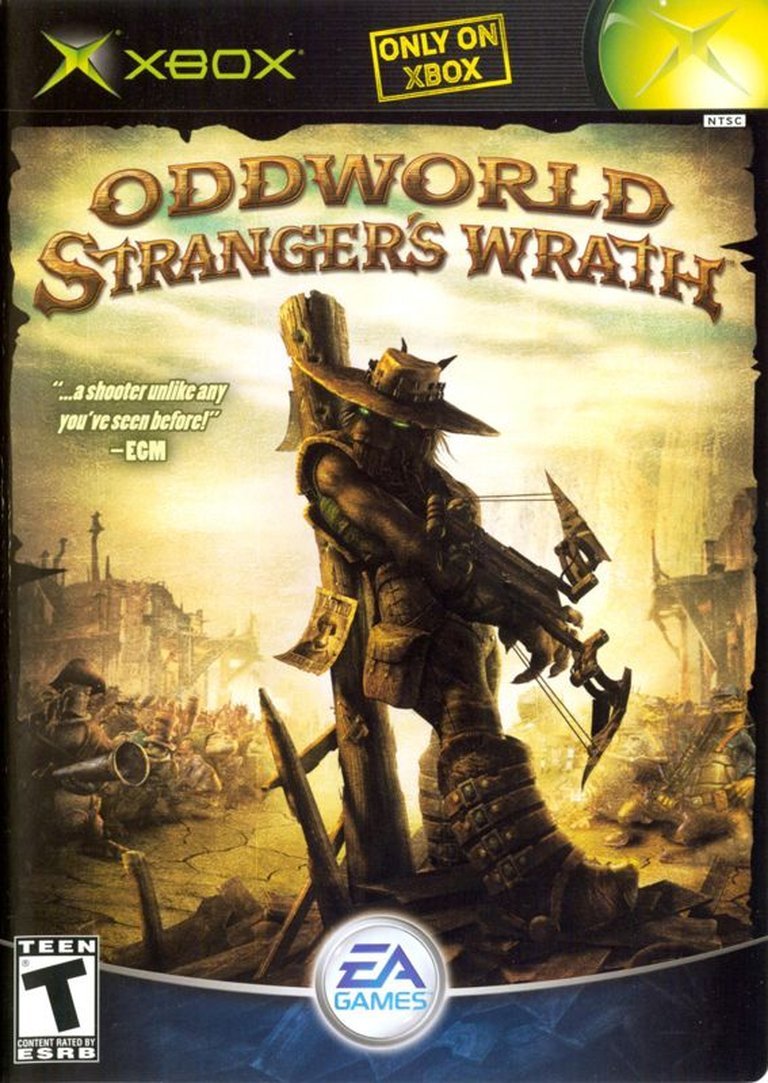
Description
Set in the Oddworld universe’s unique Steampunk Western landscape, Oddworld: Stranger’s Wrath follows a lone bounty hunter, the Stranger, as he captures outlaws to earn moolah for a secretive medical procedure. His quest unfolds in a town overrun by demons, revealing a dried-up river sabotaged by the villain Sekto’s dam, while employing a hybrid gameplay style that toggles between third-person platforming and first-person shooting with inventive ‘live’ ammunition like sentient creatures.
Gameplay Videos
Where to Buy Oddworld: Stranger’s Wrath
PC
Oddworld: Stranger’s Wrath Free Download
Oddworld: Stranger’s Wrath Reviews & Reception
metacritic.com (88/100): Few games are this fresh or entertaining.
ign.com (88/100): Oddworld just got Stranger.
opencritic.com (73/100): Despite these rough edges, Oddworld: Stranger’s Wrath is still a joy to play on Switch, and if you didn’t experience it the first time around, it’s well worth a look now.
imdb.com (90/100): it’s actually one of the best games that I’ve played.
Oddworld: Stranger’s Wrath Cheats & Codes
Xbox
Enter codes during gameplay after enabling cheat mode. The cheat mode requires inserting and removing a controller from port 2, then pressing X,X,Y,Y,B,B,A,A on controller 1.
| Code | Effect |
|---|---|
| X, X, Y, Y, B, B, A, A | Enables cheat mode (confirmation sound). |
| X, Y, A, B, X, Y | Invincibility (health gauge turns yellow). |
| Click Left Analog-stick(2), Right Analog-stick(2), Left Analog-stick(2), Right Analog-stick(2) | Grants $1,000 (repeatable). |
| ©@®& | Level select (enter as player name at new game). |
| L1, L2, R2, A, B, R1, B, A, R2, L2, L1 (then insert/remove controller from port 4) | Applies sepia color filter (repeat to disable). |
Oddworld: Stranger’s Wrath: A Genre-Defying Masterpiece From a Bygone Era
Introduction: The Maverick of Mudos
In the mid-2000s, a peculiar and powerful wind swept through the Xbox ecosystem. While the console was establishing its identity with robust first-person shooters and action titans, one game arrived that refused to be pigeonholed, blending genres with a audacious creativity that felt both nostalgic and revolutionary. Oddworld: Stranger’s Wrath, released in 2005, stands not merely as the fourth entry in the beloved Oddworld series, but as its most daring and conceptually rich iteration. It is a game that seamlessly marries the precise, tactical combat of a first-person shooter with the acrobatic, exploratory freedom of a third-person platformer, all wrapped in a gorgeously realized Western-tinged, steampunk world. Its thesis is a bold one: that a game can be a high-octane action spectacle and a nuanced narrative about identity, exploitation, and ecological vengeance. This review will argue that Stranger’s Wrath is a landmark title—a victim of its publisher’s missteps and its own uncompromising vision—whose legacy is that of a cult classic whose mechanical and thematic ambitions continue to echo in modern game design.
Development History & Context: A Studio at a Crossroads
Stranger’s Wrath was developed by Oddworld Inhabitants, the studio founded by the visionary duo Lorne Lanning (President/Creative Director) and Sherry McKenna (CEO/Executive Producer). By 2005, the studio was at a critical juncture. Their previous title, Oddworld: Munch’s Oddysee (2003), had been a commercial and critical disappointment, failing to meet sales expectations despite its innovative 2D-to-3D transition for the Xbox. The studio was financially strained, and the broader gaming industry was consolidating around big-budget, mainstream franchises, particularly within the Xbox’s shooter-heavy library.
Lanning’s vision for Stranger’s Wrath was a conscious pivot. He sought to create a game that felt like a “playable movie,” one that prioritized cinematic storytelling and fluid, dynamic gameplay over the puzzle-platforming that defined Abe’s adventures. The technological constraints of the original Xbox were significant, yet the team leveraged the console’s hardware to create a vast, open-feeling world with seamless transitions between third-person exploration and first-person combat—a technical feat that impressed even contemporary critics. The game’s exclusivity to Xbox was a double-edged sword: it secured a high-profile publishing deal with Electronic Arts (EA), providing necessary funding, but also limited its potential audience to a single platform in a crowded market. This partnership, as later revealed by Lanning, was fraught with creative tensions, and EA’s marketing push was widely perceived as insufficient, contributing to the game’s commercial underperformance. It was, in many ways, the last major “old-school” Oddworld project from the original team before the studio shifted focus to digital distribution and mobile platforms years later.
Narrative & Thematic Deep Dive: The Anatomy of a Secret
The plot of Stranger’s Wrath is deceptively simple on the surface—a bounty hunter chases outlaws for cash—but unfolds into a profound character study and an eco-fable of corporate villainy. The protagonist, known only as The Stranger, is initially presented as a gruff, pragmatic mercenary. His stated goal is to earn 20,000 Moolah for a “confidential operation,” a mystery that fuels player speculation. The first act is a classic Western: he arrives in the Clakkerz towns of Gizzard Gulch and Buzzarton, a bird-like, perpetually scheming settler population reminiscent of redneck stereotypes, and systematically dismantles a rogue’s gallery of colorful outlaws (Filthy Hands Floyd, Jo’ Mamma, Packrat Palooka).
The narrative’s genius lies in its meticulous, almost surgical, pacing and its mid-game “Wham Episode” (a term perfectly captured by TV Tropes). The moment Stranger visits Doc, the Vykker surgeon, for his operation is the catalyst. Doc is found murdered, and Stranger is captured by the Outlaw D. Caste Raider. During the interrogation, the Stranger’s medical file spills, revealing his true identity: he is a Steef, a noble, centaur-like species thought to be extinct, and he was seeking surgery to amputate his hind legs to pass as bipedal. This revelation is the game’s emotional and thematic core. Stranger’s entire journey has been an act of self-loathing and attempted erasure, a desperate bid to survive in a world that hunts his kind for trophies.
The second half transforms the game’s stakes completely. The Stranger, now stripped of his Clakkerz gear and bounties, is truly hunted. He is rescued by the Grubbs, an oppressed, amphibious native tribe whose prophecy foretells the return of the Steef as their guardian. The antagonist, Mr. Sekto, is unveiled not as a mere industrialist but as a Puppeteer Parasite: an Oktigi (a squid-like creature) that has parasitically bonded to the body of the last, “Olden Steef,” using it as a host to control the Sekto Springs Dam and commodify the Mongo River’s water. The conflict becomes explicitly ecological: Sekto’s dam has dried the river, starving the Grubbs and destroying their habitat. The final confrontation is thus both personal (Stranger reclaiming his identity and honor) and political (a fight for water as a commons against privatized exploitation). The bittersweet ending—the Olden Steef dies, Sekto escapes, and the Grubbs’ land is flooded by the dam’s destruction—cements the game’s mature, non-idealistic themes. True to its Western roots, there are no perfect victories, only hard-won, costly reckonings.
Gameplay Mechanics & Systems: The Live Ammo Revolution
Stranger’s Wrath’s gameplay is its defining legacy, a hybrid system that remains uniquely potent. The dual-perspective mechanic is not a gimmick but a fundamental design pillar:
* Third-Person View: Used for traversal (double-jumping, climbing ropes, running on all fours for speed), stealth (hiding in long grass, using radar line-of-sight indicators), and melee combat (headbutts, punches, and later, a devastating charge attack). This view creates a sense of embodied physicality; Stranger feels powerful and agile.
* First-Person View: Activated when the crossbow is drawn. This is where the game’s strategic depth explodes.
The Crossbow and Live Ammo system is a masterpiece of interactive design. Instead of traditional bullets, Stranger fires living creatures, each with a distinct function:
* Chippunks: Trash-talking bait that lures enemies to a location.
* Bolamites: Web-shooters that temporarily incapacitate (a non-lethal knockout).
* Fuzzles: Surface-bound mines that pounce on passing foes.
* Zappflies: Basic rapid-fire; can be charged to activate machinery.
* Thudslugs: Heavy, blunt-force projectiles (upgradable to explosive Riotslugs).
* Stingbees: Long-range, silent projectiles (upgradable to rapid-fire).
* Stunkz: Cloud-based gas that paralyzes groups (upgradable to pull enemies in).
* Boombats: Sticky, timed explosives.
* Sniper Wasps: High-powered, single-shot long-range eliminators (requiring binoculars acquired early).
This arsenal encourages constant tactical reassessment. Do you use Chippunks to isolate a group? Bolamites for a silent takedown? A Boombat for a chaotic entrance? Ammo is purchased or hunted, and inventory is limited, forcing resource management. The core bounty-hunting loop—scout, plan, execute, capture (using a Ghostbusters-like suction tank)—is deeply satisfying. Capturing targets alive pays more, creating a natural incentive for stealth and non-lethal methods, though the game never punishes a more aggressive playstyle.
However, the gameplay undergoes a “Bag of Spilling” after The Reveal. Stranger is stripped of his purchased upgrades, forcing the player to adopt new Steef armor and abilities provided by the Grubbs. The focus shifts from precision bounty hunting to all-out guerrilla warfare against the Wolvark mercenaries. Here, some critics noted a dissonance: the nuanced live-ammo tactics feel less effective against hordes of armored soldiers in linear trench-warfare sequences, creating a frustrating difficulty spike. The final act, a timed dash through the collapsing dam, feels like a different game entirely, tonally and mechanically jarring. This structural whiplash is the game’s most cited flaw, a consequence of its narrative-mandated shift that the gameplay systems don’t fully accommodate.
World-Building, Art & Sound: A Lush, Cruel, and Quirky Masterpiece
The world of Western Mudos is a character unto itself. The art direction, led by Raymond Swanland and others, is a stunning fusion of Spaghetti Western iconography (dusty canyons, saloon doors, desert mesas) with Diesel Punk and the series’ signature grotesque bio-mechanical aesthetic. The Clakkerz towns are ramshackle, bustling with feather-fingered, greedy settlers speaking in exaggerated Xtreme Kool Letterz. The Grubb villages are organic, watery, and spiritual, a stark contrast. Sekto Springs Dam is a monolithic, oppressive piece of industrial architecture that visually dominates the landscape.
The sound design is equally iconic. Composer Michael Bross provides a score that shifts from playful, adventurous themes in the towns to tense, stealthy atmospherics (the “spine-chilling” music noted by players) and bombastic,percussive action cues. The audio truly sells the world: the frantic chirps of Chippunks, the wet thwacks of web ammo, the satisfying clunks of enemies being stunned or captured, and the distinct, gravelly voices of the Outlaws and the chilling, modulated tones of Sekto.
The game’s atmosphere is its most celebrated element. It feels lived-in and odd. The NPCs, from the sarcastic Clakkerz vendors to the terrified Grubbs peeking from windows, have an incredible amount of personality despite limited dialogue. Environmental storytelling—like the Grubb graveyard at the start, or the dead Grubbs strung up by Wolvarks—conveys the brutality of the conflict without a single line of exposition. This is Oddworld’s signature: a world that is simultaneously whimsical and deeply horrifying, where you can admire the sunset over a canyon one moment and see the aftermath of industrial atrocity the next.
Reception & Legacy: The Classic That Time Forgot (Then Remembered)
At launch, Stranger’s Wrath was a critical darling. It holds an 81% critic average on MobyGames (based on 33 reviews) and an 88/100 on Metacritic for the Xbox version. Reviews consistently praised its originality, visuals, and seamless gameplay hybrid. Game Informer called it a “stunning and exquisitely realized masterpiece,” while IGN highlighted its successful genre-blending. It won awards for animation and character performance and was nominated for several “Best of 2005” lists.
However, its commercial performance was a catastrophe. By 2012, it had sold only 600,000 copies on Xbox, far short of the 1.6 million units Lorne Lanning stated were needed to break even. The blame is widely attributed to EA’s lackluster marketing for a game that didn’t fit an easy demographic profile. It was an Xbox exclusive in a multiplatform-leaning market, and its unique premise was apparently too risky to promote heavily.
Its legacy evolved in the 2010s. The 2011 HD remaster (by Just Add Water) for PS3, PC, and later Vita, Switch, and modern platforms was a watershed moment. It re-introduced the game to a new generation with improved textures, trophies, and refined controls, earning new acclaim and solidifying its status as a cult classic. Players on sites like MobyGames now rate it highly (3.9/5), with reviews often citing its “gem-like” quality and “badass” protagonist.
Its influence is subtle but present. The seamless transition between third-person traversal and first-person engagement can be seen in games like The Evil Within 2 (which uses it for horror tension) and certain open-world action titles. The “live ammo” concept—a single tool with wildly different tactical applications—prefigured the weapon-mod systems of later shooters. Most importantly, it stands as a touchstone for creative risk-taking. It proved that a major studio release could defy genre conventions and prioritize a singular, auteur-driven vision. Modern indie darlings from studios like Double Fine or Campo Santo inherit this spirit of prioritizing world and character over rigid genre formulas.
Conclusion: The Last Steef Standing
Oddworld: Stranger’s Wrath is a profound and flawed masterpiece, a game Burned by the business realities of its time but Sanctified by its artistic integrity. Its narrative arc—from a man hiding from himself to a hero embracing his heritage—is one of the most thematically rich stories in gaming. Its gameplay hybrid, while occasionally bumpy in its second act, remains a benchmark for creative mechanical design. The world of Western Mudos is a breathtaking, hilarious, and terrifying place that feels utterly real.
Yes, it has pacing issues. Yes, the tonal shift midway is jarring. Yes, the late-game difficulty spikes can feel unfair. But these are the scars of a game that tried something truly new and paid the price in polish. To play Stranger’s Wrath today—preferably the HD version—is to experience a relic from an era when big-budget games could still be wildly idiosyncratic. It is the story of a last-of-his-kind hero, told by a studio that felt like one of its own. In the pantheon of video game history, Stranger’s Wrath is not just a great Oddworld game; it is a testament to the power of vision over formula, and a reminder that the most memorable journeys are often the ones that take the road less traveled. It is, quite simply, essential.