
- Release Year: 1999
- Platforms: Windows
- Publisher: Decam AB
- Developer: BigBite Interactive
- Genre: Action
- Perspective: Third-person
- Game Mode: LAN, Single-player
- Gameplay: Character selection, Flying, Key collection, Shooter
- Setting: Fantasy, Germanic, Mythology: Norse
- Average Score: 58/100
Description
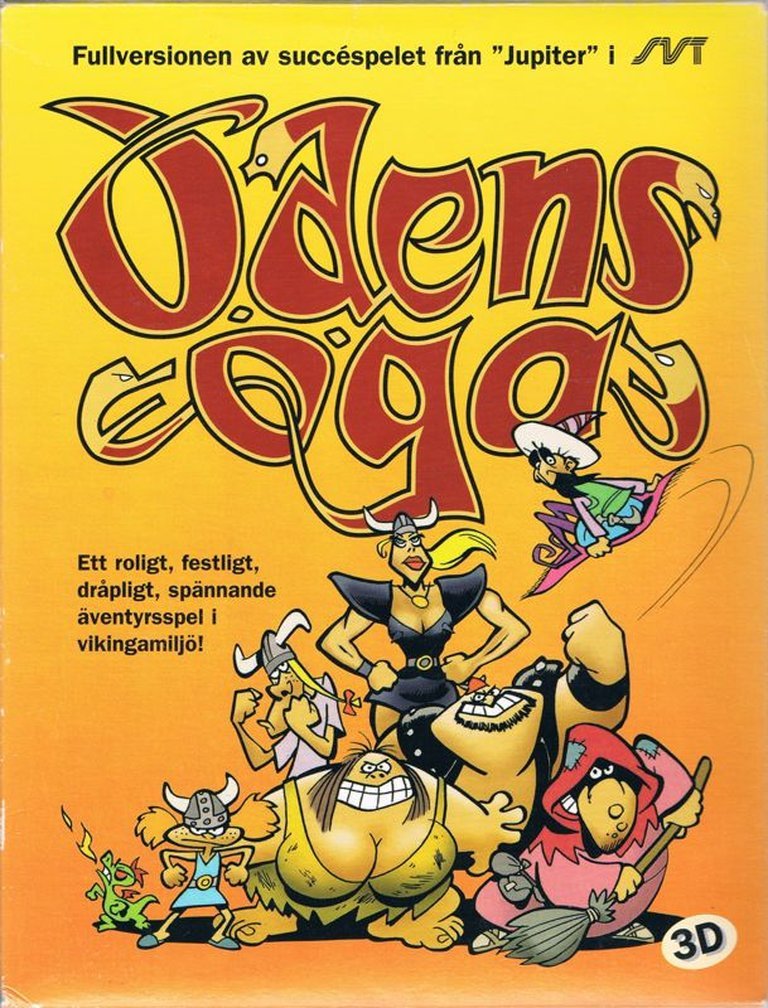
In ‘Odens öga’, Loki has stolen Odin’s eye from Mimir’s well, stripping the Allfather of his powers and threatening to overthrow him as the ruler of the Viking gods. Odin enlists the help of seven peculiar Vikings from the village of Gandar, and the player must take on the role of one of them to journey through twelve fantastical levels, battling monsters, collecting keys to progress, and ultimately retrieving the stolen eye. The game features third-person action gameplay with ranged attacks, limited flight mechanics, and a variety of collectibles that enhance abilities or health. Additionally, it includes a competitive LAN multiplayer mode where two players vie to control a pig by shooting each other.
Odens öga Reviews & Reception
mobygames.com (58/100): A third-person action game with twelve levels where players must find and collect keys to unlock gates to the next level.
Odens öga: A Forgotten Viking Adventure and Its Place in Gaming History
Introduction: The Curious Case of a Viking Game on TV
In the annals of video game history, few titles are as peculiar or as culturally specific as Odens öga (1999), a Swedish third-person action game that briefly captured the imagination of a generation of Scandinavian youth. Developed by BigBite Interactive and published by Decam AB, Odens öga is a game that defies easy categorization—a quirky, comedic adventure rooted in Norse mythology, yet inextricably tied to a television show that amplified its reach far beyond what its gameplay alone might have achieved. This review seeks to unpack the game’s development, its narrative and thematic ambitions, its mechanical quirks, and its lasting legacy as both a product of its time and a fascinating footnote in the evolution of interactive entertainment.
At its core, Odens öga is a game about retrieval: the trickster god Loki has stolen Odin’s eye from Mimir’s Well, stripping the Allfather of his wisdom and power. The player, assuming the role of one of seven eccentric Vikings, must traverse twelve levels, collect keys, battle absurd creatures, and ultimately restore Odin’s eye to its rightful place. Yet, the game’s most enduring feature isn’t its gameplay—it’s its symbiotic relationship with Jupiter, a Swedish television program that turned Odens öga into a competitive spectacle, blending gaming with the burgeoning culture of interactive TV.
This review argues that Odens öga is a game of contradictions: a technically modest but ambitious project, a comedic romp with a surprisingly rich mythological foundation, and a commercial product that was simultaneously ahead of its time and doomed by its limitations. By examining its development, design, and reception, we can better understand how Odens öga reflects the experimental spirit of late-1990s gaming and the challenges of merging traditional media with interactive experiences.
Development History & Context: A Game Born from Television
The Studio and the Vision
Odens öga was developed by BigBite Interactive, a subsidiary of the Swedish media company Decam AB, which had a diverse portfolio spanning advertising, television production, and interactive programs. BigBite was divided into two branches: BigBite Television and BigBite Interactive, with the latter focusing on game development. The game’s creation was spearheaded by a small but talented team of 15 individuals, including:
– Fredrik Agetoft, credited with the original idea.
– Torbjörn Jansson, Stefan Malmström, Alf Jonsson, and Linus Feldt, who worked on the manuscript.
– Patrik Larsson, Martin Gustafsson, and Andreas Olofsson, handling programming.
– Mikael Grahn, a renowned Swedish comic artist, who provided the game’s illustrations.
– Jonas Dahlin and Erik Andersson, responsible for 3D graphics and level design.
– Sven-Gunnar Pettersson, who composed the music and sound effects.
The game’s development was notable for its collaboration with Massive Entertainment AB, a then-emerging Swedish studio that would later achieve international fame with titles like Ground Control (2000). Massive provided the 3D technology that powered Odens öga, marking an early partnership that showcased the potential of Swedish game development. According to Martin Walfisz, one of Massive’s founders, the collaboration was exciting because it allowed the studio to contribute to a game that would be featured on national television—a rare opportunity at the time.
Technological Constraints and the Late-1990s Gaming Landscape
Odens öga was released in December 1999, a period when 3D gaming was still in its relative infancy. The game’s technical specifications reflect the hardware limitations of the era:
– Minimum System Requirements: Intel Pentium MMX, 64 MB RAM, Windows 95, DirectX 6.1, and an 8X CD-ROM drive.
– Graphics: The game employed a third-person behind-view perspective, a choice that was becoming increasingly popular in action-adventure games but was still not as refined as it would be in later years.
– Input: Keyboard and mouse controls, with the arrow keys for movement and the mouse for aiming and shooting.
The late 1990s were a time of rapid evolution in gaming. *Tomb Raider (1996) had popularized 3D action-adventure games, while Quake (1996) and Half-Life (1998) were redefining first-person shooters. Odens öga, with its third-person shooter mechanics and emphasis on exploration, was attempting to carve out its own niche. However, it lacked the polish and depth of its contemporaries, a fact that would later be reflected in its critical reception.
The Television Connection: Jupiter and the Birth of Interactive TV Gaming
What truly set Odens öga apart was its integration with Jupiter, a Swedish television show aimed at teenagers that premiered on September 17, 1999, on Sveriges Television (SVT). Jupiter was a multimedia program featuring interviews, comedy sketches, music performances, and—most notably—a competitive gaming segment where viewers could qualify to play Odens öga on live TV.
The structure of the TV competition was as follows:
1. Viewers could apply to play on the Jupiter website.
2. They would then play a web-based qualification game (likely a simple Flash game involving shooting owls in a tunnel).
3. The top scorers would be invited to compete on the show against the reigning “grandmaster.”
4. The live match consisted of a two-minute multiplayer duel where players had to capture and hold a pig (the mythological Särimner) while shooting at each other. The player holding the pig when time ran out won.
This format was groundbreaking for its time, predating the rise of esports and live-streamed gaming competitions. It also reflected a broader trend in late-1990s and early-2000s television, where shows experimented with interactive elements to engage audiences. Odens öga was not the first or last game to be featured on Swedish TV—commercial channel TV4 had similar segments as early as 1996—but it was one of the most ambitious attempts to merge gaming with traditional media.
International Ambitions and the Game’s Demise
Decam had grand plans for Odens öga, envisioning it as the first part of a “complete platform for games on the internet, TV, and CD-ROM.” The company claimed to have sold the concept to Norwegian and Finnish television, with the game appearing on the Norwegian show Etter Skoletid (“After School”). There were even plans for international tournaments, though it’s unclear how far these ambitions progressed.
The game’s official website, jerkzofodin.com, was a hub for these aspirations. It featured:
– Descriptions of characters and levels.
– Downloads, including screensavers, a patch, and an MP3 file titled “Oden låten” (“The Odin Song”).
– Promises of future content, such as WinAmp skins, desktop backgrounds, and additional levels.
– A competition where players could submit drawings of their favorite characters for a chance to win a T-shirt.
However, by 2001, both the website and Decam AB had vanished, with the company filing for bankruptcy. The game’s physical release was limited to Sweden, and its legacy became tied to the fleeting memories of those who watched Jupiter or played the CD-ROM version.
Narrative & Thematic Deep Dive: A Comedic Take on Norse Mythology
Plot Summary: A Quest to Restore Odin’s Eye
Odens öga begins with a cinematic introduction explaining the game’s premise:
– Odin, the chief of the Norse gods, sacrificed one of his eyes to Mimir’s Well to gain wisdom and oversight of the world.
– Loki, the trickster god, steals the eye, leaving Odin powerless.
– Odin turns to a village of seven peculiar Vikings, asking for their help to retrieve the eye and restore his power.
The player assumes the role of one of these Vikings, embarking on a journey through twelve levels, each representing a different realm inspired by Norse mythology. The ultimate goal is to defeat Loki and return the eye to Mimir’s Well.
Characters: A Motley Crew of Vikings
The game features seven playable characters, each with a unique design and personality, though their gameplay differences are purely cosmetic:
1. Mullgerd: A flatulent woman who uses her gas for both flight and combat. Her weapon is an endless stream of farts, making her a fan favorite among younger players.
2. Ibn: A Muslim explorer from Arabia who flies on a magic carpet and wields a “magical hypnosis gun.” His inclusion is notable for its attempt at diversity, though his characterization is somewhat stereotypical.
3. Gunnlög: A female Viking who flies with the help of a small dragon.
4. Torulf: A burly, traditional Viking warrior.
5. Three other unnamed Vikings, each with distinct visual designs but identical mechanics.
The characters’ voice lines and catchphrases add to the game’s comedic tone. For example:
– Mullgerd’s flatulence attacks are accompanied by humorous sound effects.
– Ibn’s catchphrase, “Odin is great, but Allah is greater,” reflects his unique background.
– Odin himself has several angry speeches that play when the player fails a level, adding a layer of humor to the game’s difficulty.
Themes: Comedy, Mythology, and Cultural Identity
Odens öga is, at its heart, a comedic take on Norse mythology. The game doesn’t take itself too seriously, instead opting for a cartoony, lighthearted approach that makes it accessible to younger audiences. This is evident in:
– The absurd enemy designs, such as rabbits that throw carrots, wolves that walk on their hind legs, and giant lice.
– The humorous dialogue and sound effects, including Odin’s exasperated reactions to the player’s failures.
– The inclusion of anachronistic elements, such as Ibn, the Arab explorer, who stands out in the Viking setting.
However, the game also respects its mythological roots. The levels are named after locations from Norse mythology, such as Ymer (the primordial giant whose body formed the world) and Mimir’s Well. The game’s premise—restoring Odin’s eye—is a direct reference to the Prose Edda, a 13th-century Icelandic text that details Norse cosmology.
Dialogue and Localization: A Swedish-Only Experience
One of the game’s most significant limitations is its exclusive use of the Swedish language. While the gameplay itself is simple enough for non-Swedish speakers to navigate, the story, dialogue, and menus are all in Swedish, limiting its appeal to international audiences. This was likely a deliberate choice, given the game’s ties to Swedish television, but it also contributed to its obscurity outside of Scandinavia.
Gameplay Mechanics & Systems: A Mixed Bag of Innovation and Frustration
Core Gameplay Loop: Keys, Gates, and Combat
Odens öga is structured around a simple but repetitive gameplay loop:
1. Explore a level to find and collect keys.
2. Unlock the gate to the next level by gathering all keys.
3. Battle enemies using a ranged projectile attack.
4. Navigate environmental hazards, such as chasms and high ledges, using a limited flight ability.
The game’s twelve levels are designed as labyrinthine 3D environments, with each level introducing new enemies and obstacles. However, the core mechanics remain largely unchanged throughout the game, leading to a sense of repetition and monotony.
Combat: A Third-Person Shooter with Quirks
Combat in Odens öga is ranged and projectile-based, with the player using a missile-like attack to neutralize enemies. Key features include:
– Enemy Variety: The game features a range of enemies, from lemmings and rabbits to wolves and giant lice. Each enemy has a unique attack pattern, such as rabbits throwing carrots and wolves hurling bones.
– Friendly Fire: A notable quirk is that the player can injure themselves if their projectiles impact too close to their character. Similarly, enemies can accidentally hit each other, adding a layer of unpredictability to combat.
– Damage Mechanics: Enemies take multiple hits to defeat, and their health scales with the game’s difficulty setting. The player’s health can be restored by collecting stones and chests, which also provide temporary invulnerability.
Flight and Movement: A Double-Edged Sword
The player’s ability to fly is one of the game’s most distinctive mechanics, but it is also one of its most frustrating:
– Limited Flight Energy: The player has a blue energy meter that drains while flying and regenerates slowly on the ground. This forces players to strategically manage their flight, especially in levels with high ledges and chasms.
– Precision Platforming: Some levels require precise jumps to navigate gaps, which can be difficult to execute due to the game’s clunky controls and imprecise physics. This is particularly evident in the first level, where a notorious chasm jump can feel nearly impossible without perfect timing.
– Environmental Hazards: Falling from great heights damages the player, adding an extra layer of challenge to navigation.
Collectibles and Power-Ups: Risk vs. Reward
The game features several collectibles that enhance the player’s abilities:
– Amulets: Provide bonus points but offer no gameplay benefits.
– Health Restoratives: Stones and chests increase health or provide temporary invulnerability.
– Flight Energy Refills: Wing-like objects instantly refill flight energy, though they are not mentioned in the manual.
– Anthills: Stepping on an anthill grants a random buff or debuff, such as increased strength or reduced speed. There is no indication of which anthills are beneficial, forcing players to experiment.
Multiplayer: A Novel but Limited Experience
The game’s multiplayer mode was its most innovative feature, designed specifically for the Jupiter TV show. Key aspects include:
– LAN-Only: Multiplayer was limited to LAN connections, requiring two computers to be physically linked via Ethernet. This made it inaccessible for most home players without a second PC.
– Pig Capture Mechanics: The objective is to capture and hold a pig (Särimner) for two minutes. If a player is hit enough times, the pig transfers to the opponent.
– Single Arena: The game features only one multiplayer level, though the manual suggests that more were planned. It’s unclear whether additional arenas were unlockable or available as downloads.
Technical Issues and Save System Problems
One of the game’s most glaring flaws is its broken save system. According to player reports, the game fails to save progress between sessions, forcing players to complete all twelve levels in a single sitting. This, combined with the game’s repetitive level design and occasional crashes, makes Odens öga a frustrating experience for modern players.
World-Building, Art & Sound: A Charming but Dated Aesthetic
Visual Design: Late-1990s 3D Charm
Odens öga’s visuals are a product of their time, featuring:
– Chunky, Low-Poly Models: The game’s 3D graphics are primitive by modern standards but retain a certain charm reminiscent of late-1990s titles like Tomb Raider and Crash Bandicoot.
– Colorful and Cartoony: The game’s art style is bright and exaggerated, fitting its comedic tone. Enemies like giant rabbits and wolves are designed to be humorous rather than threatening.
– Environmental Design: Levels are large and labyrinthine, with repetitive textures that can make navigation tedious. However, some areas, such as the hidden Viking village and the longship by the sea, showcase the game’s attention to detail.
Menu and UI Design: Norse-Inspired Aesthetics
The game’s menus and UI are among its most visually distinctive elements:
– Rune Stone Mechanics: Settings are adjusted by resizing runestones, a clever nod to Norse culture.
– Character Portraits: The main menu features stylized illustrations of the player’s chosen character, designed to resemble Viking longship figureheads.
– Illustrations by Mikael Grahn: The game’s 2D artwork, including the box cover and menu illustrations, was created by Mikael Grahn, a well-known Swedish comic artist. His work gives the game a unique, hand-drawn aesthetic that contrasts with its 3D environments.
Sound Design: A Mix of Electronic and Mythological
The game’s audio design is a mixed bag:
– Music by Sven-Gunnar Pettersson: The soundtrack is electronic and synth-heavy, which feels at odds with the game’s Viking theme. While the music is catchy, it lacks the epic, orchestral quality one might expect from a Norse-inspired adventure.
– Voice Acting: The game features extensive voice clips, with each character having unique catchphrases and reactions. Odin’s angry speeches are particularly memorable, adding humor to the game’s difficulty.
– Sound Effects: The game’s combat and environmental sounds are functional but unremarkable, with the exception of Mullgerd’s flatulence attacks, which are deliberately over-the-top for comedic effect.
Reception & Legacy: A Cult Classic or a Forgotten Relic?
Critical Reception: A Mixed Response
Odens öga received limited critical attention, with only a handful of reviews available:
– Aftonbladet (1999): Gave the game a 0% score, calling it “fult, segt och dumt” (“ugly, slow, and stupid”). The review criticized the game’s visuals, pacing, and overall design, suggesting it should never have left the concept stage.
– Player Ratings: On MobyGames, the game has an average player score of 2.9/5, indicating a lukewarm reception from those who played it.
Commercial Performance: A Niche Product
The game’s commercial success is difficult to gauge, but several factors likely limited its appeal:
– Swedish-Only Release: The game was never localized, restricting its audience to Swedish-speaking players.
– Tied to a TV Show: While Jupiter gave the game visibility, its success was dependent on the show’s popularity, which waned after its cancellation in 2000.
– Technical Limitations: The game’s broken save system and repetitive gameplay likely discouraged long-term engagement.
Cultural Impact: A Pioneer of Interactive TV Gaming
Despite its flaws, Odens öga holds a unique place in gaming history as one of the earliest examples of interactive TV gaming. Its integration with Jupiter predated the rise of esports and live-streamed competitions, making it a pioneer in blending traditional media with interactive experiences.
The game’s legacy is also tied to its cultural specificity. For Swedish gamers who grew up watching Jupiter, Odens öga is a nostalgic artifact, a reminder of a time when television and gaming were beginning to intersect in exciting new ways.
Influence on Later Games: A Minor Footnote
Odens öga did not directly influence later games, but its experimental approach to multiplayer and television integration can be seen as a precursor to modern trends:
– Esports and Streaming: The game’s live competitive matches on TV foreshadowed the rise of esports and platforms like Twitch.
– Interactive TV Shows: Shows like Jupiter were early experiments in audience participation, a concept that has evolved into interactive streaming and live polls on platforms like YouTube and Netflix.
Conclusion: A Flawed but Fascinating Relic of Gaming’s Past
Odens öga is a game of contradictions: a technically modest but ambitious project, a comedic romp with a rich mythological foundation, and a commercial product that was both ahead of its time and doomed by its limitations. Its integration with television was groundbreaking, but its gameplay and technical flaws prevented it from achieving lasting success.
Final Verdict: Odens öga is not a great game by modern standards, but it is a fascinating historical artifact—a snapshot of a time when developers were experimenting with new ways to merge gaming with other forms of media. For those interested in gaming history, Scandinavian culture, or the evolution of interactive entertainment, Odens öga is worth exploring, if only to appreciate its ambition and uniqueness.
Score: 6/10 – A flawed but charming experiment that deserves recognition for its innovation, even if its execution leaves much to be desired.
Additional Resources
- Archived Website: jerkzofodin.com (via Wayback Machine)
- TV Clip: Odens Öga on Jupiter (YouTube)
- MobyGames Entry: Odens öga on MobyGames
Odens öga may not be a masterpiece, but it is a testament to the creativity and experimentation of late-1990s gaming—a reminder that even the most obscure and flawed games can have a story worth telling.